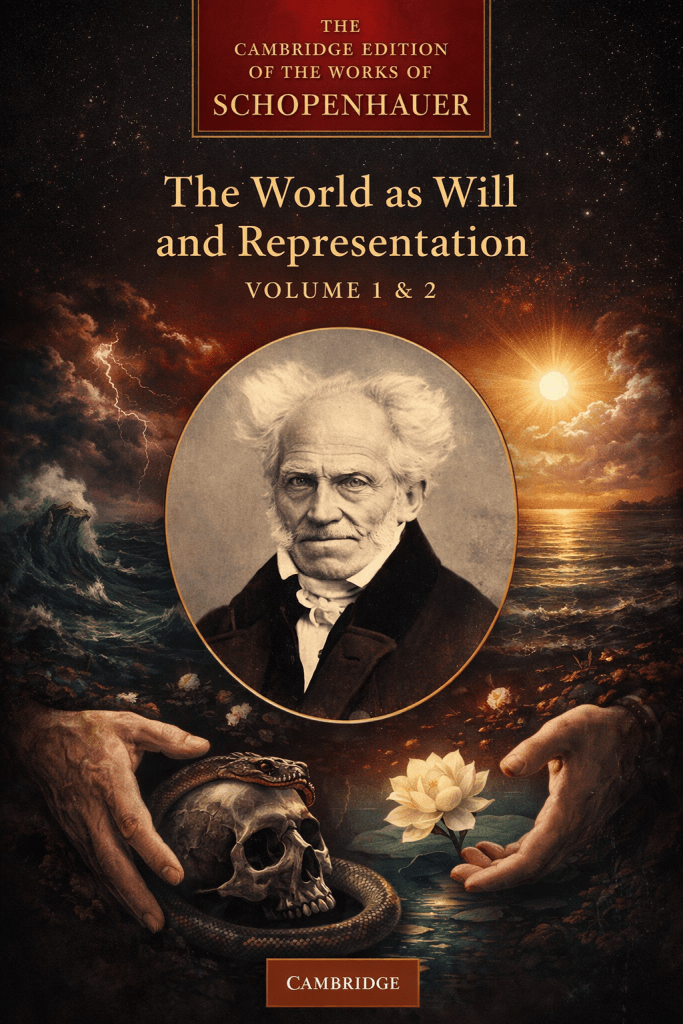
The World as Will and Representation (in its two-volume form) is constructed around a tightly constrained problem-space: how a finite knower can give an account of the world that remains faithful to the inescapable conditions of experience while still permitting a determinate claim about what the world is in itself. The work’s governing ambition is to articulate one comprehensive thought through several mutually dependent perspectives—epistemological, metaphysical, aesthetic, and ethical—without allowing any single perspective to function as an externally privileged tribunal. Its distinctive value as an object of study lies in this self-binding method: it attempts to make the transition from the world as representation to the world as will from within experience, and then to let that transition reorganize what “experience,” “knowledge,” “value,” and “liberation” can mean across the whole system.
From the outset, the text insists on being read as an internally articulated unity whose divisions are communicative compromises rather than separations in the thing itself. Schopenhauer explicitly presents the work as “aim[ing] to convey a single thought,” and he immediately adds the methodological constraint that no shorter route was available than the whole book. This insistence does not merely advertise comprehensiveness; it legislates how warrant is meant to function in the work. A “system of thoughts,” he says, can be architectonically organized so that some propositions function as foundations supporting others; the “single thought,” by contrast, requires an organic coherence, where each part “contain[s] the whole” and is also “contained by the whole,” and where no part is first in the order of understanding even though the book must begin somewhere. The epistemological first step is therefore presented under a condition that already unsettles ordinary expectations about argumentative linearity: the beginning presupposes the end “almost as much as the end presupposes the beginning,” and the work demands rereading as an integral component of comprehension rather than as an optional pedagogical aid.
This paratextual legislation is reinforced by a second, more concrete demand: the reader is told that the “introduction” indispensable for understanding is not located inside the book at all, but was published earlier as On the Fourfold Root of the Principle of Sufficient Reason. Schopenhauer characterizes that earlier essay as “introduction and propadeutic,” and he states that the present work presupposes its content as though it had been included. The consequence is structurally significant. The first volume’s opening investigation of cognition and objectivity is framed as incomplete by design unless the reader already possesses a differentiated account of the principle of sufficient reason—its forms, its domains, and its limits. The method to be attempted “for the first time,” he says, becomes visible only after the reader grasps that the principle of sufficient reason is a form in which objects are cognized by a cognizing individual, not a supreme ontological source from which “the whole world” follows as a correlate. The work thus places a restriction on how explanatory appetite may proceed: it permits explanation within the forms of ground and consequent, and it simultaneously blocks the move that would treat those forms as metaphysical absolutes.
The first determinate proposition of the system, however, is not an abstract limitation thesis; it is a formal assertion about what it is for anything to be “for cognition.” “The world is my representation” is presented as an a priori truth in the sense that it expresses “the form of all possible and conceivable experience.” This sentence does not function as a psychological report about private mental content; it functions as a claim about the subject–object form as the universal condition under which any representation—intuitive or abstract, empirical or pure—can occur. Schopenhauer intensifies the claim by locating it as more universal than time, space, and causality, since these already presuppose the subject–object relation in which they can appear as forms at all. Even at this early stage, then, the work’s neutrality has a specific complexion: it aims to begin with something maximally indubitable, while also refusing to treat that indubitability as an ontological privilege enjoyed by one class of objects. The certitude here concerns form, and it concerns the general dependence of anything that can be an object upon a subject to which it is object.
Yet this initial formal certainty immediately generates pressure on the work’s later metaphysical ambition. If the world as object is always representation, what could it mean to identify the world’s essence? Schopenhauer anticipates this pressure by staging his opening proposition within a polemical genealogy that includes sceptical procedures and idealist articulations, and then by promising a critique of Kant’s handling of this proposition. The significance of that promise becomes clearer when the work later claims that it will, in a qualified sense, modify the Kantian doctrine of the thing in itself. The system’s integrity thus depends on avoiding a collapse into either an epistemological idealism that leaves essence silent, or a metaphysical dogmatism that ignores the representational conditions it began by asserting.
The work’s distinctive move—presented as both immediate and peculiarly resistant to ordinary proof—occurs when Schopenhauer claims that one object is given to each subject in a double manner: as representation among representations, and as will. The privileged case is the body, and the privileged access is inner awareness of willing. The text insists that “willing and doing” are one “in actuality,” and that every genuine act of will is “instantly and immediately” the appearance of an act of the body; conversely, bodily affection is immediately affection of the will, taking the form of pain when contrary to will and comfort or pleasure when in accordance with it. This is not offered as a causal hypothesis about how mental states produce bodily movements; it is offered as an identity claim that dissolves the causal schema at the point where it would otherwise be applied most naturally. A central tension is already visible here: the system begins by asserting the universality of representation for objects, and it then introduces an irreducible datum—will—that “is not a representation at all,” and whose connection to the body is declared to be of a different kind than representational relations.
Schopenhauer makes the methodological stakes of this identity explicit. He says that the identity of body and will “can never be demonstrated,” because demonstration would be mediate cognition derived from some other source, whereas this identity is presented as “the most immediate cognition there is.” He therefore distinguishes this as “philosophical truth par excellence” and provides a family of equivalent formulations—my body and my will are one; the body is the objecthood of the will; besides being representation, my body is also my will—while also warning that the truth cannot be placed under the four rubrics of truth catalogued in the earlier essay on sufficient reason. The work thereby binds itself to a methodological wager: it will treat a certain immediate awareness as the interpretive key for the whole world of appearance, and it will do so while accepting that the warrant for this move cannot take the familiar form of inferential proof from prior premises.
This wager has far-reaching consequences for the book’s internal distribution of responsibilities. The epistemological first part, which might look at first like a self-contained idealist prolegomenon, is retrospectively transformed into a constrained description of the surface conditions under which the world appears; its categories are then treated as forms of objecthood that cannot explain their own content. The text itself signals this transformation when it remarks that the “entirety of the present work” is, to some degree, an explanation of the “miracle” already noticed in the earlier essay: the coincidence of subject and object in the case of the willing subject. What begins as a thesis about universal representation thus becomes a problematic: representation is the form of the world for cognition, and yet the system seeks the inner essence of that world by appealing to a datum disclosed precisely where the subject is no longer merely a representer confronting objects, but is also what is disclosed in and as bodily existence.
In the second major register of the work—its metaphysics—Schopenhauer formalizes this interpretive key by claiming that the inner essence of things is will and that will is the thing in itself, while explicitly acknowledging that inner cognition still does not present the thing in itself “fully naked.” The text gives a precise account of what remains veiled: even inner awareness divides into cognizing and cognized, and it retains the form of time, so that we cognize will only in the succession of its acts rather than as a whole. This yields a particularly productive internal friction. The work’s metaphysical claim depends on the privileged immediacy of inner awareness, and yet the same analysis insists that this immediacy remains within representational form (at least in the minimal sense of subject–object, and of temporal succession). The system’s central concept, will, therefore functions as both the closest appearance of the thing in itself and as a marker of what still exceeds cognition’s forms. The book does not remove this tension; it operationalizes it as the condition under which metaphysics can proceed without pretending to omniscience.
The phrase “objectivation of the will” (a term the work uses as a structural title for the second Book) is best understood within this operational logic. It indicates that what appears as nature and as organized life is the will’s presence under the forms of representation, differentiated into levels and stabilized into kinds. The work regularly treats individuation—governed by space and time—as a principle that pertains to appearance, while refusing to ascribe it to will as thing in itself. The metaphysical picture thereby reverses explanatory direction: individuation is no longer the ultimate given in terms of which unity must be constructed; unity belongs to the essence, and multiplicity is a mode of presentation. This reversal becomes ethically and aesthetically decisive later, but its first function is to reorient how natural explanation is to be interpreted. Scientific cognition remains bound to the principle of sufficient reason and to the relations among appearances; it can track lawful connection, causal dependence, and morphological regularity. What it cannot provide, within Schopenhauer’s framing, is the “true content” of appearance: the essence “outside and independently of all relations.” The work thus situates natural science as valid within its domain while also delimiting it, not by denunciation, but by assigning it a determinate object: appearance under relational forms.
At this point the system’s architecture begins to display its characteristic alternation between two vocabularies—representation and will—across altered registers. The table of contents makes this oscillation explicit: the first Book treats representation under sufficient reason; the second treats will and its objectivation; the third returns to representation “independent of the principle of sufficient reason,” introducing the Platonic Idea as the object of art; the fourth returns to will under the themes of self-knowledge, affirmation, and negation of the will to life. The two-volume structure intensifies the same oscillation: the second volume is expressly composed of “supplementary essays” arranged according to the fourfold division of the first volume, so that each main perspective is reopened, thickened, and re-angled rather than merely repeated.
The third register—Schopenhauer’s aesthetics—plays a pivotal role in the system precisely because it redefines what “representation” can mean once it is no longer governed by the principle of sufficient reason. The text presents aesthetic cognition as a state in which the subject becomes “pure,” liberated from willing and from individuality, and in which the object is grasped as Idea. The theory is constructed to bear two burdens at once. On the one hand, it provides a phenomenology of a distinctive consciousness—will-less, tranquil, temporally altered—that the work treats as experientially accessible. On the other hand, it supplies a metaphysical function: Ideas are described as the “immediate and adequate objecthood” of the will, and art is defined as the mode of cognition that repeats these eternal Ideas grasped through pure contemplation. In this way, aesthetics becomes an intermediate station between epistemology and ethics: it demonstrates a possible modification of the subject’s relation to representation, and it does so in a way that already implies a loosening of individuation’s grip.
The internal tension here concerns the status of the Ideas themselves. They are introduced as a metaphysical layer—more immediate than empirical individuals, less ultimate than will as thing in itself—yet they are encountered only through a transformation of the subject that suspends ordinary cognition’s interests. This gives aesthetic experience a dual aspect: it is at once a cognitive access to what is universal and a relief from the affective compulsion of willing. The text explicitly notes that aesthetic pleasure sometimes depends more on the apprehended Ideas and sometimes more on the “peace of mind” of pure cognition liberated from willing, with the balance shifting according to whether the contemplated Idea represents a higher or lower level of the will’s objecthood. The aesthetic register therefore exhibits the book’s general method in miniature: it offers a phenomenological description, and it simultaneously uses that description to justify a metaphysical distinction. The justification remains internal: it rests on recurrent structural cues—“pure subject,” “Idea,” liberation from willing—that are repeatedly mobilized across the work’s later ethical claims.
Schopenhauer’s treatment of music is especially instructive for understanding how the work handles the limits of its own warrant. In the concluding part of the Third Book, he claims that music is an “unmediated objectivation and copy of the entire will,” bypassing Ideas and thus remaining in a sense independent of the appearing world; he even says it could exist even if there were no world at all, whereas the other arts cannot. Yet he immediately adds a methodological disclaimer: the explanation is “fundamentally incapable of proof,” because it posits a relation between music as representation and something that “can fundamentally never be a representation,” treating music as the copy of an original that can never be directly presented. He therefore offers the account as personally satisfying and leaves its acceptance to the overall effect of music itself together with the overall effect of the single thought as communicated. This moment is characteristic: the book advances a strong metaphysical claim, and it simultaneously marks the boundary conditions under which such a claim can be responsibly asserted within its own method. The boundary is not sceptical paralysis; it is a discipline of assertion that keeps the system from silently substituting metaphorical aptness for demonstrative necessity.
The internal function of music in the system is then to intensify the work’s conception of “expression” without representation’s ordinary object-relations. Schopenhauer draws a detailed analogy between musical structure and the levels of will’s objectivation: the ground bass corresponds to inorganic nature, higher voices to higher levels, and harmonic relations to the fit among nature’s strata. This analogical mapping is not presented as an empirical discovery; it is presented as a conceptual articulation meant to clarify why music’s effect is experienced as more powerful and urgent than that of other arts—because it “speaks of the essence” rather than “shadows.” The important point for the book’s unity is that music is treated as both a privileged aesthetic phenomenon and as a test case for the limits of conceptual mediation: it is where the system most openly admits that some of its strongest claims cannot be anchored by proof in the ordinary sense, while also insisting that the claims remain answerable to the total architecture of the work.
The ethical register—the fourth Book of the first volume and the corresponding supplements of the second—completes the system’s trajectory by translating metaphysical unity into moral possibility. The work’s internal pivot is the principle of individuation. In the ethical register, individuation is no longer primarily a formal condition of objecthood; it becomes a source of delusion (principium individuationis, first-mention gloss: the principle through which appearance is divided into individuals). Compassion and justice are then interpreted as phenomena in which the will “sees through” this delusion and recognizes itself again in its appearances. The system thus treats moral motivation as a cognitive event: moral worth arises when the distinction between self and others is diminished, and the virtues of voluntary justice and loving kindness are grounded in this altered cognition of the unity of will. In this respect, ethics is not appended to metaphysics as an external application; ethics is metaphysics under the condition of self-knowledge, where the metaphysical thesis about unity becomes experientially and motivationally efficacious.
Here a further internal friction is deliberately preserved: moral virtue is celebrated as a sign of disillusionment with individuation, and yet virtue is also depicted as incapable of guaranteeing happiness within life. In the second volume’s discussion of the negation of the will to life, Schopenhauer treats ancient ethical philosophies that sought to prove virtue sufficient for happiness as guided by an assumption of justice that experience contradicts. The text then frames the “serious and profound solution” in terms that borrow from Christian vocabulary about the insufficiency of works, thereby binding ethics to a more radical soteriological horizon than ordinary moral theory supplies. Even when the work adopts this vocabulary, it does so in a way that remains consistent with its fundamental metaphysical claim: suffering belongs to life as appearance of the will, and the ethical transformation required is therefore not a mere improvement of conduct within individuation, but a transformation of willing itself.
The concept of “negation of the will to life” is the system’s culminating point and also one of its most delicate. The first volume explicitly presents this negation as arising “from the same source” as goodness and virtue, and it describes it as genuine salvation that is “unthinkable without the complete negation of the will.” The negation is said to come through a “tranquillizer of the will,” namely recognition of the will’s inner conflict and “essential nothingness” as expressed in universal suffering; the work distinguishes paths by which such recognition arises, whether through suffering that is cognized and freely approached by seeing through individuation, or through one’s own immediate suffering. The ethical end-point is thereby cast as a cognitive-affective conversion whose content is metaphysical: the will comes to insight into itself as the source of striving, conflict, and suffering within appearance.
Yet Schopenhauer also insists on preserving a conceptual distinction that prevents premature moralization of death or self-destruction. The text explicitly denies that suicide constitutes negation of the will; it is characterized as a phenomenon of strong affirmation, because it wills life while rejecting only the conditions under which life is given. This distinction is structurally important for the unity of the work: it keeps the ethical culmination from collapsing into a simple valuation of non-existence, and it forces the notion of negation to remain tethered to a transformation of willing, not to the mere cessation of an individual organism. The work thus treats the ethical culmination as a form of freedom that “emerges into appearance” in a singular way, and it even links this to a “transcendental alteration,” marking it as an exceptional event within the phenomenal order.
The second volume’s supplements intensify this ethical horizon by relocating several themes that were already implicit in the first volume into sustained analyses that change the reader’s sense of what was at stake all along. The editors’ introduction to the second volume highlights how the supplements to the Fourth Book concentrate on the “affirmation and negation of the will,” and it notes that Schopenhauer himself singles out the long chapter on the “Metaphysics of Sexual Love” as a neglected ethical topic, explicitly tying it to preceding chapters on death, the life of the species, and heritability. Even when one brackets the editorial voice and returns to Schopenhauer’s own text, the internal linkage is evident: sexual desire is treated as a primary manifestation of affirmation, and its power is interpreted as an index of how deeply the will is committed to life beyond the individual.
In the first volume’s treatment of procreation and sexual satisfaction, Schopenhauer describes the sex drive as the “most decisive affirmation of the will to life,” extending beyond the individual’s finite existence, and he interprets procreation as an “occasional cause” for the appearance of the will at a time and place rather than as the ground of the will itself, since will as thing in itself recognizes neither ground nor consequent. This analysis performs a characteristic migration of argumentative responsibility. The principle of sufficient reason remains valid for causal sequences in nature, and yet the ethical-metaphysical interpretation reassigns ultimate explanatory weight to will’s timeless identity across appearances. The text even integrates mythic and religious representations as symbolic expressions of this structure, treating them as modes that “transcend” consideration under sufficient reason by referring to Ideas and to a unity recovered from individuation’s dispersion. The result is not a simple syncretism; it is a methodological claim about levels of discourse: myth and dogma are taken as figurative vehicles that can, under proper interpretation, gesture at the same unity that metaphysical analysis asserts more abstractly.
The second volume’s later discussion of sexual love and marriage continues this structure in a more explicitly “metaphysical” register, treating the meticulous selectivity of sexual desire as grounded in the species’ interest in the coming generation and drawing from this an explicit confirmation of two claims: the indestructibility of the human essence in itself across generations and the priority of the species over the individual in the essence of humanity. This has the effect of retroactively sharpening the ethical meaning of individuation and compassion. If the will’s unity is metaphysically primary, then the moral phenomenon in which one recognizes oneself in others becomes intelligible as an empirical emergence of a metaphysical identity. Schopenhauer explicitly groups compassion, sexual love, and “sympathy” phenomena under this heading, defining sympathy as the empirical emergence of metaphysical identity through the physical multiplicity of appearances, a connectedness different in kind from relations conceived under sufficient reason. The ethical theory thus becomes part of a broader theory of how metaphysical unity can show itself empirically in ways that do not reduce to causal explanation.
The work’s discussion of death provides another site where the second volume reconfigures the first. The editorial introduction describes Schopenhauer’s attitude to death as consoling, emphasizing that fear of death is rooted in will to life rather than rational inference, and presenting death as an occasion to move beyond the oscillation between annihilation and crude immortality toward a “higher perspective.” In the text itself, the theme is developed through a systematic reinterpretation of individuality as a cognitive obstacle: individuation prevents awareness of the true extent of one’s being, and death abolishes the illusion that limits existence to one’s person, analogized to the stars that become visible only after the sun has set. Even where Schopenhauer discusses extraordinary phenomena (for example magnetic sleep) as “empirical traces” related to the abolition of individuated consciousness, the philosophical role of these remarks is to dramatize the same structural claim: the self’s ordinary form of cognition is insufficiently transparent to its own essence, and individuation is the medium of that opacity.
Across these developments, the internal unity of the two-volume work becomes clearer in a non-trivial sense. The first volume provides the primary articulation of the “single thought” through the fourfold alternation of representation and will. The second volume does not merely add examples or rhetorical force; it redistributes weight among themes so that what looked like one strand among others becomes a structural hinge. Sexuality, death, and species-life—topics that can seem, from a purely epistemological viewpoint, like empirical excursions—are made to function as privileged arenas where the metaphysics of will and the ethics of negation confront their own explanatory commitments. The supplements thereby change the interpretive valence of earlier doctrines: will as thing in itself is no longer merely a metaphysical postulate inferred from inner awareness; it is the concept that must bear the explanatory burden of why individuation is so compelling, why compassion is possible, and why ethical redemption, if it occurs, must appear as a radical reversal rather than a gradual optimization of desire.
The work’s self-understanding as a text is further complicated by its history of composition and revision, which the provided editions foreground as a matter of interpretive relevance rather than bibliographic trivia. The introduction to the first volume states that the original 1818/1819 publication was a single-volume work and that in 1844 Schopenhauer republished it as a two-volume work, with the second volume consisting of fifty “supplementary essays” running parallel to the first volume’s themes; at the same time he revised the first volume, rewriting passages and adding paragraphs, and he revised again in 1859 with further additions and clarificatory changes “without altering the essentials.” The editorial apparatus in the translation provided makes these layers legible: it identifies three lifetime editions for volume 1 (1819, 1844, 1859) and states that the translated text essentially follows the last edition (C), mediated by Hübscher’s 1988 edition and later editorial changes introduced by Frauenstädt and others, with endnotes cataloguing more substantial changes. For volume 2, the apparatus notes that the second volume exists only in the 1844 and 1859 editions (B and C), that the translation again follows Hübscher’s standard text, and that some later changes are based on Schopenhauer’s own handwritten additions to his copy of C.
These layers matter philosophically because the work’s very method depends on accumulation and cross-reference. Schopenhauer’s own preface to the third edition remarks that the reader “will not miss anything” from the second edition and will receive “considerably more,” and it explains that certain additions to the systematic presentation were placed elsewhere (in the Parerga and Paralipomena) because it was uncertain whether he would live to see the third edition, implying an ongoing compositional strategy of dispersing and later reintegrating materials. The editorial notes in the translation further clarify how the text is mediated: footnotes marked with letters provide either original wording or editorial information, with brackets indicating additional editorial material, while numbered endnotes track variants across editions. This apparatus situates the reader within a stratified textual field, where some clarifications belong to Schopenhauer’s later self-revision, some to posthumous editorial standardization, and some to the translators’ effort to document these differences without overwhelming the philosophical line.
The work’s demand for rereading and its resistance to linear digestion are therefore not merely stylistic. They belong to its claim that philosophical cognition, as pursued here, must be capable of shifting levels without losing conceptual discipline. The first volume’s preface contrasts an architectonic system with an organic unity, and it explicitly warns that the “relation between what is being said and everything else” cannot be simultaneously elucidated by clarity of presentation alone, because readers anticipate consequences and imagine conflicts that distort understanding. This is a methodological diagnosis: philosophical propositions, on this view, are rarely received as isolated contents; they are received as nodes within a total worldview, and their sense changes when the totality changes. The book’s internal alternation between representation and will is precisely the engine of such sense-change. The same concept—representation—has one function when it is bound to sufficient reason and another when it is freed in aesthetic contemplation; the same concept—will—has one function when it is introduced as inner essence disclosed in bodily self-awareness and another when it is treated as capable of self-negation through insight into suffering and illusion.
One can therefore describe the two-volume work as repeatedly staging a transformation of its own basic terms by forcing them to bear new responsibilities. “Representation” begins as the general form of objecthood for a cognizing subject, and it then becomes the field within which individuation and causality are valid but non-ultimate. “Will” begins as what is disclosed in the most immediate self-awareness and becomes the interpretive key for nature’s levels and for the unity beneath multiplicity. “Idea” begins as the metaphysical correlate of aesthetic cognition and becomes a means by which the system articulates a stable structure in appearance without reducing that structure to causal law. “Compassion” begins as a moral incentive and becomes an empirical emergence of metaphysical identity, grouped with sexual love and other sympathy phenomena that exceed the explanatory reach of sufficient reason. In each case, later developments do not simply add content; they re-specify what earlier claims mean, because they relocate those claims within a transformed whole.
The appendix’s announced critique of Kant (included as part of volume 1’s architecture) further stabilizes this internal movement by treating Schopenhauer’s own departure from critical philosophy as internal correction rather than wholesale rejection. Already in the first paragraph of the main text he signals a “first mistake” in Kant regarding the neglect of the proposition that the world is representation, and he frames his own approach as both indebted and corrective. The significance of this posture is methodological: the system aims to keep the critical restriction on knowledge of the thing in itself while also claiming that inner awareness supplies a privileged access sufficient for metaphysical interpretation. The pressure point is constant: the work must avoid treating will as a positive object among objects, and it must also avoid leaving will as an empty label for ignorance. Its solution is to treat will as disclosed in self-awareness in a way that is immediate yet still formally conditioned, and then to treat the world’s phenomena as interpretable by analogy to that disclosure, with an explicit admission that the analogy will not yield “absolute and exhaustive cognition.”
In its closing ethical perspective, the work offers a form of stabilization that is deliberately incomplete in one respect and decisive in another. It is incomplete insofar as it refuses to provide a fully transparent mechanism by which the will’s negation occurs; even sympathetic presentations acknowledge that the “technical details” of the process remain unclear while the conviction remains intense. It is decisive insofar as it identifies a consistent criterion for the direction of transformation: cognition that sees through individuation loosens willing, justice and loving kindness express that loosening and also deepen it through sacrifice, and the culmination appears as resignation accompanied by a distinctive peace, including a distinctive comportment toward death. The system thereby leaves certain antinomies standing—between representational form and access to essence, between empirical suffering and metaphysical justice, between the describability of negation and the demand that it be more than concept—but it also fixes the work’s internal directionality: the same metaphysical insight that reinterprets nature’s multiplicity is meant to underwrite the possibility of ethical conversion.
As a work to be read competently, The World as Will and Representation demands patience with an “organic” compositional order that repeatedly forces the reader to revise earlier understandings in light of later claims, and then to return again so that the earlier claims can be reread with altered sense. It demands tolerance for a method that openly restricts demonstrative proof at decisive junctures (as in the identity of body and will, and in the interpretation of music), without relaxing its expectation of conceptual discipline. It demands sensitivity to the work’s layered textual reality—prefaces that legislate reading, a required external “introductory essay,” lifetime revisions, and a modern editorial apparatus that distinguishes authorial notes from editorial mediation and documents variant readings—because those layers condition what counts as Schopenhauer’s settled formulation and what counts as later accretion or clarification. In return, the work offers a system whose internal architecture aims to stabilize its central tensions by letting each perspective transform the others, until the reader can see why the book claims to be one thought expressed through several interdependent forms of cognition.
If one takes seriously Schopenhauer’s repeated instruction that the work be read as an organically coherent communication of a “single thought,” the decisive interpretive question becomes less “what doctrine does he assert?” and more “what transformations of cognitive stance does the text itself enact, and how do those transformations authorize the passage from one register of discourse to another?” The four-book architecture already encodes such transformations: it does not simply juxtapose topics; it alternates between the two key terms of the title and then returns to each term under an altered condition, first for representation, then for will. The second volume, arranged explicitly as supplements according to that fourfold division, converts the first volume’s architecture into a kind of method of revision: later essays do not merely expand earlier theses; they clarify which earlier theses were meant as provisional orientations whose full sense depends on later redeployments.
The initial “dryness” of the first book, as the editorial introduction notes, belongs to its assigned role. Its conceptual sobriety is not a neutral starting-point that could stand on its own; it is a deliberately constrained inventory of the conditions of ordinary experience, articulated in a way that the later parts are meant to pressure, bend, and partially refunction. Schopenhauer’s own preface already anticipates this by insisting that the beginning presupposes the end almost as much as the end presupposes the beginning, and by warning the reader that only repeated reading with patience yields the proper “fathoming” of the thought. In practice, this means that the cognitive form described in the first book is never treated as a final account of what cognition is; it is treated as an account of what cognition is under the regime of the principle of sufficient reason, the regime in which objects are grasped through relations—Where, When, Why, and the entire economy of grounds and consequents that serve willing.
The pressure exerted by later parts can be formulated with precision. The first book orients the reader within a world of representation whose intelligibility is relational and whose “object of experience and science” is structured by sufficient reason. Yet the system’s declared aim is not to deny science, nor to replace it with a second science of hidden entities. It is to show that this relational intelligibility, however complete within its own domain, omits what the work calls the “in-itself” of phenomena—an essence that cannot be reached by extending relational explanation indefinitely. This is why Schopenhauer’s insistence that the Fourfold Root essay functions as the true introduction is philosophically consequential: the essay differentiates the forms of grounding so that one does not confuse the universality of sufficient reason for cognition with a metaphysical universality of grounds for being. This differentiation is what permits the second book’s metaphysical move to appear as something other than a relapse into pre-critical dogmatism: it is a controlled attempt to speak of the “in-itself” without turning that “in-itself” into one more object among objects.
The hinge concept here is the body, as the one object given “in a completely different way” to each subject: as representation and as will. Although the core identity-claim belongs to Schopenhauer’s authorial discourse, its later ramifications are made clearer by the way the first volume’s third book and the second volume’s fourth-book supplements repeatedly return to the same structural motif: individuation, understood as a form of appearance, can be suspended or weakened in certain states of consciousness, and those states provide experiential access to what the metaphysical thesis is meant to express. In the aesthetic theory this takes the form of the “pure subject of cognition” and the Idea as correlates outside the principle of sufficient reason. Schopenhauer’s description is deliberately formal and iterated across variations: the subject ceases to be conscious of itself as individual and becomes a will-less subject; the object ceases to be cognized as an individual thing in relations and is apprehended as the Idea; with this, temporal distinctions “vanish at once,” because both correlates are alien to sufficient reason’s forms.
Several internal tensions converge in this aesthetic construction. The first is that aesthetic cognition is still cognition of representation—it is the world as representation “second consideration”—and yet it is said to be “independent of the principle of sufficient reason.” The work therefore has to describe an intelligibility that is neither relational nor inferential in the scientific sense, and it does so by shifting the object from empirical individuals to Ideas and by shifting the subject from the individual knower to a purified, depersonalized standpoint. The second tension is that this purified standpoint is characterized through negations (will-less, painless, timeless), while the work’s own method still demands positive determination. Schopenhauer’s strategy is to interpret these “negations” as functional descriptions: the pure subject is the correlate required for the cognition of Ideas because Ideas themselves are defined as the will’s “adequate objecthood” at a particular level, and adequate objecthood requires a subject no longer tied to the will’s practical needs.
The third tension is perhaps the most revealing for the unity of the work: aesthetic cognition supplies a phenomenological template for the ethical culmination, yet it also threatens to be an escapist enclave that leaves the will untouched except for temporary respite. Schopenhauer explicitly acknowledges the peculiarity of the described state and asks the reader to suspend astonishment until the whole thought becomes clear; he frames the aesthetic elevation as a liberation from the Where, When, Why, and Wherefore in favor of the What, accomplished not by abstract concepts but by immersive intuition in which the subject “loses” itself in the object. This insistence already carries ethical implications, since the Where/When/Why register is repeatedly linked to willing’s interests, and the What-register is linked to a cognition that no longer “aims” at the will’s satisfaction.
The work then intensifies this link between aesthetics and ethics by showing that aesthetic contemplation is not merely a withdrawal from individual interests; it is also a moment in which the structure of individuation is conceptually exposed as derivative. When the Idea emerges, Schopenhauer says, subject and object can no longer be distinguished “within it” because the Idea arises only insofar as subject and object “reciprocally fill and completely permeate each other.” This is not presented as a mystical effusion; it is presented as a logical correlate of how Ideas, as adequate objecthood, function. The dissolution of the subject–object distinction in this context does not deny the representational form; it shows the form’s internal plasticity when sufficient reason is suspended. Consequently, the same conceptual move that grounds metaphysical unity—the claim that multiplicity and difference exist only “in appearance” through sufficient reason—reappears in aesthetics as an experiential-cognitive phenomenon.
What is philosophically decisive is that this aesthetic dissolution is explicitly interpreted in terms of will. Schopenhauer writes that, as will outside representation, the thing contemplated and the contemplator are “one and the same,” because in themselves they are will, and cognition here is will “cognizing itself.” The aesthetic register thus becomes a controlled instance of metaphysical self-relation: will, ordinarily blind striving, appears as capable of a cognition that alters its own posture toward its objectivations. If one later asks how compassion could arise—how the boundary between self and other could weaken to the point of justice and loving kindness—this aesthetic instance already provides a schematic: individuation is tied to sufficient reason; sufficient reason can be suspended in certain states; in those states, the unity “in itself” becomes salient in consciousness.
The sublime, as Schopenhauer defines it, further clarifies the ethical relevance of aesthetics by introducing a gradient of resistance. The difference between beautiful and sublime does not lie essentially in the object, he says, but in whether the state of pure will-less cognition arises “on its own” as the will disappears, or whether it is achieved only through a “free and conscious elevation above the will” while the object stands in a hostile relation to the will and would annul contemplation if one yielded. This formulation is methodologically significant. It introduces, within aesthetics, a prototype of ascetic struggle: a consciousness that maintains pure contemplation against the will’s immediate interests. That prototype will later be refunctioned in the ethical discussion of self-overcoming, where the will’s turning against itself requires a discipline that resembles the sublime’s elevation rather than the beautiful’s effortless absorption.
At this point the work’s internal “migration of responsibilities” becomes visible with more granularity. In the first book, the principle of sufficient reason governs the intelligibility of objects as phenomena for science; in the third book, the same principle becomes the very mechanism that obscures the world’s “adequate objecthood” by multiplying Ideas into individuals; in the fourth book and its supplements, individuation (as an effect of space and time, and thus of sufficient reason’s forms) becomes a source of ethical error and metaphysical delusion, a māyā that keeps the will “in error concerning its own nature.” The “same” formal principle thus shifts valence: from neutral condition of objectivity, to limiting horizon of science, to ethically relevant source of illusion. The system does not treat this as a contradiction. It treats it as the necessary consequence of holding together two claims: cognition under sufficient reason is valid for appearance, and essence exceeds that cognition while still appearing through it.
The fourth book’s doctrine of negation of the will to life provides the system’s strongest attempt at stabilization of these valence-shifts. Schopenhauer explicitly states that the negation “always comes from the tranquillizer of the will,” namely recognition of the will’s inner conflict and “essential nothingness,” expressed in the suffering of all living things. He distinguishes paths by which this recognition arises: through suffering that is “merely and purely cognized” and freely approached by seeing through the principium individuationis (first-mention gloss: the principle by which appearance is divided into individuals), or through one’s own immediate suffering. The essential point is that salvation is said to be “unthinkable” without complete negation of the will, which implies that ethics here is not a matter of optimizing desire but of transforming the very essence that has been disclosed metaphysically.
The careful distinction between negation and suicide is part of the same stabilization. In the first volume Schopenhauer states that nothing is more different from negation than suicide, since suicide is a strong affirmation of will: it wills life and rejects only the conditions under which life is given, destroying the individual appearance while leaving will to life intact. The text then elaborates a metaphysical reason why violence cannot suppress will: will as thing in itself lies beyond sufficient reason’s forms and remains “unmoved” by coming-to-be and passing-away; only cognition can suppress it, which is why the “only path to salvation” is that the will appears “without restraints” so that it can recognize its essence and thereby abolish itself. This passage is philosophically instructive because it ties together three motifs that the work otherwise distributes across separate registers: the metaphysical claim about will’s independence from spatio-temporal individuation; the ethical claim that salvation is possible only through cognition; and the quasi-teleological claim about nature “leading the will to the light” because only in the light it can find redemption. The book’s unity is precisely the unity of these motifs across registers, even where their combination generates new tensions.
One of those tensions concerns the status of nature. The second book often treats nature’s levels as objectivations of will, and the fourth book treats nature’s drives (especially sexuality) as the will’s most decisive affirmation. Yet in the suicide discussion Schopenhauer also suggests that nature’s aims must be promoted insofar as unrestrained appearance is required for will’s self-recognition and possible self-abolition. This produces a deliberately unstable relation between “affirmation of life” and “conditions for redemption.” The text does not resolve this by offering a moral calculus. Instead, it forces the reader to track how the same phenomenon can bear opposed philosophical functions depending on level: nature’s teleology is not a providential order, yet it can be described as “leading” will toward cognition because cognition is itself an emergence within nature’s own development.
The work’s treatment of extreme asceticism—voluntary starvation—sharpens this tension without dissolving it. Schopenhauer describes a “form of suicide” that differs from the usual kind, death by voluntary starvation at the highest levels of asceticism, and he treats its appearance as obscured by religious enthusiasm, yet interpretable as the point where even the will required for vegetative functions falls away because the ascetic has “stopped willing altogether.” The conceptual function is not to recommend this act; it is to mark a limiting case that tests the distinction between cessation of individual life and cessation of willing. The work thereby clarifies its own criterion: where the will to life persists, the act remains within affirmation; where willing itself falls away, the phenomenon can serve as an empirical boundary-marker for what the doctrine of negation intends.
The second volume’s supplements, especially to the fourth book, deepen these ethical-metaphysical structures by introducing a set of connected analyses—death, species-life, heritability, sexual love—that are presented as forming a “whole” and as belonging within ethics because they concern the affirmation of the will to life at its most fundamental. Schopenhauer himself, in the short preface introducing the fourth-book supplements, exempts himself from two major ethical topics—freedom of the will and the basis of morality—on the grounds that they have been treated elsewhere; what remains is the broader ethical theme of affirmation and negation, which the editors characterize as lying at the heart of the philosophy and receiving its fullest treatment here. This division of labor is a compositional and methodological fact with interpretive consequences: it implies that The World as Will and Representation is not meant to contain every argument needed for its ethical claims, yet it is meant to contain the systematic integration of those claims with metaphysics and aesthetics. The work’s unity is therefore partly distributed across Schopenhauer’s corpus, but the internal architecture of the two volumes is designed to make that distribution legible without turning the present work into a mere index of other texts.
Within the second volume’s own authorial discourse, the analysis of death and individuation provides a particularly clear example of how later material re-specifies earlier themes. Schopenhauer states that it is a mistake to think inner essence exists in another person only after my death; in truth it already lives in the other even now, and death merely abolishes the illusion that prevents awareness of this, analogous to stars that are always present but become visible only when the sun sets. He then explicitly identifies individuation as an obstacle that stands between cognition and the true extent of one’s being, and he calls individuation the māyā that keeps will to life in error concerning its own nature. The ethical consequence is immediate: if individuation is the obstacle, then the weakening of individuation’s grip becomes the pathway toward serenity and redemptive detachment. This is the same pathway the first volume described in aesthetic terms: in aesthetic contemplation, the individual cognizer and individual object are “suppressed” along with sufficient reason, leaving Idea and pure subject as correlates beyond temporality.
The second volume then gathers three phenomena under a single concept—sympathy—and explicitly grounds them in the metaphysical identity of will amid multiplicity: compassion (basis of justice and loving kindness), sexual love (life of the species, precedence over the individual), and magic (including animal magnetism and sympathetic cures). Sympathy is defined as the empirical emergence of metaphysical identity through physical multiplicity, a connectedness “entirely different” from connections conceived under sufficient reason. This is a critical moment for the system’s self-coherence. Earlier, Schopenhauer had already insisted that the identity of body and will cannot be proved because it is immediate cognition; later, he adds that certain intersubjective and inter-individual phenomena disclose a connectedness irreducible to causal explanation. The system thereby repositions “immediacy” as a recurring structural feature: immediacy is not confined to introspection; it also appears in compassion and in sexual love’s “obstinate selectivity,” where the will’s unity asserts itself through motivational patterns that resist rationalization in terms of individual advantage.
This re-positioning, however, comes with its own conceptual pressure. By grouping compassion and sexual love together as sympathy phenomena, the work risks contaminating moral insight with species-driven affirmation. Schopenhauer addresses this pressure not by separating the phenomena cleanly but by insisting that they share a metaphysical ground while diverging ethically according to direction: compassion expresses a seeing-through of individuation that loosens attachment to one’s own individual striving; sexual love expresses the precedence of species-life over individual happiness and therefore exemplifies the will’s affirmation at a deeper level than ordinary self-preservation. The shared ground is the identity of will; the divergence is a divergence of how that identity becomes effective in consciousness—either as ethical disillusionment or as intensified natural compulsion.
This divergence is one of the places where the second volume most strongly transforms the reader’s understanding of the first. In the first volume, the ethical culmination can appear as a lofty doctrine placed at the end of a system; in the second, the ethical culmination is shown to be surrounded by anthropological and biological analyses that make it harder to treat negation as a simple moral exhortation. The chapters listed in the contents—death, species-life, heritability, metaphysics of sexual love—occupy a substantial portion of the fourth-book supplements and thereby insert into the ethical register a detailed account of how deeply the will is committed to life through reproduction. The effect is structural: the negation of will to life becomes intelligible as a rupture only when the reader has felt, through the text’s own accumulation, the depth of the will’s affirmation in phenomena that do not merely serve the individual but perpetuate the species.
At the same time, the editorial apparatus and compositional history remind the reader that this “depth” is partly a product of revision and supplementation. The second volume’s introduction states that the work’s two-volume manifestation consists of a revised and extended edition in 1844 and a final revision in 1859, and that the translation follows essentially the last edition as a standard text shaped by subsequent editors, with endnotes documenting changes across Schopenhauer’s lifetime editions. The first volume’s introduction makes the parallel claim for volume 1: the translated text is not the 1818/1819 original but the cumulatively reworked text, longer, richer, denser, adding scholarly parallels and clarifications, with later editorial revisions tracked in endnotes. This information functions philosophically because it highlights a feature of Schopenhauer’s style that the work itself thematizes: accumulation of “inter-connecting passages and parallels” is not merely decorative; it is a method by which a single thought is made to appear through repeated triangulation, showing itself “from different sides” as metaphysics, ethics, and aesthetics.
When one reads the work with this in mind, several motifs can be seen to recur with altered valence, precisely as your prompt requests. The “pure subject” motif begins as an aesthetic correlate, then becomes a prototype for ethical serenity, and finally appears in the second volume’s descriptions of a redemptive weakening of individuality, where reality can be contemplated with a serenity void of usual pains because the subject has become void of striving and void of usual sense of self. The “Idea” motif begins as a Platonic object of art, then becomes the “genuine world as representation” that completely objectifies will, and finally functions as a mediator for the claim that, outside representation, will is one and the same in contemplator and contemplated. The “principle of sufficient reason” motif begins as the condition of science, then becomes the mechanism by which Ideas are multiplied into individuals, and finally becomes the form of connection contrasted with sympathy’s connectedness, thereby limiting what explanation can claim in ethics and in the theory of human motivation.
A further transformation of the reader’s standpoint is already legislated in the prefatory layer, and this layer deserves to be treated as more than a conventional threshold. Schopenhauer’s Preface to the second edition explains why the work appears as two mutually supplementary halves rather than as a single fused book: he identifies a change in “mode of presentation and tone of delivery” over the intervening decades and states that a literal fusion of the second volume’s material into the first would be “detrimental to both,” so the two are offered separately, with the expectation that the reader’s mind will “rectify” discrepancies by using each to interpret the other. He then frames this division through a deliberately technical analogy: an achromatic lens cannot be made from a single piece; only the combination of different glass elements produces the desired effect. The philosophical implication is methodological. The “single thought” is not represented as a static doctrine that could be poured into one uniform exposition; it is represented as something that requires two phases of intellectual life—fervour of first conception and maturity of elaboration—to become legible in the full sense, and the work itself is designed so that this temporal stratification becomes part of its evidential economy.
In this light the two-volume form functions as a systematic device for controlled redundancy with altered valence. Each volume “supplements the other in the full sense of the term,” and Schopenhauer explicitly claims that the advantages of one consist in what the other lacks. This is not simply a rhetorical apology for inconvenience. It establishes a specific hermeneutic discipline: where the first volume’s compressed presentation risks appearing dogmatic, the second volume’s elaborations, proofs, and “facts” can be treated as retroactive warrants; where the second volume’s discursive expansions risk drifting into essayistic autonomy, the first volume’s architectonic trunk can be treated as the constraint that prevents mere associative proliferation. In other words, the two volumes are designed to behave like mutually correcting instruments rather than like independent monographs, and the reader is asked to do the work of producing their joint focus.
This self-conscious staging of two ages is reinforced by the editorial introduction’s description of Schopenhauer’s revision practice. The English version you provided follows the twice-revised text, longer and denser than the original; it emphasizes that Schopenhauer’s approach is to “accumulate inter-connecting passages and parallels,” channel diverse sources into a single synthetic vision, and direct the reader outward to a wealth of reference points, while still claiming that the revisions do not alter the “essentials” of the train of thought. Even if one keeps external context subordinate, this editorial information has internal philosophical relevance, because it explains why the book’s sense is produced through recurrent motifs rather than through a single decisive proof. The “single thought” is not delivered by one inference; it is delivered by systematic recurrence, each recurrence taking on new determinations as the work migrates from cognition to metaphysics to art to salvation.
The same prefatory layer already anticipates the kind of competence required by such recurrence. In the first edition Preface Schopenhauer states that the book “aims to convey a single thought,” distinguishes an architectonic “system of thoughts” from an organically coherent single thought, and warns that comprehension depends on rereading with patience because the beginning presupposes the end and earlier parts presuppose later ones “almost” as much as the reverse. This is a rare case where a philosophical work makes its own non-linearity into an explicit methodological requirement. It also explains why the second volume’s supplements, which might otherwise seem optional, can be treated as intrinsic to the meaning of the first. The supplements do not merely complete what was left out; they enact the demanded rereading by providing new angles from which the earlier articulations can be reinterpreted.
The second volume’s own introduction makes this explicit in structural terms. It states that the fifty chapters are “advertised as ‘supplements’” (Ergänzungen) and that they relate to topics, often to specific sections, of the first volume; it also insists that diminishing their importance would be a mistake because Schopenhauer’s later reflection deepens his position and many chapters become “indispensable” for proper appreciation. The introduction further explains that, in the supplements to the First Book, Schopenhauer divides the material into two halves—“Doctrine of Intuitive Representation” and “Doctrine of Abstract Representation, or Thinking”—because the distinction between intuitive and conceptual cognition is crucial to him; it adds that Schopenhauer holds the primacy of intuitive cognition (shared with animals) and treats concepts as having genuine content only when grounded in intuition, warning that philosophy becomes empty verbiage when it forgets this. Here the second volume retroactively intensifies a tension already present in the first: the first volume begins with a formal thesis about representation as the form of all possible experience, and it is tempted toward a high level of abstraction; the second volume reasserts that abstraction is parasitic on intuition and therefore cannot legitimately function as the source of content. This is not a mere pedagogical preference; it is a constraint on metaphysics. The later claim that will is disclosed in the “most immediate” cognition depends on a conception of immediacy that would be betrayed if the system were driven primarily by conceptual construction.
This constraint helps clarify why Schopenhauer is willing to tolerate a certain kind of methodological asymmetry at the system’s core. The identity of body and will is presented in the first volume as a datum that cannot be demonstrated by proof in the ordinary sense; it is meant to be more immediate than any proof could be. The second volume’s insistence on the primacy of intuition gives this methodological stance its broader cognitive context. If the only concepts with genuine content are those grounded in intuition, then a metaphysics that pretends to legislate essence purely by conceptual deduction would violate the work’s own epistemic discipline. The system therefore chooses the opposite risk: it grounds its strongest metaphysical move in a privileged intuition (inner awareness of willing as identical with bodily doing) and then tries to discipline the metaphysical extension of that intuition by making it answerable to the whole, through repeated triangulation rather than through a single syllogistic chain.
One can see the work enforcing this discipline already in the first book’s analysis of the principle of sufficient reason as it manifests in time, space, and matter. The text states that time is nothing over and above succession, the form of sufficient reason in time; space is nothing over and above the possibility of reciprocal determination of parts (position); and matter is nothing over and above causality, so that for matter its being is its acting. This series has two important effects. First, it deflates the temptation to treat the spatio-temporal world as self-sufficient substance; the “being” of matter is redescribed as functional relation (acting), and time and space are redescribed as formal structures of ordering rather than as containers. Second, it prepares the later ethical-phenomenological description of the world as “mere appearance” and māyā (first-mention gloss: a veil of deception), where past and future are described as unreal like a dream, and the world of relations is treated as relative existence “through and for” something else similar. The internal tension is that the first book’s analytic reduction can sound like sober transcendental philosophy, while the later invocation of māyā can sound like metaphysical pathos; yet the book makes them cohere by presenting the latter as an existential intensification of the former. The formal insight that time and causality are structures of relation becomes, under the pressure of metaphysics and ethics, an insight into the instability of individuation as a claim to ultimate reality.
This is one of the work’s most characteristic transformations of register: the same formal analysis migrates into an ethically charged cognition without losing its logical content. The point is neither to denigrate science nor to discard the world’s lawful structure; it is to reposition that structure as insufficient for addressing the “true content” of the world, which the metaphysical and ethical registers identify as will and suffering. The editorial introduction explicitly describes this shift, noting that metaphysics reveals an essence of the world to which cause and effect and distinctness of individuals are alien; aesthetics provides a consciousness contrary to ordinary experience; and ethics describes misery and seeks meaning through withdrawal from ordinary experience and self-negation of the revealed essence. The same introduction also remarks that Schopenhauer dismisses some religious talk (for example “re-absorption into Brahman” or “Nirvana”) as empty verbiage only because such talk attempts to say the unsayable; he sympathizes with what it attempts to convey, namely that for those in whom the will has negated itself, this world becomes “nothing.” Even when one treats that remark as editorial mediation, it identifies a real internal dynamic of the text: its ethical end-point requires a language that strains the resources of ordinary descriptive discourse, and the work explicitly anticipates that strain.
The aesthetic book of the first volume is a crucial mediator of this strain because it provides a controlled description of a consciousness in which individuation and sufficient reason are suspended without yet requiring the total ethical rupture of self-negation. The text states that the pure subject of cognition and its correlate, the Idea, have “left behind” the forms of sufficient reason—time and place and the individual cognizer and individual cognized have no meaning for it. It then claims that only when the individual raises itself to pure subject and raises the observed object to an Idea does the world as representation step forward purely and in its entirety, “completely objectifying the will,” because only the Idea is the will’s adequate objecthood; in this state, subject absorbed into object becomes the object itself, and the Idea arises only insofar as subject and object reciprocally permeate one another. The text then draws the metaphysical conclusion that, abstracting from the genuine world as representation, nothing remains except will; will is the in-itself of the Idea and of the particular thing and of the individual cognizer, and as will outside representation it is one and the same in contemplator and contemplated, cognizing itself here.
Several tensions are concentrated in this passage, and the work uses them as structural resources rather than as defects. One tension concerns the status of the “pure subject” itself. The text earlier emphasizes that cognition as such belongs to the will’s objectivation at higher levels: nerves and brain are expressions of will at this degree, and representation serves will as a means for maintaining an organism with needs; cognition that follows sufficient reason aims to know objects only in those connections posited by sufficient reason because these connections tie back to the body and thus to the will. Aesthetic cognition, on this account, requires an “alteration in the subject” that corresponds to a radical change in the object, so that the subject is no longer an individual when it cognizes an Idea. This is a severe requirement: the work claims that ordinary cognition is structurally practical (in the service of will), and that cognition of Ideas requires a liberation from that service. The pure subject therefore functions as an internal proof-of-concept: it shows that cognition can, at least episodically, detach from willing and thereby disclose a mode of objectivity irreducible to relational explanation.
A second tension concerns the way time is reinterpreted. The same passage situates time as “the scattered and dismembered perspective that an individual being has of the Ideas” that are outside time and eternal, and it links the possibility of rising to cognition of Ideas to an alteration in subject. Thus time’s formal analysis in the first book is refunctioned: time is first described as succession, a form of sufficient reason; later, time is presented as a symptom of individuation’s limitation, a dismemberment of what is in itself eternal. The work does not simply add a second doctrine; it thickens the first by giving it a metaphysical-existential interpretation anchored in the same conceptual machinery (forms of sufficient reason).
A third tension concerns the metaphysical identification of will as the in-itself. In the aesthetic book, the text claims that will “cognizes itself here” as pure subject and Idea reciprocally permeate. Yet in the ethical book, will is treated as blind striving whose essence is conflict and whose appearance is inseparable from suffering. The system must therefore explain how a will that is the source of suffering can also appear as capable of cognition that quietens it. Aesthetic contemplation supplies the intermediate step: it is a cognition in which will is, for a time, quieted (through will-less perception) without yet being negated. This makes possible the later ethical claim that salvation comes through cognition, not through violence, because cognition can suppress will in a way that physical destruction cannot.
The suicide discussion in the first volume makes this claim with striking explicitness, and it also displays how Schopenhauer handles a delicate conceptual boundary. He states that nothing differs more from negation of the will to life than suicide; suicide is a phenomenon of strong affirmation of will because the suicide wills life and is dissatisfied only with the conditions under which life is given, relinquishing life but not the will to life, negating only the individual, not the species. The text then adds a metaphysical rationale: since will to life is the sole metaphysical entity or thing in itself, violence cannot break it, only destroy its appearance; only cognition can suppress it, which is why the only path to salvation is for will to appear without restraints so it can recognize its essence and abolish itself, ending suffering inseparable from its appearance. This passage also contains a provocative, internally motivated reversal: nature “leads the will to the light,” so the goals of nature must be promoted once the will has arrived at a resolution. The work thereby complicates any simple opposition between natural affirmation and ethical negation. Nature is the will’s appearance and therefore the arena of suffering, yet nature is also the arena in which cognition arises and therefore the only arena in which the will can come to self-recognition. The same process that deepens bondage can therefore be redescribed as the condition of possible liberation.
Schopenhauer presses this boundary further by discussing an extreme ascetic phenomenon—death by voluntary starvation—that “seems completely different” from ordinary suicide. He treats it as possibly reaching the point where even the will needed for vegetative functions falls away; here the ascetic stops living because he has stopped willing altogether, and any intention to shorten misery would already involve some affirmation of will. The conceptual function is clear: the work refuses to identify negation with the mere ending of individual life, and it identifies negation with the cessation of willing itself. Suicide is interpreted as the will’s contradiction with itself, an attempt to annul essence with appearance, driven by the delusion that appearance is essence; ascetic starvation, if genuine, is interpreted as cessation of willing. This is a structurally important move, because it prevents the ethical doctrine from collapsing into a crude valuation of non-existence. Instead, it binds the ethical doctrine to the metaphysical distinction between will and its appearances and to the epistemological claim that cognition is the only power that can affect will.
The second volume’s fourth-book supplements then reinterpret this entire boundary through the lens of “sympathy” and through an expanded discussion of justice, suffering, and salvation. In a key passage Schopenhauer explicitly groups compassion (basis of justice and loving kindness), sexual love (life of the species), and magic (animal magnetism and sympathetic cures) as three phenomena grounded in the metaphysical identity of will amid multiplicity; sympathy is defined as the empirical emergence of this metaphysical identity through physical multiplicity, manifesting a connectedness different from connections mediated by the forms of appearance conceived under sufficient reason. This passage is methodologically revealing. It shows Schopenhauer extending his notion of “immediacy” beyond introspective access to will. There is an immediacy in compassion, where another’s suffering is grasped as if it were one’s own; there is an immediacy in sexual love’s “obstinate selectivity,” where the species asserts precedence over the individual; there is an immediacy in purported magical phenomena, where connectedness seems to bypass spatio-temporal mediation. Whatever one makes of the third category, its inclusion shows that Schopenhauer is attempting to map a spectrum of phenomena that put pressure on the explanatory sufficiency of sufficient reason, thereby reinforcing his claim that sufficient reason governs appearance while leaving essence and its “connectedness” only indirectly accessible.
This expanded mapping also intensifies the ethical problem rather than resolving it. Compassion and sexual love share a metaphysical ground, yet they point in opposed ethical directions. Compassion, for Schopenhauer, is the ground of justice and loving kindness; he explicitly states that all true and pure love is compassion, contradicting Kant’s elevation of duty and disparagement of compassion as weakness. Sexual love, by contrast, is treated as the life of the species maintaining precedence over the individual. The tension is internal: the same metaphysical identity can manifest as ethical lucidity (compassion seeing through individuation) and as intensified natural compulsion (sexuality affirming life beyond the individual). The work does not dissolve this tension by separating metaphysics and ethics. It uses the tension to sharpen what “negation of the will to life” must mean if it is to be more than a moralistic gesture. Negation must address not merely selfishness as individual preference but the deeper structure by which will affirms itself as species-life.
The second volume’s chapter on negation of the will to life explicitly frames the ethical problem as a problem of justice and happiness. It observes that ancient ethical schools tried in vain to prove virtue sufficient for happiness because experience contradicts it; it interprets their efforts as guided by an assumption that there is justice such that innocence should be free of suffering. It then presents a “serious and profound solution” in the Christian doctrine that works do not justify, adding the striking claim that “man’s greatest guilt is that he was born,” and arguing that even one who practices justice and loving kindness remains abandoned to suffering as a result of a guilt that must stem from his will; this is linked to the notion of “eternal justice” discussed earlier in the first volume. Here the work makes a further methodological move that is characteristic of its late supplements: it integrates theological vocabulary as a conceptual instrument for articulating a problem that its own metaphysics generates, while maintaining a stance that treats salvation as the will’s self-abolition through metaphysical insight rather than as an externally bestowed grace. The introduction to volume 2 describes this ethical culmination as bordering on religious territory while remaining atheistic, and it describes salvation as possible only through a deep metaphysical insight revealing individuality as an illusion, so that attachment ceases.
The result is an ethically charged reconfiguration of the system’s earlier formal insights. The first volume’s analysis of the unreality of past and future, and of the relative existence of all things in space and time, becomes in the later ethical register a diagnosis of individuality as illusion and of attachment as the mechanism of suffering. The aesthetic “pure subject” becomes a prototype of the redemptive state described in the second volume’s introduction: the sense of individuality weakens to the point where reality can be contemplated with serenity because the subject is void of striving and void of the usual sense of self; this state is called the will’s self-negation or self-abolition. This is precisely the sort of transformation of motifs with altered valence that the work’s architecture is designed to enact. Aesthetic serenity is episodic and is presented as a respite; ethical serenity is stabilized and is presented as salvation. The conceptual mediator is the weakening of individuality through cognition that is no longer in the service of willing.
If one now returns to Schopenhauer’s own statement in the first volume about negation, the structural continuity becomes clearer. He states that negation of the will to life, called resignation or holiness, always comes from the “tranquillizer of the will,” recognition of the will’s inner conflict and essential nothingness expressed in universal suffering; he distinguishes two paths by which this recognition arises—through suffering purely cognized and freely approached by seeing through the principium individuationis, or through one’s own immediate suffering—and he asserts that true salvation is unthinkable without complete negation of the will. The second volume supplements do not replace this doctrine. They strengthen the reader’s grasp of its conditions by providing the anthropological, psychological, and cultural material through which one can see how deeply the will’s affirmation is lodged in ordinary life, and therefore how radical a transformation is implied by “complete negation.”
Schopenhauer’s own preface to the second edition is again relevant at this juncture because it describes precisely the kind of elaboration the second volume is meant to supply. He says that when he originally had the strength to grasp the basic idea and follow it through its four ramifications and return to the unity of the trunk, he could not also elaborate all parts with the completeness attainable only through years of meditation, testing with countless facts, supporting with a variety of proofs, shedding light from all angles, and placing points of view into bold contrast in order to separate diversity of materials and arrange them. This passage is not merely autobiographical; it is a description of method as temporal process. The single thought requires both the initial synthetic grasp and the later analytic-illustrative labour that supplies “proofs” and “facts.” The second volume’s supplements to the first book, with their wide-ranging discussions of logic, rhetoric, association of ideas, mathematics, and natural science, can therefore be read as part of the work’s attempt to discipline its own epistemology: it wants metaphysical interpretation, and it also wants conceptual sobriety about how cognition works, to prevent metaphysics from becoming “empty verbiage” detached from intuition.
This epistemological discipline is also visible, in a different way, in the first volume’s explicit warning about how readers anticipate consequences and imagine conflicts, thereby distorting what is said. The first edition preface notes that clarity of expression leaves no question about immediate meaning, yet cannot simultaneously elucidate the relation between what is being said and everything else, and so misunderstanding looks like disapproval. The work’s demand for rereading is thus grounded in a diagnosis of philosophical reception: propositions are heard against a background of assumed systems. The two-volume architecture, with its built-in alternation and supplementation, is designed to displace such background assumptions by gradually transforming the reader’s standpoint—first by limiting knowledge to representation, then by introducing will as essence via inner awareness, then by suspending sufficient reason in aesthetics, then by demanding ethical conversion.
At the level of textual strata, the work further complicates this transformation through editorial mediation. The translation’s introduction states that the text used is essentially the last edition, treated as standard through Hübscher’s edition and earlier editors, with endnotes giving detailed information about changes between lifetime editions. The philosophical relevance is twofold. First, it means that the reader of this English text is encountering Schopenhauer’s own retrospective modifications of his arguments, and therefore seeing how he later judged the adequacy of his earlier formulations. Second, it means that the reader is encountering a text that is already a composed unity across decades, a unity that enacts the very “two phases” Schopenhauer describes. The work’s “single thought” is thus not merely asserted; it is performed as the product of an intellectual life that revisits and densifies its own articulation.
The pressure point that recurs most insistently across these strata is the relation between sufficient reason and what the work calls the in-itself. In the first book, sufficient reason governs the object of experience and science. In the aesthetic book, sufficient reason becomes the form of cognition for individuals “as such” that excludes cognition of Ideas, and it is precisely the principle that multiplies Ideas into individuals and thereby obscures pure objecthood. In the ethical book, the same principle appears as māyā, a delusion enabled by the principium individuationis, and seeing through it becomes the basis of pure justice and sanctification. In the second volume, sufficient reason becomes explicitly the form of connection from which sympathy phenomena diverge, and the redemptive state is defined as arising when individuality is seen as illusion and striving is quieted through metaphysical insight.
This recurrence yields a coherent narrative of transformation internal to the work. The work begins by describing cognition under sufficient reason as the general condition of objectivity; it then reinterprets that condition as a limitation on access to essence; it then exhibits, in aesthetic cognition, a partial suspension of the condition; it then demands, in ethics, a more radical transformation grounded in seeing through the illusion that the condition produces. What changes is not the formal analysis itself but the role it plays in the total system. The same analysis becomes successively a foundation for epistemology, a boundary for metaphysics, an obstacle to Ideas, and an object of ethical critique. This is exactly how Schopenhauer’s organic unity is supposed to work: each part contains the whole insofar as each part must be reread as the whole becomes more determinate.


 Simon Gros
Leave a reply to Peter Cancel reply