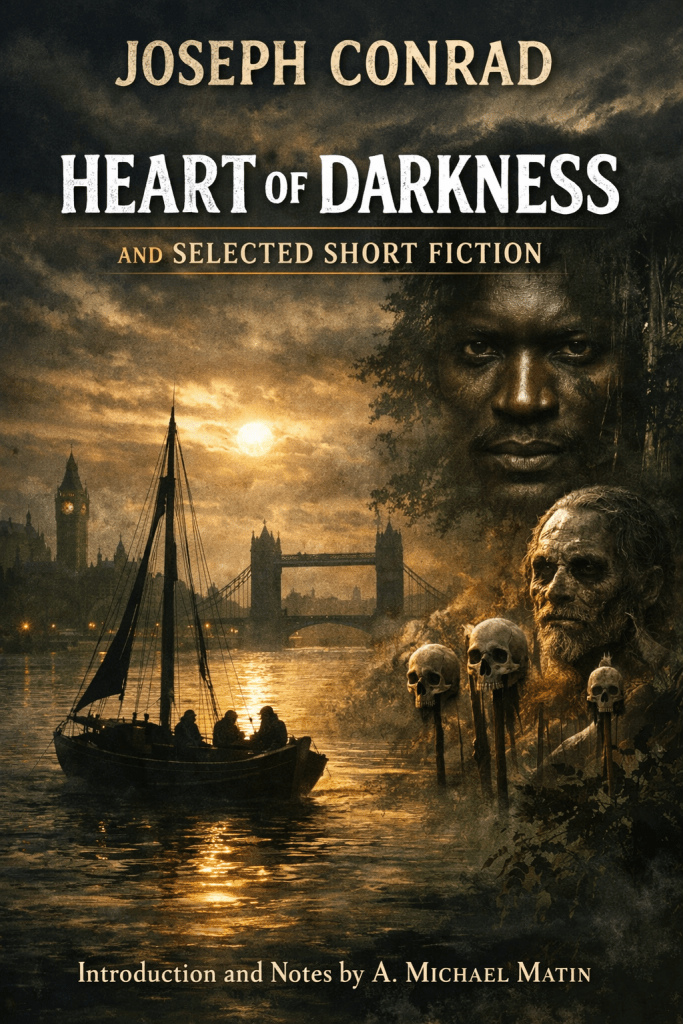
Joseph Conrad’s Heart of Darkness (1899; revised for book publication 1902) poses with compressed precision a question that refuses easy resolution: whether the categories through which European civilization understands itself — progress, idealism, civilization, moral purpose — are constitutively dependent upon the very violence they profess to redeem. The novella’s governing ambition is not to answer this question discursively but to enact the conditions of its unanswerability through a narrative architecture whose every formal feature participates in the philosophical burden it carries. Its distinctive value as an object of study lies precisely in the coincidence of its aesthetic and epistemological concerns: it is simultaneously a meditation on perception, language, testimony, and moral complicity, and a work whose formal choices — the frame narrator, the doubled narration, the fog, the unfinished sentences — are themselves arguments about the limits of what can be known and said.
The work opens not in Africa but on the Thames, aboard the pleasure yawl Nellie, anchored at the mouth of the great river as the tide turns and the light fades over London. This opening is not merely scenic. It establishes from the first sentence the temporal structure that will govern everything that follows: a present that is simultaneously an ending, a moment of stillness poised between the ebb of one current and the flow of another, in which speech becomes possible only because movement has temporarily ceased. The frame narrator — unnamed, uncharacterized beyond his membership in a small circle of professional men whose intimacy is founded on shared seagoing experience — registers the Thames at dusk with a kind of reverent admiration that the narrative will subsequently and systematically corrode. His evocation of the river as a site of England’s historical greatness, of the great knights and adventurers who have sailed from it, of Drake and Franklin carrying the torch of civilization to distant shores, is offered in a register of genuine, uncomplicated pride. This is not irony at the expense of a naive character; it is the establishment of a position, a set of values, a way of seeing the world, that Conrad requires the reader to inhabit before it is subjected to pressure.
Into this scene of comfortable historical celebration, Marlow’s voice inserts itself with what initially appears to be a digression but proves to be the novella’s first major argumentative move. When Marlow observes that England too was once one of the dark places of the earth, and invites his listeners — and through them the reader — to imagine a Roman commander sailing up this very river into an unknown wilderness, he does not simply reverse the polarity of the civilization-barbarism axis. He something more unsettling: he superimposes two temporal layers upon the same geographical space, making the Thames simultaneously the river of English imperial glory and the Congo of an earlier imperial moment. The Roman legionary who endures the savagery of Britain’s primitive interior becomes, by structural parallel, the European agent who endures the Congo — but the parallel cuts in both directions. If the Roman civilizing mission redeems or at least contextualizes that legionary’s violence, then perhaps the European colonial project is similarly redeemable. If it does not, if we register the Roman conquest as itself a form of barbarism inflicted upon what was merely a different culture, then the ideological vocabulary of civilization is revealed as always already a retrospective imposition, a story told by those who survived and conquered about why their survival and conquest were necessary. Marlow himself does not resolve this antinomy. He allows it to hover, neither affirming nor denying the parallel, letting it function as a kind of methodological infection — a device for introducing irreducible ambiguity into the narrative’s moral field before that field has properly been established.
The layered temporality introduced at the Thames returns, with increasing density, throughout the novella. Marlow narrates in the past tense a journey he has already completed, from a position of retrospective knowledge that is nonetheless curiously incomplete — he knows what happened but remains uncertain about what it meant, whether it can be told, whether the telling will communicate anything to listeners who were not there. This narrative situation creates a permanent tension between two modes of knowing: the sequential, experiential knowledge of the journey as it unfolded, and the retrospective, partial, and structurally uncertain knowledge of what it amounted to. The frame narrator mediates between Marlow’s voice and the reader, providing occasional tonal signals that calibrate the reader’s confidence in what is being said, but these signals are themselves unreliable, since the frame narrator is one of the listeners to whom Marlow addresses his confession, and his understanding of what he hears is demonstrably limited. He finds Marlow’s narration inconclusive, obscure, given to shadow rather than illumination. The reader is thus positioned at a further remove from events than even the frame narrator: receiving a text that records a narration that reconstructs a journey whose meaning remained opaque to its narrator and is further filtered through a witness who acknowledges his own incomprehension.
This architecture of epistemological recession — event, experience, retrospective narration, frame narration, text, reader — is not merely a technical device. It is the philosophical form of the novella’s central claim about testimony and truth. If what Marlow encountered in the Congo were simply describable, the elaborate structure of nested narration would be superfluous. That it is not superfluous — that Conrad constructs it with such evident care — implies that the difficulty of narration is integral to the content being narrated. Something about the Congo experience resists direct transmission, not because it is inexpressible in any mystical sense, but because the categories available to Marlow — and, by extension, to his civilization — are precisely the categories that his experience has placed in question. He cannot narrate what he saw by means of the conceptual vocabulary that made the journey possible, because that vocabulary is part of what the journey has implicated. The form of the narrative, its hesitations, its qualifications, its refusals to conclude, its recursive returns to scenes that seemed already described, enacts this conceptual displacement at the level of style.
The journey itself begins in Brussels, in offices that are evoked with extraordinary precision of atmospheric unease. The Company’s headquarters — never named, never located with cartographic specificity, yet unmistakably resonant with the administrative reality of Leopold II’s Congo Free State — presents Marlow with his first encounter with the machinery of imperial commerce operating under the sign of humanitarian mission. Two women knitting black wool appear in the outer office, and their function in the text deserves careful attention. They are not simply sinister presences; they are explicitly associated, through Marlow’s reflection, with the Fates of classical mythology — the Moirai who spin and cut the thread of mortal life. This classical allusion is not decorative. It establishes a relationship between the colonial enterprise and a structure of necessity that precedes and exceeds individual intention or moral judgment. The men who pass through this office — who sign contracts, receive appointments, travel to the Congo and in many cases die there — are not simply choosing; they are entering a mechanism that processes them according to its own logic. Marlow’s sense of unease before these two women is his first intimation that the adventure he is undertaking participates in something older and more impersonal than the humanitarian language of civilizing mission would suggest.
The doctor who examines Marlow before his departure adds a further dimension to this opening movement. His interest in Marlow is scientific in a specific and troubling sense: he measures skulls, he notes changes in those who go out, he performs his examination with a detachment that treats the departing traveler as a specimen rather than a patient. When Marlow asks whether the doctor observes these changes in the men who return, the doctor’s response — that they never return, that he sees only those who go — is calibrated to register as simultaneously a practical observation and a philosophical one. The Congo is established, before the journey has properly begun, as a place from which one does not return in any complete sense: not necessarily as a physical fatality, but as a category of experience that transforms its subjects in ways that cannot be fully communicated back to those who did not undergo them. The doctor’s scientific interest in the transformations wrought by Africa evokes the emerging field of colonial anthropology, the pseudo-scientific racism of craniology, and the broader European will to master the unfamiliar through taxonomic classification — and by making this will to mastery appear simultaneously ridiculous (the doctor’s methods are clearly inadequate to the phenomena he is tracking) and menacing (his detachment from the human dimension of what he observes), Conrad implicates the scientific register itself in the moral pathology the novella will go on to explore.
The journey to Africa, narrated in a mode of compressed, accelerating displacement, passes through a sequence of coastal stations that establish a geography of colonial horror long before Marlow reaches the inner station. The first major scene of sustained ethical weight occurs at the Outer Station, where Marlow encounters the dying Africans withdrawn into the shade of the trees. This passage represents one of the novella’s most precisely executed pieces of moral and aesthetic work, and its execution is worth examining with care. The men — described as black shadows of disease and starvation, brought from other parts of Africa to work on the railway and now discarded when illness has rendered them useless — are dying not in a place that acknowledges their dying but in a marginal space, neither hospital nor resting place, a kind of anteroom to oblivion. Marlow’s response to them is morally inadequate by almost any standard: he gives one man a biscuit, registers his helplessness, and moves on. But Conrad’s treatment of this inadequacy is not straightforwardly condemnatory. Marlow’s helplessness before what he sees is the emotional correlate of a structural fact: the system that has produced these dying men is not susceptible to the remedies that an individual with goodwill can provide. A biscuit does not address colonial economics. Marlow’s inability to do more is Conrad’s way of representing the gap between personal moral response and structural moral causation — a gap that will widen and deepen as the novella proceeds.
Against this scene of casual, industrial-scale human destruction, Conrad places the figure of the Company’s chief accountant, who has somehow managed to maintain in the African heat not only his personal composure but an almost fanatical devotion to correct bookkeeping. His books are in apple-pie order. He continues to keep his accounts meticulously, to dress immaculately in stiff collar and cuffs, to conduct himself as though the Congo were merely an administrative challenge rather than a catastrophe. This figure is among the novella’s most philosophically suggestive minor creations. His immaculate records represent the continuation, in the heart of destruction, of the bureaucratic rationality that the colonial enterprise requires in order to represent itself as legitimate. The books do not record the dying Africans; they record transactions, profits, shipments, commissions. The accountant’s devotion to his books is therefore not simply personal fastidiousness but a structural function: he maintains the representational order through which the colonial enterprise transforms exploitation into administration, human suffering into economic data. That he is personally admirable — Marlow acknowledges a kind of respect for him — only deepens the problem. The accountant is not a villain. He is a cog in a machine whose operation is villainous, and his personal virtues (discipline, precision, perseverance) are precisely the virtues that make him an effective cog.
The Central Station, where Marlow spends several months waiting for his steamboat to be repaired, introduces a new cast of characters and a new set of moral configurations. The manager of the Central Station is notable not for positive qualities but for the absence of them: he has no learning, no intelligence, no grace, no apparent character of any kind, and yet he has survived. His secret, Marlow infers, is that he generates in those around him a sense of unease — an unease that cannot be attached to any specific quality or action, a perfectly undetermined malevolence whose source remains obscure and is therefore impossible to address. This characterization of the manager as someone whose power resides not in positive attributes but in a kind of ambient, characterless menace is philosophically precise. Power, Conrad suggests here, does not require virtue, intelligence, or even wickedness — it requires only the capacity to make others uncertain, to destabilize the normal categories through which character is assessed. The manager is not corrupt in any interesting sense; he is simply empty, and his emptiness functions as a kind of power that fills itself by evacuating the confidence of those around him.
The Eldorado Exploring Expedition, whose members arrive at the Central Station while Marlow is waiting, extends this characterization into a collective register. Their desire — to tear treasure out of the bowels of the land with no more moral purpose than there is in burglars breaking into a safe — is described with contemptuous precision. They are presented as the pure commercial impulse stripped of the ideological justification that normally accompanies it, and their function in the novella is to expose, by contrast, both the necessity and the inadequacy of that justification. The colonial enterprise requires ideology — requires, that is, a story about what it is for, why it is legitimate, what moral purpose it serves — because without such ideology it is merely robbery attended by murder. The Eldorado expedition has dispensed with the ideology, retaining only the robbery, and Marlow finds them consequently more repellent than the mission-minded agents, even though, from a structural standpoint, the difference between them is merely rhetorical. This is among the novella’s most uncomfortable insights: ideology is not merely false consciousness layered over a reality that remains the same with or without it. The ideology of civilization and progress, even when it is sincerely held, changes something about how the enterprise is conducted — it introduces constraints, hesitations, moments of moral self-examination — and its complete absence produces something that Marlow, and by extension the reader, experiences as qualitatively worse. This creates an uncomfortable position: to acknowledge that ideology makes a difference is to partially rehabilitate it, even when one knows that the ideology is false or self-serving.
It is in this context that Marlow’s obsession with Kurtz must be understood. Kurtz is not simply a villain, not simply a genius, not simply a man who has gone native or succumbed to the temptations of power. He is, from the moment Marlow first hears of him, the figure who carries the colonial ideology to its logical extreme — and who then, by some mechanism that the novella works hard to understand, passes through that extreme into something that can no longer be described in ideological terms at all. Kurtz appears, in the accounts Marlow receives before reaching him, as the Company’s most successful agent, the one who sends down more ivory than all the others combined, and also as an idealist of the first order, a man who came to Africa not for personal enrichment but with a genuine mission to civilize, to educate, to carry the white man’s burden with moral seriousness. He has written a report for the International Society for the Suppression of Savage Customs — a document that Marlow reads and that occupies a significant place in the novella’s intellectual architecture. The report is, by Marlow’s account, eloquent and moving, the work of a man who genuinely believes in the civilizing mission and is able to articulate its premises with unusual clarity and force. It argues that white men appear to Africans as supernatural beings, and that this appearance of supernatural power could be used for the good of the native populations — that the appearance of divinity imposes a corresponding moral obligation.
The horror that concludes this report — a scrawled postscript that reads “Exterminate all the brutes!” — represents not a contradiction of the report’s argument but its completion. This is a point the novella makes available to patient reading without insisting on it, and it deserves careful unfolding. The logic of the report holds that the appearance of divinity gives white men power over Africans, and that this power should be used to benefit them. The postscript recognizes — or records the recognition — that the appearance of divinity is not merely a means to an end but is itself a kind of power that demands realization through unconstrained exercise. If the white man is as a god to the African, then the appropriate expression of godhood is not charitable administration but the full assertion of that power — including its most destructive forms. Exterminate all the brutes is not the counsel of a man who has abandoned the civilizing mission; it is the counsel of a man who has understood what the civilizing mission, if taken with absolute seriousness and stripped of its humanitarian hedges, actually licenses. The ideology of civilizational superiority, pressed to its logical conclusion, generates genocide. The postscript is the premise of the report made explicit.
This logic, which the novella makes available but does not state as a proposition, is part of what makes Heart of Darkness philosophically irreducible to any simple moral scheme. Kurtz is not a hypocrite who pays lip service to civilization while practicing barbarism. He is a man who has followed the logic of the civilizing ideology further than its architects intended, and who has in doing so revealed that logic’s own content. The horror that attaches to Kurtz in Marlow’s account is not the horror of disillusionment — the discovery that a supposed idealist was secretly motivated by greed or cruelty. It is something more vertiginous: the discovery that the idealism and the horror are not separate, that the one generates the other, that there is a path that runs directly from “we Europeans are the light of the world, appointed to carry civilization to the darkness” to the skulls on the fence posts around Kurtz’s dwelling.
The journey up the Congo toward the inner station is narrated through a series of perceptual intensifications that function as philosophical arguments about the limits of understanding. The fog that descends on the river is among the novella’s most deliberately theorized images. It is not simply dangerous — though it is that, trapping the steamboat in potential firing range of unseen attackers — but epistemically disabling. Marlow cannot see, and more importantly, he cannot interpret what he hears. The cry that rises from the shore, the drumbeats that continue through the night, the sense of a presence and a will and an intention that cannot be brought into focus: these constitute a mode of not-knowing that is specifically conditioned by colonial encounter. Marlow acknowledges with uncomfortable honesty that there is something in this darkness that calls to something in him — a prehistoric recognition, a kinship with what he cannot name, a sense that the line between himself and what he is observing is less secure than civilized self-understanding requires. This recognition is offered not as a regressive fantasy — not as a longing to “go native” in any straightforward sense — but as a piece of epistemological honesty: the coherence of the civilized self is, in part, a function of the distance it maintains from what it designates as primitive, and when that distance is threatened, the self that was organized by it becomes uncertain.
The attack on the steamboat, in which Marlow’s African helmsman is killed by a spear while Marlow himself remains physically unharmed, crystallizes several of the novella’s central concerns in a sequence of extraordinary compression. Marlow’s response to the helmsman’s death is one of genuine grief — a grief that surprises him, that exceeds what he would have expected to feel for a man with whom he could not communicate in language, whose inner life remained opaque to him, but with whom he had developed a working relationship of mutual dependence. This grief, and Marlow’s subsequent act of disposing of the helmsman’s body in the river rather than allowing the cannibals on board to consume it, raises questions about the moral structure of the encounter that the novella refuses to resolve. Marlow’s respect for the dead man and his determination to preserve the body from what he regards as desecration is simultaneously an act of genuine human feeling and an imposition of his own cultural values upon a situation he does not fully understand. The cannibals’ claim to the body — which they regard, from their perspective, as entirely legitimate — is dismissed without argument. Conrad records this dismissal without endorsing it, registering through the gap between Marlow’s decisive action and his uncertain understanding both the inevitability of acting within one’s cultural frame and the moral inadequacy of that frame as a universal standard.
The arrival at the inner station introduces the Russian — a young man of indeterminate nationality who has attached himself to Kurtz with the devotion of a disciple. His motley appearance, his coat covered with bright patches that evoke the image of a harlequin, functions visually as an emblem of a particular kind of innocence: the innocence of a man who has not yet understood what he is witnessing, who has been captivated by Kurtz’s voice and vision without being capable of assessing their moral content. The Russian’s defense of Kurtz — his insistence on Kurtz’s greatness, his enlargement of one’s mind, his ability to see things clearly — is offered in good faith and received with the ambivalence it deserves. That Kurtz has enlarged this young man’s mind is beyond doubt; what it is that his mind has been enlarged to accommodate is exactly the question. The Russian represents, in compressed form, the problem of the relationship between intellectual charisma and moral judgment: the susceptibility of the unformed mind to the magnetic force of a powerful personality, the way in which the experience of being illuminated by another’s intelligence can disable the critical faculties that would otherwise evaluate the content of that illumination.
Kurtz himself appears late, after an anticipation so extended and so dense that his physical presence risks anticlimactic. Conrad manages this risk with considerable skill, ensuring that Kurtz’s actual appearance — ravaged by illness, terrifyingly reduced and yet somehow still overwhelming — functions not as a deflation of the build-up but as its strange confirmation. What makes Kurtz overwhelming is not his physical presence but his voice: Marlow has been warned about the voice before he encounters the man, and the voice, when it appears, is precisely what he has been told it would be. Kurtz is a voice. This formulation, which Marlow himself uses, is among the novella’s most carefully prepared conceptual pivots. The reduction of Kurtz to voice — to pure linguistic power, to the ability to articulate with extraordinary force what others can only dimly feel — is simultaneously an elevation and a diminishment. It is an elevation because voice is the medium of reason, of civilization, of the capacity to transmit insight across the gap between minds. It is a diminishment because it reduces Kurtz to a function, evacuates him of the embodied, contingent, particular humanity that would be required for genuine moral agency, and reveals that what has made him effective and compelling is precisely what has made him dangerous: the capacity to give compelling expression to ideas without being bound by the human constraints that might limit their application.
The night during which Kurtz crawls back toward the native encampment, and during which Marlow follows him and confronts him, is among the most interpretively compressed passages in the novella. Marlow’s method of bringing Kurtz back to the boat is not argument, not moral appeal, not force, but a kind of rhetorical counter-seduction: he speaks to Kurtz in Kurtz’s own terms, invoking the practical consequences of staying, the certainty of death, the reputation he has built, the people who are waiting for him in Europe. What Marlow conspicuously does not do is appeal to morality, to conscience, to a recognition of what Kurtz has done. He does not say: come back because what you are doing is wrong. He says, in effect: come back because your story in Europe is not yet over, because there is still a future in which the self that went to Africa might be recovered or renegotiated. This rhetorical choice is not accidental and not merely tactical. It reflects Marlow’s understanding — developed through the whole journey — that the moral framework through which Kurtz’s behavior might be condemned is not available to either of them in any straightforward way, because that framework is constitutively implicated in what has produced Kurtz’s situation. To condemn Kurtz in the language of civilization would be to invoke precisely the ideology that generated his crimes.
Kurtz’s final words — “The horror! The horror!” — have generated more commentary than perhaps any other words in the novella, and the reason is that they are irreducibly ambiguous in a way that is deliberately designed rather than carelessly left open. What, exactly, does Kurtz see in his last moments? The horror of what he has done? The horror of what he has seen human beings — himself, others, the colonial system — capable of? The horror of the universe as constituted, of the absence of any redemptive structure that would make suffering meaningful? The horror of the civilizing ideology unmasked? All of these readings are available from within the text, and none is definitively excluded. What can be said with confidence is that the words constitute a judgment — Kurtz judges, at the end, rather than merely experiencing — and that this capacity for judgment is what Marlow, remarkably, treats as Kurtz’s saving grace, his distinction from those who die without having looked. The manager and his associates, Marlow suggests, will die as they have lived, without any final confrontation with what their activity has meant. Kurtz, by contrast, has arrived at the darkness by a logic he has followed to its end, and his final judgment on it — however cryptic, however insufficient to the enormity — is the product of that terrible journey of following a premise to its conclusion.
The lie Marlow tells Kurtz’s fiancée — the Intended — upon his return to Brussels is among the most debated passages in the novella, and its philosophical interest is proportional to the discomfort it generates. The Intended has waited faithfully for Kurtz, preserving an image of him as the great man who sacrificed himself to a noble mission, and when Marlow arrives she asks him what Kurtz’s last words were. Marlow, who has described himself throughout the narrative as a man who detests lies, who finds lying a kind of moral death because it cuts one off from the ground of shared reality, tells her that Kurtz’s last words were her name. This is not what the text has recorded as Kurtz’s last words. Marlow lies. His reasons — never stated explicitly but reconstructable from the text — appear to involve something like mercy: to tell the Intended the truth would be to destroy the image that sustains her, the meaning she has made of her waiting and her loss, and what truth would be gained thereby? The horror would not illuminate her; it would simply devastate her. And yet the lie, however merciful its intention, participates in exactly the structure of mystification that the colonial enterprise depends upon: the maintenance, at home, of a version of the adventure that bears no relation to what the adventure actually consisted of. The Intended’s image of Kurtz — devoted idealist, civilizing hero, martyr to a noble cause — is the story that Belgium and Europe tell themselves about the Congo, and Marlow’s choice to preserve that image rather than shatter it with the truth of “The horror! The horror!” makes him complicit, however reluctantly and humanely, in the ideological function of colonial mythology.
The novella does not judge Marlow for this. It records the choice, attaches to it a weight of irony — the darkness that closes in as Marlow tells the lie, the crape bonnet of the Intended that suggests mourning but also the costume of ideological mystification — and leaves the reader with the discomfort of having to evaluate a merciful lie that is also a structural collaboration with a system of lies. This refusal to adjudicate is characteristically Conradian and philosophically deliberate. Heart of Darkness is not a work that tells the reader what to think about colonialism, or about lying, or about the relationship between personal virtue and structural evil. It creates the conditions in which these questions are felt with full complexity and then withdraws, as Marlow’s boat moves out toward the sea and the frame narrator looks out at the Thames in its final image of darkness.
The darkness that concludes the novella — the Thames leading into the heart of an immense darkness — returns the reader to the opening image of the Thames at dusk and retroactively determines its meaning. The frame narrator began by seeing the Thames as the site of England’s civilizing glory, as the river of great men sailing toward light and progress. He ends by seeing it, through the mediation of Marlow’s story, as another Congo: a river that flows into darkness, carrying not civilization but the capacity for the same darkness that has been projected onto Africa. This closing movement is not a simple reversal — not a replacement of European light with European darkness. It is a suspension of the binary itself, a suggestion that the categories of light and dark, civilization and barbarism, progress and savagery, are themselves ideological constructions that cannot survive contact with what actually happens when one civilization brings its technology and its ideals to bear upon another, less powerful society.
The novella’s narrative form is instrumental to this philosophical conclusion in ways that deserve explicit attention. Conrad did not choose to tell this story in the third person, from an omniscient perspective that would provide the reader with authoritative access to events and their meaning. He chose instead a double remove: an unnamed frame narrator who records Marlow’s voice, and Marlow whose voice itself is constitutively uncertain, given to qualification and retraction, aware of the inadequacy of language to what it is attempting to communicate. This formal choice enacts, at the level of narrative structure, the epistemological claim the novella makes thematically: that there is no position outside the colonial encounter from which it can be seen clearly and judged comprehensively. The omniscient narrator who could tell us definitively what happened and what it meant would be claiming precisely the kind of transcendent perspective that the novella argues is unavailable — the perspective of the civilizing ideology itself, which claims to see the world from above, to know what progress is and which direction it runs.
Marlow’s much-discussed identification of himself with those who do not follow the work — those who have never left the familiar, who cannot understand what he is attempting to say — and his corresponding identification of Kurtz as the only man who has truly looked, introduces a hierarchy of insight that is simultaneously morally troubling and epistemologically significant. To have seen the heart of darkness, in Marlow’s implicit valuation, is to have undergone an experience that transforms one’s relationship to all ordinary moral and epistemic categories. Those who have not seen — the Intended, the accountant, the frame narrator, indeed most of the people Marlow encounters after his return — are not simply ignorant; they inhabit a different epistemic world, one organized by the illusions that make ordinary social life possible and that Marlow now knows to be illusions. This puts Marlow in the position of the gnostic: the one who has been initiated into a dangerous knowledge that cannot be shared without destroying the social fabric that depends on shared ignorance. The lie to the Intended is, from this angle, not merely merciful but epistemically appropriate: the truth is simply not transmissible to those who have not followed Marlow’s journey, and to force it on them would be not illumination but destruction.
And yet the novella itself constitutes precisely such a forcing: it tells the reader what Marlow decides not to tell the Intended. It shares the dangerous knowledge, or at least brings the reader to the threshold of it, in the hope — never guaranteed — that narrative art can accomplish what direct testimonial assertion cannot: the gradual conditioning of the reader’s perceptual and moral apparatus to sustain contact with what would otherwise be unbearable. This is Conrad’s wager on the social and ethical function of literary form, and it is a wager that the novella’s construction enacts rather than merely argues for. By building the darkness gradually, by surrounding it with layers of narrative mediation that give the reader time to adjust, by never quite stating the horror but only approaching it from multiple angles, Conrad attempts to make the reader capable of receiving what Kurtz’s Intended is deemed incapable of receiving — not because she is less intelligent or less morally serious, but because she has not been subjected to the formal preparation that the novella provides.
The question of race in Heart of Darkness cannot be evaded by a responsible reading, though it requires the same care about register and context that the novella demands of all its themes. Chinua Achebe’s famous 1975 essay, delivered as a lecture and subsequently widely circulated, argued with polemical directness that Conrad uses Africa and Africans as a backdrop and a foil for European self-examination, denying Africans individuality, voice, and inner life in the service of a drama that is fundamentally about European moral anxiety. This charge has shaped decades of subsequent debate and cannot be dismissed, not because it is unambiguously correct — it is, as many scholars have argued, overstated in certain respects — but because it identifies a genuine structural feature of the novella’s construction. The Africans in Heart of Darkness are, with few exceptions, rendered in terms of collective rather than individual presence, in terms of otherness rather than interiority, in terms of what they represent to Marlow rather than what they experience in themselves. The dying men at the Outer Station are described with moral clarity and evident compassion, but they remain unnamed and largely undifferentiated. The helmsman, who is perhaps the most individualized African character, is characterized primarily through his relationship to Marlow and through his death. The voices that rise from the shore remain voices — human in origin, powerful in effect, but not attached to particular persons with particular histories and perspectives.
Whether this constitutes a moral failure on Conrad’s part, a reflection of the ideological limits of his historical moment, or a deliberate aesthetic strategy (in which the absence of African interiority is itself a critical representation of the colonial gaze that denies African interiority) remains genuinely contested. What can be said with precision is that the novella is aware of the problem at some level — Marlow’s acknowledgment of kinship with the people on the shore, his recognition that they are undeniably fully human, his discomfort with the ideology that denies this — without being able to overcome it formally. The gap between what Marlow knows (that Africans are human beings with inner lives) and what the narrative renders (a collective, undifferentiated, primarily symbolic African presence) is real, and it corresponds to a gap that runs through the entire colonial ideology the novella is analyzing: the gap between the stated humanitarian commitment to African welfare and the actual practice of treating Africans as instruments, obstacles, or symbols rather than as subjects of their own histories.
This gap, unreduced and uncomfortable, is part of the novella’s philosophical legacy: it does not resolve the contradiction between humanitarian ideology and colonial practice, because that contradiction is not susceptible to resolution within the terms it has been posed. It dramatizes the contradiction with a clarity that remains valuable precisely because it does not pretend to transcend its own historical position. Conrad writes from within the ideological formation he is analyzing, and his novella’s power — and its limitation — derive equally from this implication. To read Heart of Darkness responsibly is to hold these two things together: its remarkable capacity for internal critique, its systematic dismantling of the ideological vocabulary of civilization and progress, and its simultaneous inability to fully escape the representational practices through which that ideology has organized the world it depicts.
The novella’s relationship to history is continuous and specific rather than merely atmospheric. The Congo Free State — the personal possession of King Leopold II of Belgium from 1885 to 1908, administered as a rubber-extraction operation of extraordinary brutality, in which the systematic mutilation, murder, and enslavement of Congolese people produced both vast personal profits for Leopold and a humanitarian scandal that eventually forced the Belgian state to annex the territory — provides the historical ground of Heart of Darkness. Conrad traveled to the Congo in 1890 as the captain of a river steamboat, and his Congo diary from that journey records with journalistic directness many of the details that appear in transformed and mediated form in the novella: the dying men at the Outer Station, the incompetent management of the Company, the isolation and physical deterioration of those who remained in the interior. The transformation of this documentary material into fiction is not a retreat from historical engagement but a deepening of it: the novella uses the narrative techniques of fiction — voice, temporal manipulation, symbolic density, formal self-awareness — to make available dimensions of the Congo experience that straight reportage could not capture, including the phenomenology of moral complicity, the epistemology of colonial encounter, and the structural relationship between metropolitan ideology and colonial practice.
The Barnes & Noble Classics edition in which this text is presented makes available to the general reader a version of the novella accompanied by scholarly apparatus appropriate to a work of this canonical standing and interpretive complexity. The introduction by A. Michael Matin, professor of English at Warren Wilson College, situates the novella within its historical context and the range of critical debates it has generated, providing the non-specialist reader with the contextual framework necessary for an informed engagement with the text. The edition also includes a chronology of Conrad’s life and times, notes that gloss Conrad’s references and clarify historical and geographical details, and a bibliography for further reading. These paratextual features are designed to serve the dual function of accessibility and scholarly rigor — to make the novella available to student and general readers without diminishing the intellectual demands it makes.
The text itself, as established by the publishing history of the novella, is based on the version that appeared in the collection Youth: A Narrative; and Two Other Stories (1902), which represents Conrad’s revised and final intention for the work following its original serial publication in Blackwood’s Magazine in 1899. The revisions Conrad made between the serial and book versions are largely matters of phrasing and emphasis rather than substantive structural alteration, but they reflect the care with which Conrad continued to shape the novella’s tonal and rhetorical register. The book version is the standard text for all serious study of Heart of Darkness, and the Barnes & Noble edition’s use of this text as its basis places it in the mainstream of editorial practice for the work.
To read Heart of Darkness in the early twenty-first century is to read a work that has accumulated a substantial critical and pedagogical tradition — a tradition that has shaped, and in some respects distorted, the conditions under which the novella can be encountered. The Achebe controversy, the postcolonial readings, the feminist responses to the novella’s treatment of women, the New Historical recuperations of its documentary dimension, the narratological analyses of its frame structure: these constitute a critical surround that is impossible to ignore and necessary to engage with, but that can, if allowed to substitute for direct encounter with the text, prevent the kind of careful, patient reading that the novella demands and rewards. What Heart of Darkness offers to the reader who is willing to move slowly through its dense, resistant, deliberately difficult prose is an experience of reading as a moral and epistemological event — an experience in which the ordinary certainties of the reader’s self-understanding are gradually, carefully, and permanently unsettled.
The novella’s final image — the Thames “leading into the heart of an immense darkness” — achieves its effect by retroactive determination: it takes the image with which the novella began (the Thames at dusk, poised between light and dark, carrying the history of England’s civilizing mission) and reveals that image’s concealed content. The river that the frame narrator saw as the vehicle of civilization is the same river as the Congo; the darkness that civilizing ideology projects onto Africa is the darkness at the heart of civilization itself; the light that Europe carries to the world is indistinguishable, at the level of what it produces and what it requires, from the darkness it claims to illuminate. This is not a counsel of despair, not a nihilistic leveling of all moral distinctions. It is, rather, the novella’s characteristic philosophical gesture: the refusal of easy consolation, the maintenance of tension where resolution would be false, the insistence that honest thought must pass through darkness rather than around it. Heart of Darkness does not tell the reader how to live well in a world implicated in structural violence. It makes that implication impossible to ignore, and trusts — in the manner of great literature — that the impossibility of ignoring it is itself a beginning.
 Simon Gros
Leave a comment