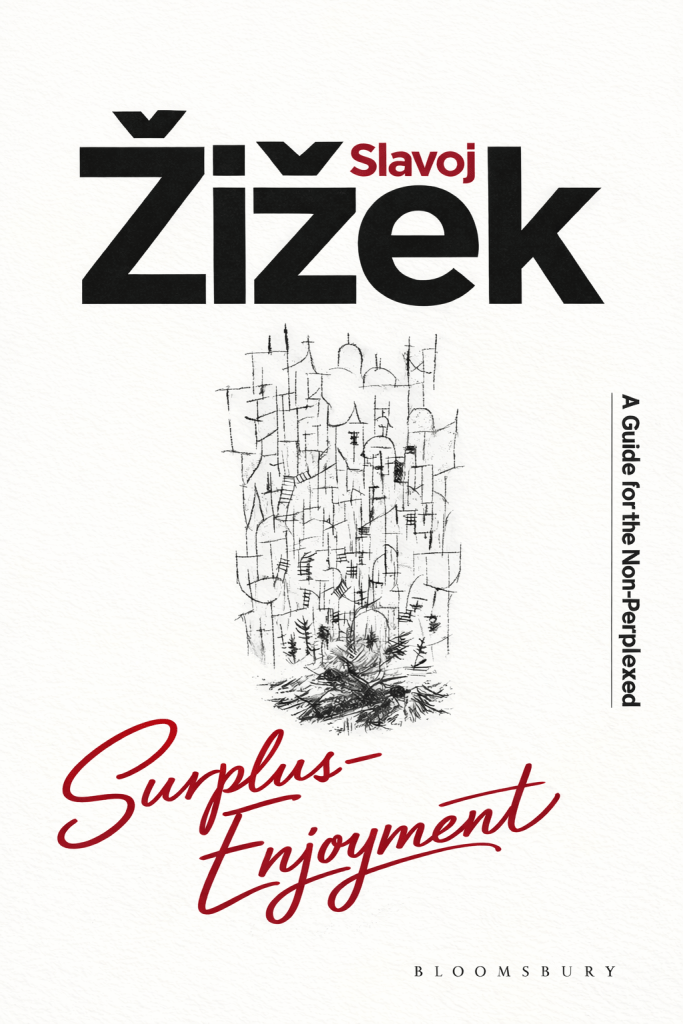
Žižek’s Surplus-Enjoyment: A Guide for the Non-Perplexed presents itself, with unusual explicitness, as an ontology of the present articulated through a conjunctural relay among Marx, Freud/Lacan, and a final political wager on subjective destitution, while Hegel operates as the recurrent formal intelligence that makes the relay legible without becoming the declared object of exposition. The book’s contribution is in how it reconstructs contemporary ideological impasses through the category of surplus-enjoyment as a structurally constitutive excess—an excess that gives consistency to social normality precisely by disturbing it—and then tests whether this same logic can be traversed politically rather than merely diagnosed. Its central achievement is methodological as much as doctrinal: it advances a deliberately conflictual practice of reading, assembling philosophical argument, pop-cultural scenes, political events, and psychoanalytic distinctions into a single problem-space in which the very instability of exposition becomes evidence for the instability of the object.
The opening “Ouverture” names the contemporary world through Hegel’s figure of the verkehrte Welt (topsy-turvy world), and the gesture is not decorative. Žižek uses the figure to characterize a social order in which projects invert into their opposites, normative commitments generate their own practical sabotage, and emancipatory energies are repeatedly captured by the very forms they contest. He then immediately narrows the focus: the book is not, by his own emphatic avowal, “about Hegel” in any straightforward thematic sense; Hegel remains omnipresent as a background logic, while the declared topic is the way the paradoxes of surplus-enjoyment sustain contemporary topsy-turviness. This self-positioning is already the book’s principal mode of argument: Hegel is treated as a formal matrix that permits the diagnosis of reversals, while the substantive field is contemporary ideology in its libidinal organization. The book thereby announces a double refusal: it declines both a purely historical history-of-ideas treatment and a merely topical political commentary. It proposes instead a conceptually armed reading of the present as a field of reversals structured by enjoyment.
The “guide for the non-perplexed” formula is equally exact and should be read as a methodological declaration rather than a marketing joke. The work does not aim to pacify confusion by rendering the present transparent to a stable explanatory schema. It aims to produce perplexity in readers who already experience themselves as cognitively and morally settled within everyday ideology, and to demonstrate that this produced perplexity corresponds to contradictions that belong to the object itself. The book’s avowed refusal of “safe space” functions in this context as a polemical extension of the same claim: if contemporary ideological self-relations are libidinally invested, then argument adequate to them must at times disturb identifications rather than merely refine them. This is also the point at which Žižek clarifies a third term beyond the flat opposition between biological fact and symbolic construct in debates around sex and gender, namely sexual difference as a real antagonism (real here in the Lacanian sense of what resists full symbolization). Whatever one makes of the local formulations and examples, the structural point is crucial for the whole book: a large share of contemporary disputes are, for Žižek, misframed by opposing two positive positions while leaving unthematized the antagonistic gap that generates the field of positions in the first place.
The composition sequence is unusually explicit and contributes decisively to the book’s intelligibility. Žižek states that each major movement functions as a reader’s report instigated by an “outstanding text”: Kohei Saito for Marx and ecology, Gabriel Tupinamba for Lacan and the ideological limits internal to psychoanalytic discourse, Yanis Varoufakis for the political deadlocks of desire, Frank Ruda for the theologico-political stakes of freedom, and Saroj Giri for the elevation of subjective destitution into a political category. This compositional disclosure is not a merely autobiographical aside. It explains the peculiar shape of the work: it is a sequence of engagements that progressively widen and displace the original thematic center. The category of surplus-enjoyment begins as a psychoanalytic key to obedience and renunciation, then becomes a cross-domain operator for reading political economy, ideological critique, contemporary culture wars, and revolutionary subjectivity, and finally yields pride of place to the question of subjective destitution as a possible mode of political passage beyond the compulsive circuit of enjoyment. In this sense, the book’s title names both the central concept and the problem from which the later parts seek partial extraction. The work is architecturally cumulative, but also self-displacing.
The formula “2 + a” condenses the governing architecture. The “2” designates Marx and Freud as the two founders of modern hermeneutics of suspicion, each exposing a visible order as structured by hidden mechanisms—political economy in one case, the unconscious in the other. The “+ a” introduces the Lacanian object a (the object-cause/residual object of desire, here functioning as the operator of surplus-enjoyment) as the additional element that both links and deranges the dual framework. The formula is therefore not a mere sequence marker. It indicates a structural thesis about reading the present: Marx and Freud provide indispensable forms of suspicion, yet their contemporary efficacy depends on a further articulation of the logic of excess, remainder, and performative gain. Žižek also insists in this framing that his reading of Marx and Freud seeks to avoid reductionist objectivism. He emphasizes an irreducible subjective dimension in social and psychic processes and frames the whole enterprise as an “ontology of our present,” in which classics are re-read from current deadlocks rather than restored to historical self-identity. He then adds a decisive complication: there is no classical author whose theory directly maps our present in its notional structure; the final movement therefore enters a zone without settled cognitive mapping. This admission gives the book’s increasing formal volatility a principled basis. It is not only a stylistic preference; it corresponds to a claim about historical legibility.
The book’s methodological self-consciousness is among its strongest and most revealing dimensions. Žižek acknowledges that the style “gets crazier and crazier,” and he affirms this as a positive strategy. The key methodological term is his “violent reading,” a practice that tears apparent organic unities apart and extracts passages from their immediate contexts in order to establish new, sometimes trans-historical, constellations. He explicitly situates this practice near Benjamin’s “dialectic at a standstill” and contrasts it with both a merely faithful immanent reconstruction and an arbitrary instrumental quotation practice. The Suslov anecdote about indexing Lenin quotations to justify virtually any policy serves as the negative image of this method: both involve decontextualization, yet one is pragmatic legitimation by authority, the other a struggle with the quoted text and with the present predicament, where external disfiguration can become, paradoxically, more faithful to the traversing antagonisms than a harmonizing reconstruction. This methodological declaration is indispensable for evaluating the work fairly. Without it, the text can appear as a merely associative cascade. With it, the cascade becomes legible as a wager that only a fractured mode of exposition can track a fractured object. The method remains risky, and the book knows it. This explicitness is a mark of seriousness.
At the conceptual center stands the account of surplus-enjoyment. Žižek reconstructs it through Freud’s Lustgewinn (gain of pleasure) and Lacan’s plus-de-jouir, in structural homology with Marx’s surplus-value. The book’s defining insistence is that surplus-enjoyment is not an additive supplement appended to a prior “basic” enjoyment. Enjoyment as such is already surplus-form; the excess is constitutive. In this sense, objet a names a paradoxical element that is “nothing” in its normal state and nonetheless generates the consistency of desire, attraction, and social adherence. The illustrative examples, including bodily “imperfection” as the feature that sustains the mirage of perfection and the possibility that externally regulated, de-stimulating conditions can themselves become eroticized, are not presented as anecdotal curiosities. They function as micro-demonstrations of a formal law: the obstacle, detour, or disturbing remainder often provides the libidinal gain that organizes the field. The performative dimension is decisive here. Gain occurs through the very process of striving, counting, renouncing, and obeying, rather than through attainment of a final state. This performative logic then becomes the bridge toward politics, ideology, and economy.
From this point onward the book’s major power lies in how it generalizes the surplus structure without flattening all domains into one. Žižek continually proposes homologies while also emphasizing displacements. One sees this in the transition from renunciation and repression at the level of psychic life to social obedience and ideological interpellation. Power does not secure compliance only through fear and punishment. It also “bribes” subjects with a gain in renunciation itself, a perverted satisfaction in the very act of compliance, sacrifice, and rule-following. This is the exact hinge on which the book’s title and subtitle turn. A “guide” to surplus-enjoyment is a guide to the mechanisms by which subjects collaborate with domination, often in the mode of moral seriousness and self-sacrifice. The resulting explanatory ambition is considerable: political impasse is not treated primarily as a deficit of information or moral will, but as a libidinally sustained reproduction of deadlocks in which critique can itself become a source of enjoyment and thus a support of what it opposes.
The first large movement, organized around Marx, capitalism, and ecology, is particularly instructive because it demonstrates how Žižek’s approach differs from both orthodox productivism and simple anti-Hegelian ecological critiques. His engagement with Saito is rigorous in structure even when polemical in tone. He accepts the centrality of the metabolic rift and the irreducible externality of nature against a purely self-mediating social idealism; he recognizes the importance of treating labor as part of a wider material metabolism and the ecological devastation produced by capital’s autonomous valorization process. At the same time, he resists the linear schema in which capitalist modernity simply produces a rift from an originally unified human-earth relation and communism would restore the lost unity. His repeated move is to locate a prior break already within the supposedly pre-capitalist or “primitive” forms of labor and social metabolism: language, symbolic regulation, sacrificial apparatuses, and the big Other mark a constitutive discontinuity in human life that prevents any direct image of reconciled immediacy from serving as the normative horizon. The ecological argument is thereby re-inscribed into a more fundamental theory of alienation. Alienation is not a merely capitalist distortion of an otherwise transparent species-being; it belongs to the symbolic constitution of social existence. Capitalism intensifies, exploits, and reorganizes this condition in a specific way, but it does not invent ex nihilo the gap on which it feeds.
This is where the book’s treatment of labor and abstraction becomes especially consequential. Žižek dwells on Marx’s distinction between human labor and animal activity, yet his purpose is to show that the obviousness of this distinction conceals another break that Marx and Saito alike move past too quickly. Human labor presupposes distance from natural immediacy, and that distance is inseparable from language and the symbolic order. Accordingly, social metabolism always already includes symbolic mediation, and this mediation includes disruptive, non-homeostatic operations such as sacrifice. The rift is constitutive before it is historically intensified by capital. This allows Žižek to preserve the ecological urgency of the metabolic-rift thesis while refusing a naturalized image of communist restoration. It also enables his striking notion of “good alienation,” especially when he argues that a viable communist horizon requires a thick, trusted, largely invisible web of regulations that sustains the space of freedom. The argument is easily caricatured as contrarian provocation. In the book it is more systematic: if symbolic alienation is constitutive, emancipation cannot consist in transparent immediacy; it must consist in a transformed and trusted form of mediation. This position shows the deep continuity between the Marx-ecology chapter and the later psychoanalytic and political material.
A further strength of this first movement lies in Žižek’s refusal to let “science” become either the villain or the redeemer in simplistic fashion. The contents sequence already signals “No capitalism (and no way out of it) without science,” and the broader argument confirms this twofold claim. Capitalist reproduction depends on scientific development and abstraction, while emancipatory politics cannot simply abandon these forms without abandoning the capacity to intervene effectively in planetary conditions. The philosophical stake is substantial: critiques of capitalist abstraction that romanticize immediacy are internally unstable because they rely, in practice, on the very cognitive and technical capacities they denounce. Žižek’s approach seeks a dialectical retention of abstraction under altered social ends, and this approach is consistent with his treatment of alienation as constitutive. The relation to ecology thereby becomes more difficult and more precise: ecological politics requires neither pure technocracy nor anti-modern retreat, but a transformed mediation that can assume social planning without fantasizing a return to presymbolic balance.
The second major movement, centered on psychoanalysis, politics, and philosophy under the rubric of “a non-binary difference,” is where the book’s problem-laden character intensifies visibly. Here the method of engaged, antagonistic reading becomes content, because Žižek’s direct interlocutor (Tupinamba) is himself occupied with separating the radical core of Lacan from “Lacanian ideology.” Žižek both adopts and redirects this operation. He seeks to preserve a strong Lacanian account of the Real and of sexual antagonism while criticizing forms of psychoanalytic discourse that become politically neutralist or doctrinally complacent. At the same time, he extends the same separation procedure to contemporary transgender and feminist ideological formations, proposing that one must distinguish their radical emancipatory core from ideological articulations that negate positive universals while losing sight of a negative universal, namely the impossibility/antagonism constitutive of sexuality as such. Whatever the reader’s political agreement or disagreement, the internal philosophical form is clear: Žižek is not merely choosing one side in a cultural conflict; he is repeatedly trying to transform oppositions among positive identities into a confrontation with a constitutive impossibility that each camp, in different ways, occludes.
This movement is also central for understanding the book’s treatment of universality. Žižek distinguishes between the negation of positive universals (for example, exposing the historical contingency of binary gender codifications) and the assertion of a negative universal (the irreducible antagonism that traverses all codifications). This distinction has broad reach across the book. It informs his reading of ideology, his critique of “safe” epistemic self-certainty, and his interpretation of psychoanalysis itself. The negative universal is not a hidden essence. It names a constitutive impossibility that structures the field and generates symptomatic conflicts. This is why the “coffee without cream / coffee without milk” type of example recurs as more than a joke: formally equivalent empirical outcomes can differ conceptually because the absence is indexed differently within the symbolic structure. The force of the second movement lies in its insistence that emancipatory discourse becomes fragile when it treats plasticity, experimentation, and identity reconstruction as if they could dissolve antagonism altogether. Žižek’s counterclaim is that antagonism returns within these very projects, often in intensified and moralized forms.
At the same time, this part of the work demonstrates one of the book’s recurrent productive tensions: the relation between historicization and structure. Žižek repeatedly resists reducing Lacanian impasses to merely contingent historical limits while also rejecting timeless transhistorical essences in a naïve form. The resulting position is constructively unstable in the best sense. He wants historical specificity and structural necessity at once, and he treats their articulation as a problem rather than a solved method. This produces some of the book’s strongest analytical moments and some of its greatest exposure to objection. Yet the instability is integral to the project’s seriousness. The contemporary ideological field is interpreted as one in which historical shifts in norms, institutions, and discourses reconfigure the modalities through which an invariant antagonistic core is encountered, denied, managed, or enjoyed. This is precisely why the text needs both Marxian and Lacanian resources and why Hegel persists as formal background.
The third major movement, explicitly dedicated to surplus-enjoyment and the question of why we enjoy our oppression, is the conceptual keystone from which the earlier analyses become retrospectively legible. Here Žižek assembles a sequence of distinctions around law, superego, prohibition, permissiveness, impossibility, and transgression that make the category of surplus-enjoyment operational at the level of contemporary institutions and everyday conduct. One of the most significant claims is that permissiveness and superego injunction are structurally continuous: once enjoyment is permitted, it tends to become an injunction, the cruel imperative to enjoy. The corresponding psychoanalytic aim is then reformulated as a modulation of the relation to enjoyment, from the enjoined to the permitted, and from prohibition toward immanent impossibility. This distinction between prohibition and impossibility is one of the most philosophically fertile operations in the book. Prohibition often creates the illusion that enjoyment would be possible if only the prohibition were violated; psychoanalytic work seeks a recognition that some limits are immanent to the structure itself. Yet Žižek immediately complicates the point by insisting that ideology can also present socially imposed prohibitions as if they were immanent impossibilities, thereby naturalizing class domination and institutional exclusion. The conceptual gain here is substantial: no simple opposition between “external social prohibition” and “inner structural impossibility” can be maintained. Their interplay is itself a principal site of ideology.
This third movement is where the book’s account of oppression becomes especially sharp. Žižek examines not only enjoyment in transgression but enjoyment in obedience, rule-following, moral self-scrutiny, and critical renunciation. Examples involving pandemic rule-compliance, politically correct self-policing, and repeated critical detection of power-relations in every concrete case are treated as manifestations of a structural mechanism in which the operation of critique itself yields surplus-enjoyment. His argument at this point has a very particular force: critique can become libidinally self-validating when every case confirms the same matrix, and the pleasure of discovery fuses with the pleasure of renunciation. This is not a rejection of critique. It is a demand that critique include analysis of the libidinal economy of critique itself. The best evidence for the seriousness of this demand lies in the fact that the book applies a homologous suspicion to psychoanalytic schools and leftist politics, not only to liberal or identitarian formations. The target is not a specific camp but any structure in which moral or theoretical activity reproduces itself through the gain generated by its own repetitions.
The section on “So what is Surplus-Enjoyment?” clarifies the category through an exemplary cultural analysis of Brecht/Weill. Žižek’s reading of Peachum’s lines and Weill’s musical setting isolates the discrepancy between semantic content and enunciative or performative tone: the “bad news” about miserable circumstances is delivered with a lively cynical pleasure, and this pleasure is not accidental ornament. It is the very phenomenon under description. This analysis is important because it demonstrates the book’s method at its most exact. Surplus-enjoyment is not simply named in abstract psychoanalytic vocabulary; it is shown in the differential between message and mode of delivery, between avowed lament and libidinal investment. Such readings exemplify why the work’s frequent movement through songs, film, and popular culture is not merely a populist concession or stylistic signature. These objects serve as laboratories for formal distinctions that are harder to perceive in theoretical prose alone.
A related strength of the third movement lies in its treatment of authority and permissiveness in contemporary social forms. Žižek traces how the decline of traditional symbolic authority fails to produce straightforward emancipation and can instead generate atomized social spaces more effective at neutralizing organized resistance than direct repression. He links this to the decomposition of class solidarity, the prevalence of chaotic revolts unable to become durable organization, and the libidinal consequences of life under permissive injunctions. The argument is not nostalgic for paternal law; he rejects the simple restorationist solution. Yet he also refuses the optimistic belief that the erosion of the Master automatically liberates desire. Desire, on his account, depends on structured impossibility and symbolic mediation; unstructured permissiveness can destroy desire and intensify domination in new forms. This whole line of analysis prepares the later turn to subjective destitution because it shows why neither return to law nor hedonistic release offers a sufficient political passage.
The theologico-political line in the latter part of Chapter 3 is another crucial bridge to the finale. When Žižek engages Ruda on freedom, “God,” and the decentering of enjoyment, he uses theology as a materialist index for the problem of an enjoying big Other. “God” names, in this register, the figure of enjoyment externalized into an Other that threatens subject freedom by compelling submission to an alien will or cause. The issue then becomes how to think freedom beyond liberal self-possession, beyond permissive consumer choice, and beyond reconstituted symbolic fictions maintained in a purely cynical mode. This discussion intersects with his reflections on Lacanian subjective destitution and the post-analytic reconstitution of semblances. The tension is explicit: if destitution is a punctuating moment and ordinary symbolic life must return in improved form, how can destitution be elevated to a political category without collapsing politics into either mystical intensity or unsustainable catastrophe? The finale is the book’s attempt to hold this question open while still moving toward an answer.
The finale, “Subjective Destitution as a Political Category,” is where the book’s argumentative narrative both culminates and displaces its earlier center. The stated guiding question is whether there exists a subjective gesture that can interrupt the vicious cycle of surplus-enjoyment. Žižek now shifts from diagnosing libidinal reproduction to testing a form of subtraction from identifications, fantasies, and ego-wealth. The movement is framed in terms of a space “beyond” Heideggerian being-towards-death, articulated instead as a space of the living-dead or undeadness, and condensed through his reading of Rammstein’s “we must live till we die.” The point is not a melodramatic fascination with death but a precise re-specification of the death drive: an endless compulsion to continue, an obligation to live that exceeds organic self-preservation and ruins any simple ethics of happiness. The ethical-political force of this move lies in its refusal to let “happiness” serve as the final criterion. If surplus-enjoyment binds subjects to domination through gains in renunciation and complaint, then a politics calibrated only to reducing suffering and maximizing satisfactions remains vulnerable to the same circuit. The finale therefore seeks a different subjective register.
A major achievement of the finale is the taxonomic care with which Žižek distinguishes multiple forms of what might be called destitution. He does not collapse them into one mystical essence. The text differentiates Buddhist detachment (distance from cravings), mystical identification with a higher absolute (depersonalized desire overlapping with the enjoyment of the big Other), Giri’s revolutionary destitution (the agent as instrument-object of radical change), self-destructive social nihilism (with Joker and Eisenstein’s champagne-cellar destruction as emblematic figures), and Lacanian traversing of fantasy. This multiplicity is indispensable. It prevents the political use of “subjective destitution” from functioning as a slogan attached to any anti-ego event. At the same time, the multiplicity raises the central conceptual difficulty of the finale: by what criterion can these forms be discriminated politically, and how can one preserve the transformative force of destitution while preventing slippage into nihilistic destruction or fundamentalist submission? The book does not dissolve this difficulty. Its merit lies in making it unavoidable.
Žižek’s account of Lacanian traversing of fantasy is especially important in this regard because it clarifies why subjective destitution cannot be reduced to a dramatic interior experience. Fantasy, in his reconstruction, provides the coordinates of reality as experienced and the coordinates of desire; when fundamental fantasy dissolves, one loses not only a private narrative but the very practical consistency of reality and the capacity to desire. This is why subjective destitution is both attractive and dangerous as a political category. It names a genuine break with libidinally saturated ideological reproduction, yet it threatens the conditions of social and subjective livability. Žižek further notes that traversing fantasy is not Lacan’s final word; later Lacan moves toward identification with the symptom as enabling a “moderately acceptable form of life.” This acknowledgment is philosophically crucial because it inserts a principle of reconstitution into the finale itself. The political question is then recast: how can a collective or militant process include moments analogous to destitution while also generating forms of reconstitution that do not simply reinstall the old libidinal economy?
The book’s handling of “les non-dupes errent” in the finale crystallizes this issue in relation to contemporary catastrophes. Žižek mobilizes the phrase against skeptical positions that pride themselves on not being duped by official narratives of catastrophe (pandemic, climate crisis) while in fact missing the immanent systemic processes that generate these crises. This analysis is consistent with the book’s broader critique of ideological self-certainty: one can derive surplus-enjoyment from seeing through appearances, from occupying the stance of the undeceived, and from converting every event into confirmation of a hidden plot. The force of his argument emerges most clearly when he insists that capitalism generates pandemics and ecological disasters through its own contradictions without requiring a secret central fabrication. The system’s immanent destructiveness is sufficient. Here again, the book’s explanatory economy is notable: the same concept that explained obedience and renunciation in everyday life also illuminates the libidinal rewards of conspiratorial “lucidity.” The non-duped err precisely where they take their own non-dupability as proof of insight.
The later subsections on “Lambs to the Slaughter,” “Destructive Nihilism,” and “The Return of Vanishing Mediators” (as indicated by the contents and supported by the finale snippets) reveal the final displacement of the book’s center of gravity. Surplus-enjoyment remains the indispensable diagnostic concept, yet the concluding wager concerns forms of mediation and transition rather than enjoyment alone. The political problem becomes one of passage: how to move from disintegrating liberal-permissive orders and exhausted protest forms toward organized emancipatory agency without relying on restorationist authority, cynical semblance-management, or nihilistic eruption. The category of “vanishing mediator” is the appropriate sign of this transition because it names a form that is necessary for passage and yet cannot remain as the final order. In this sense, the finale’s movement beyond surplus-enjoyment is not a rejection of the title concept but its political consequence. If enjoyment structures ideological reproduction, political transformation requires forms of subjective and collective mediation that alter the libidinal coordinates themselves.
A further merit of the book, often underestimated in polemical receptions, is the way it stages and preserves disagreements with its instigating interlocutors rather than absorbing them into a system of confirmations. Žižek repeatedly states that each “reader’s report” involved a “liminal” disagreement and that Hegel supplied the missing element in each case. Whether one accepts each supplementation, this compositional honesty helps explain the text’s productive unevenness. It is not a monograph built from a single stationary thesis applied to different materials. It is a sequence of encounters in which the object itself shifts under pressure. The ecological chapter pushes psychoanalytic categories into political economy; the psychoanalytic-political chapter reveals ideological limits inside critique; the chapter on surplus-enjoyment transforms diagnosis into a problem of complicity; the finale stretches psychoanalytic destitution into revolutionary and anti-revolutionary registers, then tests its political validity through distinctions among nihilism, fundamentalism, and organization. The work’s unity is therefore dialectical in the strict sense of a unity sustained through internal displacement and rearticulation.
One should also register the evidentiary style of the work. Žižek mobilizes philosophical classics, psychoanalytic doctrine, political reportage, media episodes, films, songs, and anecdotes as a deliberately heterogeneous archive. The heterogeneity is not a concession to contemporary attention economies; it is the chosen empirical field for a concept that concerns the circulation of enjoyment across institutions, discourses, and everyday conduct. The evidentiary criterion is therefore not disciplinary purity but formal intelligibility of a recurring mechanism under altered guises. This criterion can produce remarkable insights, especially when the shift from “high” to “low” culture discloses a structure more sharply than canonical conceptual prose. It can also overextend, because the speed of analogical transfer sometimes exceeds the explicit development of mediations. Yet the book partially anticipates this objection by thematizing its own “violent reading” and by treating stylistic acceleration as part of the object’s truth. In scholarly terms, this means the work invites evaluation less as a conventional argument with linear proof and more as a constellation whose validity depends on the cumulative force of repeated structural demonstrations.
The book’s most consequential conceptual thesis may be its redefinition of political blockage. Rather than locating impasse chiefly in false consciousness, insufficient organization, or moral corruption, Žižek identifies a more pervasive mechanism: the libidinal gains generated by the very practices through which subjects experience themselves as resisting domination, obeying necessity, caring for others, preserving norms, transgressing norms, exposing ideology, or refusing to be duped. Surplus-enjoyment in this sense is a universal solvent of simple political moralism. It does not abolish distinctions between emancipatory and reactionary politics. It compels a deeper criterion by showing that each side can derive stabilizing enjoyment from its own failures, denunciations, and repetitions. The finale’s turn to subjective destitution then appears as an attempt to think a break at the level where these gains are generated. That attempt remains hazardous and incomplete by design, yet it is philosophically serious because it recognizes that any politics confined to rearranging explicit beliefs will leave the libidinal machine intact.
One can also see, with special clarity, how the parts merge into and are displaced by one another. The opening topological image of the topsy-turvy world initially frames social and ideological reversals; in the finale it returns transfigured as a question of whether one can inhabit “turvy without topsy,” a phrase that condenses the refusal of restorationist normality and the search for a transformed relation to alienation. The ecological “rift” begins as a debate about metabolism and capital’s valorization, but it broadens into a generalized account of constitutive breaks in symbolic life, which then feeds into psychoanalytic antagonism and finally into the possibility of destitution. The psychoanalytic analysis of prohibition, impossibility, and injunction begins as a theory of desire and superego, then becomes a political theory of liberal-permissive domination, and finally supplies the conceptual grammar for distinguishing forms of revolutionary severity, nihilism, and fundamentalism. Surplus-enjoyment itself moves from being the named object of inquiry to functioning as the pervasive explanatory medium that the finale seeks to traverse. This pattern of merger and displacement is the book’s deepest formal intelligence. It justifies the compositional sequence and confirms that the outer framing is not ornamental but architectonic.
Its recurrent attempt to formalize the relation between libidinal economy and political economy without reducing one to the other. The text insists, often with deliberate overpressure, that the homology between surplus-value and surplus-enjoyment cannot be treated as a tidy analogy between two parallel regions, one “economic,” one “psychic.” It is presented as a short circuit in which capitalist extraction reorganizes the coordinates of desire itself, so that the social machine and the subjective machine cannot be separated by a simple division of levels. This is why the book can move from commodity circulation to the superego, from financialized repetition to depressive suffocation of desire, and from ideological fantasy to concrete political paralysis without presenting these transitions as metaphors. The transitions are intended as structural transpositions within one field of social reality understood as materially mediated and libidinally invested at once. In this respect, the work’s density is not ornamental difficulty; it is an attempt to preserve a multidimensional object from disciplinary decomposition.
This point becomes especially clear in the way the book treats capitalism’s resilience. Žižek’s claim, as it emerges through his engagement with Lacanian interlocutors and adjacent Marxist-Lacanian formulations, is that capitalism possesses a singular historical strength because it integrates the paradoxical structure of desire into its own operational logic. It does not promise stable fulfillment and then merely fail to deliver; its dynamism is organized by a constitutive excess in which every attained object opens the field for further circulation, further postponement, further investment. The system thereby synchronizes accumulation and dissatisfaction, hedonism and ascetic postponement, expansion and self-undermining. This is one reason the book repeatedly returns to the thesis that contemporary crises do not automatically weaken capitalism in a politically usable way: crises can be metabolized by a system whose very principle is imbalance. Political opposition then confronts a form of domination that derives strength from the same logic of excess that also structures subjective desire. The diagnostic implication is severe: anti-capitalist rhetoric that leaves this libidinal articulation untouched risks reproducing the conditions of what it opposes.
What gives the book distinctive philosophical texture is that this diagnosis does not culminate in a sociological thesis about consumer manipulation, nor in a moral denunciation of greed. Žižek persistently shifts the discussion toward the constitutive status of lack and excess in subjectivity, and this is where the Lacanian apparatus is treated as indispensable. The object a is not a hidden thing secretly possessed by some subjects and stolen by others. It designates the function of a remainder that gives consistency to desire by preventing closure. The political potency of this move lies in the way it reframes envy, resentment, conspiracy fantasies, and cultural hatred. What appears at the level of public discourse as conflict over values can often be redescribed as conflict over enjoyment: the other is experienced as one who either deprives us of our way of enjoying or enjoys in a manner that appears intolerably excessive. In this sense, social antagonism is not psychologized away; it is rendered more exact by showing how material contradictions acquire subjective force through fantasies of enjoyment. The book’s references to racism, right-wing populism, and polarized responses to public events are all organized by this basic explanatory strategy.
A notable strength of the work is its recurring effort to distinguish antagonism from plurality. The text’s discussions of sexuation, queerness, transgender politics, and the critique of binary codifications are framed within a larger philosophical claim about the structure of difference itself. Žižek’s guiding insistence is that a critique of fixed binary norms gains conceptual force when it locates the irreducible gap or impossibility that traverses every normative codification, whereas it loses force when it treats fluidity as a positive plenitude capable of neutralizing contradiction. The result is a demanding and often contentious account in which the emancipatory importance of contesting codified norms is affirmed within a stricter ontology of antagonism. For the purposes of a description of the book’s contribution, the essential point is that the text tries to preserve negativity as a formal resource of critique. It repeatedly resists accounts of liberation that define freedom as an ever-expanding menu of positive options, since this image readily becomes compatible with the permissive injunctions and marketized self-fashioning that the book elsewhere criticizes.
One can also appreciate, at this stage, how the book’s polemical style is internally related to its theory of ideology. Žižek often writes by staging collisions among examples that appear disproportionate in scale or register: a classical philosophical distinction, a filmic scene, a political scandal, an anecdote, a pop song, a psychoanalytic formula. Read superficially, this can seem to dissolve argumentative hierarchy. Read through the method the book itself announces, the procedure aims at something else: a test of whether the same formal mechanism can be tracked across heterogeneous materials without presupposing a neutral metalanguage. The risk is obvious. The text sometimes advances faster than the mediations are fully stabilized, and a reader committed to linear demonstration will experience this as insufficiency. The gain is equally obvious. Certain ideological structures become visible only when the distance between domains is shortened, because each domain illuminates the blind spot of the others. In this respect the work behaves less like a cumulative treatise and more like a machine for generating philosophical legibility under conditions of conceptual and political overload.
The question of historicism, which the book addresses in the outer framing, remains decisive throughout and deserves further elaboration in any serious review-description. Žižek’s move is neither a simple affirmation nor a simple rejection of historicist contextualization. He radicalizes historicism by arguing that our own epoch retroactively constitutes the field within which earlier epochs become intelligible to us, while simultaneously defending a Hegelian-Marxian account of “concrete universality,” according to which universal structures become experientially visible only in particular historical constellations. This double claim is crucial because it allows the book to speak of universal topsy-turviness, universal antagonism, and universal surplus-logic without relapsing into abstract transhistoricism. The present is not treated as a contingent case among others. It is treated as a site in which certain universals appear in a sharpened and socially generalized form. This is part of the rationale for the work’s repeated insistence that our epoch lacks an inherited conceptual map equal to its own contradictions. Marx and Freud are indispensable, yet no already completed doctrine simply contains the present in advance. Hence the text’s oscillation between disciplined reconstruction and speculative improvisation.
The ecological dimension gains fresh significance when viewed through this lens. The book’s dispute with eco-Marxist readings does not weaken ecological urgency; it intensifies the philosophical conditions under which ecological politics can avoid either technocratic managerialism or romantic images of reintegration. Žižek’s insistence on constitutive alienation and symbolic mediation prevents ecology from becoming a narrative of return to lost immediacy. It also underwrites his difficult but important defense of mediation, regulation, and social planning as possible conditions of freedom rather than merely alien impositions. In the broader argument, this connects directly with the later critique of permissiveness. A world organized by deregulated circulation, individualized self-entrepreneurship, and injunctions to enjoy presents itself as anti-authoritarian, yet it often destroys the symbolic and institutional supports required for durable collective action. The ecological question thus converges with the political question of mediation: how can one construct trustable forms of collective regulation that do not reactivate oppressive authority and yet do not dissolve into market anarchy or moralized voluntarism? The book does not present a policy program, but it repeatedly sharpens the conceptual necessity of this problem.
The treatment of permissiveness and depression in the central pivot chapter deserves extended attention because it provides one of the book’s most precise diagnoses of everyday subjectivity in affluent-capitalist cultures. Žižek argues that when enjoyment becomes a social imperative, desire is not liberated into a harmonious field of satisfactions. It is suffocated. Desire depends on detour, asymmetry, and the object-cause that sustains movement without closure; if the object is presented as immediately available under a regime of injunction, the subject encounters not fulfillment but a flattening of libidinal space. Depression appears here as a structural consequence of a social order that confuses availability with desirability and permission with freedom. This diagnosis is not merely clinical rhetoric. It links the psychoanalytic distinction between desire and enjoyment to a social form in which subjects are increasingly organized as managers of their own satisfaction, performance, and optimization. The book’s value at this point lies in the exactness with which it renders a common experience—exhausted permissiveness—conceptually legible.
Closely related is the way the book recasts the relation between repression and oppression. The title of one central subsection itself binds repression, oppression, and depression into a single argumentative arc, and this should be read as more than verbal play. Žižek is attempting to demonstrate that the contemporary subject’s suffering cannot be adequately grasped by a binary between external coercion and internal pathology. Social domination and psychic formations co-produce one another through the circulation of surplus-enjoyment, and the resulting pathologies are often sustained by the subject’s own investments in the very practices that oppress them. The conceptual consequence is that emancipatory politics cannot restrict itself to denunciation of external structures while leaving intact the forms of enjoyment that attach subjects to those structures. Yet the reciprocal error is equally excluded: the book also rejects therapeutic privatization of political antagonism. In its strongest moments, it holds open the unity-in-division of these dimensions and forces the reader to think political transformation and libidinal transformation together without conflating them.
The chapter segments signaled by titles such as “Enjoying Alienation,” “Martin Luther as a film noir Figure,” and “A Desire Not to Have a Mother” indicate another distinctive feature of the work: its refusal to preserve inherited boundaries between doctrinal analysis, theological motifs, and cultural diagnosis. This refusal is methodologically continuous with the earlier declaration that certain philosophical deadlocks can only be approached through a domain Žižek is willing, provocatively, to call “theology” in a materialist sense. The point is not confessional rehabilitation. It is an attempt to name a zone where ontology, transcendental analysis, and naïve realism all fail to capture the traumatic gap that structures subjectivity and social life. In the finale this same zone reappears as the space “beyond” Heideggerian being-towards-death and is linked to living-dead subjectivity. The recurrence is significant: what begins as a methodological excess in relation to standard philosophical taxonomies becomes, in the political conclusion, the very condition for conceptualizing a break from surplus-enjoyment. One sees here again the book’s pattern of early motifs returning in displaced form.
The finale’s engagement with religious forms and fundamentalism is especially important for evaluating the seriousness of the category of subjective destitution. Žižek does not simply contrast secular revolutionary politics with religious fanaticism in a conventional Enlightenment schema. He identifies structural proximities among forms of self-emptying, submission, and anti-ego rupture, then labors to distinguish them without neutralizing their common terrain. This is why the finale must pass through contrasts such as revolutionary self-destitution and religious fundamentalism, and why the surrounding discussion invokes Buddhism, mysticism, Christianity, and militant politics in a shared problematic. The philosophical difficulty here is extreme. Any politics of destitution risks sliding into obedience to an enjoying big Other, ecstatic self-erasure, or destructive purification. Žižek’s approach gains credibility precisely because he does not conceal this risk and because he differentiates destitution from several seductive counterfeits that mimic its anti-ego form while preserving domination in intensified guise.
This, in turn, clarifies the function of the book’s repeated references to nihilism, catastrophe, and “man as a catastrophe.” These are not merely rhetorical escalations. They indicate the limits of a political imaginary centered on stabilization, adaptation, or incremental adjustment to the existing order of enjoyment. Žižek treats humanity itself as a destabilizing intrusion within nature and sociality, a thesis that complicates both ecological harmony narratives and liberal humanist self-images. From that standpoint, the political problem becomes how to organize catastrophe without fetishizing destruction, how to admit constitutive derailment without transforming derailment into a positive cult. The finale’s discussion of destructive nihilism is therefore not an appendix to the main argument; it is a necessary test case for the political use of negativity. Subjective destitution must be distinguished from the enjoyment of destruction itself. The distinction is difficult because both involve rupture, de-identification, and distance from ordinary life-wealth. The book’s contribution lies in insisting on that distinction as a matter of concept, not only of moral sentiment.
If one asks what kind of evidence the book offers for these ambitious claims, the answer is best given in terms of recurrent warrants rather than formal proof. Žižek repeatedly returns to structures of reversal, performative gain, and libidinal investment across disparate materials, and the cumulative recurrence functions as evidence. He also grounds the composition in explicit encounters with specific contemporary interlocutors whose arguments provoke local disagreements and forced reformulations. This dual evidentiary regime—constellational recurrence plus engaged report—explains both the book’s unusual persuasive force and its selective opacity. The reader is expected to track a pattern through transformations rather than receive a single deductive derivation. For a philosophically dense review-description, this point matters because it clarifies how accuracy should be measured. Accuracy here consists less in reproducing isolated theses than in preserving the dynamic by which the text tests, revises, and repositions its own central concept across changing argumentative terrains.
Seen from this angle, the subtitle “A Guide for the Non-Perplexed” acquires a final, sharpened sense. The book addresses readers who possess settled interpretive reflexes—political, theoretical, moral, even critical—and seeks to expose the libidinal supplements that stabilize those reflexes. Its guidance consists in rendering the reader less secure in exactly the places where contemporary ideology most often provides self-confirming pleasures: certainty of opposition, certainty of lucidity, certainty of innocence, certainty that one’s dissatisfaction testifies to one’s distance from domination. By tracing how surplus-enjoyment inhabits these certainties, the text makes perplexity into a disciplined philosophical effect. The closing turn toward subjective destitution then appears as an attempt to think a form of subjectivity that could sustain political action after such certainties have been stripped of their libidinal reward. Whether one finds the wager convincing in full, the work’s distinctive achievement remains clear: it transforms the problem of excess from a sociological description of consumerism into a comprehensive theory of ideological reproduction and a difficult, unfinished inquiry into what a break with that reproduction would require.
Surplus-Enjoyment is most valuable when read as a philosophically combative diagnostic construction of the present, organized by a rigorously unstable central concept and culminating in a deliberately hazardous political hypothesis. Its central explanatory thesis is that excess is constitutive, that the disturbing supplement gives consistency to the substantial order, and that contemporary ideology reproduces itself through gains generated by obedience, renunciation, critique, and anti-ideological self-certainty alike. Its methodological thesis is that only a correspondingly conflictual mode of reading—capable of forcing constellations among disparate materials—can track this object without domesticating it. Its political thesis is less a doctrine than a wager: any serious emancipatory project must confront the libidinal economy of surplus-enjoyment and therefore must think forms of subjective and collective destitution, reconstitution, and mediation beyond both permissive hedonism and restorative authority.
 Simon Gros
Leave a comment