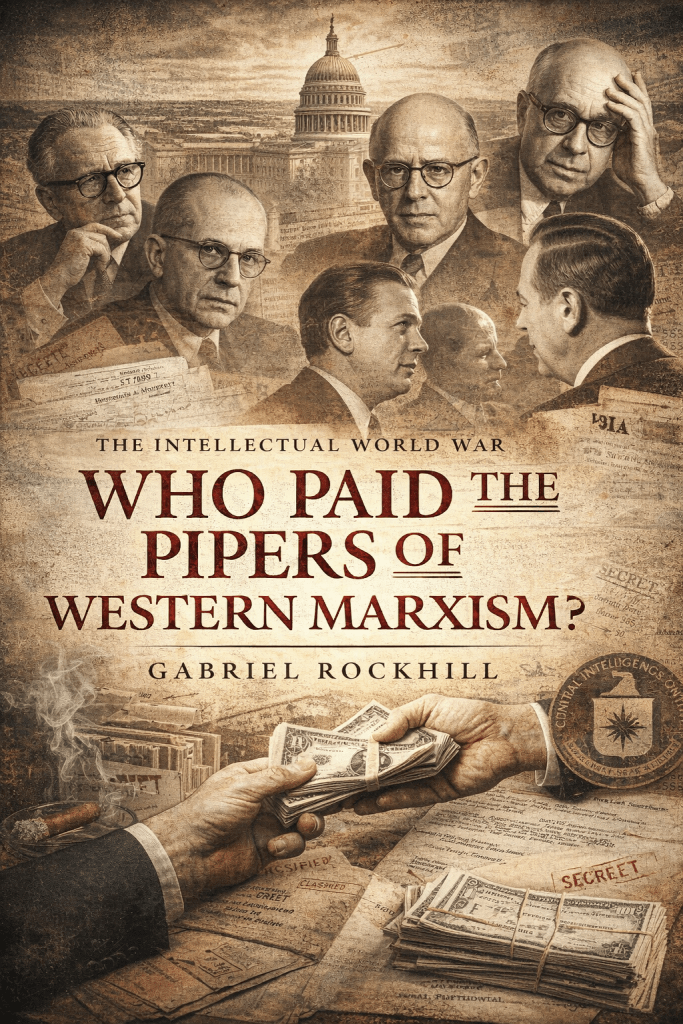
Who Paid the Pipers of Western Marxism? is organized around a guiding question that is at once empirical and methodological: by what material circuits of funding, institutional mediation, and state–class strategy did a certain “Western Marxism” become globally authoritative, and what does that genealogy disclose about its practical function within twentieth- and twenty-first-century class struggle? The book’s governing ambition is to reconstruct the “world of ideas” as a determinate terrain of conflict whose agents, commodities, and infrastructures belong to an imperial superstructure rather than to an autonomous republic of letters. Its distinctive value lies in the attempt to fuse dialectical and historical materialist epistemology with a political economy of knowledge production, so that “critical theory” appears not primarily as a self-unfolding conceptual tradition, but as a socially engineered and socially rewarded formation within an “intellectual world war.”
From its earliest compositional cues, the work asks to be read less as a neutral inventory of intellectual currents than as a calibrated intervention into the conditions under which “Marxism” is named, circulated, purchased, and consumed. Even the table of contents functions as an interpretive operator: it stages an “Opening Salvo,” moves through “Imperial Knowledge” and the “Imperial Theory Industry,” inserts an “Intermezzo” that redefines “Western Marxism,” and only then enters “Compatible Critical Theory,” where the Frankfurt School becomes the privileged case through which the preceding methodological apparatus is tested. The internal logic thereby signals a wager: to understand the Frankfurt School’s place in Western Marxism one must first reconstruct the social totality of intellectual production under imperialism, and the book explicitly instructs that the first half supplies “the overall framework” within which the Frankfurt School “can only be fully elucidated,” namely by situating it in the “evolution of the imperial superstructure in the twentieth century.”
This wager depends on a specific conception of dialectics and of materialist explanation. In the methodological reflections placed early in the “Introduction,” the book targets what it describes as a characteristic historiographic reflex within “the Western persuasion”: the tendency to correlate large, reified epochal categories (for instance, “postmodernism” and “neoliberalism”) through a loose superstructure–base linkage that slips into a quasi-idealist narration of a “spirit of the times,” while allowing class struggle, imperialism, and the institutional matrices of culture to vanish into abstraction. The critique is not primarily that such accounts are false in each of their claims; it is that they misconstrue what counts as an explanation by neglecting the minute points of connection between economic forces and the concrete organization of knowledge production, circulation, and consumption. Dialectics, on this view, is not a rhetorical posture of contradiction-talk; it is defined as an epistemic practice that begins from reality as a web of interrelated processes and seeks a fine-grained mapping of relations through “ongoing” conceptual elucidation aimed at delineating an overall system. The book’s self-understanding is thus methodological before it is polemical: it proposes to demonstrate the “explanatory superiority” of a dialectical and historical materialist approach to knowledge and culture by showing that it can do what the reigning academic narratives cannot do, namely identify the institutional and geopolitical mechanisms through which certain theories become hegemonic commodities.
The methodological core is further sharpened where the work articulates “Dialectical Materialist Epistemology” and explicitly introduces “dialectical and historical materialism (DHM)” as the missing analytic capacity of bourgeois humanities and social sciences. DHM is characterized as a way of situating intellectual labor within the “general socioeconomic relations of production,” themselves embedded in the natural world, beginning from “real premises” of human life under “definite conditions,” and grasping the dialectical relation between objective forces and subjective agency. A tension is already installed here that will govern many later analyses: the book refuses two symmetrical simplifications, the one that reduces intellectuals to passive automata of structure, and the one that elevates intellectual production into an autonomous sphere of pure agency. Instead, it insists on an explanatory form in which agency appears as socially conditioned opportunism and as strategic accommodation, yet remains agency, precisely because the theory industry requires labor, training, discipline, and self-formation in order to reproduce itself.
The conceptual invention that binds these methodological claims into an object-domain is the category of the theory industry. It is introduced through a deliberate analogy: just as there are movie and music industries, there is an industry that manufactures theoretical products and simultaneously manufactures the producers and consumers of those products. The point is not merely that ideas can be commodified; the claim is that under modern capitalism—and, with heightened force, under imperialism—knowledge production has undergone “industrialization,” generating global networks for production, circulation, and consumption whose apex is located in the imperial core and led by the United States. The theory industry is thus not a metaphor for intellectual fashion; it is a thesis about a materially organized apparatus of symbolic value creation.
Within that apparatus, the book introduces a social topology: the “intellectual labor aristocracy” in the imperial core and a comprador variant in the periphery and semi-periphery. Membership is depicted as a long process of proving “fealty,” performing and conforming, so that intellectual distinction becomes legible as a reward structure, not simply as a marker of conceptual insight. Here the work’s neutrality takes a characteristic form: it does not need to impute hidden motives when it can describe incentives, career mechanisms, and the distributional logic of prestige. The “star system,” often treated naively as the recognition of brilliance, is redescribed as the institutional elevation of those who most effectively manufacture ideological products aligned with the owners and managers of the “means of intellectual production.”
This framework then generates a second key concept, whose function is to stabilize the relation between cultural production and state–class power: the “financial-state-intellectual” complex (also presented with variant ordering as state-financial-intellectual nexus). It names the “deeply intertwined” relation between bourgeoisie, bourgeois state, and bourgeois intelligentsia, and it is proposed as the correct level of generality for understanding the theory industry’s dependence on government forces and ruling-class funding. At this juncture the work’s argumentative responsibility shifts: having claimed that dialectics demands a relational mapping of the whole, it must now show that such mapping can actually be carried out without collapsing into vague totality-talk. The way it meets this burden is by promising, and intermittently demonstrating, attention to concrete institutional linkages: universities, foundations, intelligence agencies, propaganda organs, and the circulation protocols through which certain discourses are made globally available and desirable.
A distinctive tension accompanies this movement. On the one hand, the book characterizes the imperial theory industry as a domain in which radical-seeming products are marketed as “innovative,” “cutting-edge,” even “sexy and edgy,” and become culturally mandatory within certain intellectual milieus, whereas Marxism can be dismissed as “old school” and criticized without serious engagement. On the other hand, the same analysis insists that the industry’s temporal logic resembles other culture industries, combining anchoring “tried and true values” with an endless stream of new products competing for future canonization. The tension is methodological: if the industry operates through novelty and fashion, how can one identify stable political functions rather than merely ephemeral trends? The book’s answer, implicit in its architecture, is that novelty is itself a stable mechanism of capitalist circulation, and that the political function is stabilized not by the durability of any particular theory, but by the boundary-policing operations that define what counts as legitimate radicalism.
This is where the concept of the compatible left enters as a decisive operator. The work repeatedly frames the theory industry—especially its “radical fringe”—as a site of “intellectual war on communism,” whose function is to shore up anticommunism and capitalist accommodation by offering radical-coded discourses that remain institutionally safe. The “radical recuperators” of the intellectual labor aristocracy appear here as agents who can perform symbolic gestures of radicality as substitutes for substantive social change, co-opting potentially insurgent elements within the “consumerist and symbolic realm” while maintaining their superior social standing. This description is not merely sociological; it serves as a bridge between epistemology and political strategy. If DHM is said to be oriented toward changing the world through analysis of concrete relations, then a “radical theory” that detaches itself from class struggle and condemns “authoritarian socialism” alongside capitalism can be redescribed as an ideological product whose use-value for revolutionary practice is low even when its exchange-value in the academic market is high.
At this point, the book’s internal movement performs a decisive re-posing of its object. “Western Marxism” is not treated as a neutral descriptor for Marxist theory in the West; it is presented as a phenomenon whose very naming and prestige are outcomes of the imperial superstructure’s operations. In the “Intermezzo,” the book engages prominent accounts—explicitly naming Perry Anderson’s characterization of Western Marxism as a “product of defeat”—and claims that such accounts remain “primarily superstructural” insofar as they fail to analyze the “economic base of imperialism” and the “totality of social relations of intellectual production.” The decisive move is to shift explanatory priority: rather than deriving Western Marxism from an internal narrative of European revolutionary failure and intellectual retreat into philosophy and culture, the book seeks to derive it from imperialism as a world system and from the social location of the imperial core. Drawing on the work it cites in this context, it proposes that Western Marxism emerged historically as a “social chauvinist” Marxism within the imperial core, marked by a supercilious derision toward anticolonial and anti-imperialist Marxism associated with the “East.”
The conceptual pressure generated by this reframing is significant. If Western Marxism is to be redescribed as “imperial Marxism,” the analysis must show more than ideological inadequacy; it must show structural embedding and material support.
The book signals awareness of this burden when it states that its investigation aims to extend such analyses by providing a “political economy of knowledge production, circulation, and consumption,” foregrounding the “dialectical play” between objective forces of the imperial superstructure and the subjective agency of intellectuals. This phrase, “dialectical play,” is not ornamental; it operates as a promise that later chapters will not flatten intellectuals into puppets, yet will not absolve them through appeals to pure intention.
The transition into the Frankfurt School is therefore presented as a test-case for the method. The work prepares the reader for a conflict with prevailing academic common sense: it notes that within the imperial core the Frankfurt School is often interpreted as offering a more “sophisticated” and culturally refined Marxism, contrasted with allegedly economistic or authoritarian Eastern-oriented Marxism, and it claims that this valuation itself was an ideological objective of “powerful forces in the capitalist class and the bourgeois state” that supported Western Marxism as a weapon against revolutionary Marxism and “actually existing socialism.” The “dogma” that Western Marxism is more advanced is thereby redescribed as an outcome of a “semi-clandestine intellectual world war,” not as the settled result of philosophical argument.
Here the book’s neutrality again takes its characteristic form: rather than celebrating or denouncing the Frankfurt School by interpretive fiat, it proposes to change the frame of intelligibility within which their work is assessed. The philosophical wager becomes visible: if critique is to be critical, it must include the critique of the institutions that authorize critique, and it must treat the prestige of critical theory as a phenomenon requiring material explanation. The text makes this explicit when it suggests that leading figures of the theory industry have not diagnosed the theory industry because this blind spot is “constitutive” of their ideology as imperial intellectuals; being trained by the industry, they train others not to see the imperial power structures that promote their anticommunist knowledge as the most sophisticated critical theory.
When the work arrives at “Anticommunist Critical Theory: Adorno and Horkheimer,” it immediately situates the Frankfurt School as one of the “hottest commodities” of the imperial theory industry (paired with French theory) and as a common source for many trend-setting forms of critique in the contemporary academic market. It notes that the political orientation of this tradition has had a “foundational effect” on a globalized Western intelligentsia, and it frames the task as recontextualizing the Institute’s work in relation to “international class struggle,” so as not to become “dupes of history” or of the imperial academy’s parochialism.
A subtle tension emerges here between two possible readings of “political orientation.” One reading would treat orientation as a matter of doctrines expressed in texts; another would treat it as a matter of practical alignments, institutional collaborations, and antagonisms enacted through funding and state service. The book’s method commits it to the second without abandoning the first, and this commitment becomes explicit in the concluding reflections it later offers on Western Marxists: it insists on examining “what they said and did,” while situating these activities within the “overall social relations of intellectual production and global class struggle,” in order to elucidate practical impact from the standpoint of the “primacy of practice.” In this sense, “critique” is judged by its location within social totality and by its tendency to shore up or challenge the socialist alternative.
The Frankfurt School analysis, as far as the available internal evidence indicates, repeatedly mobilizes the category of performative contradiction: purported Marxists laboring in the service of the capitalist state and its imperial apparatus. The book’s most explicit formulation of this point appears in the chapter devoted to what it calls the “Washington School of Critical Theory.” The chapter begins by stating that during wartime and immediate postwar exile, most core Frankfurt members were not working as professors or full-time Institute researchers; rather, they were employed by U.S. state agencies for years, including the OSS (named as predecessor to the CIA), the State Department, and propaganda agencies such as the OWI and Voice of America. The text notes that the Frankfurt scholars themselves often defended this record as a practical application of critical theory in political struggle, interpreting it as antifascist work, and that within the imperial academy this has supported a consensus that their efforts were noble and beyond reproach.
What follows is an explicit refusal of that consensus’s form rather than merely its conclusion: such defenses are described as expeditive, insufficiently attentive to archival detail, and unwilling to situate the scholars within social totality through materialist analysis; they are even said to be motivated by “brand management within the theory industry.” The rhetorical question that anchors the chapter—whether it is not “remarkable” and worthy of scrutiny that the most famous Western Marxist school was “very largely integrated into the intelligence and propaganda agencies of the U.S. government”—operates as a methodological pivot: the Frankfurt School’s fame is to be explained partly through such integration, not in spite of it. The text claims that seven affiliates worked for the U.S. government for a combined total of over fifty years, and it characterizes their governmental service as a “career springboard” that supported research agendas, launched them into prestigious academic positions, connected them to soft power operators dispensing ruling-class funds, and integrated them into the military-industrial-academic complex and the broader financial-state-intellectual nexus.
The conceptual pressure here is intense because it reverses a familiar defense: instead of treating state service as an accidental deviation from theoretical purity, the analysis treats it as materially continuous with the later prestige and dissemination of critical theory. The “ivory tower” picture of the university is displaced by an image of an “organic system” in which bourgeois state, big capital, and universities co-produce and disseminate knowledge; the Frankfurt scholars’ careers are treated as exemplary of this organic whole insofar as they worked for state agencies, received foundation grants, and pursued research at major universities, all within a single totality. The burden of proof becomes archival and institutional: the reader is asked to accept that what counts as “Frankfurt School” cannot be restricted to published theory, because the material conditions that shaped its production and circulation are part of its effective meaning in the world.
At the same time, the work consistently reintroduces agency, and this reintroduction is one of the sites where its own commitments generate strain. It insists that intellectuals “met the system” at variable ratios—halfway, a third of the way—and that the reward was “uplift” into the bourgeois pantheon through global celebrity and material advantages that exceed ordinary career preferments. The text names opportunism as a principal form of agency mobilized by those who succeed in the theory industry. Yet if opportunism is central, a question presses from within the method: how does one distinguish opportunism from strategic antifascism, from ordinary survival, or from genuine conviction under constrained conditions? The work’s internal answer, where it is visible in the evidence at hand, is to treat the question as resolvable only by detailed reconstruction of what was done, what alliances were formed, what institutions rewarded which orientations, and how theoretical positions aligned with imperial interests—hence the insistence that these matters cannot be “arbitrarily severed” from scholarly careers and notoriety.
Within the Adorno–Horkheimer chapter, the work appears to pursue precisely such reconstructions by moving through episodes that function as diagnostic scenes for political orientation. One such scene, presented in the excerpted evidence, concerns Adorno’s stance toward collaboration with figures implicated in the Nazi regime, including his remark that it was “indifferent” with whom he shook hands provided nothing remained “sticking to the paper” on which he wrote. The book interprets this as suggesting that practical collaboration with those who had sworn allegiance to the Third Reich could be acceptable so long as it did not sully the reputation of intellectual commodities. It then describes how former Nazi collaborators occupied leadership roles within the Institute’s postwar structure, including a legal representative and advisers who linked Institute leadership to industrialists and politicians, and it notes that because genuine de-Nazification did not occur in occupied West Germany, such connections facilitated the Institute’s financial, political, and social success.
The function of such material is not reducible to moral indictment. Within the book’s own argumentative economy, it works as evidence that the Institute’s postwar institutional consolidation depended on alliances that sit uneasily with the self-image of antifascist critical theory, and that the reproduction of the Institute as a successful cultural apparatus in West Germany was conditioned by the very social totality that critical theory purported to criticize. The internal tension becomes sharper when the analysis links these collaborations to the Institute’s own conceptual production—raising, for example, the question of how an Institute associated with antifascist critique and even with diagnostic instruments such as the “F scale” could integrate former Nazi-trained actors into leadership, and what this implies about the practical bearings of its theoretical work.
At the level of the system of the book, these Frankfurt School analyses retroactively reconfigure the earlier concept of the theory industry. The theory industry was first presented as a capitalist-driven system manufacturing products and subjects. Once the Frankfurt School is shown as institutionally interwoven with foundations, state agencies, and postwar West German power structures, “critical theory” becomes legible as a commodity whose exchange-value is increased by imperial endorsement and institutional embedding, while its use-value for anti-imperialist class struggle is called into question. This retroactive effect is essential to the work’s method: later empirical reconstructions are meant to determine the sense of earlier conceptual claims, not merely to illustrate them.
The “Intermezzo” had already prepared this retroactive determination by proposing that “Western Marxism” is better described as “imperial Marxism.” The conclusion, in turn, appears to stabilize this renaming by presenting a set of “ideological coordinates” that define Western Marxism’s practical tendencies: rejection of actually existing socialism; opposition to organized revolutionary politics including party form and seizure of state power; a drift toward anarchist-adjacent moralizing and horizontalist democracy; a failure of strategic thinking about the dialectics of socialist transition; and, when forced to choose, practical siding with capitalism over communism despite criticisms of capitalism. In the book’s internal economy, these coordinates are not merely descriptors; they are the functional traits that make Western Marxism compatible with imperial interests, hence its promotion as a global commodity.
Here, however, another methodological tension emerges: the concept of “Western Marxism” shifts from a historical-sociological category to a quasi-typological set of ideological coordinates. The work’s own commitments press it to justify such typologizing without dissolving into abstraction. It meets this pressure by repeatedly tying typology back to the apparatuses of promotion and consumption: Western Marxism is described as a product of the imperial core, bolstered by the imperial superstructure including bourgeois state and cultural apparatus, directly funded by the capitalist ruling class, and widely consumed by the intellectual labor aristocracy and comprador allies in the periphery. The point is that the coordinates are not “free-floating ideas”; they are stabilized by a pyramid of knowledge production and the rewards it allocates.
In this respect, the conclusion returns to the book’s earliest methodological insistence on dialectics as relational mapping: the “objective realities” of imperial support and promotion are said to be “in part” results of subjective orientations, and the two planes are described as “dialectically enmeshed,” since the imperial superstructure “encouraged and cultivated” the theoretical practices in which Frankfurt scholars “willfully” engaged. This formulation both asserts and manages a difficulty. It asserts that imperial institutions do not merely exploit innocent theory; they cultivate forms of theory that will then appear, within bourgeois culture, as the highest form of critique. Yet it must avoid the implication that Frankfurt scholars were simply manufactured agents, which would contradict the earlier insistence on agency and opportunism. The text appears to navigate this by stressing that their integration into the imperial superstructure helped earn them a place in the bourgeois pantheon, while anti-imperialist Marxism can disclose the totality that bourgeois narratives naturalize.
The book’s philosophical unity is perhaps most visible where it converts critique into orientation. Near the conclusion it states that the “primary purpose” of an extensive dialectical critique of Western or cultural Marxism, demonstrating that it is ultimately imperial Marxism, has been to provide knowledge necessary for people to orient themselves in the “intellectual world war,” determine “what side they are on,” and advance coherently; it then announces that this orienting direction has been “more of a subtext” and will now be made explicit through an outline of anti-imperialist Marxism. This remark is structurally important because it reveals the book’s own reflexive awareness: the analysis has operated with an implicit normative orientation (primacy of practice, anti-imperialism), and only at the end does it disclose this as a guiding telos rather than pretending to have been merely descriptive.
The outline of “AIM: Anti-Imperialist Marxism” functions as the book’s positive reconfiguration of its categories. Anti-imperialist Marxism is described as unpromoted by the imperial theory industry, often demoted, demonized, or repackaged; it is oriented toward changing the world rather than merely interpreting it; it preserves what Lenin is said to have called the “revolutionary core” of Marxism, against revisionisms that “gut” it; it is presented as Marxism in its “universal form” in the era of imperialism, whereas Western Marxism is a particular cultural “permutation or perversion” better described as imperial Marxism. It is grounded in a class basis located in “working and oppressed peoples,” particularly those most exploited in the colonial periphery, rather than in the intellectual labor aristocracy; it is guided by use-value rather than exchange-value insofar as it strives for the most rigorous systematic understanding of concrete reality and how to change it; it is firmly grounded in primacy of practice as an evolving collective tradition of analysis and intervention.
The philosophical tension that remains, even after this stabilizing outline, concerns the relation between epistemology and political alignment. The work defines DHM as the epistemic capacity to grasp totality, situate intellectual labor within socioeconomic relations, and articulate the dialectics of objective forces and subjective agency. Yet the conclusion implies that anti-imperialist Marxism is not merely a better politics; it is the epistemically adequate Marxism of the era, “Marxism tout court,” whereas Western Marxism is structurally prone to distortion by its embedding in the imperial superstructure. This implies—by inference from the internal architecture—that epistemic adequacy is partly a function of class position and institutional mediation, not solely of conceptual rigor. The book does not treat this as a scandal; it treats it as the dialectical truth of knowledge under imperialism. Still, a pressure persists: if epistemic adequacy is socially conditioned, how can the book’s own claims avoid the same conditioning? The work’s own strategy, as far as one can reconstruct from its internal cues, is to thematize this reflexivity by foregrounding the “political economy of cultural production, distribution, and consumption,” and by aligning itself explicitly with a tradition it presents as having demonstrated practical transformative capacity in breaking the chains of imperialism.
A further tension concerns the status of evidence. The book repeatedly insists that the dominant academic narratives skate over archival complexity and that the correct materialist approach must delve into details of institutions, funding, and state agency linkages. This insistence culminates in the “Washington School” thesis, where governmental service, foundation support, and academic placement are treated as mutually reinforcing moments in the production of Frankfurt School prestige. Yet the book also frames itself as an “intellectual world war” analysis in which ideological operations are semi-clandestine, mediated by soft power, and normalized by the silence of prominent intellectuals. The methodological tension is that clandestine operations, by definition, generate gaps, silences, and asymmetries in the record. The work appears to respond by shifting emphasis from secret intentions to public consequences: even silence by major intellectuals about known CIA infiltration, for example, is treated as a practical demonstration of complicity between forms of knowledge and imperial power, regardless of whether the silence was intentional. This aligns with the primacy-of-practice criterion: what matters is the role played in the social totality, not the purity of subjective motives.
Within the composition as a whole, the Frankfurt School functions less as an isolated target than as a nodal case through which the theory industry’s structural thesis becomes determinate. The claim that Frankfurt School critical theory, alongside French theory, serves as a foundational reference point for the imperial theory industry, and that it has been used to redefine Marxism into a compatible anticommunist radical theory, gives the Frankfurt School analysis a systemic role: it explains how a discourse can be canonized as radical while being politically useful to empire. The point is not only that some Frankfurt figures held problematic positions; it is that a certain form of critique—abstracted from party politics and socialist state-building, repurposed as cultural criticism and moralizing denunciation of domination—becomes a commodity suited to the needs of an imperial academy and its broader cultural apparatus.
In that sense, the book’s inner movement repeatedly returns to a core set of oppositions, each time thickening them by new determinations. “Knowledge” first appears as an object requiring dialectical epistemology; it then appears as a commodity produced in an industry; it then appears as a weapon in psychological warfare operations aimed at anticommunism; it then appears as a canonized tradition whose canonization itself is a material phenomenon; finally, it appears as an instrument of orientation, separating compatible left commodities from anti-imperialist Marxism as collective science of liberation.
The internal unity attained by the end is therefore not reconciliation in the sense of harmonizing all tensions, but a controlled stratification: the book layers methodological epistemology (dialectics as relational mapping), social theory (theory industry, labor aristocracy, financial-state-intellectual nexus), historical redescription (Western Marxism as imperial Marxism), and political orientation (AIM) into a single argumentative machine. The guiding tensions—agency versus structure, critique versus complicity, autonomy of theory versus material embedding—are not dissolved; they are reordered so that they become legible as products of the imperial superstructure itself, and as diagnostic criteria for evaluating the practical impact of intellectual production.
 Simon Gros
Leave a comment