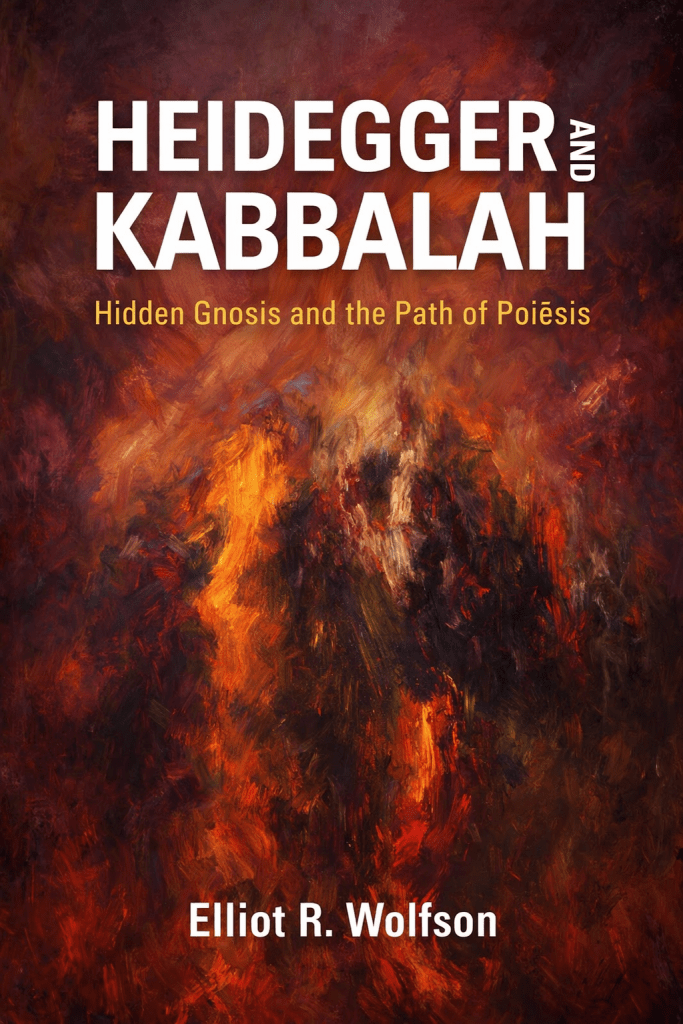
Elliot R. Wolfson’s Heidegger and Kabbalah: Hidden Gnosis and the Path of Poiēsis stages a sustained comparison between Heidegger’s later thinking of beyng as event and key kabbalistic articulations of the infinite, concealment, and linguistic disclosure. The book’s governing ambition is neither a general survey of “mysticism” nor an exercise in associative parallel-hunting, but an internally disciplined attempt to let two heterogeneous corpora illuminate one another at precisely those points where each presses thought toward what it cannot straightforwardly theme as an object. Its distinctive value as an object of study lies in the way it treats comparative work as a methodological problem: how a tradition can be “repeated” without being duplicated, how novelty can arise as return, and how language can disclose by withholding—so that “foreignness” functions as an operator of intelligibility rather than as an obstacle to it.
The work signals from its paratextual framing that it wants to be read as a meditation on the conditions of access to what eludes representational mastery. The volume appears in the series New Jewish Philosophy and Thought, and the early apparatus positions the undertaking within a conceptual rather than merely historical register: the epigraphs and dedication point toward a logic in which illumination and obscurity remain bound together rather than resolved by clarification. The two Heidegger epigraphs that precede the main argument, one invoking the un-rest of questioning as a guarding of what is most question-worthy and another insisting on the danger of venturing into discordance “in order to say the Same,” are not decorative. They serve as instructions for how the ensuing comparisons are to count as comparisons. The book repeatedly returns to the thought that genuine proximity to what is most near demands a passage through what is strange, and it treats this passage as a rigorous demand on method: the foreign is not an empirical otherness that can be mastered by additional information, but a structural feature of the matter at issue, since the matter at issue is precisely what withdraws from the regime of “presence” that would permit mastery.
Wolfson situates the project, in the opening movement of the introduction, against the backdrop of Heidegger’s stature and the persistent controversy surrounding his political allegiance and his failure to acknowledge publicly the catastrophe bound to National Socialism. He indicates that he has addressed the political-philosophical nexus elsewhere and declines to reproduce that argument here, yet he refuses to treat the ethical and historical burden as externally irrelevant to the philosophical labor. The introduction’s gesture is more exacting: it frames the comparative entanglement as taking place under the pressure of a dissonance that cannot be neutralized by professional compartmentalization. At the same time, the book’s tone remains closer to conceptual scholarship than to moral rhetoric: it treats the fact of the controversy as a condition that shapes what questions can be posed responsibly, and how one must read for what a discourse permits itself to say and what it systematically occludes.
From within that constraint, Wolfson states a long-standing personal and scholarly orientation: for decades he has employed Heideggerian themes as interpretive lenses for the phenomenological and hermeneutical aspects of kabbalistic esotericism. The present book is characterized as an expansion and deepening of that work, a move from episodic application toward a more comprehensive thinking-through of what it means to juxtapose Heidegger and kabbalah. The introduction includes an extended review of prior scholarship on “Heidegger and Judaism,” and this is philosophically functional rather than merely bibliographic. By rehearsing how the question has been posed—whether via claims about Hebraic inheritances in Heidegger, questions of biblical and Christian mediation, or inquiries into the Jewish reception of Heidegger—Wolfson makes visible the ambiguity that haunts any attempt to speak of “influence.” The book thereby establishes, as part of its own internal evidence base, the difference between causal-historical derivation and structural-conceptual affinity, and it treats this difference as itself a matter requiring interpretation rather than as a preliminary distinction that can simply be assumed.
The decisive methodological turn occurs when Wolfson articulates the relation between two tasks that are often forced into competition: a historiographical inquiry into how ideas could have reached Heidegger and a conceptual inquiry into how two discursive formations can converge on analogous problems without being reducible to one another. He explicitly allows for the possibility that certain kabbalistic ideas entered Heidegger’s orbit through intermediaries, and he names conduits such as Böhme and Schelling as historically relevant figures within the book’s own frame. Yet he also assigns primacy to a different form of argument: a mapping of constellations of themes, in which the correlation between Heideggerian and kabbalistic motifs is to be grasped as a sameness that persists through difference rather than as a dialectical reconciliation. This is not presented as a license for anachronism; on the contrary, Wolfson anticipates the standard objection and answers it by refusing the assumption that diachronic contextualization exhausts what it means to read a text. The claim, in the book’s own terms, is that interpretive access to what a text can mean presupposes some capacity to step outside immediate contextual closure; otherwise one could not even identify a context as such. The comparative act is thereby redescribed as a disciplined wager about how meaning can be retrieved through “genuine repetition,” where repetition is neither duplication nor free invention, but a re-beginning in which what was “always” already operative becomes newly determinable.
This methodological self-binding is reinforced in the first major conceptual elaboration of the work: the theme of hermeneutic circularity. Wolfson approaches “tradition” as an intricate interplay of novelty and repetition grounded in the circular structure of understanding—an understanding that returns to what it seeks precisely because it never begins from a neutral outside. The book’s formulation of this circularity is sharpened by paradoxical temporal language: recurrence is described as the return of “that which always never was,” and time is figured as a “linear circle.” These are not merely stylistic flourishes; they operate as conceptual constraints. If tradition is to be intelligible as tradition, it must involve transmission; if it is to be philosophically significant rather than merely antiquarian, it must involve transformation. The circularity Wolfson foregrounds is meant to make it impossible to rest in either pole. What counts as “genuine repetition” is repetition that repeats forward, repetition that receives its norm from a futural orientation that retroactively determines what the past will have been. In this sense, the book does not treat tradition as a storehouse of contents but as a temporal form in which meaning is continuously reconstituted.
At this point the argument tightens its criteria. Wolfson introduces, early in the discussion of tradition, procedural stipulations that function as internal rules of evidence. One stipulation affirms the reciprocity of the interpretive prism: Heidegger can be used to examine kabbalah, and kabbalah can be used to examine Heidegger, without elevating either to the status of a mandatory master-key. The reciprocal structure blocks a familiar asymmetry in comparative studies, where one discourse becomes the explanatory measure and the other becomes a reservoir of “examples.” Another stipulation addresses the recurrent charge of essentialism in Wolfson’s scholarship on kabbalah. Here the book’s internal movement becomes especially tension-sensitive: it aims to retain the intelligibility of enduring structures and patterns of thought while also recognizing historical mutability and multivocality. Wolfson’s response is to expose a logical instability in a version of historicism that attempts to universalize contextualization without granting any standpoint from which “context” could be detected. The work thereby positions itself in a space where categorical claims remain possible, but only under a discipline that acknowledges how categories are themselves historically inflected and how the identification of a pattern is already an interpretive act shaped by the reader’s conceptual equipment.
The hermeneutic circle, then, is not merely a topic about Heidegger and not merely an abstract principle; it becomes the book’s own enactment. Later claims are repeatedly allowed to return and reconfigure the sense of earlier ones. When, for instance, the book later develops the notion of beyng as “bestowing refusal” and aligns it with kabbalistic accounts of withdrawal that enables manifestation, the earlier methodological insistence on “discordance in order to say the Same” acquires retroactive determinacy: discordance names the structural nonidentity that any genuine sameness must preserve. Similarly, when the work later treats language as “apophatic occlusion of occlusion,” the early emphasis on the “un-rest” of questioning takes on a more exact function: questioning guards what is most question-worthy precisely by refusing to translate it into a stable object for representational cognition.
In the second large movement, Wolfson turns from tradition to what he calls “inceptual thinking” and to the peculiar rigor by which Heidegger’s “other beginning” seeks to begin again. The emphasis here is methodological in a new sense: the question concerns the form of thinking that could correspond to the matter of beyng as event rather than to beings as present objects. Wolfson repeatedly stresses that the point is not to celebrate obscurity; it is to specify the kind of order that cannot be measured by the criterion of “system” without being distorted. To ground this claim, he draws on Heidegger’s own remarks about systemlessness: the thinking at issue lies outside the domain in which mathematical thought determines truth as certainty, and therefore it does not belong to the question of whether it forms a “system.” Yet this “un-systematic” character is explicitly distinguished from arbitrariness or confusion; disorder appears only if system is assumed as the measuring rod. Wolfson develops the implications of this distinction by comparison to musical form, specifically to the fugue: a polyphonic joining in which multiple “junctures” articulate the same sequence from distinct perspectives without a single tonal center.
The fugue analogy is not treated as an illustrative metaphor that could be dropped without loss. It becomes an operator for grasping how the book itself is composed. The argument does not proceed by linear accumulation toward a final theorem. It proceeds by reiterated returns to a set of motifs—withdrawal, concealment, nothingness, naming, temporality, otherness—each time introducing new constraints. The “atonality” of the work’s conceptual movement is thus also a claim about evidence: what counts as evidence is repeatedly shifted from representational adequation to phenomenological disclosure, from causal explanation to structural articulation, from propositions about entities to staging of the conditions under which entities can appear. The book’s insistence on this shift is also a way of licensing its kabbalistic engagement. If kabbalistic discourse is approached as speculative theosophy in a naive metaphysical sense, it will seem simply incommensurable with Heidegger’s project. If, however, kabbalistic materials are read as disciplined attempts to articulate the genesis of manifestation from a dimension that cannot be thematized as a being, then a field of comparability opens, albeit at the price of continual vigilance against conflation.
This vigilance intensifies when Wolfson introduces the central juxtaposition that organizes the book’s middle: Heidegger’s Seyn/Nichts and the kabbalistic Ein Sof. The work treats these as “names” whose function is inseparable from their limit. Heidegger’s “beyng” is presented, in the register Wolfson favors, as an occurrence rather than an entity, and the book emphasizes Heidegger’s own movement toward thinking beyng as event (Ereignis). In parallel, Ein Sof is described as a name that names what exceeds naming: the “name that names the name that is beyond all names,” a formulation that makes the act of naming reflexive and unstable. The comparability is thus grounded, from within the text, in a shared concern with namelessness. Wolfson adduces Heidegger’s counsel about learning to exist in the “nameless” as a marker of this concern, and he aligns it with kabbalistic traditions of the unnameable divine name, thereby shifting the question from metaphysical predication to the dynamics of linguistic approach.
Here the book is especially careful to maintain a non-dialectical logic of sameness through difference. The identity of beyng and nothingness is explicitly distinguished from the sort of identity that would dissolve difference into a higher synthesis. Wolfson reinforces this by staging a contrast with Hegel’s account of determinate negation. The book’s discussion of Hegel is not an external detour; it serves as a clarifying boundary-condition. Hegel’s dialectic, as Wolfson presents it through explicit textual engagement, treats “pure nothingness” as always the nothingness of something from which it results; negation carries content as determinate negation and yields a new form. Against this, the Heideggerian “nothing” that matters here is neither a mere negativum nor a simple abstraction, but the nullity or negativity of beyng itself, given as withdrawal. The book’s insistence is that nothingness in this register cannot be handled as an object of representation; it is bound to the way beyng gives itself as self-withdrawing refusal. On the kabbalistic side, ayin (nothingness) and related terms function analogously: they do not signify a mere absence, but a generative concealment that enables manifestation.
As the work thickens, definitions acquire new constraints. Namelessness, first appearing as a feature of how one must “exist” near being, is later redescribed as a sign-structure: the “nameless” is not an unsignifiable object beyond signification, but a sign of excess that disseminates through chains of signification without arriving at a final referent. This shift is crucial. It allows Wolfson to avoid treating kabbalistic apophasis as a simple theology of transcendence. The “atheological” orientation the book repeatedly attributes to its own comparative result is not a denial of theological language, but a refusal to let theology stabilize the “beyond” as a supreme being. The “divinity” in view becomes, in the book’s own terms, that which cannot be reduced to any being, including a being “beyond being,” because even that formulation risks smuggling in an objectified transcendence. The pressure generated here is methodological: the book seeks a vocabulary that can speak of ultimacy without producing an ultimate object.
The fourth movement sharpens the genesis-problem by aligning Heidegger’s clearing (Lichtung) and the “appropriating event” with the Lurianic doctrine of ṣimṣum (rendered in the text as ẓimẓum/ṣimṣum), the primordial contraction. Wolfson is explicit that this is a conjecture that will strike readers as either provocative or preposterous, and he anticipates an objection grounded in Heidegger’s finitude: Heidegger’s question of being is thought from the finitude of Dasein, and transcendence is understood as the ecstatic temporal horizon of disclosedness rather than as a reified beyond. Wolfson does not dismiss this objection; he uses it to force a more precise articulation of what “infinity” means in the kabbalistic material he privileges. The book’s comparative wager depends on a “relatively ignored facet” of kabbalistic doctrine: the inessential essence of Ein Sof manifested as potentially infinite concretizations of the finite, an “absolute emptiness” that no being can ever be except by not being. Infinity, in this construal, is not the maximal being; it is an inexhaustible withdrawal that permits finitude to occur.
The clearing, on Heidegger’s side, is treated as the open region in which beings can appear, and Wolfson emphasizes the paradox that the open is opened through a concealment that conceals itself. The kabbalistic account of contraction likewise describes an opening through withdrawal: the overflow of infinite radiance and the formation of an empty space in which manifestation becomes possible. Wolfson’s language here repeatedly performs the work’s central dialectic without reducing it to dialectical synthesis: concealment is concealed and thereby revealed as concealment; revelation occurs as concealment and concealment occurs as revelation. What counts as “bestowing refusal” is precisely the giving that gives by withholding, the bestowal that is inseparable from refusal. The comparative effect is to treat ṣimṣum less as a mythic episode in divine history than as an ontological figure for how manifestation requires withdrawal as its condition. Yet the book does not simply identify the two. It repeatedly keeps the difference in play: Heidegger’s finitude and the existential analytic continue to haunt any attempt to construe the kabbalistic infinite as a straightforward analogue, and the kabbalistic theosophic register continues to resist being domesticated into phenomenology.
At this point a notable migration of argumentative responsibility occurs. Early on, the hermeneutic circle served as the main methodological warrant for comparison. As the middle chapters unfold, the warrant shifts toward the inner logic of concealment and disclosure itself: the similarity between Heideggerian and kabbalistic structures is increasingly grounded in how both treat the origin as non-origin, the beginning as a leap that already contains the end latently. Wolfson explicitly brings this to the fore when he develops the theme of autogenesis and the nihilating leap. The beginning is described, with Heidegger, as an unmediated leap that nevertheless “prepares itself” for the longest time, inconspicuously; it is a head start in which what is to come has already been leaped over in disguised form. Wolfson leverages this structure to interpret kabbalistic origin-speculation as a self-generating genesis: the emergence of the other occurs within the nihility of the not-other.
The problem of alterity then becomes the explicit focus. Wolfson’s conceptual apparatus here is carefully staged. The “not-other” motif, tied in the book to Nicholas of Cusa’s language of pure negativity and negative self-refraction, functions as a way to name an alterity internal to identity. The other is not simply external to the same, as if the same could first be secured and then related to an outside. The other emerges as the self’s own fissure, as a self-differentiation that does not abolish sameness but deprives it of closure. This is also where the earlier Hegelian boundary-condition re-enters with altered valence. The book insists that the Heideggerian “being is nothing” must be understood in a register different from Hegel’s determinate negation; yet it also uses Hegel’s dialectic as a foil that clarifies what is distinctive in Heidegger’s and the kabbalists’ logic. The pressure point is the status of “nothing.” If nothing is always determinate nothing, then origin can be narrated as a rational transition. If nothing is the self-withdrawing of beyng or the abyssal concealment of Ein Sof, then origin is not a transition within representational logic; it is a leap that changes what counts as logical possibility.
This pressure is not merely theoretical. It bears directly on the ethical and political question that the book never fully leaves behind. Insofar as both Heidegger and kabbalistic traditions can be read as privileging a singular language, a singular people, or a singular destiny, the logic of alterity internal to identity becomes an ethical demand: the self is itself only by being otherwise than itself. The work’s comparative strategy thereby acquires a double edge. On one side, it discloses affinities that might seem, by conventional cultural taxonomy, incongruent. On the other, it exposes how each discourse’s most universal gestures risk collapsing into ethnocentric or essentialist closures unless the internal logic of otherness is permitted to constrain those gestures.
The sixth movement, devoted to temporalizing and the granting of time-space, makes explicit how deeply the work’s comparative claims depend on a reconstrual of temporality. Wolfson begins this portion with a quotation from Gustav Landauer that proposes, with striking pertinence for the book’s musical analogies, that the challenge is to express space through time and to develop a new language more akin to hearing and music than to visual-spatial categorization. Wolfson treats Landauer’s remark as a prescient diagnosis of a twentieth-century concern with historicity and with the dominance of spatial logic, and he integrates it with his earlier account of “atonal” inceptual thinking and fugue-like composition. The book’s own method is thereby aligned with a temporal discipline: the argument is constructed so that earlier motifs remain present as retentions while later determinations function as protentions that reconfigure what has already been said.
Temporality, in this register, cannot be reduced to a sequence of “nows.” It becomes the granting of an open region in which presence and absence, past and future, can be articulated at all. Wolfson’s Heideggerian resources here include the idea that the truth of beyng is disclosed as event and that the “abandonment by being” becomes visible only when thought from the other beginning. The kabbalistic resources involve the way divine withdrawal, contraction, and emanation can be read as temporal operators rather than as merely cosmogonic episodes. The “time-space” that matters is not a container but a donated openness. Consequently, the book’s earlier insistence that tradition is “genuine repetition of futural past” returns with sharpened force. Past becomes what it is only from a futural projection; future becomes what it is only as the opening in which the past can be repeated. The hermeneutic circle thus becomes temporalized in a more radical sense: understanding is the enactment of a temporality in which origin is never simply behind us but remains ahead as the unfulfilled demand of beginning.
The seventh movement concentrates the entire comparative enterprise in the phenomenon of language. Wolfson’s guiding claim, supported by repeated invocations of Heidegger’s remarks, is that the essential being of language cannot be anything merely linguistic, if “linguistic” means a system of signs available for technical manipulation. Language is the site where being is simultaneously disclosed and concealed, and poetic saying becomes exemplary because it can preserve concealment within saying rather than abolish it. This is where the book’s subtitle, “the path of poiēsis,” becomes fully operational. Poiēsis is treated less as an aesthetic category and more as a mode of bringing-forth that lets what is unspoken resonate within what is spoken. Wolfson aligns this with the kabbalistic apophatic dimension: the discourse that approaches the divine by acknowledging that any predication risks idolatry of concept, and that the most truthful saying must, in some sense, say its own failure.
A crucial internal invention here is the formulation “apophatic occlusion of occlusion.” The phrase captures the book’s refusal to treat apophasis as mere negation. Negation would still be a determinate act within the logic of predication. Apophatic occlusion, by contrast, is a withholding that withholds even its own withholding: concealment remains concealed. Such concealment is not a deficiency that thinking must overcome; it is an essential feature of what the book calls “hidden gnosis,” a knowing that does not become a possession of knowledge but remains an attunement to withdrawal. This is also why the work repeatedly returns to namelessness. The name that is no name, the counsel to exist in the nameless, the kabbalistic discipline concerning the unnameable name, and the insistence that the nameless is a sign of excess rather than an object beyond signification—these motifs converge here into a theory of linguistic event. Language becomes the medium in which the absence of final referent is itself disclosed as the condition for any referentiality whatsoever.
In the final movement, the book turns the comparative apparatus upon one of its most precarious sites: ethnolinguistic enrootedness and the invocation of historical destiny. This is where the potential ethical corrective is most explicitly articulated, and it is also where the work’s internal tensions become most exposed. Wolfson notes that Heidegger’s thinking of language can be tied, in Heidegger’s own corpus, to claims about the unique destiny of a people and the privileged role of a particular language. Wolfson juxtaposes this with kabbalistic traditions that sacralize Hebrew, that construe language as bearing divine status, and that can be entangled with conceptions of election or unique vocation. The book brings into view how the very logic that makes language the site of disclosure can be mobilized to sanctify exclusionary boundaries. The comparative method thus reaches its critical edge: the same structural insight—language as disclosive concealment—can generate either a universalizable openness to otherness or a closure that identifies the path to truth with a particular ethnos.
Wolfson does not allow the argument to resolve by simply condemning one side and redeeming the other. Instead, he presses the logic of “identity of nonidentical” and the dialetheic sensibility that has governed the work into the ethical domain. The other is described as always in the process of being determined by the same and the same by the other; identity and alterity co-constitute one another in a relational rather than substantialist conception of self. From within this framework, the work formulates an ethical imperative that arises from the negative propensity of singular universality toward a universal singularity: equality is secured through diversity. The boundary between self and other need not be traversed by incorporating or annihilating the other; it can be traversed by a transformation of the self’s own mode of being such that becoming otherwise than oneself becomes the condition for any authentic singularity. The book’s culminating image returns, with deliberate circularity, to the motif that opened its path: the route to the familiar passes through dwelling within the foreign. The journey is long, the book suggests, because it leads through what is most near, and nearness is accessible only through the disciplined cultivation of “two ways of seeing and two ways of listening,” together and separate.
By the end, the work’s unity appears less as a reconciliation than as a controlled antinomy stabilized through methodological restraint. The comparative claims do not culminate in a single decisive identification between Heidegger and kabbalah; they culminate in a clarified field of tensions that the book holds in articulation. One tension concerns influence and affinity: the book permits the historical question to remain open within limits while treating conceptual correlation as the primary philosophical yield. Another tension concerns the status of nothingness: the book continually differentiates nihilating withdrawal from dialectical negation while also exploiting dialectical resources as boundary-markers. A third tension concerns language: the same apophatic discipline that opens thought beyond objectification can, when tied to ethnolinguistic destiny, harden into exclusion. The book’s internal organization stabilizes these tensions by repeatedly converting earlier premises into later results: tradition as futural repetition becomes the temporal logic of origin; systemless rigor becomes the fugue-like form of argument; namelessness becomes the sign-structure of excess; concealment becomes bestowal; alterity becomes the internal fissure of identity; ethical universality becomes inseparable from preserved particularity. The unity attained is thus layered: an integrated system whose coherence resides in articulated relations, recurrences with altered valence, and transitions that repeatedly change what counts as evidence, while leaving the foreignness of the foreign irreducible as the condition of any belonging-together.
While many scholars have noted Martin Heidegger’s indebtedness to Christian mystical sources, as well as his affinity with Taoism and Buddhism, Elliot R. Wolfson expands connections between Heidegger’s thought and kabbalistic material. By arguing that the Jewish esoteric tradition impacted Heidegger, Wolfson presents an alternative way of understanding the history of Western philosophy. Wolfson’s comparison between Heidegger and kabbalah sheds light on key concepts such as hermeneutics, temporality, language, and being and nothingness, while yielding surprising reflections on their common philosophical ground. Given Heidegger’s involvement with National Socialism and his use of antisemitic language, these innovative readings are all the more remarkable for their juxtaposition of incongruent fields of discourse. Wolfson’s entanglement with Heidegger and kabbalah not only enhances understandings of both but, more profoundly, serves as an ethical corrective to their respective ethnocentrism and essentialism. Wolfson masterfully illustrates the redemptive capacity of thought to illuminate common ground in seemingly disparate philosophical traditions.
 Simon Gros
Leave a comment