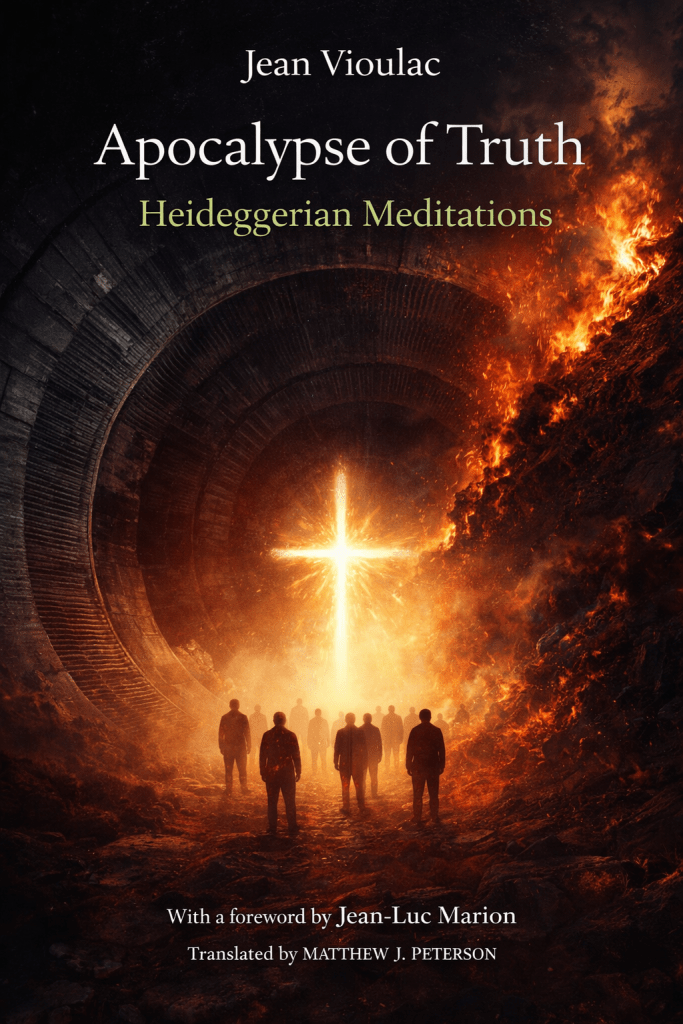
Jean Vioulac’s Apocalypse of Truth: Heideggerian Meditations is a systematic attempt to determine what “truth” must mean when the historical configuration that made truth self-evident enters into collapse. The book’s central question concerns the inner connection between an epochal diagnosis—technology, market-totalization, mass equalization, the waning of communal and sacred horizons—and the fate of truth as the opening in which beings can appear at all. Its governing ambition is to reconstruct, largely with Heidegger as guiding interlocutor, how Western truth (understood as unconcealment) carries within itself a concealed relation to withdrawal, absence, and mystery, and how the consummation of this destiny can be articulated as apocalypse—an unveiling that exposes truth’s own finitude and its internal “in-truth.” The work’s distinctive value as an object of study lies in its disciplined effort to make that unveiling conceptually precise across ontology, politics, and theology, without treating these registers as separable.
The book does not begin from a sociological inventory of crises and then append philosophical reflections. It begins from a methodological demand concerning lucidity. The opening movement—explicitly framed as “clarifications”—treats lucidity neither as psychological sharpness nor as the accumulation of correct propositions, but as a transformation of the stance from which anything like correctness could first become relevant. Evidence, in the Cartesian sense invoked at the outset, is treated as a real phenomenon: it is the clarity in which something becomes indubitable for an “I.” Yet the work insists that evidence presupposes the very condition it tends to ignore, namely a clearing in which anything can be seen. When the text recalls Descartes’s image of living without philosophizing as having one’s eyes closed, it uses that image to displace the center of gravity: what must be brought into view is the light that makes seeing possible, and the way in which that light is historically given. Clairvoyance, as the term is staged, concerns a seeing of the enabling openness rather than merely a seeing within it. From the beginning, then, “truth” is approached as the condition of manifestation, and the question becomes: what is the nature of this openness, how is it dispensed, how does it determine us, and what happens when its mode of dispensation turns against itself?
This displacement immediately generates a pressure internal to the project. The book wants lucidity, yet it refuses to let lucidity be satisfied by the same form of certainty that classical epistemology valorizes. The first systematic operator introduced to maintain this tension is “faultiness,” a term whose translation is explicitly justified in the Translator’s Note as preserving Vioulac’s play between défaillance and the constitutive faille—a fault-line that hollows out the self. The work treats faultiness neither as a contingent weakness nor as a moral defect. It is approached phenomenologically as an experience in which the ego’s sufficiency breaks down before something that cannot be domesticated as an object of representation. Anxiety, the relation to death, love, boredom—these are analyzed as privileged sites where the self’s hold on itself is interrupted by an absence of intuition, a lacuna in what can be made present. The text’s logic here is that the deepest access to the clearing does not proceed by strengthening evidential mastery, but by attending to experiences in which mastery fails in a way that discloses the clearing’s finitude from within.
The function of these analyses is methodological rather than merely descriptive. The book repeatedly converts what could appear as existential “themes” into constraints on how truth must be conceived. Anxiety is presented as a moment where the ego falters and discovers a fault within itself; death is approached as an enforced exposure rather than a willed skepticism; love is staged as a “fall” that opens a non-self-grounded relation; boredom is read as an attempt to flee emptiness through entertainment and activity. In each case, the phenomenon is treated as a way in which negativity intrudes at the heart of existence. Yet the text is careful to prevent this negativity from becoming a mere cult of the void. Faultiness is not introduced in order to glorify collapse. It is introduced as the condition under which lucidity can become more than the self-confirmation of the ego. The book thereby binds lucidity to a discipline: to see clearly requires learning to remain with the fault-line rather than covering it over with compensatory satisfactions.
At this point the argument makes an essential transition: the clearing that enables evidence and the faultiness that disrupts sufficiency are not treated as private structures of an individual consciousness. They are situated as historical. Here the book activates a cluster of terms whose technical precision is stabilized by the Translator’s Note: “existant” and “existance” are used to render what is often left as Dasein, while “essance” (with an “a”) is retained to mark the temporal, historical occurring of what is usually called essence. This vocabulary is not decorative. It allows the work to argue that Being is not a static “is,” but an event of dispensation that opens a site in which existance takes place. Being is approached as the “history of the clearing,” a movement in which light and openness are given in determinate formations. The text’s reasoning is that the most radical reduction does not arrive at a neutral “lifeworld” or a natural ground; it arrives at a historically formed world, an epochal arrangement of intelligibility. Lucidity therefore becomes inseparable from thinking the epoch in which one stands.
This is one of the book’s decisive wagers: to think truth requires thinking destiny. It is not an optional “context” added to a theory of truth; it is what truth, as an opening, is when taken in its essantial occurrence. The book elaborates this by treating the history of Being as a history of variations of light—different “formations” that determine how beings can appear, how the human can relate to them, and how the human can understand itself. The argument develops toward the thesis that there is no timeless “man” who then has a history. Humanity is historical through and through because its essance is existance, understood as openness to a dispensation. To claim objectivity by standing outside history is treated as naïveté, because history is said to pass through us: we are enclosed within the dispensation that grants our possibilities of understanding.
This historical turn intensifies a further tension: if lucidity demands radical solitude (the text cites Heidegger’s insistence that the philosopher must remain solitary), it simultaneously demands thought of the community. Language is introduced as the “translucent domain” where phenomenological luminosity is manifest, broken down, and diffracted. The book’s claim is that human beings stand in the light of Being only insofar as they stand in language, so that one does not have language as an instrument; one dwells within it. “Language is the house of Being” is cited in order to make language function as the place where truth occurs as world-opening. The result is that lucidity cannot be framed solely as an “I” achieving clarity; it must take the form of the question “Who are we?” The book insists that the “We” precedes the “I” as the condition under which selfhood can articulate itself at all, since even the ego’s evidential proposition is carried by grammar and inherited structures of sense.
Here the text’s internal movement becomes visible: the initial critique of evidence expands into an analysis of the historical clearing; the clearing becomes inseparable from language; language becomes inseparable from communal destiny; and the question of truth becomes inseparable from the situation of a people. This “We” is not introduced to dissolve individuality into mass anonymity; it is introduced to specify the ontological locus where an epoch’s evidence is generated. Yet precisely at this point, the book begins to show how the very category of a people is destabilized by the epoch it diagnoses. This destabilization is not treated as a purely empirical fact; it is treated as an ontological mutation in the clearing itself.
The second major conceptual block, which the book names through Heidegger’s vocabulary, is “machination.” The argument does not equate technology with the presence of many machines. Technology is treated as a determinate mode of revealing: the regime of phenomenality in which beings show themselves as machinable, available, calculable. The book argues that contemporary science exemplifies this machinational interpretation by approaching beings primarily with the question “how does it work?” rather than “what is it?” The phenomenon itself is said to be redefined by the interaction between instrument and reality, so that appearance is mediated by apparatus. Machination thereby becomes the name for a clearing whose light is artificial, spectral, and self-intensifying.
This machinational clearing is not restricted to laboratories. The book integrates economic and political determinations into the analysis of how beings appear. It describes a figure of the ego appropriate to this clearing: “lived experience” as a basic form of representation belonging to the machinational, and an “ego computo” that approaches beings through utility calculus and cost-benefit analysis. The market is not treated as a merely external institution; it is treated as a site that defines the clearing in which beings, human labor, and social relations appear. The book explicitly links machination to an absolute productivism and to the dissolution of “what is human about humans and thingly about things” into market value. Here a methodological responsibility migrates: the initial analyses of evidence and faultiness placed emphasis on phenomena like anxiety and death; the analysis of machination transfers the burden of determining the clearing to structures that organize mass existence, production, and publicness.
The book’s account of publicness intensifies this migration. It interprets the public realm as the space where everything is convened and forced to become public—explicitly naming it as ob-scene in the sense of compelled visibility. While Heidegger’s analysis of the “They” is acknowledged, Vioulac’s text presses further toward the historical and machinational conditions under which a “dictatorship of the public realm” can unfold. The public is treated as an element of the machinational clearing: a demand for transparency that functions as a mode of domination. Importantly, this is not presented as a conspiracy thesis; it is presented as an essantial unfolding of a clearing that subjugates by making everything available, comparable, exchangeable. Even the “private” is described as ossifying in denial while testifying, against its will, to subservience.
The concept of “cyberspace” is then introduced as the spatiality proper to this clearing. Informatics is treated as the “software of machination,” a global language toward which older languages move as they melt into simplified global communication. The text explicitly claims that under this planetary totality the distinction between national and international collapses, and that the question of communal belonging loses its determinate answer. This is not staged as lamentation; it is treated as an ontological feature of the epoch: masses replace peoples, and the mass becomes raw material for total mobilization in the service of a global apparatus. Cybernetics—explicitly glossed as steering, kybernēsis—is treated as the governing logic immanent to machination, disqualifying politics in favor of technocracy. A striking internal claim is cited from Heidegger’s own warnings: cybernetics, as theory of the steering of human labor and planning, transforms language into an exchange of news and threatens to take the place of philosophy. Whether one takes this claim as prophetic or diagnostic, within Vioulac’s argument it functions as an operator: it shows how the fate of truth and the fate of thought are bound to the fate of language within a machinational clearing.
Equalization is then conceptualized as the process through which difference is suppressed. The book treats this suppression as more than standardization; it is a structural “lack of differentiation” in which distances are removed and everything becomes equally near and far. Cyberspace is described as producing coexistence without distance through incessant circulation. The equal becomes the same: this is the core transition named in the chapter title. Yet the book’s conceptual burden is to show that equalization is not a neutral leveling; it is a transformation in what counts as a being. Beings become equi-valent and equi-distant within a clearing whose principle is exchangeability. The “distanceless” thereby becomes an uncanny standing, and the human lapses into what is everywhere of equal value. In this analysis, a further tension surfaces: the book began by insisting on the primacy of the “We” and the communal destiny of language; it now argues that the machinational clearing liquidates the very conditions under which a people could gather as a historical “We.” The “We” becomes a problem within the argument itself, and the work treats this as a symptom of a deeper ontological disappropriation.
At this stage the exposition cannot remain at the level of phenomenological diagnosis, because the book’s stated aim is to think truth and its destiny. The third major block, “Truth and Its Destiny,” therefore returns to the concept of truth with the entire weight of the epochal diagnosis now pressing upon it. Truth is reconstructed in its Greek configuration as ἀλήθεια, unconcealment, the clearing that opens the region where beings and λόγος can meet. The book’s analysis is philologically explicit at several points: it reads ἀλήθεια as privative negation of λήθη, a withdrawal or hiddenness that includes forgetfulness and latency (the text notes the kinship with the English “latent”). Unconcealment is described as wrested from concealment in struggle, so that truth is never simply “in itself” available; it is gained in conflict. This insistence on struggle functions to prevent truth from being imagined as a static realm of transparency.
The decisive conceptual turn in this block is the articulation of “in-truth” (Un-wahrheit) as belonging to the essence of truth. Concealment is not reduced to falsehood. It is treated as the originating region of the not-yet-disclosed that truth needs as a reservoir. The text explicitly asserts that concealment is “older” than every openedness of this or that being, older even than letting-be. This is not a peripheral remark. It reconfigures the meaning of truth so that truth’s essence includes an in-essance—what the book calls the Un-wesen of truth—through which the clearing rests in what it cannot clear. Truth is thereby constituted by an intimate tension: it opens by withdrawing from the depth it draws upon.
The book then names the determinate phenomenality of withdrawal as “mystery.” It moves from the Greek μῦω (to close, to shut) toward μυστήριον, and it notes Luther’s rendering of μυστήριον as Geheimnis. Heidegger is cited for the claim that the proper in-essance of truth is the mystery. The mystery is defined with exactness: it is the mode in which what is hidden appears, the “presence proper to absence,” a manifestation through disappearance. This is a pivotal point for the later use of “apocalypse.” The work wants to avoid two symmetrical errors: treating truth as pure disclosure without remainder, and treating withdrawal as a mere void or nihilistic nothingness. Mystery is introduced to articulate a phenomenality of withdrawal that appears precisely as withdrawal, in glimmers, resonance, refusal.
The book’s treatment of death and mourning belongs to this conceptual architecture. Death is described as a phenomenon whose appearance is disappearance, a “concealment appearing in the essence of death.” It is presented as a gateway of Nothingness by which the nothing flows into beings and opens the region of Being. Yet the central phenomenon for the book’s further movement is mourning: the relation to the death of the other, where the presence of absence is lived as remembrance that “lets what is absent come again and again.” Mourning is interpreted as a truth-bearing comportment toward absence, a keeping watch over a crypt of the absent within oneself. In this way, faultiness is integrated into the ontology of truth: faultiness becomes a mode in which the mystery is borne within existance, and mourning becomes a privileged site where the clearing is held open to what withdraws rather than flattened into machinational transparency.
The analysis of “origin and beginning” then deepens this structure by introducing a distinction that governs the book’s historical logic. The “Beginning” is treated as the delimitation of the bounds of truth in relation to the depths of concealment, a configuration that projects a horizon of possibilities and thereby decides a destiny. The “inception” is treated as the first empirical occurrence within that configuration. This allows the book to claim that the Beginning is not simply behind us; it is “all around us,” holding us captive. The end, in this framework, is not a mere chronological stopping point; it is the moment when the possibilities projected in the Beginning are unreservedly unfolded. This conceptuality prepares the ground for the book’s insistence that catastrophe belongs to destiny as a structural possibility of truth itself.
The terms “teleology” and “eschatology” are then bound into the argument with a specific function. The epoch is described as the technological catastrophe, the consummation of the destiny of the West, and thus the epoch of the end. The book cites Heidegger’s formula that “the history of Being is at an end,” and clarifies that what ends is Being, understood as the clearing of difference, rather than beings. The end is described as a darkening of the clearing, a closure of the Open, a return—within global equalization—to the totality of beings enveloped within themselves. Yet, crucially, the end is also the moment when thought can “step back” to behold the whole of this history and thereby exceed it. This exceeding is the condition for what the book calls eschatological revelation: the completion of teleology becomes the disclosure of what teleology dissimulated. The text explicitly names nihilism as the hidden essence revealed in the terminal decomposition of truth, understood as the reduction of originary absence to nothingness. Catastrophe is thereby the mode in which what the history denied becomes manifest.
At this juncture, the concept of apocalypse becomes necessary within the book’s own logic. Apocalypse is not introduced as a sensational theme; it is introduced as a concept required to circumscribe an event in which the collapse of onto-logical truth dislocates the conditions of manifestation and thereby allows what they dissimulated to be glimpsed. The book explicitly proposes that the teleological destruction of truth founds the possibility of an eschatological revelation of mystery. This is the point where a later claim retroactively determines the sense of earlier ones: the initial insistence that lucidity concerns the clearing, the methodical use of faultiness, the diagnosis of machination, the reconstruction of truth’s in-essance as mystery—all of this is now re-read as preparation for a thinking of apocalypse as the unveiling of truth’s own finitude.
The fourth major movement, explicitly devoted to “apocalypse and truth,” begins by situating ἀποκάλυψις as unveiling: an un-covering, a removal of a veil, a bringing to light. Yet the book’s governing contrast—already sharply articulated in Jean-Luc Marion’s foreword—concerns the difference between Greek unconcealment and biblical revelation. Marion formulates the hypothesis in a condensed but programmatic way: Greek ἀλήθεια, understood as wresting beings into visibility, risks leaving Being itself buried under a tautology in which λόγος returns to the same (the Parmenidean to auto), whereas biblical ἀποκάλυψις names an uncovering that brings the world itself to light on the basis of a λόγος other than the one that returns to the same—on the basis of the λόγος of God. This contrast is not a mere comparative religion motif. Within the book’s internal development it functions as the possible name for an “other thinking” that can confront what onto-logical truth structurally turns away from: mystery, withdrawal, the abyssal character of Being.
The conceptual risk here is considerable, and the text does not conceal it. To move from a phenomenology of truth’s in-essance to an apocalyptic thinking could easily become a simple substitution: replacing philosophical truth with theological revelation. The book instead attempts to think apocalypse as an event that judges and convicts truth itself of error, by exposing errancy in its destiny. Apocalypse is thereby made to function as a crisis in the literal sense of judgment. The text insists that such an event must be circumscribed because it transforms what counts as evidence. Earlier in the book, evidence was already destabilized by the primacy of the clearing and by faultiness. Apocalypse radicalizes this destabilization: it is the unveiling of what is inaccessible to “wise men,” to wisdom as calculative mastery. The book stages this through the biblical figure of Daniel, where the mystery sought by the king exceeds the competence of magicians and diviners and is unveiled by God. The point is structural: apocalypse names an unveiling that is not within the reach of an onto-logical λόγος that binds itself to beings as such.
The Pauline dimension of this thought is then developed as more than a doctrinal excursus. Paul is treated as articulating a relation to the mystery that destabilizes Greek “philosophy” understood as the vulgate of Hellenistic wisdom. The book emphasizes that Paul’s preaching unfolds as the proclamation of an event in which the mystery hidden throughout ages is manifested. What matters for Vioulac’s argument is the form of intelligibility at work: the mystery is disclosed as mystery, and the disclosure reorders the place of wisdom, law, and world. Here apocalypse is not simply future prediction; it is a transformation of the present as the site in which the end has, in a decisive sense, already taken place and yet remains awaited. This structure—an eschatology that is ever-present—will later become decisive for the book’s portrayal of Christianity in terms of mourning and waiting.
The phrase “apocalyptic regrounding of truth” signals what is at stake in the book’s systematic architecture. Truth, as ἀλήθεια, was shown to rest in concealment and to include mystery as its in-essance. Yet the destiny of Western truth, culminating in machination and equalization, tends to deny this in-essance by reducing it to nothingness or by covering it over with transparency and control. Apocalypse is introduced as the event through which this denial is judged. It reveals that the history founded on the Greek inauguration of truth carries within itself a forgetting of the ontological difference, and that this forgetting becomes consummate as technology. Apocalypse thereby functions as an unveiling of the mystery from which truth has turned away, and as a disclosure of the abyssal character of what the book calls Beyng (a translation choice noted in the Translator’s Note as rendering Heidegger’s Seyn). Apocalypse is thus not added to the history of truth; it is presented as the mode in which the history of truth, at its end, becomes readable as a destiny.
This is where the book’s tension-sensitivity becomes explicit. The argument does not resolve the relation between Greek truth and biblical apocalypse by declaring one superior and the other obsolete. It treats their relation as a conflictual articulation within the fate of the West. The West is described as reaching a terminal crisis where the onto-logical clearing collapses into machinational closure. This collapse is catastrophic and threatens annihilation. Yet precisely in this collapse, the concealed dimension of truth—mystery, withdrawal—can appear as what the clearing had always presupposed and denied. Apocalypse is the concept that can hold together the double structure: catastrophe as destruction of a historical configuration, and revelation as disclosure of what that configuration dissimulated. The book’s internal responsibility, then, is to show how apocalypse is neither mere destruction nor mere unveiling of beings, but unveiling of the clearing itself as finite, abyssal, and governed by absence.
The fifth movement, “on the edge of the abyss,” intensifies this structure by integrating poetics. The argument has already established that language is the house of Being and that works of language—especially poetic works—condense and transmit the light of a historical destiny. In the machinational epoch, however, language is transformed into information exchange, and publicness demands transparency. The book therefore needs an account of how truth can be safeguarded when the clearing is dominated by machination. “Poetics of truth” functions as an attempt to articulate a relation to language that resists informational flattening and maintains openness to mystery. In the earlier “clarifications,” the work treated silence as a mode of signifying and cited Heidegger’s remark about the hand’s gestures speaking most purely when one speaks by being silent. This earlier motif now acquires a sharpened significance: poetics becomes a way of letting withdrawal resonate within language rather than forcing it into machinational publicity.
In this context the book’s treatment of the “apocalypse of the West” is not a geopolitical slogan. It is the designation of an essantial event: the consummation of a destiny in which metaphysics prevails unchecked over the whole world as machinery totalizing beings. Marion’s foreword explicitly formulates this in terms of metaphysics carrying out the totalization of beings by machinery “like a cancer without end or limit.” Vioulac’s own text, working from Heidegger, identifies this consummation with the closure of difference, the reduction of beings to machinability, and the suppression of mystery. “Apocalypse of the West” therefore names an unveiling of what the West has become by virtue of its own truth, and a disclosure of the abyss that its truth had always circumscribed and denied.
The sixth and culminating movement, “abyss of the deity,” introduces the theological register with a precision that the book has prepared through its earlier analysis of mystery and mourning. The entry point is the contemporary absence of God. The book quotes Heidegger’s claim that the radiance of the deity is extinguished in world-history and that even the track to the sacred appears extinguished. Atheism is treated as the truth of the technocratic cosmos, the evidence illuminated by the spectral light of cyberspace. Yet the book insists that this atheism is not an individual standpoint (“I believe” / “I do not believe” are treated as egological statements); it is a destiny of a historical community. Metaphysics is described as atheist in its essence insofar as it approaches the divine through the idolatry of a cause, ground, idea, or substance, thereby binding the divine to the sphere of beings and enclosing it within onto-logic. The loss of the divine is thus integrated into the same history of truth that culminates in machination. Atheism becomes legible as a structural effect of the destiny of truth.
Within this movement, the “death of God” is not treated as a cultural slogan but as an index of how the divine withdraws within the history of truth. Hölderlin and the Heideggerian motif of the “last God” are introduced as names for a relation to the divine that is no longer secured by metaphysical grounding. The book’s method here is to let the earlier analysis of mystery dictate how theology must be approached. If the proper in-essance of truth is the mystery—manifestation as withdrawal—then the divine, if it is to be thought without idolatry, must be approached in terms of withdrawal rather than presence at disposal. This is the systematic bridge by which the book can move toward its climactic engagement with Meister Eckhart.
The Eckhart material is treated as a conceptual intensification of the theme of withdrawal. The central term “deity” (rendering gotheit, deitas, θεότης) is defined as naming the intact, inaccessible depth of God—God in a domain out of reach for creatures. The book uses Eckhart’s metaphors to articulate a structure: the deity is God “in his dressing room,” naked in his intimacy, untouched by effects. The deity’s light is described as darkness for human faculties, not because it is mere absence of light but because it exceeds natural luminosity and saturates vision. The text integrates biblical motifs here (the blinding at Damascus) to show how overwhelming light can appear as darkness. The conceptual point is that the deity is “unknowable” in the precise sense of being out of reach of unconcealment; it is hidden stillness, withdrawn into itself. This is the strongest form of the book’s claim that withdrawal is not a deficiency added to presence; it is a mode of manifestation proper to what exceeds the clearing.
From this follows, within the book’s own logic, a critique of concept and predication at the limit. Eckhart is read as insisting that whatever understanding can grasp or desire can desire is not God. Concepts become obstacles; divine attributes, even eminent ones, must be renounced because they enclose what they aim to name. Knowledge can thereby function as veiling power. Approaching the deity becomes a matter of dispossessing oneself of concept and image, diving into an essential forgetting and unknowing where stillness and silence allow a Word to be heard. The book’s earlier emphasis on silence as a mode of signifying, and on the need to resist machinational transformation of language into information, now acquires a theological determination: silence becomes the comportment appropriate to the deity’s simplicity. Eckhart’s claim that whoever speaks of God by “nothing” speaks properly, and his invocation of stammering, are used to mark the limit of λόγος when it encounters the withdrawn.
This development is not appended as mystical ornament. It functions as the concluding determination of what “apocalypse of truth” can mean. If apocalypse is unveiling, and if the destiny of truth culminates in machinational closure that denies mystery, then apocalypse—understood as eschatological revelation—must disclose withdrawal itself as the ultimate “truth” of truth’s in-essance. The abyss of the deity thereby appears as the extreme form of mystery: withdrawal as divine withdrawal, absence as divine absence. It is here that the book’s portrayal of Christianity as mourning becomes intelligible from within its conceptual system. Mourning was earlier treated as a comportment that lets absence come again and again, keeping watch over the absent within oneself. In the theological register, this can be transposed into a structure of waiting for a God who has already passed by—an eschatology whose end has, in a decisive way, already taken place and yet remains awaited. The book’s materials repeatedly bind mourning, waiting, absence, and eschatological time into a unity of experience appropriate to an apocalypse that reveals absence rather than supplying a new inventory of present beings.
The epilogue’s imagery, with its invocation of deserts and oases where wilderness flourishes and its figuration of Leviathan prowling around spaces he cannot access, functions as more than rhetorical closure. It stages, in a compressed form, the book’s concluding stance toward the machinational totality. Death and Eros are named as powers of the depths that resist domination: those who do not fear death are described as superior to temporal powers; love creates a space not controlled by Leviathan. Read in the light of the earlier analyses, this returns to faultiness and mourning as modes of openness to Nothingness and absence, and to love as a fall that disrupts egoic sufficiency. The epilogue thereby gathers the existential, ontological, and political threads into a final configuration: the machinational empire seeks total transparency and control; the abyssal structure of truth, borne in mortality and love, opens sites of resistance that are not simply political countermeasures but ontological comportments toward mystery.
What form of unity does the work attain by the end? The book does not resolve its guiding tensions by dissolving them. It stabilizes them through a layered stratification in which each later conceptual operator retroactively determines the earlier ones. “Lucidity” begins as a critique of evidence and becomes the demand to think the epochal clearing; “faultiness” begins as a phenomenology of egoic collapse and becomes the mode in which the mystery of truth can be endured; “machination” begins as the determination of an epoch and becomes the consummation of a destiny of truth; “mystery” begins as the in-essance of truth and becomes the condition under which apocalypse can be intelligible; “apocalypse” begins as unveiling and becomes the eschatological event in which the destiny of truth is judged and its abyss disclosed; “deity” becomes the name for withdrawal at the limit, compelling a comportment of silence, unknowing, mourning, and waiting. The unity achieved is therefore neither reconciliation nor mere antinomy. It is a controlled tension in which the book sustains an unresolved pressure between Greek truth and biblical apocalypse, between ontological history and theological revelation, and between machinational closure and the abyssal openness borne by mortality and love.
The nexus in continuation—nihilism, the “other beginning,” and the relay between technological equalization and the later theological-poetic determinations—becomes maximally legible in the book at the point where its diagnosis of technology ceases to be merely descriptive and becomes genealogical in the essantial sense the author explicitly requires. The text insists that the danger proper to the epoch of technology bears the character of annihilation, and it gives this claim a very strict target: annihilation concerns Being itself rather than primarily beings. The book grounds this in Heidegger’s remark that “everything is functioning,” and that precisely this indefinite functioning has an uncanny quality. The point is structural: the persistence of an autonomously operating apparatus remains compatible with a collapse of the clearing in which thinking can take place. When the book therefore speaks of “danger as such,” it seeks to identify a danger whose object is the condition of any meaning of “object,” namely the openness in which beings can appear and be taken up by thought.
In order to make this danger intelligible as something other than contingency or political accident, the argument stipulates a methodological constraint: no “historiological” investigation suffices. The provenance of technology cannot be uncovered by assembling causal chains among events, because technology is treated as a mode of essance’s unfolding, a regime of phenomenality that determines what can count as a cause, an event, an agent, and a decision. The book therefore requires what it calls an “essantial genealogy,” capable of bringing to light an “essantial provenance.” This requirement is not merely announced; it is enacted through an interpretive reconstruction that binds together the machinational complexion of beings, the mathematical projection of nature, and the latent history of metaphysics. Technology appears, on this reconstruction, as the historical metamorphosis in which phenomenality is identified with calculability and objectivity, so that “all objectification of the real is a reckoning.” The Industrial Revolution is accordingly treated as a derivative response to a prior revolution in the projection of nature: mechanization arises within a horizon that has already decided in advance what a body can be, and thus what an object can be, by making it representable as a spatio-temporal coherence of motion calculable ahead of time. This is why the book can connect, without treating the connection as an empirical analogy, Newtonian physics’ mathematical “position” with an accord to economics, and can present contemporary economism as unfolding from the same a priori determination of the phenomenon by calculative projection.
This genealogical line is then condensed into an extremely consequential claim that the book repeats with altered valence across contexts: technology is an ontological disappropriation. The word “disappropriation” is not used as a loose metaphor. It names, in the book’s own idiom, a toppling of the ontological difference by which Being’s essance is stripped away and disseminated into a total system of beings. The text explicitly cites Heidegger’s formula that beings attain unlimited power through machination, and it interprets this as the result of Beingness dissolving into pure machination. Cyberspace, in this analysis, is not merely a digital environment among others; it is the artificial space-time opened and configured by a system of beings that has ceased to receive its measure from Being. That is why the book can treat the machine, distinguished from the tool by its autonomous functioning, as the emblem of an epoch in which beings unfold nothing but their own beingness. The system becomes self-regulated, and phenomenality takes the figure of machinability.
It is precisely at this juncture—where the analysis of equalization presses beyond sociological leveling and becomes a determination of Being-historical destiny—that the book introduces, in a tightly controlled way, the concept it calls the “Appropriation” (and glosses by linking it to the inaugural event of the West). The meaning is given through the book’s reconstruction of the “Principle of Reason” as the essence of metaphysics and as the explicit statement of a hypothesis that, in the book’s view, was already operative latently from the Greek beginning: the postulate of a necessary correlation between what is and λόγος. This becomes decisive in the book’s interpretation of the Being-historical “tonality” of the principle, where Heidegger formulates it by returning to the Greek proposition that Being and λόγος are the same. The argument’s burden here is not philological ornamentation. It is to show that the machinational regime of calculability and uniform reckoning is the terminal unfolding of a far older decision about intelligibility itself, a decision that bound the appearing of beings to a translucence of λόγος while leaving the other of Being in anonymity. When, later, the book will speak of the West as twilight in its essance, it will treat this as the structural consequence of an inception that, as soon as it arises, declines into beings: the beginning itself bears within it a withdrawal that its own unfolding attempts to deny.
On this basis, the text can now articulate a proposition that is easy to misunderstand if one hears it as rhetorical: equalization is the destinal consummation of the Appropriation. This claim carries two responsibilities in the book. It must show that equalization, as the reduction of beings to exchangeable sameness, is not an accidental drift but the completion of an onto-logical trajectory. It must also show that the present danger of annihilation is the consummation of the Greek beginning, the end of what the book, citing Heidegger, calls the “incubation period” of the Principle of Reason. The work therefore frames our epoch as catastrophe in the strict Greek sense: the final act of a tragedy in which the logic of the worst is consummated as a disastrous dénouement no hero could prevent. This is not offered as a dramatic flourish; it is the conceptual form by which the book holds together necessity and terror. Lucidity is tasked to see the epoch’s light; what it sees is a destiny whose completion threatens the annihilation of Being.
The transition into the book’s third chapter is then governed by a crucial redefinition: the “decay of truth” is not primarily the proliferation of lies or the weakening of norms of verification. It is the intrinsic finitude of onto-logical truth as instituted by the Greek event, a finitude defined by the circumscription of essance according to presence alone and by the refusal to grant absence any positivity. The book here explicitly specifies the structural decision: the other of truth is taken as pure nothingness (μὴ ὄν), and the paradoxical phenomenality of the mystery is rejected. The “disavowal” (Absage) of originary withdrawal becomes, in this reconstruction, the trait that differentiates the Greek inauguration of truth. The existant, as the one who endures this destiny, stands there in the region of onto-logy; and to exist, for Western humanity, is to insist on that place. The text cites Heidegger’s characterization of the human being as not only ek-sisting but also in-sisting, holding fast to what is offered by readily available beings as if they were open of and in themselves. This insistence and the turning away from the mystery belong together as one and the same movement.
What follows from this is a precise reshaping of what “untruth” means. The book claims that Western thinking did not think the opposite of ἀλήθεια as λήθη in the sense of the undisclosable, but as ψεῦδος, falsity as incorrectness, the badly unconcealed. The opposition that holds sway at the beginning is thus “truth and falsity,” and the book cites Heidegger’s formulation that “untruth” is identified with “falsity” and paired with correctness. The effect of this pairing is decisive for the book’s overall architecture: philosophy thereby fails to think truth in its founding struggle with in-truth, because it construes untruth as a derivative deficiency inside the same horizon of correctness, rather than as the originary concealment that belongs to truth’s essance. The decay of truth, in the sense at stake here, is the historical unfolding of a truth that has refused the mystery and therefore cannot safeguard it.
This is why, when the book later speaks of the “safeguard of truth,” it gives the word “safeguard” a surprising affective and methodological register. Safeguard does not mean the construction of institutions that defend truth from propaganda. It means the capacity of thinking to endure the terror disclosed by lucidity when it recognizes the danger as destiny. The text states that lucidity regarding our epoch discovers the consummation of the decision that inaugurated Western history; and because this danger is fate rather than contingency, bringing the epoch’s essance to light leads thought to terror. Yet terror, in the book’s terms, is lucidity. It unveils behind progress and domination a dark emptiness of irrelevance and a shrinking back in face of first and last decisions. The argument’s wager is that thought can escape determination by machination only if it is carried by a fundamental attunement (Stimmung) that grants access to essance. The book cites Heidegger’s claim that all essantial thinking demands that its thoughts and utterances be extracted each time, like ore, out of a basic disposition; without it, everything becomes forced clatter of concepts and mere shells of words. Terror, in this framework, becomes freeing precisely because it breaks the spell of calculation. It compels the step back by which the thinker becomes solitary, and this solitude is conceptual rather than psychological: it marks an essential separation from the epoch’s phenomenality so that its light can be seen from another light, from another truth.
The tension that now governs the work becomes sharper: the book wants an openness toward the mystery within errancy, yet it insists that the site in which we stand is defined by the rejection of originary chaos since its Greek inauguration. The spectral luminosity of machination withers every trace of absence. The author makes this withering concrete through determinations that are simultaneously phenomenological and diagnostic: death is managed by a motorized burial industry in the big city, with anticipation taken over by insurance; death becomes simple putrefaction; love is reduced to pheromone secretions; boredom and silence are hunted down day and night by an industrial entertainment apparatus that controls the entire earth; faultiness, the constitutive fault of existance, is reduced to psychopathology. These claims are not offered as empirical reportage. They function as indications of how the machinational clearing eliminates the residue in which the mystery might glimmer as inexplicability, and how even “evidence” is thereby epochally determined. The book explicitly refuses the idea that a “little ego” elevates calculability to the measure of the real; it insists that the modern age, in accordance with its metaphysical depth, builds broad avenues through all continents and thereby no longer has a place free for the residue in which mystery could still glimmer.
Here the argument makes one of its most exacting conceptual maneuvers: it shows why the mystery cannot “manifest” itself under onto-logical conditions. Manifestation, as a function of the clearing instituted by ἀλήθεια, belongs to a configuration that dissimulates withdrawal by construing appearance as step into presence. The book therefore claims that the mystery can never manifest itself, because manifestation is its veiling. It can only appear against the conditions of manifestation, in an annulment—however provisional—of the configuration of phenomenality. This is the point at which the term “revelation” is introduced with strict necessity: revelation names the appearance of what the conditions of manifestation expressly dissimulate. The book draws the consequence with unusual rigor: the revelation of the mystery within ἀλήθεια is the condition of possibility of overcoming ἀλήθεια, yet such revelation is possible only by the annulment of ἀλήθεια. Because humans remain dependent on epochal possibilities, such dislocation is not within human reach; it can happen only as an event.
At precisely this point, the book turns the apparent negativity of technological catastrophe into an ambiguity that bears the entire weight of its later thought of apocalypse. The epoch of technology is explicitly identified as “the collapse of truth.” The author then cites Heidegger’s claim that the essence of technology is ambiguous in a lofty sense: it threatens annihilation, and at the same time it grants a perspective on the mystery capable of opening truth to its other. The argument is that catastrophe is not unilateral because, for the first time, it allows the mystery of the originary to be glimpsed. The thought that reflects on danger is seized by terror of need; and need, as the book describes it, is a shock by absence—pain of abandonment—through which absence is first discovered as a haunting mode of presence, a premonition of mystery. Technological catastrophe, as collapse of ἀλήθεια, allows what ἀλήθεια dissimulated to be glimpsed; it is in itself revelation. The book cites Heidegger’s formulation that machination confronts us with beings as the sole hierarchy and causes us to forget Being, while what actually happens is that Being abandons beings, letting them be on their own and thereby refusing itself. This refusal, the text insists, is not nothing and not merely negative; it is primordial revelation. In this way, the book binds the experience of abandonment to the first opening of a clearing of Being: refusal itself becomes the phenomenon in which Beyng announces itself.
The work then deepens this with an intricate articulation of absence as promise. Withdrawal gives rise to ἀλήθεια’s zone of presence; within that zone, withdrawal appears as mystery, an echo of closing within opening, a voice that makes itself heard in attunement. As withdrawal announces itself, Beyng promises itself. The book explicitly characterizes Being, insofar as it withholds itself in ab-stention, as “the promise of itself,” and it defines the destiny of the West as “the history of the mystery of the promise of Being itself.” This is not treated as a devotional metaphor. It functions as a theory of history: ab-stention as promise is the originary temporalization of history, and each epoch is determined by the respective distance of withdrawal, which the book links to the term epochē in its Being-historical sense. The promise cannot be consummated as full presence. The book explicitly rejects the idea of bringing Being out of retreat or reaching the bottom of the abyss; it frames consummation as becoming able to experience the ab-stention of Being’s unconcealment as such, as an advent of Being itself. Openness toward the mystery is then defined as the capacity to recognize in absence a determinate mode of phenomenality.
These determinations reconfigure the earlier analyses of faultiness and mourning in retrospect. Faultiness, initially approached as the ego’s hollowing by a crack, becomes intelligible as the existential exposure to ab-stention, a way in which withdrawal is borne rather than reduced. Mourning, initially treated as a comportment toward absence that lets the absent return again and again, becomes a lived analogue of the promise-structure: it preserves absence as absence, without converting it into an object to be mastered. This is an inference in the strict sense, since the book develops these motifs in distinct sites; yet the inference is warranted by the explicit insistence, repeated across the text, that the mystery must be “preserved as mystery,” and that the voice of withdrawal is heard in attunement rather than captured by calculation.
The teleological and eschatological articulation now gains its full systematic role. The book claims that our epoch, as the “most extreme release of beings as such,” opens the clearing as publicity and information, transforming man and every aspect of culture into a stockpile incorporated into the working process. This transformation is framed as consummation of metaphysics and as threat to annihilation of man’s essance. Yet precisely here humanity becomes capable of experiencing with trepidation the ab-stention of Being itself. The end, accordingly, is defined as end of Being rather than end of beings: darkening of the clearing, closure of difference, return to the totality of beings enveloped within themselves. The end is not a mere limit; it is the unreserved unfolding of all the possibilities of the beginning. In that consummation, however, thought can perform the step back that brings the whole history into confrontation and allows the beginning to be thought. The book cites Heidegger’s claim that in essantial history the beginning comes last, and that at the outset the beginning appears veiled in a peculiar way. The terminal consummation becomes revelation of the beginning’s hidden essance. The work then names this hidden essance as nihilism: the destiny is revealed as the rule of a truth that refused absence and thereby made itself susceptible to a consummation in which absence is annihilated as nothing.
It is here that the book’s later movement into prophecy, Hölderlin, and the “last god” must be read as an internal necessity rather than an external turn to religion. The book’s sixth chapter begins by explicitly naming Parmenides’s Poem as the inaugural saying of the destiny of the West, a saying that gains its historical status through Plato. Parmenides is described as the prophet of the West, and the domain in which we always stand is the “Same remaining in the Same which rests in itself,” the tautological sphere of onto-logy consummated today in planetary technics. The saying of the poem is interpreted as a disavowal (Ab-sage) that refuses to think Nothingness and decides to leave it unnameable (ἀνώνυμον). This decision is not treated as an arbitrary omission; it is construed as the rigorous explicitness of the Greek λόγος itself. The Greek λόγος, on the book’s account, is translucent to Being and thereby unfolds the realm of phenomenality, yet it is opaque to the mystery. The prophetic question that thus emerges is formulated with great exactness: the challenge is to know the prophet’s name, meaning the name of the poet for the time of apocalypse, and above all the name he gives to the originary Nothingness that has remained anonymous since the beginning.
The “death of God” is then approached under the same constraint of lucidity that governs the entire work. The text explicitly refuses “ancient fallback solutions” satisfied with withered forms, and it insists on the scale and imminence of the threat. It cites Heidegger’s warning against believing that assertion of production would be risked without danger if other interests, perhaps those of a faith, remain valid; it treats such belief as naïveté. To reduce the divine to a keystone in a system of values or to a political ideology is presented as a radical profanation, because it maintains sufficiency and infallibility, the very stance the book has treated as complicit with machinational domination. The text then situates the “loss of the gods” (Entgötterung) as the essantial condition of the epoch, and it invokes Léon Bloy’s formulation, “God withdraws.” It clarifies the “default of God” through a precise definition it quotes: the default does not negate individual Christian relations to God, and it does not disparage them; it means that a God no longer gathers men and things visibly and unmistakably and from this gathering ordains world-history and man’s stay within it. The book then binds this absence directly to machination: in our epoch, gathering is replaced by total mobilization of all that is, and the order of human stay is imposed by an ontic mechanical entity. Heidegger’s statements about the extinction of the radiance of the deity and the extinction of the track to the sacred are cited as determinations of the epoch’s phenomenality.
Atheism, on this basis, becomes “evidence,” and the book is careful to specify the sense in which it claims this. Atheism is not treated as a private opinion; it is treated as the truth of the technocratic cosmos, illuminated by the spectral light of cyberspace. The argument then takes a further decisive step: metaphysics is atheist in its essance because it approaches the divine through idolatry of a groundwork, cause, idea, or substance, thereby privileging an eminent being and subjecting the divine to the yoke of onto-logy. This claim retroactively integrates the earlier analysis of the Principle of Reason and the identity of Being and λόγος: onto-theo-logy becomes the form in which the divine is assimilated to the regime of presence and therefore exposed to a terminal eclipse when that regime collapses into machinational closure.
The function of Hölderlin in the book becomes intelligible against this background. Hölderlin’s “Patmos” is invoked as a poem named after the island where the Apocalypse of John was composed; the book tracks Hölderlin’s own movement “over the abyss” and his desire to approach the dark grotto where the surface cracks. It uses Hölderlin’s line “where danger threatens, that which saves from it also grows” as an explicit articulation of the meaning of apocalypse: extreme need and risk bear within themselves the possibility of revelation capable of salvation. Hölderlin’s task is described as collecting what is revealed and saying it to his people. The book then cites the lines from “Germania” that describe a heaven casting prophetic shade, fraught with promises and threatening; and it cites Hölderlin’s imperative to name what is before one’s eyes so that the unspoken no longer remains a mystery though long veiled. These citations are used to justify the book’s decisive claim that Hölderlin is the prophet of our time for Heidegger, and that Hölderlin’s work is the site of the “revelation of Beyng.”
Hölderlin is then integrated into the book’s earlier distinction between origin and beginning through a sustained meditation on rivers and sources. The work treats Hölderlin as the thinker of destiny and of the power of destiny against which mortals can do nothing; it cites Hölderlin’s counsel that, in face of destiny, it is imprudent to wish. The fluvial poems are interpreted as a deepened meditation on the relation between a river’s course and its source, and thus between destiny and the enigma of its beginning. The Alps become the originary domain from which rivers emerge; yet what decides each river’s direction is the reception of the water, the configuration of the valley and arrangement of rocks. The book uses this to articulate the conceptual difference: the originary is that from which the source springs, while the beginning is the capture that provides the source with its first configuration, and this configuration is decisive. Here the earlier third-chapter analysis of the beginning’s veiling and the end’s revelation is given a poetic figure: the beginning shapes the course in a way that becomes legible only when the course has unfolded.
From this poetic-theoretical relay, the book passes into its culminating Heideggerian motif: the “last god.” It cites Heidegger’s definition of Hölderlin’s historical time as the time of the gods who have fled and of the god who is coming, a time of need standing in a double lack, the no-longer and the not-yet. The book then frames Heidegger, at the terminal moment of the eschatology of Being, as standing within this gap and concluding, in face of the monstrosity of machinery and the hopeless attempts to master technology, with the testamentary sentence: “Only a god can still save us.” This sentence is treated with strict discipline: it recognizes that a threshold has been crossed such that human beings no longer can “do something” in the usual sense, leaving only the possibility of waiting for an event. Yet it also expresses, in fidelity to Hölderlin, expectation of a new coming of the divine, which the book links to Heidegger’s expectation of the “passing by of the last god.”
A decisive tension is then articulated: the necessity of renouncing the gods of old and enduring this renunciation is interpreted, following Heidegger, as “the safeguarding of their divinity.” Nietzsche’s atheism is treated as a dismantling of onto-theo-logy that may open a possibility of openness to the truly divine god; the book cites Heidegger’s claim that god-less thinking that abandons the god of philosophy as causa sui may be closer to the divine god. At the same time, the book insists that the god capable of saving is neither a being nor a nonbeing and is not to be identified with Beyng. It cites Heidegger’s characterization of the last god’s unique uniqueness and its standing outside the calculative determinations expressed by “mono-theism,” “pan-theism,” and “a-theism.” The plural “gods,” used in Heidegger’s Contributions, is interpreted as marking undecidability of the Being of gods and as refusing to attribute Being to gods in a way that would destroy the divine.
The book then returns, with heightened precision, to its earlier ontology of absence. The god’s mode of being is described as ab-stention: the god comes to presence only by concealing himself. This coming does not refer simply to Being or to Nothingness; it refers to the passing of one into the other. The text then mobilizes Dionysus as a figure in which presence and absence interpenetrate, and it cites Heidegger’s interpretation of Dionysus as present in absencing and absent in presencing, with the mask as symbol of originary relatedness of Being and Nothingness. This mask-logic makes naming more difficult and demands modesty and shyness, and the book explicitly warns against discourse that becomes too loud, too frequent, too rhetorical about the divine name, because such discourse risks sliding into obscenity and profanation.
From here the transition into Meister Eckhart acquires the strictest possible grounding within the book’s own internal movement. The work has already demanded preservation of mystery as mystery, has articulated withdrawal as promise, has treated revelation as the appearance of what the conditions of manifestation dissimulate, and has interpreted the divine as coming to presence through concealment. Eckhart is introduced as a thinker capable of giving a name to the domain of the divine that escapes metaphysical capture. The text insists on the term “deity” (Gottheit) as naming the inaccessible depth of God, and it describes the deity through metaphors of intimacy and withdrawal, including the image of God in his “dressing room,” naked in intimacy and untouched by effects. The deity’s light is treated as darkness for faculties because it overwhelms natural luminosity. The book thereby intensifies its central thesis: the highest “light” appears as darkness because it exceeds the clearing in which beings are unconcealed. Naming the deity becomes inseparable from dispossessing concept and image; the book treats Eckhart’s discipline of unknowing and silence as the comportment appropriate to a truth that appears as withdrawal. This brings the entire argument to a condensed extreme: apocalypse, understood as unveiling, culminates in the unveiling of truth’s own finitude and in the disclosure of the abyssal absence that truth had always enclosed and denied.
At this point the work itself begins to “say farewell” to its own Heideggerian itinerary, the text brings into explicit focus a question that had been operative as an undertone from the beginning: whether the “other Beginning” that Heidegger anticipates as dependent upon the passing-by of a “last god” must be thought solely as a future possibility within the destiny of the West, or whether it already names an event that, while irreducible to the temporal line of the first Beginning, has nevertheless been operative “otherwise,” as a clandestine counter-history within and beneath the history of metaphysics. The book articulates this with an unusually determinate parallel: Saint Paul’s decisive hypothesis—formulated as the Christic title granted to Jesus, Jesus = Christ—is presented as an inaugural event comparable in structural rank to the ontological inauguration that Parmenides formulates in his Poem as εἶναι = λόγος (Being = λόγος, with λόγος here functioning as the site of articulability, discourse, reason). On the book’s own account, to say that Jesus is Christ means to say that he is a Beginning, and this Beginning reconfigures the naming of the originary as Father and thereby reconfigures what “truth” can mean: truth becomes bound to mourning, commemoration, safeguard, fidelity, memorial. In this framing, the Christic hypothesis confronts the Principle of Reason with what the text explicitly names, by reference to Acts 3:15, a “Prince of life.” The argumentative function of this juxtaposition is not the construction of a theological proof. It is the determination of a second principle of intelligibility—an alternative head or “prince” of recapitulation—that contests the metaphysical axiom that what is must be transparent to λόγος under the regime of sufficient reason.
The book then formulates a decisive constraint on how such an “other Beginning” could occur. It cannot take over from the first Beginning on “the same timeline,” because the first Beginning is precisely the temporalization constitutive of the history of metaphysics. If the other is genuinely other, its temporality must be other. The text therefore characterizes sacred history as unfolding in a mysterious, occult, clandestine manner “in the catacombs” of the first, and it explicitly invokes Augustine’s thesis that the two histories are “entangled” in the present age. This entanglement becomes the work’s immediate concern, because lucidity—retained as the enduring demand of thinking—requires specifying the relation between these two histories today, under the conditions of the end of metaphysics and the technological totalization that the earlier chapters call machination, cyberspace, and equalization.
At this point the book introduces an event as the “crucial event of the twentieth century,” even calling it “the cross of our time,” and it identifies it as the apocalyptic conflict of the two histories in Auschwitz. The stakes here are defined with exceptional strictness. The text treats Auschwitz as the peak of an exterminatory process directed against sacred history by a totalitarian machinery obeying only its own logic, a process characterized as the eradication of every trace of alterity through the closure of totality upon itself. The book also imposes a critical interpretive boundary: it would amount to endorsing Nazi racism to deny that the Jews were assassinated as Jews. The apocalyptic character of the event is then tied to a further determination: the “God of Israel” did not “awake to punish all the Nations,” even though the faithful were “accounted as sheep for the slaughter” (the scriptural citations are the book’s own). The effect of this is formulated as the destruction of every theodicy: the end of the attempt to justify evil in history by integrating it into a divine plan, thereby preserving providence against the evidence of immediate suffering. The Shoah is named as the Unjustifiable. Here the book explicitly relies on Levinas to articulate the philosophical consequence: the “end of theodicy” becomes “perhaps the most revolutionary fact” of twentieth-century consciousness, because twentieth-century suffering appears less as residual barbarism destined to be overcome by “culture” than as an effect of the historiological process itself, revealing its essance as nihilism. Under such conditions, integrating suffering into any divine plan would introduce obscenity into thought. At the same time, the text registers Levinas’s further claim that the collective soul and destiny of Israel cannot be reduced to nationalism and that its historic deeds, in certain circumstances, still belong to Revelation—possibly as apocalypse. This remark functions as a hinge: Auschwitz disqualifies providential theodicy, yet it also forces thought to ask what is “revealed” in an apocalypse whose revelation consists precisely in the collapse of justificatory integration.
The book then identifies a demand it calls an aggiornamento: renunciation of the idea of a God who is lord of history, abandonment of divine providence as the principle of historical explanation, and the duty to think what is revealed in the apocalypse of Auschwitz. It takes up Hans Jonas’s lecture “The Concept of God after Auschwitz” as a decisive attempt to respond to this demand. Jonas’s starting point, as the book recounts it, is stark: no saving miracle occurred; through the years that Auschwitz raged, God remained silent. This observation disqualifies theodicy and compels a rethinking of the relation between God and world history. Jonas proposes, in the form of a myth, a conception of “God’s being in the world” that the book emphasizes as the opposite of pantheistic immanentism: it affirms that the very possibility of a space-time of the human world can only be granted by withdrawal and abstention. Creation “from nothing” is interpreted as combining divine oneness with a self-limitation that permits the existence and autonomy of a world; Jonas is quoted by the book as naming creation an act of divine self-restriction (ein Akt der göttlichen Selbstentäußerung). The book draws the conceptual consequence: the advent of Being itself can only occur through originary renunciation; God renounces his Being, divests himself of deity, effaces himself for the world. The renunciation includes renunciation of omnipotence, and Jonas’s argument about the contradiction of “absolute power” is presented as a decisive clarification: absolute power, in total solitude, lacks an external object upon which to act and thus collapses into impotence. Creation is therefore interpreted as letting-go, aban-donment in the literal sense the book has prepared earlier as a structural motif of withdrawal: things are abandoned to their course so that they can take place. God “leaves something for other agents to do,” takes a risk, becomes an endangered God, and—through the coextension of this risk with the time of the world—becomes a suffering God.
What is philosophically decisive here, within the work’s own architecture, is that this “myth” does not function as an external religious consolation appended to a Heideggerian diagnosis. It functions as a further determination of the same logic of withdrawal that the earlier chapters articulate as the in-essance of truth, the mystery, and the ab-stention of Being. In the book’s internal economy, Jonas’s rethinking of creation radicalizes and concretizes the thesis that opening is purchased by withdrawal: an originary abdication clears the space-time in which history can occur. The apocalypse of Auschwitz then appears, not as a mere “problem of evil” for theology, but as an extremal disclosure of what it means for history to be granted by withdrawal without providential interference. The consequence is a sharpened tension that the text does not resolve into harmony: sacred history remains entangled with profane history, yet the historical evidence of extermination and divine silence disqualifies the logic by which sacred history was often interpreted as the visible unfolding of a providential plan. The “other Beginning,” if it is to remain thinkable, must therefore be thought under the sign of mourning and safeguard rather than triumphal fulfillment.
This is the point at which the book’s final Epilogue can be read as the work’s own methodological self-interpretation, since it explicitly defines “apocalyptic thinking” in terms that retroactively clarify what the preceding chapters have been doing. To think apocalyptically is to think from the point of view of the ultimate (ἔσχατον, glossed by the book through its Greek term): a recapitulatory standpoint capable of circumscribing finitude in its being. The text proposes this first at the scale of the individual existant: because an existant’s essance unfolds temporally until death, only a “recapitulatory” viewpoint can de-fine it, and eschatological thinking, in this sense, consists in each person asking what he “will have been,” what he “will have made” of his life, thereby adopting upon himself a final judgment that speaks from the ultimate. The decisive move, however, is that the book claims our epoch demands transferring this eschatological perspective to history, humanity, life, and the universe, because their finitude is now manifested “from all sides.” History had a beginning and will have an end; the human species arose after millions of years of animal evolution and will have an end; life emerged after billions of years of minerality and will have an end; and modern cosmology itself has made thinkable a universe in becoming whose beginning can be dated and whose end can be foreseen. The book’s claim is that, whereas for millennia the cosmos gave itself as an eternal whole under a cyclical form and eschatological perspective could appear heterogeneous—something brought by messengers of God who could be dismissed as mad—now the world itself, from its immanent rationality, unfolds in anticipation of its own end. The horizon of the possible becomes the horizon of the end, and the epoch demands that thought take into account the imminence of this possibility.
The book then articulates this imminence with determinate examples drawn from its own earlier diagnosis of technology as annihilatory power: contemporary technology possesses chemical and nuclear means capable of annihilating all life on earth, and climatology, in some predictive models, raises the possibility of an imminent collapse of the biosphere. The book adds a further, more disturbing phenomenological note: humanity appears increasingly to desire this end and to be motivated by a will to “get it over with.” It describes a fatigue of man, an ancient tiredness seeking to forget itself and flee itself through any pharmacopoeia and any entertainment, to the point of seeking to leave the earth, of planning genetic mutation, of liquidating its heritage in sales where “everything must go.” Humans once understood themselves as intermediaries between animal and divine; now they consent to have been intermediaries between nature and machine and resign themselves to disappearance. The book then states a limit-condition for philosophy that belongs to its own ethos of lucidity: thought cannot know whether a “genuine revolution of the whole of Being and knowledge” will occur to ward off threats, and thought is not intended to organize it. The task remains thinking, precisely from an eschatological point of view that tries to think λόγος from the silence that succeeds it—hence from the epi-logue—and thus to think in the “future anterior”: what will have been the event of speech and thought, what will have been human history within the universe once the earth becomes sterile and deserted again and continues its orbit for millions of years.
This eschatological recapitulation then becomes the site where the book binds together its ontological and politico-economic analyses in a final concentration. Humanity emerges from nature, yet within nature it is the advent of something not natural: a light that illuminates nature in totality (science) and a power that dominates, turns against, and can destroy it (technology). In the “eternal silence of infinite space,” humanity becomes a blaze that must be thought as such. The book gives this a Heideggerian determination: humanity makes non-being emerge within beings, meaning Being and nothing; it makes meaning (sens) emerge in primordial senselessness (insensé). It therefore cites Heidegger’s formulation that the human being must be conceived, not as one among other things, but as the “meaning of the Earth,” in the sense that with and through the existant each being first arises as such, closes itself off, succeeds and fails, and returns again to the origin. Yet precisely because history is the advent of meaning, its vanity becomes unbearable, and the book explicitly mobilizes Ecclesiastes: “vanity of vanities,” and the vexation that accompanies increased wisdom and increased knowledge. Here, within the epilogue’s logic, the emptiness of signification becomes revelatory: it reveals an unfathomable abyss from which meaning proceeds, and reveals meaning itself as lack and as empty.
The epilogue introduces a decisive concept that gathers earlier threads under a new head: recapitulation itself. Citing Hegel in a form “often recalled by Heidegger,” the book states: Wesen ist was gewesen ist—essance is the gathering of what has been—so the thinking of our epoch becomes recapitulatory. The crucial question becomes the principle of recapitulation: who or what is the “head” (caput, κεφαλή) that gathers. Hegel, and metaphysics, answer: the Idea, recapitulating itself encyclopedically. The book then claims that speculative logic is verified in contemporary totalization: the effective gathering of all that is into the planetary totality of technology and dissolution into the spectrality of cyberspace. It insists that the present re-capit-ulation is capit-alization: nations, languages, generations are gathered into an abstract universal space-time that reduces everything to quantity of ideal value, and the word “capital,” derived from caput, becomes the emblem of this headship.
Overall, the book describes the triumph of calculative thinking and of its functionaries. Knowledge itself becomes a reserve fund for “research,” and the scholar disappears in favor of the researcher pressed by inner compulsion into the sphere of the technologist. Philosophy, art, religion become “culture,” meaning an available stock of cultural products, fundamentally cultural capital. The epoch thus becomes domination of specialists who are granted the power to state the meaning of history, giving the impression that the conquering rationality is itself the Universal. The eschatological question then shifts into an explicitly apocalyptic register: who has the “keys” to define the meaning of humanity’s irruption within nature, who is “right” in the recapitulation of meaning, who is the head and the prince. Apocalyptic thinking, the book claims, sends the sufficiency of specialists back into insignificance. It does so by recalling a scene from the Apocalypse of John (5:2) as interpreted by Hans Urs von Balthasar: “Who is worthy to open the scroll and break its seals?” The epilogue repeats the question with insistence: who can decipher the meaning of the universe, its nature, its history. To this a terrifying silence responds: no one on earth or under the earth can open the scroll or read it. In the middle of this silence the visionary weeps bitterly because no one is found worthy. The book explicitly assigns epistemic priority to these tears over the dry-eyed manipulations of philosophers and sages who handle seals as they see fit, offering solutions and “ways” that slip through or deny the seals’ existence. The work’s methodological self-portrait is concentrated here: lucidity belongs to the capacity to endure the silence and the sorrow where meaning proves abyssal, rather than to manufacture a system that neutralizes the enigma.
The epilogue draws the theological-ontological consequence that completes the inner movement of the book without turning it into a program. Humanity is an “essantial interruption” in immanence that opens a fault where transcendence occurs from a word introducing meaning. The abyss of this fault reveals lucidity regarding meaning itself. The Qoheleth’s grasp of the vanity of history and labor becomes, in the book’s hands, the disclosure of an emptiness of absence and a haunting lack of the essantial that could only be filled by an infinite love. The book then introduces, as the “ultimate key” to this fissuring, divine kenosis as fault-iness: in the singular person of “the poorest,” who endures, takes on, and recapitulates the infinite by an infinite acquiescence to the mystery, unveiling its abyss. This is the epilogue’s final, explicit re-staging of the work’s initial pairing of “sufficiency and faultiness,” now raised to the level of a theological-eschatological determination: fault-iness becomes the place where the infinite can be borne without objectification, as acquiescence to mystery.
Against this, the book restates the destiny of the West as a panicked flight before the abyss of the infinite, a history of transferring the infinite into thingness and objectivity, completed today in techno-capitalist Machinery. Machinery is defined here as extroverted infinitude: attribution of the infinite to beings. The epilogue mobilizes Balthasar to sharpen the danger: humans invent new atomic bombs to “blow up” finitude and acquire the infinite, risking lighting the match that by explosion of creation would send the finite into the infinite. The book interprets this as refusal of the originary infinite and idolatry of an objectified infinite promising annihilation while covering the abyss. The “blinding clarity” of contemporary rationality and the immensity of space exhibited by it strike thought with terror and dissimulate the possibility of the originary infinite; the universe veils the One. Contemporary existance, as functionary of technology, becomes dedicated to fleeing melancholy, avoiding solitude, eradicating silence, despising the sacred, renouncing the past, denying death, anesthetizing faultiness. Yet the abyss does not retreat, and the epilogue cites Heidegger’s remark that one can shut one’s eyes and erect illusions, yet the abyss remains.
The epilogue proposes a final practical-conceptual determination without presenting it as an organizational solution: apocalyptic thinking can only give the key to the abyss, and “that key is charity.” It rejects “the wisdom of the princes of this epoch” (1 Corinthians) and addresses contemporary sufficiency through the Apocalypse’s own judgment: “You say, ‘I am rich… and I need nothing,’” yet do not realize wretchedness, poverty, blindness, nakedness. The upshot is a stance: standing resolutely in eschatological imminence. The book then characterizes what this demands in communal terms by recalling early Christianity’s eschatological community, gathered in end time—time that has “grown short” or “contracted” (the Greek phrase from 1 Corinthians is given) by knowledge that the end of all things is near (1 Peter). Such a community expects nothing from time, rejects historiological progress, places itself in the parvis of eternity. The epilogue explicitly restricts what can be said here: an eschatological community is difficult, essentially aporetic and exodic; it cannot be identified with politics; it could only be underground; it remains exposed to the apparatus’s atomizing power and to the violence of “real nihilism”; it does not constitute a “solution” to technological danger. Yet the tension of eschatological imminence gives weight to death and love and thereby supplies a setting and a provision for the crucial phenomena the book has tracked since its initial analyses of faultiness.
 Simon Gros
Leave a comment