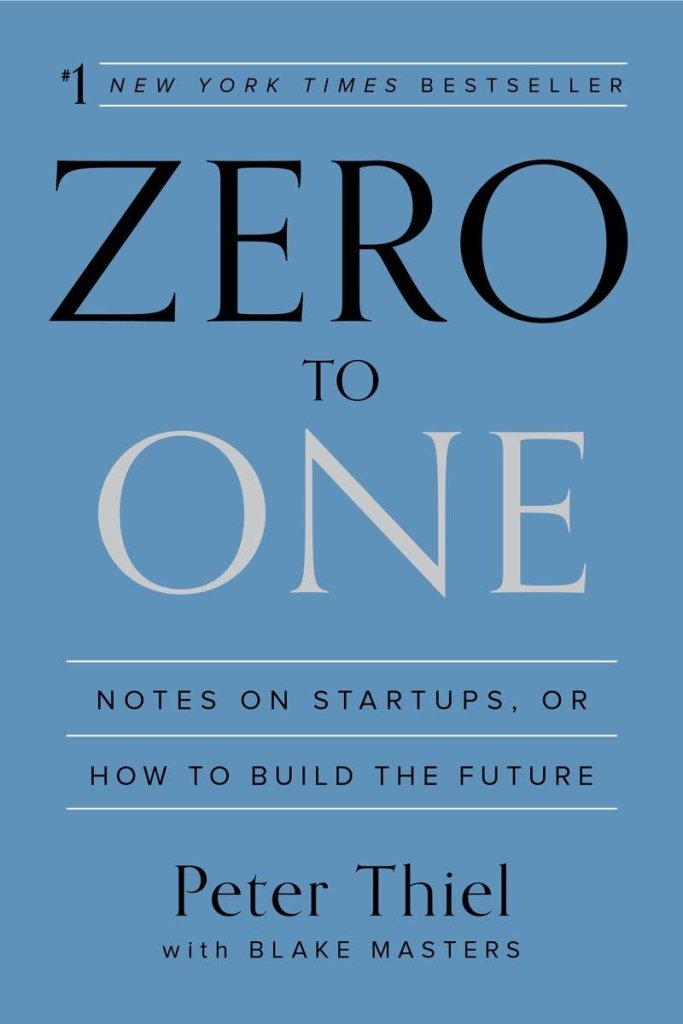
Zero to One can be read as a sustained attempt to isolate what “newness” means when it is treated as an object of practical reason rather than as a decorative label for novelty. Its governing problem-space concerns how a finite agent, acting under uncertainty and inside institutions oriented toward repetition, can nonetheless form determinate commitments that genuinely increase the space of human capability. The book’s distinctive value lies in the way it binds together, within a compact architecture, a metaphysics of technological change, a theory of firm-formation, and a discipline of judgment about the future—while continually testing each component against the others. As revised lecture-derived prose, it also exposes the ideational costs and gains of translating situated pedagogical claims into general theses.
The outer frame already conditions how the work asks to be read. The copyright and production apparatus places the text within a contemporary commercial publishing ecology, with explicit attribution of design, graphics, and illustration labor. That material is not decorative: it quietly reiterates one of the book’s recurring commitments, namely that value creation is rarely the simple emanation of an isolated “idea,” and that realization is mediated by craft, coordination, and presentation. Yet the more decisive paratext is the preface’s account of origin. The book stems from a course about startups taught by Peter Thiel at Stanford in 2012; Blake Masters, then a student, took detailed class notes that circulated beyond the campus; Thiel reports that he then worked with Masters to revise the notes for a wider audience. This sequence matters analytically because it installs a structural doubleness into the voice of the book. The explicit first-person register—Thiel’s “I” that recounts interview practice, investment experience, and contrarian opinions—presents itself as authorial. At the same time, the declared mediation by student notes and later revision introduces a layer in which the “I” functions as a stabilized persona, curated from an event of teaching. The text therefore belongs neither to spontaneous lecture nor to fully autonomous treatise. It occupies an intermediate form: a system of claims that retains the urgency and compressive style of classroom propositions while acquiring the editorial coherence of a book.
That hybrid form shapes the method. The work proceeds through definitional contrasts, recurring questions, and strategic exempla. It repeatedly returns to a small set of terms—future, technology, progress, competition, monopoly, secrets, plans, foundations, distribution, power laws, teams, machines, energy, founders—and thickens them by reintroducing each term under new constraints. A reader who approaches it as a linear accumulation of business advice will miss the more systematic movement: earlier categories are repeatedly re-specified by later ones, and the text places pressure on its own initial simplifications. In that sense, its unity is closer to an integrated argumentative field than to a sequence of independent lessons.
The first conceptual initiative is the book’s insistence that the future is a proper object of thought, while also being an object that resists passive extrapolation. Thiel’s opening gesture in the first chapter describes a question he uses in interviews: “What important truth do very few people agree with you on?” The function of this question is not merely rhetorical. It is introduced as a test of intellectual independence, and then immediately bound to the theme of futurity: if the future were simply a predictable extension of present trends, courage and originality would be ornamental; the labor of judgment could be replaced by consensus forecasting. The book’s early move is to deny that substitution. It presents the future as near at hand in temporal distance, yet genuinely open in its content. This stance already contains an internal friction that the work will manage rather than resolve: it demands determinate commitments about what is coming while rejecting the authority of prevailing agreement.
The book’s concept of technology stabilizes the first axis of this problem-space. In the preface, technology is described in explicitly capacity-oriented terms: it enables doing more with less and rewrites what is possible. This is not a narrow definition tied to computers; it is a definition of technology as transformative capability. The crucial effect of this definition is that “progress” becomes legible as an increase of capability rather than as mere increase of scale. From that point, the book introduces an organizing distinction that it will repeatedly revisit: a difference between copying what already works (which it associates with moving from “1 to n”) and creating something genuinely new (associated with “0 to 1”). The distinction is initially presented with an almost mathematical clarity. Yet its analytical function is subtler: it supplies the text with a criterion of novelty that can be applied to firms, products, and entire economies, and it supplies a way to treat innovation as a discontinuity rather than as an incremental curve.
Once installed, this distinction begins to reorganize the book’s treatment of globalization and technological change. In the early chapters, globalization is associated with spreading existing forms across space, while technology is associated with altering the form itself. The text’s early diagnosis of “stagnation” depends on this separation: an economy can feel dynamic, even frenetic, while remaining largely committed to diffusion and optimization rather than to creation. This produces a methodological wager that governs the rest of the work: the book assumes that the deepest explanations of economic outcomes depend less on the intensity of competition within given categories than on whether a category itself has been transformed through new capability. That wager will later collide with other commitments—especially when the book turns to distribution, sales, and branding, domains that concern diffusion, persuasion, and adoption. The work’s internal architecture forces these domains to meet under one roof, and that cohabitation generates some of its most instructive tensions.
The second major initiative is the revaluation of competition. Here the book’s method becomes particularly visible: it treats a commonplace moral and economic picture—competition as the engine of improvement—and subjects it to a reversal in evaluative emphasis. Across the chapters titled “All Happy Companies Are Different” and “The Ideology of Competition,” the text develops a claim that competition often impoverishes thought: it captures attention, narrows strategic imagination to relative positioning, and can lead firms to imitate one another until they converge on thin margins. The book insists that firms frequently describe their activity as “competitive” even when their real practice is a species of mutual fixation, akin to conflict rather than to productive differentiation. The conceptual device here is the contrast between competition as a social relation (rivalry) and business as value creation. Thiel’s argument repeatedly returns to the point that profits signal something more than operational success: they signal differentiation that has escaped immediate replicability.
This is where the book’s headline provocation—its defense of monopoly—enters as a structural hinge. Monopoly is not introduced primarily as a legal category; it appears as a functional category describing durable advantage grounded in something difficult to copy. In this register, monopoly is treated as the result of successful creation and as a condition for sustained innovation, because it allegedly provides the surplus that funds further development. The work thereby composes a triangle: innovation yields differentiation; differentiation yields monopoly-like position; monopoly-like position yields the financial slack that can sustain long-term projects. That triangle is one of the book’s central integrative devices. It allows the text to unify a normative claim (that society benefits from genuine innovation) with a descriptive claim (that profits tend to accrue where imitation is constrained) and a strategic claim (that entrepreneurs should seek defensible uniqueness).
Yet the triangle also introduces a pressure on the book’s own category of “progress.” If monopoly is the economic form most congruent with innovation, then the diffusion of technological capability—the very phenomenon that might count as “progress” at the level of society—becomes conceptually dependent on institutions that restrict diffusion at the level of the firm. The book does not dissolve this tension; it manages it by shifting levels. At the level of the firm, it treats defensibility as rational; at the level of society, it treats the existence of novel capability as beneficial. The reader is left to supply the mediating political economy that would show when these levels harmonize and when they conflict. The work’s choice to bracket that mediation is itself a methodological decision that reveals the book’s intended competence: it is written for agents who must decide under constraints of private action, while still wanting a language that gestures toward public benefit.
The text’s analysis of monopoly is furthered by its account of how durable advantage is constituted. It describes characteristic sources of durability—proprietary technology, network effects, economies of scale, branding—and it treats these sources less as a checklist than as ways of describing the same underlying phenomenon: an asymmetry of replicability. Each source is a different mechanism by which copying becomes costly or slow. The analytical interest lies in how the book uses these mechanisms to refine the earlier “0 to 1” concept. “Newness” becomes insufficient by itself. A novelty that can be instantly replicated collapses into a “1 to n” dynamic at the market level even if it began as “0 to 1” at the design level. In other words, the text retroactively narrows its initial criterion: the relevant novelty is novelty that can persist, and persistence is mediated by structure—technical, social, financial, and symbolic.
This is one of the book’s recurring moves: an early concept is introduced with apparent simplicity, and later chapters impose additional determinations that change what the concept can mean. “Technology,” introduced as transformative capability, later becomes inseparable from organization and distribution. “Uniqueness,” introduced as a creative property, later becomes inseparable from defensibility. “Progress,” introduced as “0 to 1,” later becomes inseparable from planning, capital allocation, and human–machine division of labor. The work’s unity is precisely this repeated retroactive requalification.
The chapter “Party Like It’s 1999” supplies another layer of method, using the dot-com era as a scene of analytical error. The text formulates “lessons” from that period that function as negative constraints on startup thinking: it treats certain slogans and habits—especially those associated with exuberant growth narratives, superficial metrics, and ungrounded optimism—as sources of systematic misjudgment. What matters for the overall system is how this historical episode disciplines the book’s later claim that entrepreneurs must think independently. Independence, in the book’s own practice, is not romantic spontaneity; it is the capacity to hold a determinate picture of reality even when an atmosphere rewards conformity. The dot-com chapter therefore reinforces the interview question from the opening by giving it an empirical theater: the test of contrarian judgment is not mere disagreement; it is disagreement that remains accountable to what is real.
This accountability requirement becomes explicit in the book’s treatment of planning and optimism in “You Are Not a Lottery Ticket.” The title itself indicates a refusal of pure chance as an explanatory or justificatory frame for entrepreneurial success. The chapter constructs a typology of attitudes toward the future, distinguishing forms of optimism and pessimism, and further distinguishing “definite” from “indefinite” orientations. Here the text is unusually analytical in its structure: it is not simply describing psychological dispositions; it is describing epistemic postures—ways of relating to what one does not yet know. “Definite optimism,” as the book presents it, involves confidence paired with planfulness; “indefinite optimism” involves confidence without specification; the parallel pessimisms invert the valence while retaining the distinction between plan and vagueness. The systematic function of this typology is to position startups as institutions of definiteness: they are supposed to convert an open future into an articulated project.
But this raises a new internal friction. The book’s earlier emphasis on contrarian truth and discovery of “secrets” suggests that the decisive insight is something few agree with, something hidden in the present. The planning chapter, by contrast, emphasizes design, intention, and projection. Discovery and design have different temporal logics. Discovery implies that the future is already seeded in the present as an overlooked fact; design implies that the future is brought into being through commitment that is not simply read off from present facts. The book does not explicitly theorize this difference, yet its architecture forces both logics into cooperation. A careful reading sees a division of labor emerge across the work: “secrets” name the epistemic condition for beginning; planning names the practical condition for continuing; monopoly names the economic condition for enduring. The text thereby converts a potential contradiction into a staged process.
The chapter “Secrets” intensifies the discovery side of that process and in doing so clarifies the book’s view of knowledge. A secret, in the book’s usage, is not merely private information; it is a truth about how the world works that remains unrecognized or under-acknowledged. The chapter’s guiding question—formulated as an invitation to ask what important truth remains hidden—recasts entrepreneurship as a kind of applied epistemology. It treats the entrepreneur as someone who sees what others do not yet see, and who can act on that vision. Yet even here, the text is careful to place limits on romantic revelation. It repeatedly ties the existence of secrets to concrete domains—technological possibilities, market structures, institutional rigidities—so that “secret” becomes a disciplined term for neglected realities rather than a license for arbitrary contrarianism. The epistemic posture recommended is therefore doubly constrained: it demands independence from consensus, and it demands responsibility to the structure of the world.
This is also the point at which the book’s lecture-origin becomes ideationally salient again. As revised notes, the prose often moves by compressed assertions that invite expansion. “Secrets” as a concept gains force precisely because it sits at a boundary between pedagogy and treatise: in the classroom, it can function as a prompt for students to generate hypotheses; in the book, it functions as a general thesis about where innovation comes from. The revision from notes to publication thereby changes the responsibility of the term. What was once an educational provocation becomes a claim that must withstand scrutiny across contexts. The book meets that new responsibility by repeatedly linking the “secret” motif to the monopoly motif: a secret that can be acted on becomes, under favorable conditions, a defensible position. The conceptual unity is reinforced: epistemic asymmetry becomes economic asymmetry.
“Follow the Money” extends this unity by imposing a statistical constraint on startup narratives. The text’s emphasis on the “power law” in venture outcomes functions as a corrective to the temptation to treat the startup world as a domain of evenly distributed chances. Here, the book reframes rationality. If outcomes follow a heavy-tailed distribution, then diversified mediocrity becomes structurally mismatched to the domain, and judgment must focus on exceptional possibilities. The power-law motif transforms the earlier refusal of lottery thinking. The refusal is not a denial that chance exists; it is a demand that one take seriously the shape of the domain in which one acts. The book uses this domain-shape to motivate concentrated bets, careful selection, and attention to outliers.
But again, the architecture introduces tension. If outcomes are power-law distributed, then even excellent planning cannot guarantee success; the domain itself amplifies variance. The book’s insistence on definiteness therefore stands in permanent tension with its statistical realism. This tension is productive. It prevents the book from collapsing into naive voluntarism, and it prevents it from collapsing into fatalism. The work’s practical analysis of action thus becomes a balancing act: one must plan as though agency matters, while also allocating attention as though distributional facts constrain what planning can achieve.
The chapters “Foundations” and “The Mechanics of Mafia” push the system from epistemology and macro-structure into institutional formation. “Foundations” treats early decisions as path-determining. It portrays the startup’s initial structure—ownership, roles, governance, and the choice of what to build first—as a set of commitments that later become costly to revise. This resonates with the book’s broader theme of definiteness: to found is to commit, and to commit is to close off alternatives. The work thereby gives a metaphysical weight to organizational beginnings. Yet it also introduces an ethical and political ambiguity: the same rigidity that enables coherence can harden into dysfunction. The book’s focus remains on the rationality of early coherence, while the shadow possibility of coercive entrenchment remains present as an unthematized counterpart. The reader is invited to notice that the text’s admiration for decisive structure has an oblique affinity with its admiration for monopoly; both are forms of durable closure.
“The Mechanics of Mafia” adds a sociological layer by treating teams and culture as constitutive rather than incidental. The very title alludes to the PayPal-associated network of founders and executives and uses that history to argue that a startup is shaped by the internal relations among its members. The book characterizes culture as something that emerges from shared work and shared commitments, and it implies that a coherent internal world can become a competitive advantage. This again transforms earlier motifs. “Secrets” begin to appear as socially distributed within a group; “definiteness” appears as something that must be collectively sustained; “monopoly” begins to look less like a purely external market position and more like a reflection of internal cohesion that enables long-term execution. The text thereby tightens the link between epistemic and social order.
At this stage, a reader might expect the system to remain primarily “creative” and “internal,” emphasizing invention, teams, and defensibility. The book’s architecture then performs one of its most important redistributions of responsibility: it makes distribution and sales central. “If You Build It, Will They Come?” refuses the fantasy that superior products automatically find users. The book describes sales as pervasive, even when denied, and treats distribution as an essential component of value realization. This move is consequential because it forces the “0 to 1” concept to confront a domain that resembles “1 to n”: persuasion, channels, marketing, and adoption are often incremental and repetitive. The text absorbs this apparent mismatch by reinterpreting distribution as a technology of realization. A novel capability that remains unused is, on the book’s own terms, an incomplete creation. The “act of creation” therefore expands: it includes the act of bringing others into relation with what has been made.
This expansion generates a tension that the book manages by shifting the meaning of “technology.” In the preface and early chapters, technology is framed as miraculous capability. In the distribution chapter, the “miracle” is insufficient. The real world contains frictions: attention is scarce, trust is costly, channels have gatekeepers, and adoption follows its own dynamics. The book does not abandon its earlier celebration of invention; it subjects invention to an additional condition of actuality. The result is a more mature conception of innovation as a compound: invention plus organization plus dissemination. One can also see the editorial logic at work. A lecture about startups aimed at students can emphasize creative insight; a book aimed at a broader audience must incorporate the prosaic but decisive facts of selling. The revision from course notes to publication thus coincides with a conceptual maturation: the “idea” is demoted from sovereign cause to partial element in a larger causal structure.
The chapter “Man and Machine” introduces yet another requalification, this time concerning the role of computation. The book treats computers as complements to human capacities in many cases and warns against simplistic substitution narratives. It suggests that competitive pressure can push humans into activities where they are least advantaged relative to machines, while more rational design places machines and humans in roles that amplify what each does well. This argument interacts in complex ways with the earlier themes. It adds a normative criterion for “progress”: progress involves reassigning tasks and reconstructing the division of labor. It also complicates the book’s valorization of monopoly. If machine intelligence alters the landscape of defensibility, then durable advantage depends even more on organizational and social factors, because purely technical edges may erode faster. The text does not explicitly draw out all implications, yet the placement of this chapter within the whole invites the inference that “defensible technology” is inseparable from a defensible human organization and from a strategic understanding of automation.
“Seeing Green” functions as a retrospective critique of an investment and entrepreneurial wave centered on clean technology. The chapter is significant for two reasons. First, it provides a case in which the book’s central categories can be tested against failure. Second, it introduces a more formal evaluative apparatus: the text enumerates a set of core questions that any business must answer, ranging from the engineering and timing questions through monopoly, people, distribution, durability, and secrecy. Even without reproducing the list as a schematic, one can see its systemic role: it gathers the book’s dispersed motifs into a compact evaluative instrument. Earlier, the reader encountered these motifs as separate chapters—technology, monopoly, teams, distribution, secrets, durability. Here they reappear as criteria that must be jointly satisfied. The chapter thus performs a kind of internal synthesis. It also reveals how the book conceives the unity of its own method: entrepreneurship is a discipline of answering interlocking questions, each of which constrains and interprets the others.
Yet this merger also brings into view an unresolved friction: the book’s desire for principled evaluation and its awareness of domain variance. A checklist-like instrument promises rational assessment, but the power-law motif and the critique of lottery thinking both imply that uncertainty and skewed outcomes remain structurally present. The chapter navigates this by implicitly positioning the questions as necessary conditions rather than as a mechanical generator of success. The competence demanded is therefore judgment under constraints, where criteria structure attention and reasoning but do not eliminate contingency.
“The Founder’s Paradox” closes the numbered chapter sequence by turning the analysis back to individuals. The paradox, as the text presents it, concerns the relation between extreme founder traits and company success: the same intensity that can enable singular achievement can produce instability, conflict, or irrationality. Placed near the end, this chapter retroactively reframes much that came before. The early image of the entrepreneur as a clear-sighted contrarian is complicated by an account of founders as psychologically and socially atypical. The earlier theme of definiteness is complicated by the risk that definiteness becomes personal domination or brittle obsession. The earlier theme of culture and team is complicated by the founder’s outsized influence on the social world of the company. In this way, the book’s concluding movement resists the temptation to end on pure system. It insists that the system is always instantiated in particular human agents whose virtues and pathologies are entangled.
The conclusion, titled “Stagnation or Singularity?”, returns explicitly to the book’s opening concerns about the future, now with a widened horizon. It invokes a framework (attributed in the text to philosopher Nick Bostrom) that sketches possible large-scale trajectories for humanity, including scenarios of stability, collapse, extinction, and radical transformation. The conclusion’s function is less predictive than orienting: it situates startup-building and technological progress within a broader question about whether the future will differ meaningfully from the present. The earlier distinction between globalization and technology returns with a heightened existential coloring. “Stagnation” is no longer merely an economic diagnosis; it becomes a condition of historical imagination. “Singularity,” treated cautiously, marks the possibility of qualitative discontinuity at the level of civilization.
Here the book’s internal tensions achieve a kind of final configuration. The text maintains its commitment to agency and definiteness: it continues to present technological creation as the human capacity to “work miracles,” to rewrite what is possible. It also maintains its recognition of uncertainty: even farsighted founders, it says, face limits on planning horizons, and the future remains open in ways that no plan can fully domesticate. The work stabilizes these pressures by distributing them across levels. At the micro-level, founders and teams must act with planful definiteness, answer interlocking questions, and construct durable advantage through real mechanisms. At the macro-level, humanity faces structural possibilities that exceed any single firm, and the book treats technological progress as one of the few levers that can shift the overall trajectory away from mere repetition.
As a whole, the book demands a specific reading competence. It asks for patience with compressed claims that often function as prompts for further inference. It asks for tolerance of unresolved antinomies, especially between agency and variance, openness and closure, diffusion and defensibility. It asks for sensitivity to level-shifts: the text moves quickly from individual judgment to firm structure to civilizational futures, and its arguments often depend on seeing how a claim changes meaning when carried across those levels. It also asks for an ability to read an edited pedagogical artifact as a systematic object: one must track how motifs recur with altered valence, how later syntheses retroactively qualify earlier enthusiasm, and how the book’s revision-history—lecture, notes, collaboration, publication—quietly shapes the authority and limits of its voice.
 Simon Gros
Leave a comment