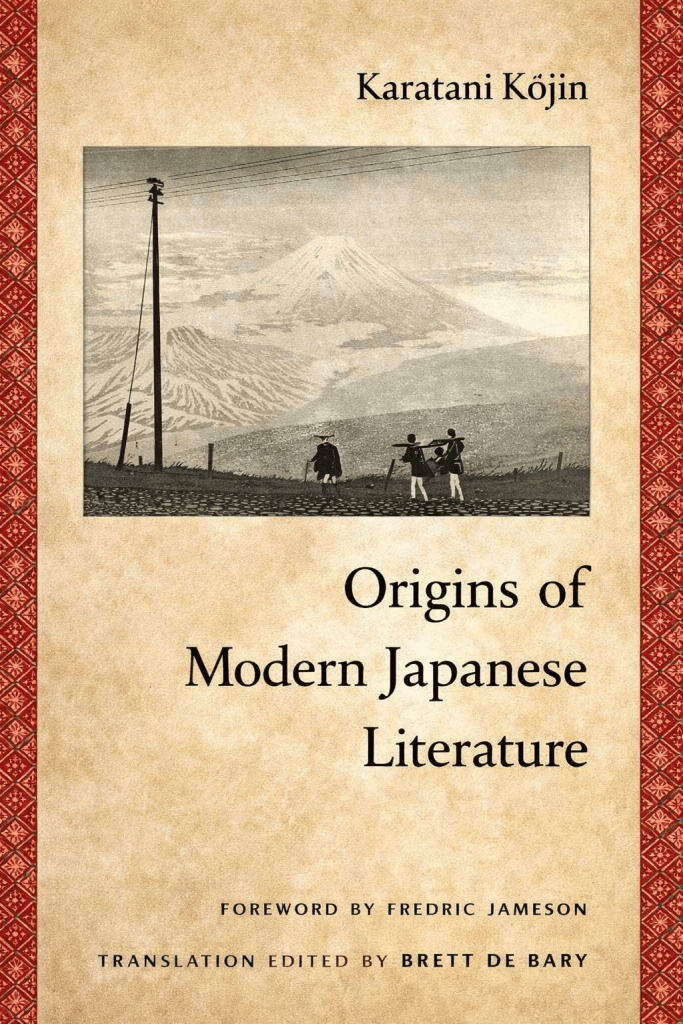
Origins of Modern Japanese Literature analyses the historical constitution of “modern literature” by treating it as an institutional and epistemic formation whose apparent self-evidence is produced through determinate operations of perception, language, and social organization. Karatani’s distinctive contribution is in a method that reconstructs “origins” as effects of inversion: the modern system retroactively posits the very past it claims to discover, naturalizing contingent techniques (of representation, narration, schooling, medicalization, national language) into seemingly timeless categories. The book thereby re-describes modern Japanese literature as a privileged site where modernity’s universal pretensions become legible as historically local procedures, whose abstractions—landscape, interiority, confession, disease, childhood, depth—function as apparatuses of subject-formation and state mediation, while simultaneously generating internal resistances that re-enter the system as its “pure” forms.
The framing already signals that the work’s “aboutness” exceeds literary history in the ordinary sense. The prefatory discourse (in the Anglophone presentation) teaches the reader how to read the ensuing analyses as schemata that are at once descriptive and constructive: an account of production conditions and form-problems that invites projection, as if theory itself were a device for generating an absent text—an intelligible configuration of a social reality—rather than a commentary that follows accomplished masterpieces. The foreword’s insistence on inversion (tento) names the core operator: the historical becomes natural, and continuity appears as a fabricated depth, including the felt evidence of a past that seems to have always already been there. Modernity’s scars—subject/object, scientific objectivity, the novel, landscape, disease, children, depth—flare into visibility only by way of this operator, which is simultaneously conceptual and institutional, a logic and a mechanism.
Yet the work’s own self-consciousness about framing is doubled by its internal after-reflections. In the later afterword addressed to an English readership, Karatani cautions against the very seduction implied by the title: the attraction of “origins” as if they were stable points of departure. He clarifies that what is sought is not a foundational substance but a reversible problematic, a field in which “modern Japanese literature” is itself one moment of a more general procedure: the formation of “literature” as a modern institution, and the simultaneous fabrication of the subjective interior that literature seems merely to express. Here “origin” becomes a methodological lure whose function is diagnostic: it reveals how a system posits its own genesis by converting the contingency of its emergence into the necessity of its history. In that sense the book’s outer frame is part of its argument: it does not merely present findings; it stages the reader’s susceptibility to the very inversions it analyzes.
The composition sequence, as the work itself indicates, is important because the argument is not a linear accretion of theses but a deliberate circulation through problems whose recurrence is itself a symptom. The analyses began as essays produced within the intellectual pressures of late twentieth-century Japanese debate and within Karatani’s own encounter with theory as a foreign language—an encounter that made “distance” into a method, akin to a phenomenological bracketing that suspends inherited obviousness so that the system of obviousness can appear. The later additions—most notably the essay on the extinction of genre—do not simply append a further chapter; they re-situate the whole enterprise by returning to the work’s initial figure (Sōseki) under a reversed aspect, thus converting the book’s beginning into a displaced beginning: a start that becomes intelligible only after the end has been reached. The effect is that of a constructed circle whose closure is also a critique of closure, since any closure risks being reabsorbed as another perspectival configuration, another manufactured transparency.
From within this frame, the book’s procedure can be characterized as a sequence of conceptual extractions from seemingly empirical cultural phenomena. Each extraction isolates a category that modern readers routinely treat as given—landscape, interiority, confession, disease, childhood, depth—and demonstrates its historicity as system. The insistence on system is decisive: what is targeted is not an ideology understood as a set of explicit doctrines, but an ensemble of practices and perceptual techniques that produce the conditions under which doctrines become legible and persuasive. Thus the book’s evidentiary texture is heterogeneous in a principled way: it moves through literary texts, debates, reforms in writing and education, shifts in medical discourse, and transformations in visuality, with the aim of reconstructing the configuration that makes “modern literature” possible as a space in which the subject can appear as interior and the world can appear as landscape, object, nation, and history.
The inaugural movement begins with an apparent paradox: the book opens by treating Sōseki as a theorist, thereby placing the origin of modern Japanese literature inside an explicit attempt to conceptualize “literature” as such. This beginning is already a displacement of ordinary genealogies. Rather than starting from the emergence of a novelistic corpus and then abstracting a concept from it, Karatani begins from the conceptual ambition to define the literary, and reads that ambition as symptomatic of an institutional transformation. “Modern literature” is thereby grasped as a regime in which literature becomes an object for theory, and theory becomes an internal component of literature’s self-legitimation. The book thus positions its own discourse—its theoretical density—within the very field it describes, refusing the comfort of an external metalanguage. The reader is placed in a predicament: to understand modern literature, one must already be subject to its categories; to critique those categories, one must practice a discourse that risks reproducing their most refined forms.
What then becomes visible is the decisive role of language reforms and representational techniques in producing the sense of reality and self that modern literature presupposes. The question of genbun itchi—often glossed as the unification of speech and writing—appears here as a privileged site where the creation of a new literary language is mistaken for a naturalization of the colloquial. Karatani’s insistence is that genbun itchi cannot be reduced to transcription; it is an invention that produces readability and difficulty in a new key, generating a disciplined “naturalness” that must be learned and that initially resists the very audience in whose name it is justified. The point is methodological: one must treat “ease of reading” as a historical artifact, an effect of schooling and standardization, rather than as an intrinsic property of a linguistic form. Even defenses of premodern styles against the alleged accessibility of the new style become evidence that the system is being negotiated, and that “naturalness” is itself a stake in institutional struggle.
At the same time, the emergence of a national language and of “national literature” is not approached as a benign cultural consolidation. It is grasped as an apparatus that produces a homogeneous space in which subjects can be counted, addressed, and educated as members of a nation. The “literary” is thereby bound to the state form without being reducible to propaganda or official ideology: the binding occurs at the level of techniques that render a world commensurable. Here the book’s style—its refusal to segregate aesthetic questions from institutional ones—enacts its claim that the aesthetic is one of the privileged sites where the state’s abstraction becomes livable, precisely because it can be misrecognized as experience.
The “discovery of landscape” then functions as a paradigmatic case of inversion. Landscape appears, in common sense, as what has always been there: nature as visible object. Karatani’s reconstruction reverses that naïveté. Landscape is treated as a modern form in which the world becomes legible as scene, and scene becomes the correlate of an interior observer. The crucial point is that landscape is not merely a theme in poems or novels; it is a perceptual organization that presupposes a subject-object dichotomy, and that retroactively projects itself into the past as if earlier writings were “missing” landscape rather than operating with different configurations of worldhood. The evidentiary strategy is characteristic: rather than proving the thesis by an inventory of descriptive passages, Karatani tracks how the category emerges through institutional failures and social displacements, where political energies that cannot realize themselves in collective form are reorganized into inwardness, and inwardness finds its “objective” mirror in nature as landscape. The transformation is thus simultaneously libidinal, political, and epistemic; it is readable in literature because literature becomes one of the privileged sites where the reorganization is practiced and stabilized.
This movement immediately generates a tension that the book refuses to resolve into a simple antagonism between “West” and “Japan.” The category of landscape is indeed implicated in Western modernity and its representational regimes, yet Karatani’s procedure avoids a derivative narrative in which Japan merely receives Western forms. The emphasis falls on the way a modern system, once established, creates the illusion of its own universality by producing the very criteria that define what counts as modern. In this sense the colonizing force is not an external content alone but the internalization of a form: the adoption of a configuration that makes certain distinctions appear self-evident—subject/object, interior/exterior, nature/culture—and that then legitimates itself by narrating its own emergence as progress.
The “discovery of interiority” is therefore not a psychological claim about people suddenly becoming deeper. It is a formal claim about the production of “depth” as a perspectival effect. Here Karatani’s analyses become explicitly transmedial: he draws on the history of visual perspective in order to clarify how literary realism and modern subjectivity are bound to techniques of projection. Depth, in this account, is neither a natural feature of consciousness nor a direct imprint of social suffering; it is a configuration that produces the possibility of identifying with characters as if one could “enter” the scene, as if the text extended unbroken toward the reader. The discomfort modern readers feel before premodern works is treated as evidence of a missing configuration, not of a missing humanity. The book thereby dislodges moralizing historicisms that treat earlier literature as immature. The evaluative consequence is stringent: the presence of depth cannot serve as a criterion of merit, since depth itself is a historical product of a specific system of representation.
At this juncture, the analyses of confession and of the so-called I-novel (shishōsetsu) sharpen the book’s central claim: modernity produces the illusion of interiority by instituting practices that demand interiority as their condition of truth. Confession appears as a moral technology that requires the subject to posit an inner core whose exposure becomes the criterion of authenticity. Yet this authenticity is not merely personal; it is systemic. Confession, once institutionalized as literary virtue, becomes a mechanism through which literature defines its purity by renouncing “construction,” plot, and overt mediation, thereby presenting itself as immediate access to self. The paradox, which the book treats as a structural symptom rather than a cultural idiosyncrasy, is that this renunciation becomes the defining mark of “pure literature” (junbungaku). The aversion to construction is thus internal to the modern institution of literature; it is one of the ways the institution reproduces itself by generating an internal opposition that appears to resist it while in fact revitalizing it.
The book’s attention to literary debates is crucial here because debates externalize a system’s implicit constraints. A debate does not merely exchange arguments; it constructs the very “problem” that the arguments seem to address, because the oppositional form cuts away the interwoven differences that constituted the situation prior to the debate’s crystallization. Hence Karatani’s repeated insistence on reading debates as symptoms: their reversals, their apparent ironies, their retrospective winners and losers, are not accidental but follow from the way an opposition produces its own memory and erases its own conditions. When later literary history proclaims that an “evident loser” nevertheless dominates the future, the book treats this as a clue to the operation of inversion within the institutional archive.
The culminating conceptual operator for this whole line is “depth” itself, which becomes the abstract pattern governing the production of landscape, interiority, disease, childhood, and even the intelligibility of Marx and Freud. Karatani’s analysis of depth has the character of a critique of metaphysics conducted through cultural history. Depth functions as a schema that converts spatial arrangements into temporal narratives, projecting stratification into the past as if history were naturally layered. The book’s procedure is to show how even radical critiques can be recuperated by this schema: Marx and Freud are routinely celebrated as discoverers of substrata, yet Karatani reconstructs their critical force as a dismantling of the very perspectival configuration that makes substratum-thinking possible. What they attend to, in this reconstruction, is the surface as the site where excluded meanings are configured, not a hidden basement where truth resides. The irony is systemic: modernity cannot easily represent a critique of depth except as a deeper depth.
This is also why the analyses of sickness are structurally indispensable and not an ornamental excursus. Disease appears, in the modern imaginary, as a purely physical fact that medical science neutrally investigates. Karatani’s account treats this neutrality as an ideological accomplishment. The medicalization of tuberculosis, the shift toward bacteriology and “objective” causality, and the literary romanticization of illness are not presented as separable domains; they form a configuration in which suffering becomes meaningful, and meaning becomes a mode of subject-formation. Disease is “infected” with the literary in the strict sense that the very idea of an objective physical reality, purified of ideology, is itself part of the ideological constellation modernity installs. The literary does not merely represent illness; it participates in constituting “illness” as a privileged site where interior depth can be read off from bodily decay, and where the subject can claim authenticity through suffering.
The analysis of “the child” then extends the same logic into an even more stubbornly self-evident domain. Children have always existed; “the child” as an objectified category does not. Karatani’s argument proceeds by mobilizing precisely the kind of evidence that usually guarantees obviousness—pedagogical practices, games, folktales, school reforms—and converting it into evidence of historicity. The decisive claim is that the modern division between child and adult is not a biological given but a structural product, bound to the division between play and labor and to the reorganization of society under capitalism and the nation-state, while retaining its own specificity that resists reduction to economic determinism. The child becomes comparable to landscape: a modern discovery that appears as the belated recognition of what was always there, while actually naming a new system of perception and governance. Rousseau’s child, read carefully, is grasped as a methodological concept—an instrument for critique that works backward through accumulated inversions—yet modern pedagogy converts this instrument into a substantive object and thereby intensifies the very problems it claims to solve. The chapter’s reflections on psychology and applied science sharpen the book’s broader thesis about modern knowledge: “pure” inquiry tends toward application precisely because it is structurally without intrinsic ends, and thus the child uprooted from its lifeworld becomes a manipulable abstraction.
What makes this analysis decisive for the overall architecture is the way it binds literature to the school system without collapsing the one into the other. Modern literature becomes generalized after 1900 on the basis of the school system’s consolidation, which produces the “schoolchild” as a new human type and thereby creates the audience and the demand for children’s magazines and children’s literature. Critiques that focus on the moral content of education miss the system’s signifying function: compulsory schooling, paired historically with conscription, operates as an apparatus that reorganizes life by uprooting children from concrete productive relations and re-inserting them into homogeneous age cohorts, thereby manufacturing the very abstraction “the child” whose protection later becomes an ethical fetish. In this perspective, even humanistic devotion to the “true child” risks functioning as a dictatorship of innocence: a utopian pedagogy that remains unaware of its own systemic violence because it experiences itself as care.
At this point the book’s parts have begun to merge into a single figure: a modern perspectival configuration that produces depth and then distributes it across cultural domains as if each were independently discovered. Landscape becomes depth externalized, interiority becomes depth internalized, confession becomes depth moralized, disease becomes depth somatized, childhood becomes depth temporalized as development, and literary history becomes depth narrativized as progress. Yet the book refuses to let this figure settle into a single master concept. Instead it stages the internal displacements through which the system reproduces itself: each “discovery” generates an internal resistance that appears to oppose the system yet becomes one of its privileged modes of continuation.
This is why the final analytic movement—“the power to construct”—is both culmination and displacement. It culminates because it renders explicit the schema that has been tacitly at work: the production of depth through techniques of drafting and projection, and the conversion of those techniques into common sense. It displaces because it reorients the reader from thematic “discoveries” toward the meta-problem of how problems are constructed. The initial discussion of premodern literature’s alleged lack of depth is re-specified: depth is an effect of a particular perspectival configuration, comparable to linear perspective in painting, whose history is mathematical and technical as much as aesthetic. Hence the question becomes: by what means was the modern feeling of “entering” a scene produced, and how did that feeling become the criterion by which readers judge reality, identification, and literary value?
In the analysis of debates over “submerged ideals,” Karatani locates a dramatic outcropping of a broader historical shift: the transformation of juxtaposed differences into stratified schemas organized around a vanishing point. The debate is crucial because it shows how “ideals” can mean fundamentally different things depending on the configuration: on one side, ideals as meanings that can be seen through the text, while the text itself retains inexhaustible permutations; on the other, ideals as the organizing principle that renders texts transparent as expressions of a spirit of the age, thus enabling a temporalized, developmental narrative of literature. The point is not to adjudicate who is right; it is to show how the debate’s form produces the opposition and thereby constitutes the problem-space within which modern literature can be instituted as a coherent historical object. Here Karatani’s methodological severity becomes visible: he refuses the temptation to counter one perspective with an “anti-modern” one, and instead calls attention to the schema that makes perspective itself appear natural.
The second debate, over the “novel without plot,” pushes the analysis into the late modern moment where the aversion to construction becomes explicit. Plot is revealed as a name for perspectival configuration itself: a technique of assembling events into a coherent architecture that presupposes a vanishing point, a transcendental organization of meaning. The apparent opposition between fragmenting and constructing is shown to be unstable because the same word “plot” covers subtly different senses, and the debate’s oppositional form forces the participants into an antagonism that may conceal covert collusion at the level of shared constraints. The debate’s later reversal—where the seeming loser becomes the historical victor—is then legible as the predictable effect of symptom-formation: the institution needs the aversion to construction as one of its mechanisms of purity, and the debate supplies the archive through which that aversion can be canonized.
This culminates in the book’s most demanding conceptual gesture: the critique of stratification as a metaphysical habit that captures even its own critiques. The analysis of Freud becomes exemplary: once madness is homogenized as “human,” spatial exclusion yields to developmental stratification, and psychoanalysis, insofar as it becomes cure, risks reintroducing a teleological integration that belongs to the very metaphysics it might have disrupted. Freud’s actual innovation, in Karatani’s reconstruction, lies in his attention to surface configurations—dreams, associations—through which exclusions organize themselves. Marx, similarly, becomes legible as dissolving the oppositions that perspective produces, even while later Marxism can be absorbed into the very plot-logic it seeks to realize. The reader is thus placed before an unsettling conclusion: modernity’s perspectival configuration is so tenacious that it can convert critiques of depth into new depths, and critiques of plot into new plots.
If the book ended here, it might still risk being read as a closed system: an elegant theory of modernity’s perspectival production. The later framing materials work against that closure. The foreword already warns that even the minimal figure of depth versus surface might plunge the reader back into the episteme it seeks to analyze, because the very act of naming the schema can become a new vanishing point from which everything is rendered transparent. The afterword to the English edition intensifies this warning by re-problematizing “origins” themselves, insisting on the reversibility of the problem-field, and thereby refusing the comfort of a final explanatory altitude.
In this context the added essay on the extinction of genre assumes a structural role that retrospectively reorganizes the whole. The work that begins with Sōseki as theorist is brought, by this addition, to a point where Sōseki reappears under the sign of practice and genre, as if the initial theoretical beginning were itself a product of the institution’s later need to conceptualize itself. The trajectory thus loops: theory emerges as a symptom of institutional consolidation; institutional consolidation produces the categories through which theory can appear necessary; and the genre-question names the moment where the institution’s forms no longer stabilize, where literature’s internal differentiation—its genres—ceases to function as a reliable mediator between social experience and aesthetic form. The “extinction” here should be read neither as a simple empirical observation nor as an apocalyptic flourish. It functions as a limit-concept: it indicates that the modern institution of literature, which the book has traced through its constitutive inversions, arrives at a point where its own mechanisms of self-differentiation become unreadable, and where the very categories that once enabled critique risk dissolving into generalized textuality or generalized cultural production.
The book’s internal motion can therefore be described as a sequence in which earlier parts are progressively displaced by later ones, without being annulled. Landscape is initially grasped as a discovery that mirrors interiority; later it is displaced by the more abstract schema of depth, which shows that “landscape” was already an effect of perspectival configuration. Interiority is initially treated as a literary and linguistic production; later it is displaced by the analysis of confession and illness, which show that interiority is stabilized by moral and medical apparatuses that demand inner truth and translate it into readable signs. Childhood is initially legible as a discovery analogous to landscape; later it is displaced by the critique of schooling as apparatus, which shows that childhood’s visibility depends on the production of homogeneous subjects through education and conscription. Finally, the entire sequence is displaced by the analysis of debates and construction, which shows that each domain’s “origin” is bound to the construction of problems through oppositional forms that generate their own archives, their own pasts, their own victors.
This shift is constructive because it refuses a hierarchy of explanations. The book does not simply ascend from empirical observations to conceptual schema; it repeatedly returns from schema to the specificity of cultural forms—debates, reforms, institutions—so that schema itself remains historically endangered. The effect is a deliberate convolution: the reader is compelled to hold together the necessity of systemic explanation with the contingency of historical emergence, and to recognize that modernity’s universals are produced precisely through such oscillations. In this sense the work performs, at the level of method, the tension it describes at the level of content: modernity stabilizes itself by producing abstractions that are usable across domains, while critique attempts to restore the historicity of those abstractions without installing a new transcendental standpoint.
To read Origins of Modern Japanese Literature as a “book about Japanese literature” would therefore miss its governing stake. The object is modernity as a procedure of constitution, and Japan functions as an analytic prism because the visibility of importation, translation, reform, and institutional rebuilding makes the procedure legible in intensified form. Yet the procedure is not assigned to a geographic essence. The work’s polemical force lies in the reversal whereby the reader who begins by observing Japan ends by being observed by Japanese theory, compelled to ask what it would mean to diagnose landscape, interiority, confession, disease, and childhood in a Western context without simply universalizing Western theory as the measure. The book thereby performs a geopolitical inversion that is also an epistemological one: it relocates theoretical authority by demonstrating that modernity’s categories, often treated as Western gifts or Western discoveries, are in fact techniques whose historicity becomes clearer when traced through the discontinuities of a non-Western modernization.
I will end, for now, by clarifying the work’s distinctive contribution in the strict sense. Karatani offers neither a narrative of literary influence nor a sociology of literature that reduces form to external causes. He reconstructs a system of inversions that produce the conditions under which “literature” can appear as literature, “modernity” as modernity, and “origin” as origin. The book’s rigor consists in showing that these conditions are simultaneously perceptual, linguistic, institutional, and conceptual; its historical complexity consists in tracking how each new stabilization generates a resistance that returns as a privileged internal form; its philosophical consequence consists in displacing depth as metaphysical comfort and compelling attention to the surface where configurations are made. If you would like, I can continue from here by unfolding, in the same register, the book’s final recirculations—how the construction debates retroactively reorganize the earlier “discoveries,” and how the added framing materials re-stage the reader’s desire for origins as the last object of critique.
 Simon Gros
Leave a comment