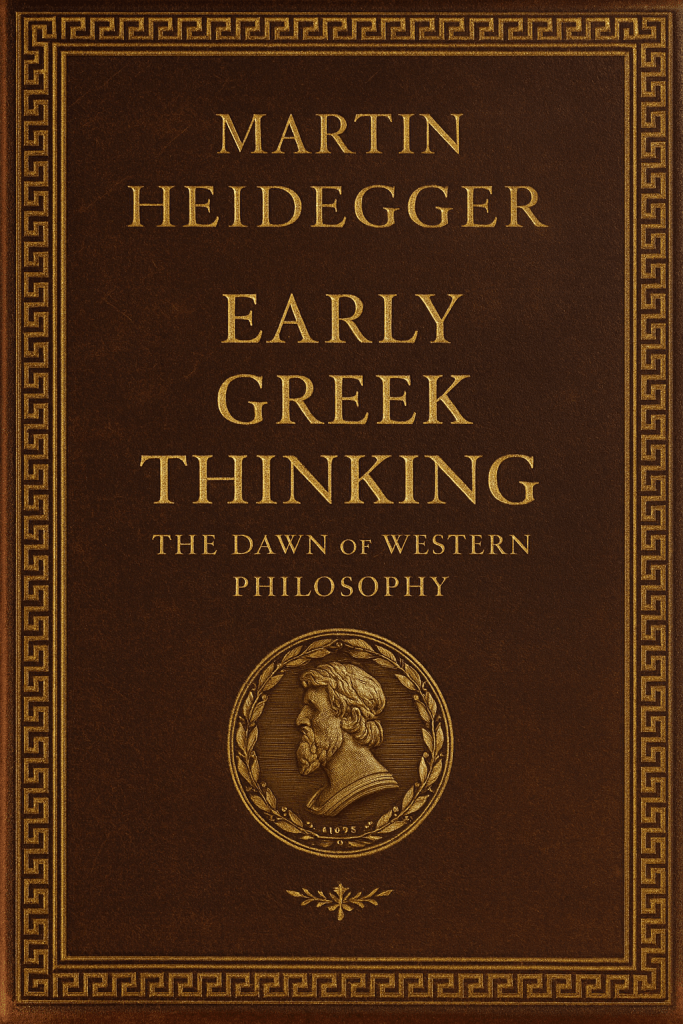
Early Greek Thinking: The Dawn of Western Philosophy relocates the earliest Greek fragments into an ontological field in which language, presencing, and concealment form a single, problem-laden scene of truth. Its distinctive contribution lies in showing how Anaximander, Heraclitus, and Parmenides name an inaugural configuration of Being as presencing (Anwesen understood dynamically), and how that configuration both enables later metaphysics and withdraws before it. The book’s wager is methodological as much as historical: one must translate oneself to the fragments’ way of saying before translating their words; only then can their key terms—logos, moira, aletheia—be heard as structural indices of an event in which beings come to presence while presence keeps itself in reserve. The result is an argument about the fate of thinking in the West that unfolds through a concentrated dialogue with four succinct, recalcitrant sayings.
The work’s outer frame is exact and, for the present purpose, decisive. It gathers four essays written between 1943 and 1954, translated by David Farrell Krell (the first two pieces) and Frank A. Capuzzi (the last two), with Krell providing the footnotes. The Anaximander essay is the closing path in Holzwege; the three lectures on Logos, Moira, and Aletheia form the third part of Vorträge und Aufsätze. The translators set the textual scene plainly: the volume ponders those words—aletheia, logos, moira—by which early Greeks said a pre-metaphysical experience of Being. This composition sequence matters for interpretation, because it aligns the Anaximander reading with the long, difficult detour through art, technology, and nihilism in Holzwege, while the subsequent triad occupies the open clearing of the lectures and essays, where paths are meant to lead to a gathering (the Same, to auto), not to a system. The book’s unity thus resides neither in chronology nor in doctrinal closure, but in the steadily intensified attempt to let language bring to language what gives language its claim on thinking.
The method declared is exacting and norm-setting for the whole. Before any lexical decision, one must translate oneself to what the fragment says; otherwise the translation disintegrates into philological arbitrariness or reconstructive psychology. Thinking here is defined as a form of poetizing more originary than poetry: an original dictare that lets the truth of Being speak by keeping pace with its withdrawal. Hence the necessary “violence” of interpretation—the leap across an abyss that is deeper than historical distance: it is the rift opened by the self-concealment of Being in the very act of unconcealment. The essay insists that we are bound to the Greek saying and to our mother tongue in a single experience of language; fidelity depends less on literalness than on speaking “from the language of the matter itself.” This binding, rigorously maintained, does not temper the risk; it names the risk.
That risk first appears in the attempt to hear ta onta and einai without superimposing the modern stock-meanings of “beings” and “to be.” The work diagnoses a long-standing confusion: because Being-talk became buoyant on formally correct but thought-poor translations, the very region to be thought (the realm in which ta onta and einai speak) was never clarified. The remedy is not a definition, but a bending of thinking toward the lightning-flash in which the fragment first appears as fragment—toward the streak in which presencing gives a glimpse of the difference between presencing and what is present. The essay calls this destiny-structure an epoché of Being, not in the Husserlian sense of a methodological bracketing, but as the luminous self-withholding by which Being grants the unconcealment of beings and founds the concealment of Being. What shows itself thereby sets us adrift in errancy, and history—understood as the sequence of epochs in which Being destines itself—unfolds in that errancy. This is the eschatology of Being: a gathering at the outermost point where the metaphysical sense of Being runs its course, with early Greek thinking standing at the dawn that already exceeds what comes “late.”
The Anaximander inquiry exemplifies the method by refusing both antiquarian piety and representational naturalism. The essay foregrounds the instability of the transmitted text (Simplicius copying Theophrastus), the contested delimitation of the fragment (Burnet contra Diels), and the danger of hearing its words—genesis, phthora, dike, adikia, taxis, chronos—through Platonic-Aristotelian conceptualization. The point is not pedantic. If the saying addresses ta onta as manifold in totality rather than “natural things,” then the charge that moral-juridical notions have been anthropomorphically projected onto nature collapses. The vocabulary of dike and adikia is broad in the precise sense of naming the unity of the manifold, the formal balance in which presencing distributes itself. This prepares Heidegger’s own provisional rendering—“along the lines of usage; for they let order and thereby also reck belong to one another (in the surmounting) of disorder”—which does not aim to be demonstrably correct in philological terms. Its warrant is thinking through the saying as said, i.e., letting the fragment’s matter dictate what counts as fidelity. What is thereby gained is an access to Being as presencing in which the ordinance of time no longer reads as a late juridical codicil but as the play of emergence and withdrawal in which beings keep to measure.
The pressure of the book, however, falls on the conceptual reconfiguration that this hearing of Anaximander compels. Presence (Anwesen) must be thought as a coming-to-presence that includes a tendency to wane, to recede, to hold itself back. In that sense the tragic tone that the essay acknowledges is not rhetorical decoration: the essence of tragedy attaches to presencing because every approach harbors withdrawal; every rise, a fall. The “justice” of beings refers to the fittingness by which each present thing, in coming forth, belongs to a whole that cannot be reduced to a stock of objects. If later metaphysics reduces Being to a highest being—idea, energeia, actus purus, reason, will, will-to-power—this does not refute the Anaximandrian insight; it shows presencing overtaken by the predominance of what is present, the ontological difference eclipsed. The early saying, heard as saying, names the measure of unconcealment that already includes its own withholding.
The lecture on Logos turns this structural insight into a demand on thinking: to think logos as the gathering that lets something lie-before (legein as letting-lie) and, correlatively, as the bringing-into-view (phrasis) whereby what is gathered appears. The path here is precisely “most needed” because the prevailing accounts of language render it a system of signs, significations, and finally data; such accounts eliminate the possibility of saying as a response to the call of presencing. If one follows Heraclitus’ B50—“Listening not to me but to the logos … all is one”—in this register, the “one” is neither an ontic totality nor an abstract identity; it is the Same (to auto) that gathers presencing and present beings as a mutual belonging. The lecture’s insistence that thinking must poetize on the riddle of Being marks an intensification of the method: the closer one draws to logos as gathering, the less one can expect propositional assurances. To ask the logos to furnish certainties is already to have fallen under the spell of the representational.
What is gained by this turn to logos becomes legible when the Parmenidean text in Moira is made to speak. The canonical line—“for thinking and Being are the same”—is neither an epistemological identity claim nor a metaphysical monism. The lecture binds the line to Fragment VIII’s expanded account: no noein—no taking-heed—apart from to eon, and no eon apart from the gathering that grants noein something to preserve. This yields a demanding thesis: thinking belongs with Being in precisely the sense that both stand within the unfolding duality of presencing and what is present. The name Moira marks the destining by which this disclosure becomes determinate; it names neither blind necessity nor mythic doom, but the measure by which the duality distributes itself, and in distributing, conceals itself. Hence “mere names”—coming-to-be and passing-away, Being and non-being, change of place and shifts in the shining of colors—dominate mortal discourse: because the twofold as such remains concealed, mortals are destined to speak within what shows itself while overlooking the showing. The lecture presses the point further: to think language from saying is the task prescribed by Parmenides; a logic of signs and “symbolic” formalisms, in assuming the primacy of statement, veils the very event in which there can be anything to state.
Within this frame, the motif of The Same reappears as the clandestine center that lets the four essays cohere without collapsing into a doctrine. The Same is neither equivalence nor identity; it is the “onefoldness” in which presencing and present beings belong together. The Anaximander lecture reaches toward it by hearing usage as the order that gathers; the Heraclitus lecture articulates it as the logos that calls for a hearing beyond any individual speaker; the Parmenides lecture inscribes it in the very syntax of noein and eon; and the final Heraclitus lecture (Aletheia, B16) exposes its riddle at the point where unconcealment cannot be separated from concealment. Each path ends where another begins; and that relay is the work’s most consequential thesis about beginnings.
The closing essay on Aletheia insists that an appeal to the dictionary meaning of aletheuein accomplishes nothing. The claim is neither anti-philological nor arbitrary; it states that the grammatical fact (the privative a- on lēth-), however accurate, will not yield the phenomenon: the lighting (Lichtung) in which what shows itself is opened to show itself. The essay’s brief philological detour (Homer’s lath-, the Epicurean lathe biōsas) is instructive only insofar as it lets concealment be seen as a positive and ineliminable trait of presencing. Odysseus’ hidden weeping does not just evade detection; the event of presencing takes place in a mode of remaining concealed as such. Hence the essay’s governing thought: the presencing of what is present comes to language in verbs of shining, arising, lying-before, stepping-into-appearance, only because concealing/unconcealing governs that presencing. The term truth (aletheia) can thus no longer serve as a property of propositions; it names the event of unconcealment that also withholds itself. One cannot stabilize this event through “objectivity” or “subjectivity,” because those pairs already presuppose the clearing. The question becomes whether thinking can abide in the bestowal that grants the belonging-together of subject and object as a secondary effect.
A consequence follows for the book’s internal economy. If aletheia so understood exposes language itself to the double bind of showing and withdrawing, then commentary must learn to “point toward the event” rather than to “conclude.” The text refuses the comfort of closure on principle. One does not “apply” Heraclitus’ B16; one learns to hear how its question—How could one hide before what never sets?—already situates us in the clearing where concealment is the condition of any appearing. To be “lucid” is not to be immediately intelligible, but to speak from the lighting that lets things appear at all. The work names this as the sobriety proper to thinking; it has no charming authority and yet changes the world by deepening its riddles. In this sense the early Greeks are neither archaic nor preliminary; they speak from a dawn that outstrips our lateness.
One can now indicate how the parts congeal and displace one another. The Anaximander path, beginning with a patient dismantling of inherited delimitations, opens the space in which Being as presencing can be named without equivocating it with a highest entity. That opening immediately forces a reconsideration of language, hence the turn to Logos. But any thinking of logos risks absorbing saying into sign-use; the lecture must therefore relocate logos inside the destiny of presencing, which requires the Parmenidean articulation of noein as belonging to to eon. The moment that relation is heard, the temptation to read it as a theory-of-knowledge identity must be refused; hence Moira is introduced to state the measure by which the duality destines disclosure. Yet as soon as disclosure is destining, the question of concealment returns as what makes disclosure possible and precarious; thus Aletheia closes the circle by exhibiting the lighting in which the entire arc occurs. Closure here is not system, but the Same—a ring of pathways where each path ends in a clearing that demands the next.
Evidence for these claims is always textual in the strong sense: each assertion about Being, language, and measure is fastened to the literal saying of the fragments, but that literalness is regulated by the book’s announced rule of fidelity—speak from the matter. Thus, when the Anaximander essay retracts the naturalist reading, its warrant is the fragment’s grammar (two clauses, ta onta as manifold-in-totality) and the historical placement of conceptual language; the restriction of “physics, ethics, jurisprudence” as distinct disciplines is a late arrangement that cannot be retrojected onto a saying addressed to the whole. When the logos lecture insists that thinking on language begins from saying itself, its warrant is the Heraclitean imperative to listen to the logos rather than to the poet; this is not a modern methodological scruple but the fragment’s own command. When the moira lecture reads the identity of thinking and Being as belonging-within duality, its warrant is the syntax of Fragment VIII, where noein appears only in relation to to eon. And when aletheia is withdrawn from propositional truth, its warrant is the astonishingly pervasive Greek practice of speaking presence in terms of emergence into the open, which carries the sense of concealment as a structural counter-trait. These are not embellishments; they are the way the book’s arguments deploy the fragments as their own grounds.
The work’s most delicate distinction is between what is textually secured and what is marked as inferential. Textually secured are, for example, the compositional provenance and sequence of the essays; the specific fragments cited (Anaximander; Heraclitus B50 and B16; Parmenides VIII, 34–41); the translators’ division of labor; the framing claim that these pieces return to words with which the Greeks named what was to-be-thought before metaphysics codified it. Inferential, by contrast, is the claim that Anaximander’s “along the lines of usage” restoration more accurately captures the fragment’s intrinsic matter than the received construal organized by genesis/decay; the text explicitly acknowledges that no scholarly proof is decisive here and places the burden on a thinking-through of the saying. Textually secured is the refusal to reduce logos to sign-use; inferential is the extension of that refusal into a broader criticism of contemporary “symbolic logic” as a paradigm of interpretation that eclipses saying. Textually secured is the experienced co-belonging of noein and to eon; inferential is the precise specification of Moira as the name for destining rather than necessity. Textually secured is the emphasis on concealment in aletheia; inferential is the translation of this emphasis into the thesis that subjectivity/objectivity are derivative of the clearing. The book is candid about these thresholds: where demonstration ends, pointing begins.
One should also stress how the book confronts the question of historical authority. The Anaximander essay refuses to install antiquity as such as criterion. Its authority, if any, flows from a future-directed proximity: what was early may outdistance the late, such that what occurred at the dawn returns at the end—an eschatological fold in which the earliest is also the last to arrive. This is not a thesis of cyclical history but a claim about the way presencing gathers its epochs. The result is a renewed standard for historical reading: historiography (sequence, sources, scholarly apparatus) is indispensable, yet insufficient; the true test is whether we can be mindful of what is destined, which requires that we risk thinking with the fragments rather than about them. The insistence that the early Greeks are contemporary in precisely this sense is neither Romantic nor primitivist. It is a claim about our lateness: perhaps we are late enough to hear what could not be heard while metaphysics was still on the ascent.
In that light, the book’s polemic is measured and, where necessary, sharp. The target is never philology as such, but historicism—the subtle conviction that the past is to be reconstructed in its causal context and then left behind. Against this, the essays argue that the fragment’s claim on us does not derive from our needs but from the fragment’s matter: Being destines itself through language and, in that destining, calls for a hearing we cannot delegate to methods. This is why the volume repeatedly announces its refusal of “conclusions” and its preference for pointing. The form is integral to the content. To conclude would be to foreclose the very clearing the text tries to prepare.
From this vantage, one can mark the conceptual tensions the book cultivates as its constructive engine. There is the tension between presence and presencing: presence tempts us to stabilize what shows itself; presencing obliges us to think the event that grants any stability. There is the tension between logos as gathering and language as sign: the former demands a hearing; the latter invites manipulation. There is the tension between moira as the measure of the twofold and the human demand for certainty: measure here withdraws formula, offering a fittingness that cannot be algorithmically secured. There is the tension between aletheia as unconcealment and the will to objectivity/subjectivity: the latter pair presupposes the clearing they cannot produce. There is finally the tension between path and clearing: the essays must “go too far” (violence) in order not to fall short (arbitrariness). Each tension is staged rather than dissolved; the book’s pedagogy lies in sustaining them until a different comportment to language becomes possible.
The work’s closing clarity is, therefore, neither synthesis nor verdict; it is a clarified exposure. The fragments are made to speak as fragments, and the reader is invited into a kind of scholarly sobriety that measures interpretations by their capacity to keep the twofold in play. If one asks what the book secures, the answer is exact and modest. It secures that the earliest Greek words for what is to be thought—Anaximander’s ordinance of usage and time, Heraclitus’ logos and the never-setting, Parmenides’ co-belonging of thinking and Being, Heraclitus’ aletheia—can be heard as indices of a single experience of presencing in which unconcealment is grounded in concealment. It secures that the history of metaphysics, in exalting the presentness of the present, occludes this experience without annihilating it. It secures that thinking today, late and exposed, may still prepare a region where what has been unthought can be addressed. And it clarifies the sense in which this preparation is the book’s entire aim: to point, in a language disciplined by the fragments, to the lighting that makes any language possible.
 Simon Gros
Leave a comment