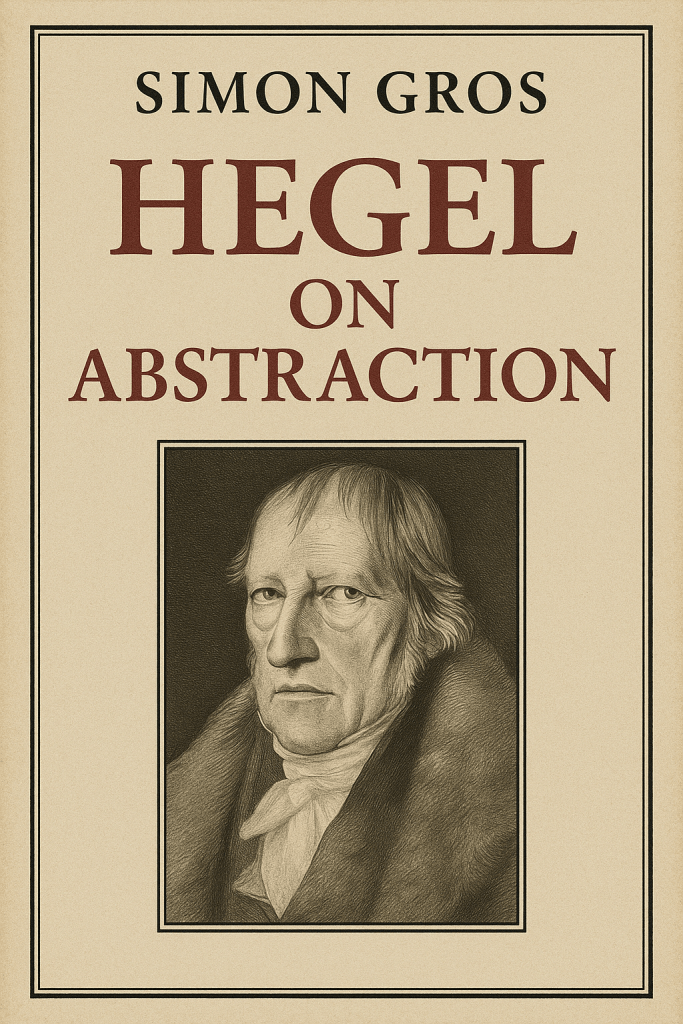
Simon Gros’s unfinished book Hegel on Abstraction stakes out a precise scholarly intervention by treating “abstraction” neither as a mere slogan for “thin universals” nor as a detachable keyword whose meaning can be stabilized by dictionary definition, but as a repeatedly refunctionalized operator whose sense shifts with Hegel’s changing tasks: logical determination, methodological beginning, social-moral reduction, political terror, skeptical emptying, and the discipline of conceptual concretion. Its distinctive contribution lies in binding together two usually separated labors: a conceptual morphology of abstraction across systematic contexts, and a philological-technical strategy for harvesting occurrences without mistaking concordance for comprehension. The study thereby proposes a defensible middle position between doctrinal fixity and mere contextual relativism, and it uses its own compositional stratification—overview, keyed contexts, concordance-style harvesting, methodological protocol—as an enacted model of abstraction’s internal dialectic.
The work begins in the register of an answer that refuses the comfort of terminological sovereignty. Abstraction appears immediately as a problem of philosophical semantics under historical conditions: the same word-family (Abstraktion, abstrakt, Abstraktheit) circulates through Logic, method, critique of “empty” universals, social and ethical judgment, and the analysis of political forms, and the text construes this circulation as evidence that “abstraction” is not a system-central technical term in the rigid sense. Yet the refusal of rigidity does not dissolve the term into an amorphous equivocity. Instead the book pursues a controlled, almost laboratory-like differentiation of senses: abstraction as isolating, abstraction as necessary beginning, abstraction as one-sidedness, abstraction as product (Abstraktum, the abstractum), abstraction as moral and political violence of predication, abstraction as the skepticism that empties content into a resulting nothing, abstraction as the reflective power of Verstand (understanding) whose separations generate clarity at the cost of truth when they are taken as ultimate. Gros’s initial wager is methodological: one can speak accurately about Hegel and abstraction only by tracking how the term functions as a moment—a partial determination—whose legitimacy depends on its integration into a larger movement toward concretion. The project thus constructs “abstraction” as a name for the recurring temptation to treat a moment as a whole, a predicate as a substance, a starting point as a conclusion.
From that starting register, the text performs a characteristic Hegelian maneuver upon its own procedure: it begins with abstract characterizations and compels them to show their insufficiency by confronting them with the multiplicity of contexts in which the term works. The early paragraphs treat abstraction as an index of one-sided determination—an “empty” universality achieved by omission rather than by articulated unity. Here the book aligns itself with Hegel’s insistence that the truth of universality is found in the concrete universal, a form of universality that contains and holds together universality, particularity, and individuality (the triadic structure often gathered under Begriff, concept). In Gros’s presentation, abstraction becomes the conceptual image of universality that cannot bear individuality—universality as a thin remainder after excision. Even when the study keeps the German lexicon to a minimum, it cannot avoid the gravitational pull of a few terms whose first-mention glosses mark the border where translation becomes philosophical decision: Begriff as concept that is living unity, Verstand as understanding that fixes and separates, Aufhebung as sublation that preserves while transforming, and “determinate negation” as the negativity that yields a structured result rather than an empty null. These glosses do not decorate the book; they serve as minimal anchors that prevent the discussion from sliding into homiletic contrast between “abstract” and “concrete.” The more demanding claim is that abstraction is not simply the opposite of concretion, since abstraction itself belongs to the productive economy of thought. It is a selective act that makes determinacy visible, though at the price of isolation. Its falsity arises when isolation is absolutized.
This gives the work its organizing problem: how to maintain three claims simultaneously without allowing any one to collapse the others. First, abstraction is unavoidable, since conceptual work begins by selecting, separating, and holding determinations steady. Second, abstraction is insufficient as a final form of truth, because truth demands mediated totality rather than isolated moments. Third, abstraction has a normative ambiguity: it can be a legitimate methodological beginning, and it can be a socially crude and morally violent reduction. The study’s structure emerges as an attempt to hold these claims in tension while giving each a domain of warranted application. It therefore proceeds by generating “contexts” as quasi-experimental frames. In one frame, abstraction is treated as logical form: a determination considered in separation from its mediations. In another, it is treated as method: the beginning with simplicity that must be driven onward. In another, it is treated as critique: the exposure of “bad” abstraction, the thought of isolation as the thought of truth. In another, it becomes political and ethical: abstraction as the reduction of persons to a single predicate, the conceptual violence that makes terror intelligible as the actuality of abstraction. In yet another, it becomes epistemological: skepticism as an abstraction that empties content and struggles to comprehend its own result as determinate negation rather than mere nothing. In each case the text presses for a concrete payoff: abstraction is read as an operation whose consequences show up in the shape of the object domain—logical, ethical, political, religious, methodological—rather than as a mere “attitude” of the thinker.
The distinctive voice of the book appears when it refuses to let “abstraction” remain a generalized reproach. The study could have stabilized itself by identifying “abstraction” with “empty universals” and then repeating the familiar dictum that the true is the whole. Instead, it records a more fragile, more technical observation: abstraction can name a legitimate moment of clarification—a way that thought comes to itself by separating a determination from its entanglements—and yet this same successful act of separation produces a danger that is internal to its success. The abstract determination appears clear precisely because it has been detached from the mediated complexity that would render it true. The work therefore treats abstraction as a phenomenon of epistemic economy: separation yields liquidity of concepts, ease of deployment, and immediate communicability. The cost is loss of systematic weight. In this way the text exhibits a quasi-sociology of conceptual forms even before it reaches explicit treatment of social and political contexts. Abstract universals travel fast; concrete concepts resist circulation because they carry their mediations with them. The book thus implicitly asks whether Hegel’s critique of abstraction is also a critique of a certain market-like circulation of concepts, where the portable is preferred to the true because it is portable.
At this point the book’s composition reveals itself as more than a vehicle for its content. The text begins with an overview that behaves like an “abstract” exposition: it offers a synoptic differentiation of senses. It then displaces this overview by moving into a more anchored mode: textual reference, concordance-like listing, and the pragmatic question of how one even secures an “all occurrences” claim across editions. This movement is itself the logic of abstraction at work: an initial abstract mapping is compelled to mediate itself through empirical constraints—digitization, editorial segmentation, the reality that “Hegel” is not given as a single searchable unity. The study does not merely mention that different editions segment texts differently; it treats that fact as conceptually decisive. If abstraction is the isolation of a determination from its mediations, then the edition that presents an occurrence is itself a mediation. The philological scaffold, often ignored in purely systematic exegesis, becomes in Gros’s project the very arena in which abstraction’s meaning is tested. A concordance without editorial awareness is itself an abstraction, a “product” that pretends to be the thing itself. The book’s form is thus self-corrective: it begins by offering a conceptual typology, and then it warns against the abstraction of thinking that typology can be inherently complete without a definable corpus.
The internal pivot of the work is therefore a methodological tension between comprehensiveness and integrity. Gros’s early rhetoric gestures toward collection of “main references and uses,” and then it encounters the demand for completeness as a temptation whose satisfaction would require an impossible edition-independent “all references” list. In confronting this, the text advances one of its most instructive claims: completeness is a function of a chosen corpus and a declared method, not a metaphysical attribute of scholarship. The project thereby transforms what might look like an apologetic limitation into a positive epistemic norm. One can offer a concordance “you can trust” only by fixing the edition, converting to machine-readable text where possible, specifying the lemma-family to be searched, and extracting contexts with a repeatable protocol. The insistence on regex-patterns and the explicit enumeration of search forms (abstrakt, Abstraktion, Abstraktheit, abstrahier-) is not a mere practical aside; it is a philosophical enactment of conceptual determinacy. The study treats philological method as a case of abstraction under control: one isolates a lemma-family, then restores mediation by providing surrounding context and by relating each hit to a conceptual role. This is a crucial internal movement: abstraction is first criticized as isolating, and then reappropriated as disciplined isolation in the service of systematic comprehension.
When the book turns to the logical context, it presents abstraction as a form of one-sided determination, and it places particular emphasis on Hegel’s opposition between abstract determination and the concrete unity of determinations. Here the conceptual grammar tightens. Abstraction is no longer merely “leaving out details”; it becomes the act by which a determination is posited as self-standing without being exhibited as internally related to its other. The abstract is thereby revealed as a metaphysical stance disguised as epistemic economy: to treat a determination as absolute is to treat the abstraction as substance. The text’s reference to Abstraktum—the product of abstraction—shows the direction of the argument. The abstractum is not simply an abstract idea; it is the reification of a predicate into a supposed thing. The study thus reads abstraction as a kind of metaphysical illicitness: it generates false substances. Within a Hegelian frame, this means abstraction is the conceptual counterpart of what Hegel attacks in “reflection metaphysics,” where fixed determinations stand in external relations and are taken as ultimate.
Yet the book does not permit the logical critique to become a blanket denunciation. It also emphasizes that abstraction can be a “point of departure.” The movement “from abstract to concrete” is treated as a methodological structure: thought begins with minimal determinations and must develop them. This is not presented as a pedagogical simplification; it is situated as a necessity grounded in determinacy itself. A beginning in pure immediacy cannot already include everything; it must be poor in content. The study’s interest lies in how Hegel can simultaneously insist that truth is concrete and insist that thought must begin abstractly. In Gros’s presentation, abstraction as beginning is not valorized as such; it is treated as legitimate insofar as it is self-transcending. An abstract beginning earns its legitimacy by showing its own incompleteness and therefore demanding mediation. The text thereby distinguishes between abstraction as moment and abstraction as stance. The moment is a controlled partiality, a provisional determination; the stance is the absolutization of that partiality. This distinction is one of the work’s central achievements, because it allows the text to avoid moralizing and to remain within a scientific register: the legitimacy of abstraction is a function of its place within a sequence.
This focus on sequence becomes increasingly explicit as the book develops. The text repeatedly returns to the idea that the meaning of “abstraction” shifts with context, and it organizes these shifts as a series of conceptual roles. Abstraction in “logic,” abstraction in “method,” abstraction in “social critique,” abstraction in “political terror,” abstraction in “skepticism,” abstraction in “religious practice,” and so on. Yet the deeper claim is that these are not merely external contexts; they are stages in which abstraction reveals different dimensions of its own essence. To say that abstraction is “isolation” is already to say that abstraction contains a relation to the whole from which it isolates. The abstract is parasitic on the concrete: it is a moment extracted from a totality. The abstract thus secretly presupposes totality—precisely what it denies when it presents itself as self-standing. In this sense, abstraction is internally dialectical: it is what it is only by reference to what it excludes. The insistence on reading each occurrence in context is therefore more than scholarly caution; it is a statement of the concept: abstraction is a function of relationality in denial.
This becomes most vivid when the book turns to the popular-ethical critique associated with “abstract thinking.” Here abstraction is presented as reduction of a person to one predicate, the act by which a human being is transformed into a single determination. Gros’s selection of examples—such as the reduction of an individual to “the murderer,” or the treatment of a soldier as a beatable subject, an Abstraktum—serves to show that “abstract thinking” is not a refined philosophical vice reserved for scholastics. It is a common social operation, perhaps even the default mechanism of judgment in a world of scarce attention. The implicit argument is that abstraction in this sense is a social technology: it produces legible identities by compressing persons into single attributes. The vice is not mere incorrectness; it is the loss of the person as a mediated unity. Conceptually, this section performs a decisive displacement: it moves “abstraction” from the sphere of purely logical determination into the sphere of ethical-political life, while retaining a single formal core—reduction through isolation. The study thereby suggests a continuity between the logical error of reifying predicates and the social violence of reducing persons: both are forms of abstraction that treat the product as the whole.
The political dimension becomes sharper in the book’s evocation of revolutionary universality and terror. Abstraction here is no longer merely a cognitional failure; it becomes a historical force. Universal freedom that cannot mediate universality and individuality splits into extremes and expresses itself as negativity. The study treats this as a kind of conceptual pathology that attains actuality: abstraction, once installed as reality, produces a world in which the universal has no determinate content except itself, and individuals appear as replaceable instances. The interest lies in the internal logic by which abstraction becomes destructive. If the universal has been abstracted from all determinacy, it can recognize individuality only as negation. If individuality has been abstracted from universality, it can recognize the universal only as external constraint. The result is a field of mutual cancellation. In this context, abstraction is not a term of abuse; it is a diagnostic of why a certain form of universality does not hold. The book thus avoids reductive political moralizing and instead builds an explanatory model: abstraction becomes catastrophe when it governs actuality rather than functioning as a moment within mediation.
The text’s handling of skepticism further deepens this explanatory ambition. Skepticism, in Gros’s presentation, can be understood as an “emptying” that abstracts from determinacy and ends in nothing. The philosophical interest lies in whether the result is grasped as determinate negation—negation of a specific content that yields a structured remainder—or whether it is grasped as empty nullity. The study uses this to refine its account of abstraction. Abstraction can be understood as emptying that leaves nothing, and it can be understood as selective negation that produces a determinate remainder. The latter belongs to conceptual development; the former arrests development. Here the key move is to treat “abstraction” as a criterion for distinguishing two kinds of negativity. The distinction matters because it connects a logical point to the possibility of progress in thought. If abstraction yields empty nothing, thought collapses into formal skepticism; if abstraction yields determinate remainder, thought moves forward. Abstraction thus becomes, within the book’s horizon, a test for whether negation is fertile.
A further complication enters when the work gestures toward the philosophy of nature and spirit by invoking phrases such as “abstract processes” and “abstract certainty.” These gestures function as bridges rather than as fully unfolded analyses, yet their presence is significant for the overall architecture. “Abstract process” indicates an analysis that takes a process in separation from its systematic embedment, thereby treating a partial structure as if it were the whole. “Abstract certainty” indicates a self-relation that has not mediated itself through objective content and social actuality. These instances show that the concept of abstraction, as the book develops it, is not confined to the logic of predicates. It extends to the analysis of forms of subjectivity: certainty without truth, inwardness without objectivity, self-relation without social mediation. The work thereby suggests that abstraction can name a structural deficiency of spirit: a form of selfhood that persists as immediate inwardness. This extends the term’s range without dissolving its core: abstraction continues to mean partiality taken as completion.
Throughout these developments, the book repeatedly returns to the contrast between the abstract universal and the concrete universal. Yet it refuses to treat the concrete universal as a mere rhetorical prize. The manner is to treat the concrete universal as an achieved form whose achievement must be shown by method, by dialectical sequence, and by resistance to premature stabilization. Abstraction is continually positioned as the danger of premature stabilization. The concrete is not a simple “addition of details,” but the unity of determinations in and through their difference. The repeated emphasis on “unity-in-difference” functions as a quiet polemic against reductive readings in which “concrete” means merely “empirically rich.” In this work, concretion is conceptual, not merely descriptive. It is the conceptual bearing of determinations upon one another. Abstraction is the severing of this bearing.
The study’s compositional sequence is itself an enacted argument about abstraction. It begins in a relatively free, explanatory idiom, offering categories and interpretive remarks. It then shifts into a more technical register: the harvesting of occurrences in standard searchable corpora, the sense that a concordance can be built “right now,” and the acknowledgement that completeness depends on digitization and editorial structure. Finally it shifts again into a protocol-like mode: fix a digital edition, convert to plain text, run a search for lemma-families, extract contexts with a defined window. Each shift partially displaces the previous one. The initial overview is displaced by the demand for textual anchoring. The textual anchoring is displaced by the demand for methodological transparency about corpora. The methodological transparency is displaced by the demand for a repeatable technical procedure that produces a concordance one can trust. This sequence mirrors the central claim that abstraction is a moment that must be mediated: the initial overview is itself abstract; it becomes more concrete by encountering the constraints of the archive; it becomes more concrete again by specifying procedures. The book thus carries its reader through a movement from conceptual abstraction to concrete methodological accountability. It does so without breaking its neutral register, because the text is not lamenting limitations; it is converting them into epistemic norms.
One might say that the work thereby proposes a two-level account of “Hegel on abstraction.” On the first level, abstraction is an internal logical and systematic notion: it names one-sided determination, the reduction of mediated unity to isolated moment, the temptation of fixed predicates. On the second level, abstraction is an interpretive danger for Hegel scholarship itself: the danger of taking a scattered term-family and reifying it into a single doctrine; the danger of taking a concordance as comprehension; the danger of confusing a corpus-dependent harvest with an edition-independent totality. The most subtle achievement is to let these two levels illuminate each other. The philological cautions are not external addenda; they exemplify the concept. An edition-independent “all occurrences” claim, made without specifying corpus, is itself an abstraction: it isolates “Hegel” from the concrete mediation of editorial history and textual availability. A concordance produced without interpretive caution is itself an abstractum: a product of abstraction treated as substance. By allowing scholarly method to become a site of conceptual critique, the study tightens its internal coherence.
The book’s declared preference for organizing references “by context / conceptual role” rather than by chronology also deserves attention, because it reveals a philosophical choice. Chronology would emphasize development across Hegel’s career, and one could certainly ask how early theological writings treat abstraction differently from the mature Logic. The work acknowledges this possibility and gestures toward it, especially in relation to early writings where the mature apparatus may not yet be in place. Yet it chooses, at least in its present unfinished state, a systematic orientation. It asks how “abstraction” works across domains, rather than how it evolves historically. This choice is methodologically consistent with the text’s central claim: abstraction is not univocal, so the first obligation is to map its functional differentiation. Only after such differentiation can a developmental story avoid flattening. In this way the book implicitly argues that diachronic narrative should be built upon a prior synchronic morphology of conceptual roles. That is a significant scholarly stake: it proposes an order of operations for Hegel interpretation.
At the same time, the unfinished status shows itself precisely at the points where these orders of operation threaten to compete. The text wants to be both a conceptual essay and a concordance. It wants to remain “mostly internal to Hegel” and yet to offer practical advice for constructing a digital-harvested list across corpora. It wants to avoid overclaiming completeness and yet to satisfy the reader’s desire for coverage. These tensions are not merely editorial; they belong to the concept of abstraction as the book develops it. The desire for completeness is itself a drive toward the concrete totality; the inevitable incompleteness of any corpus-based harvest reintroduces abstraction; the solution is methodological self-limitation. One could say that the unfinished book already carries the form of its completion: it will be completed when the protocol and the conceptual mapping are fully mediated into each other, so that the concordance is not an appendix and the conceptual exposition is not merely prefatory.
The recurring emphasis on “reading in context” functions, in this light, as the work’s governing maxim. Yet it is not a banal maxim. The study treats context as conceptually constitutive: abstraction has no meaning apart from the relation between determination and totality that the context supplies. “Context” here is not external circumstance; it is systematic place. In logic, the abstract is the one-sided determination; in ethical judgment, the abstract is predicate-reduction of a person; in politics, the abstract is universal freedom without mediation; in epistemology, the abstract is emptying without determinate result. This is why the book can insist that “abstrakt is not univocal” while still maintaining a disciplined account. The unity across contexts is formal: abstraction is the severing of mediation and the absolutization of the severed moment. The pluralization across contexts is functional: what counts as “mediation” differs with the domain. In logic, mediation is categorical; in ethics, it is the web of determinations that constitute a person; in politics, it is institutional and social actuality; in epistemology, it is the determinacy of the result. The work thus yields a robust theoretical claim: abstraction is a family resemblance concept whose core is a formal relation—part/whole, moment/totality, predicate/substance—while its concrete shape depends on domain-specific mediations.
A further strength of the work lies in its refusal to treat abstraction simply as error. It recognizes that abstraction is also a necessary operation of thought; the difference between legitimate and illegitimate abstraction is the difference between an abstraction that knows itself as partial and an abstraction that forgets its origin. In the book, “bad abstraction” is the abstraction that cannot return to concretion, cannot restore the mediations it has bracketed, cannot comprehend itself as moment. This provides the work with a normative framework that remains internal to Hegel’s method: the criterion is whether abstraction is aufgehoben—sublated, preserved and transformed—within a more concrete concept. This framework also allows the work to avoid the common simplification in which “abstraction” is equated with “formality” and “concrete” with “content.” The implicit message is more demanding: form itself can be concrete when it is the unity of determinations, and content itself can be abstract when it is a single determination masquerading as totality.
The book’s treatment of interpretive nuance reinforces this internal normativity. It insists that one must determine whether “abstraction” is used in a preliminary sense, a critical sense, or a theoretical-logical sense. This tri-partition is itself a methodological tool. Preliminary abstraction belongs to beginnings and to didactic staging; critical abstraction belongs to polemic against fixed universals and isolated determinations; theoretical-logical abstraction belongs to the analysis of how determinations function within the system of categories. In the work’s best moments, these senses are shown to interpenetrate. A preliminary abstraction can become an object of critique if it is taken as final. A theoretical-logical abstraction can become a social critique when its structure is realized in ethical judgment. A critical polemic can itself become abstract if it degenerates into mere denunciation without mediating its claim into systematic understanding. The book gives itself room for these interpenetrations by keeping its categories flexible, treating them as orienting roles rather than as rigid boxes.
Because the work remains “mostly internal” to Hegel, it resists the impulse to stabilize its claims through external secondary literature. This is methodologically consistent with its aim: to allow the term-family “abstraction” to display its own shifting sense across Hegel’s texts. Yet the study also shows awareness of how easily such an internal approach can overreach when it claims exhaustive coverage. The most striking remedy is to transform “coverage” into a declared procedure rather than a metaphysical boast. The advice to choose “one digital edition,” run the lemma-family search, and extract contexts is in fact the work’s answer to its own central difficulty: how to honor context while still offering a harvest that is more than impressionistic. This is where the book becomes, in a quiet way, programmatic for contemporary Hegel scholarship. It suggests an alliance between conceptual analysis and technical philology: the scholar’s task includes establishing a trustworthy set of hits, and the philosopher’s task includes interpreting those hits into functional roles. Neither task alone suffices, and the work’s own layered composition demonstrates this.
The outer framing—its origins in an inquiry that begins “Good question,” its repeated gestures toward what can be done “right now,” its explicit acknowledgement of limits—also matters for understanding its scholarly ethos. The book positions itself as a working instrument rather than a completed monument. It is written in a register that is simultaneously didactic and research-oriented: it teaches the reader how to think about abstraction in Hegel, and it teaches the reader how to find the relevant textual material in a way that remains accountable. This ethos aligns with the work’s central conceptual claim: abstraction is not only an object of Hegel’s critique; it is a danger for scholarship, and scholarship combats it through declared mediation—procedures, corpus specification, context windows, and a disciplined refusal of edition-transcendent claims. The unfinishedness thus appears as a kind of methodological honesty: it prefers to be incomplete in coverage rather than abstract in its claims.
Closing with clarification, one can say that the book’s deepest unity arises from the way it lets “abstraction” operate on three planes at once: as a logical operator of one-sided determination, as a socio-ethical operator of reductive judgment, and as a scholarly-epistemic operator that tempts the interpreter to substitute searchable products for conceptual comprehension. The work’s deliberate movement from conceptual overview into concordance-like practice and finally into protocol is itself the enacted passage from abstract mapping toward concrete methodological accountability. In its present unfinished form, Hegel on Abstraction already offers a distinctive contribution: it shows that the critique of abstraction is inseparable from a disciplined use of abstraction, and that Hegel’s demand for concretion can guide both conceptual interpretation and the technical labor of textual retrieval without collapsing into either dogmatic definition or unbounded contextual drift.
 Simon Gros
Leave a comment