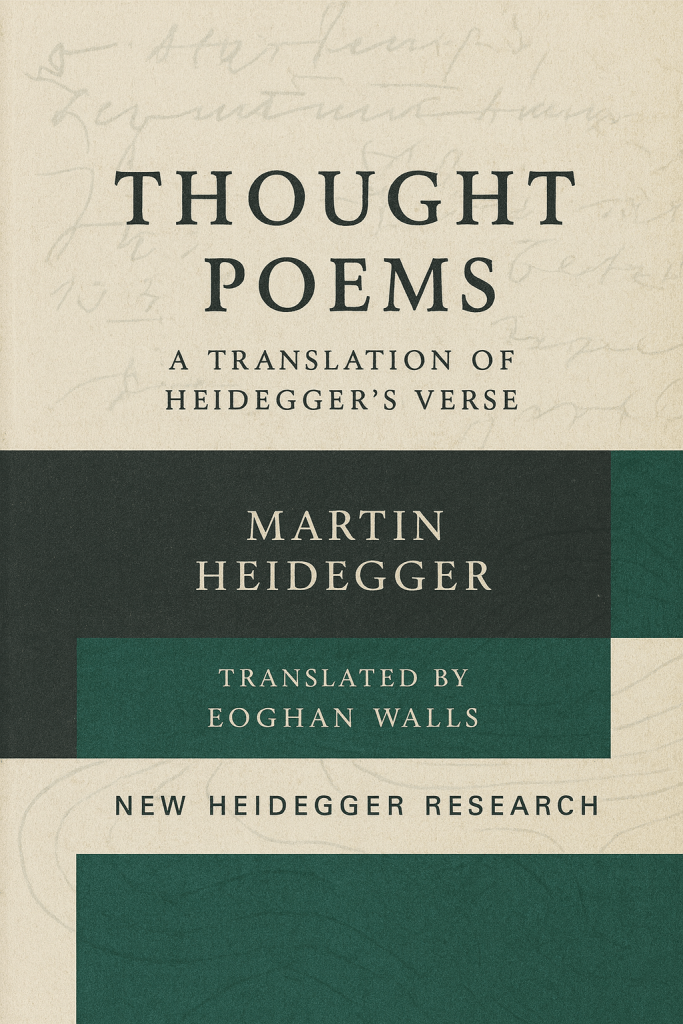
Thought Poems: A Translation of Heidegger’s Verse stakes a very precise claim in Heidegger scholarship: it establishes volume 81 of the Gesamtausgabe—Gedachtes—as a central laboratory of Heidegger’s late thinking, by presenting for the first time in English the entire corpus of what Heidegger names “thought-poems,” together with the early poems, intimate letters, and scattered fragments through which this hybrid genre was prepared, developed, and retrospectively framed. In doing so, the book demonstrates that Heidegger’s late poetics of Seyn, Ereignis, worlding, dwelling, and “the last god” cannot be understood solely through his readings of Hölderlin and the other poets he revered. They must also be read through the poetizing of his own thinking, in a mode that claims to overcome the sentence as the basic unit of philosophical discourse, while still binding thinking to rhyme, rhythm, pun and the musical estrangement of language.
The book’s distinctive contribution lies in the way it layers three different operations on a single body of text. First, there is Heidegger’s own work of generic invention: the constitution of “Gedachtes” as a form that borrows heavily from verse while explicitly denying the status of “poetry.” Second, there is the editor’s archival and compositional work in GA 81, which arranges heterogeneous manuscripts into a four-part sequence—early poems and letters, the large manuscript Aus der Erfahrung des Denkens, the private “legacy” booklet for Elfride’s eightieth birthday, and the final “scatterings”—and thus gives them the contour of a quasi-autobiographical, quasi-systematic whole. Third, there is Eoghan Walls’ translation, whose own method of estrangement, neologism and prosodic fidelity re-inscribes the thought-poems in a new linguistic medium, so that the very problem they stage—a thinking that must move in the medium of language without collapsing into either conceptual prose or decorative lyric—reappears at the level of translation itself.
From the outset, the volume situates the thought-poems within a contested space of genre. Botho Strauss, cited in the Translator’s Note, speaks of the texts in GA 81 as lacking “beautiful and unforeseen metaphor,” sensual detail, ornamentation, and “free sound-play,” and concludes that they are “not poetry.” Heidegger himself insists on the designation Gedachtes—formed from Gedicht (poem) and Gedacht (what was thought)—and states, in a programmatic note later reproduced as “Why write ‘Thought Poems’?,” that the form is chosen precisely because it permits the “avoidance of statements and even sentences” and forces the writer to abandon all “filler words.” In this framing, the thought-poem appears as the linguistic correlate of his long-announced “step back” from metaphysics: the sentence, understood as the bearer of propositional content and the basic unit of judgement, belongs to the metaphysical regime of Vorstellung, representation; to overcome it requires a different mode of saying in which thought is not expressed about something as an object, but moves in attunement to the “custom of thinking” founded by Parmenides when he first brought τὸ ἐόν—presence as such—to speech.
Yet this very attempt at overcoming reveals a tension that structures the entire volume. To call something Gedachtes is to insist that thinking itself has taken form; that what is thought has come to rest in a configuration that can be repeated, re-read, handed over as a legacy. That configuration is written in lines, arranged in stanzas, bound by rhyme and assonance. Walls’ Translator’s Note shows in meticulous detail how the thought-poems depend upon dense and often intricate rhyme schemes and on an elaborate punning that plays across multiple semantic layers of single German words. Heidegger’s later prose already indulges in such word-play—the classic examples are the wohnen hidden in bauen, the eignen in Ereignis, the Fug in Fügung—but in Gedachtes these etymological and phonic resonances become the very engine of composition. There is a constant movement between semantic clarification and semantic thickening: distinctions are created by archaic spelling (Seyn), by hyphenation (Ge-wesen, An-fang), by forcing verbs, adjectives and even pronouns into the role of nouns (e.g. Eigen, Ist), and by folding “ordinary” words into the vocabulary of beyng, ownness, and worlding.
Walls emphasizes that this is not “etymology” in the scholarly sense, in which historical attestations would anchor meaning in traceable usage. It is a tracing of the “aural textures of language,” following sound—bauen, Nachbar, bin; stillen as “to quieten” and “to nurse”; Freyen as “courting” and “freeing”—into a network of hints that are meant to disclose a more primordial dimension of dwelling, ownness or destiny. The thought-poems thus inhabit a threshold: they renounce the sentence, but they intensify the line; they forego propositional clarity, but they organize sound and meaning with an almost artisanal care. The very gesture through which Heidegger distances himself from poetry—he declares that “by outer impression ‘verses’ and rhymes, the texts look like ‘poetry’, but they are not”—is undercut by the fact that the philosophical work is carried by precisely those poetic resources he claims to sidestep.
Walls’ translation enters into this tension and amplifies it in another language. His method, as he explains, involves a double fidelity: to the conceptual content of the thought-poems and to their musical and graphic form. He preserves line-breaks, stanza divisions, page breaks, editorial apparatus, and the German–English facing-page layout. He adopts parallel estranging techniques, using hyphenation (on-set for An-fang, pre-essence for Ge-wesen), creating English neologisms (ownness for Eignis, worlding and worldness), and in some cases transplanting German capitalization into English (“Is,” “He”) in order to indicate that an ordinary word has acquired a specially charged function in Heidegger’s usage. He also attempts, whenever possible, to respond to Heidegger’s rhymes with near-equivalent rhyme or half-rhyme in English, accepting semantic shifts where the conceptual structure can accommodate them.
A key example is the poem Denken from 1946, where German rhymes (e.g. Nahe-Wohnen / stille Dank, edle Schonen / kühne Rank, Rosen ohn’ Warum / Strom und Tal etc.) are rendered as “dwelling-in-closeness / quiet thanks,” “noble defense / bold plan,” “Whyless roses writing poems, / hailing vales and rivers.” Here the translator introduces “Whyless” to echo the famous “rose without why,” and “writing poems” to catch both the activity of dichten and the rhyme with “rivers.” The result is that the English text repeats, at another level, the central problem of the original: thinking is described in a series of images, comparisons and sonic patterns that never simply name an ontological structure, but also never abandon the attempt to say thinking as such. The translation does not sit outside this game, commenting on it; it participates in it by reconfiguring the thought in the very act of rendering its word-music.
The external frame of the volume intensifies this reflexive structure. The Editor’s Afterword explains that GA 81 brings together four distinct corpora, each with its own genesis and internal coherence, but here collated in an arrangement that is at once chronological, thematic, and testamentary. Part One, “Early Poems – Letters – Thought Poems (1910–1975),” consists of material that Heidegger dedicated to his fiancée and later wife Elfride: early unpublished poems and letters from 1910–1918, followed by thought-poems from 1945–46 and again from 1972–75. These materials formed part of Elfride Heidegger’s personal property and entered the literary estate only after Martin’s death. Part Two, “From the Experience of Thinking,” is a large manuscript of fragmentary texts, written in the style of the thought-poems and organized by Heidegger into sixteen sections at the end of the 1930s and in the 1940s; some of these were partially published as Winke in 1941 and as Aus der Erfahrung des Denkens in 1954. Part Three, “Thought Poems for the Legacy of a Thinking,” collects texts that Heidegger physically handed to Elfride on her eightieth birthday, 3 July 1973, “laid in your hands at the cabin” in the presence of their family; this booklet was later expanded and also donated from Elfride’s papers. Part Four, “Scatterings,” gathers individual fragments from the late 1930s to the end of Heidegger’s life.
This compositional history already prevents a naive reading in which the thought-poems would simply be a homogeneous expression of a single phase of Heidegger’s “turn” to poetry. The book’s outer framing makes clear that Gedachtes stretches over decades and is layered over existing publications; what we read as Part Two was already selectively published in other contexts; what we read as Part Three both recapitulates and displaces earlier formulations in the mode of a personal Vermächtnis, a legacy. The editor has transcribed all four parts from handwritten manuscripts, silently correcting obvious errors and expanding unusual abbreviations, but preserving dedications and letters in a more diplomatic manner to retain their intimate character. The result is that the volume presents itself as both archival and architectonic: it shows traces of the workshop while projecting an implicit narrative of Heidegger’s “thinking” as it moves from youthful religiosity and love, through the catastrophic mid-century, into a late period preoccupied with legacy, appropriation and the last gods.
Walls, for his part, promises in his Translator’s Note to “preserve the integrity of the original text, including the line-breaks, page-breaks, referencing and the editor’s afterword,” and to limit his own textual intrusions to necessary apparatus: a translation of François Fédier’s French version of “Sprache” (“Langue”), translated Greek where Heidegger does not already translate himself, and a system of angular brackets and numbered footnotes to differentiate his own clarifications from those in the original German edition. In this way, the translation doubles the editorial work of GA 81: it reproduces the German scholarly frame in English and thereby positions the Anglophone reader within the same layered structure of archive, legacy, and experiment that governs the original publication.
Within this frame, Part One plays a crucial role, because it both precedes and retroactively belongs to the regime of Gedachtes. The early poems and letters to Elfride from 1910–1918 are not yet thought-poems in Heidegger’s later sense; they are lyrical, sometimes religious, often exuberant pieces of youthful expression. Yet the later Heidegger decides to place them under the same heading as the postwar and 1970s thought-poems, and the editor retains that collation. The volume thereby asks the reader to trace continuities between early motifs—love, faith, the divine “You,” the experience of “living being” (lebendiges Sein)—and the later elements of ownness, beyng, worlding and Ereignis.
A pivotal intermediary text is the long reflective piece dated June 1918, which Walls renders in prose as a kind of phenomenological self-account. Heidegger describes how the “basic experience of ‘you’” became “a totality flowing through all existence,” transforming the “sphere of lived experience” into a “fully real, mutual and reciprocal” for-and-to-each-other of the fully living “I” and “You.” The “basic experience of living love and true trust” unfurls and grows his being, breaking the crust of earlier conditioning and reorganizing consciousness such that the “primordial reality of God” is now approached through the streaming mutuality of this I–You relation. Heidegger explicitly names this configuration “historical consciousness”: the primordial fact of living consciousness as the for-and-to-each-other of I and You, and he calls this “living being” the “primordial concept of all detachedness that philosophers long to know,” whose inner essence is “trusting faith” coming to life in the “silent closeness” of Elfride’s loving soul.
Already here, then, one sees a decisive configuration of the problems that will govern the later thought-poems: the relation of lived experience to philosophical concept; the way a basic experience (love, trust, religious awakening) reorganizes the entire “historical” field of consciousness; the insistence that what philosophers seek in abstract form is rooted in an irreducibly concrete, relational and affective event. The text hovers between theology, phenomenology and intimate confession; in that hovering, we can already sense the pressure that will later lead Heidegger to invent Gedachtes as a form that is neither systematic treatise nor private lyric, but something that wants to be both a thinking of beyng and a saying that remains bound to one “You,” one beloved, one addressee.
When we move within Part One from the early letters to the postwar sequence “Thought Poems 1945–1946,” the shift in style is pronounced, yet the thematic threads remain continuous. The thought-poem Wort und Welt (“Word and World”), dedicated to Elfride for Christmas 1945, stages the relation between silence, world, and gratitude. “Only when the too silent calls you / do you come into listening, / encounter what has long already / rested in the word, / happy from the passing of the world.” The “too silent” (zu Stilles) is both oppressive and gracious; it calls one into listening, but it is constantly deferred by the impatience of the “whenever” (Wann?). The poem questions whether a “nursing of silence” (Stillen der Stille) can still “live” in a world where “everything is just process, / exploitation and drudgery,” and poses the counter-possibility that “the world [is] already nursed from grace, / built in thanks.” The interplay of verbs (stillen, bauen), the double sense of “nursing” and “stilling,” the question of whether world is exhausted by work and utility or preserved by a hidden grace—these are precisely the themes that, in the later thought-poems, will be reworked within the vocabulary of Ereignis, worlding and the last god.
The poem Denken, again addressed to Elfride in January 1946, condenses this into a series of gnomic descriptions of thinking: “Thinking is dwelling-in-closeness, / is quiet thanks. / Thinking is noble defense, / is the bold plan.” It moves through “a twisting path of dark signs / between being and nothing,” insists that thinking “never flies / out of evil, from suffering,” and concludes with the remarkable line: “Thinking stays the all-freeing, / the call of the tuneless, / so that mortals bey beyng: / for the healing of purpose.” Here thinking is neither pure contemplation nor technical calculation; it is a dwelling that remains exposed to suffering, a “call of the tuneless” that frees mortals to “bey beyng” (Walls’ solution to the difficult seyend seyen). The rhyme and rhythm carry this characterization forward; “dwelling-in-closeness / quiet thanks” and “noble defense / bold plan” enact in sound the double motion of protected intimacy and daring. The poem’s dedication anchors this grand, ontological description in a very specific address—“E. on the 21st January 1946 / M.”—and thus exhibits, within Part One, the merge between intimate love-letter and ontological thought-poem that will become structurally explicit in Part Three’s legacy sequence.
Between these two postwar thought-poems we find another, Tagwerk des Denkens (“Day’s Work of Thinking”), which already anticipates the later use of agricultural, pastoral and artisanal images to figure thinking. It speaks of the “deference of the joiner / of one saga from beyng,” the “slowness of the tiller / for sowing starlight seeds,” the “solitude of the shepherd / of a pain without reprieve,” and “day’s work of the bewildered, / for them wildness extreme.” The joiner of saga, the tiller, the shepherd, the bewildered—all appear as figures of thinking’s labour under the sign of Seyn, in which beyng is not a static ground but a demanding, painful, slow cultivation. The poem stands in resonance with the description of thinking from the earlier piece, and the pairing of German and English in Walls’ translation allows the reader to perceive how key terms—Fügsamkeit, Füger, Seyn, Pein—are carried forward as rhyme and as conceptual hinge.
The third component of Part One, “Thought Poems 1972–1975,” returns both formally and thematically to these postwar pieces, but now viewed through the lens of a life spent in the “experience of thinking.” The very first text of this late sequence is titled Einige (“The Few”) and dated “around the 26th September 1972” at “Halde.” It reads: “Only a few / learn – / meekly belonging to ownness – / the wait.” Those few are “in tune, urgently to tend / the wavering arrival / of the primordial restraint / of onetime custom,” and they confess “forsworn knowledge, / saved perhaps in thinking – / a traceless action.” The vocabulary has shifted: Eignis (“ownness”), Brauch (“custom”) and Ereignis (in the background) are now central, as is the idea that thinking preserves a “forsworn knowledge” whose effect is a “traceless action.” But the situation is recognizably continuous with Wort und Welt: a few mortals, attuned to some restrained primordial custom, wait; thinking appears as the place where what has been sworn off (forbidden, surrendered) might be preserved in another mode.
Immediately following, another late thought-poem titled Sprache (2. Fassung) (“Language, 2nd Version”) asks: “When will terms / once again become the word? / When they say – // not meaning / through signing – // If they bear leading / to the place / of primordial ownness / mortals in the custom, / where the bells of silence clamor, / where thought-poems of de-termination / meekly clear / rise together.” Here, the distinction between “terms” (Wörter) and “word” (Wort) is staked on a transformation of meaning: as long as words function merely as signs denoting a referent, language is confined to the regime of representation; when words “say” by “bearing” towards the place of Eignis, they become something else. The “bells of silence” and the “thought-poems of de-termination” indicate that the very form of Gedachtes—short, rhymed, dense fragments—is designed as a place where such bearing could occur. And again, the dedication “For you / as a memory / of the days upon the ‘Halde’ / from the 25th Sept. to the 3rd Oct. 1972 / M.” inscribes this high-level linguistic reflection into a concrete joint experience.
When we cross into Part Two, “From the Experience of Thinking,” the reader discovers that much of what seemed late in Part One has already been developed here in a different compositional rhythm. The opening piece of this Part, which also gives the whole its title, begins in descriptive register:
“If at the start of autumn at / the nocturnal break of day Orion / climbs the eastern heavens and / separates its silver light from black / mountain forests…”
The evocation of Orion over the Black Forest mountain line—“black mountain forests”—situates the thought-poem cosmically and locally at once. The continuation draws the line between description and thinking: “Poetry yes, if not song. / But thinking, that won / in the poor late harvest / of a free saga, so it lasts.” The text calls itself Dichtung yet denies the status of Gesang; it claims to be thinking that has succeeded in the sparse, late gleaning of a “free saga” (freye Sage). The very movement enacted here—description of a scene, self-thematization of form, then claim to a particular mode of thinking—provides a template for many of the subsequent thought-poems in this Part.
The next piece, Tagwerk des Denkens (in a second version) again speaks of the “deference of the joiner / of a saga from beyng,” the “slowness of the ploughers / for the seed from starlight,” the “loneliness of the shepherds / of an unexpired pain,” and the “gentleness of the errant, / waiting: thanking ‘bread and wine’.” This gives the agricultural, pastoral imagery a liturgical inflection (“bread and wine”), binding the day’s work of thinking to Eucharistic motifs and to the patient endurance of pain. Later, in the poem The Measure, the “singers, thinkers” are said to be “alone, / themselves in the selfsame,” and “the repetition of the word / in the selfsame / remains the unique / measure of pure encounter / in owning.” Here thinking and poetry are paired as the “few” who bear the “measure” of encounter, and their task is described in terms that echo both the early I–You experience and the later Einige (“The Few”).
The sequence in Part Two gradually intensifies this focus on nearness, distance, suddenness and worlding. In The Spoor (Die Spur), the imperative is: “Keep to the spoor / near the unique. / Ward the way home. / Think of beyng. / Say its unspeakables. / Leave it unspoken / resting in language. / Build to the on-set. / Dwell, as the used, / in the guide of signals. / Signals show spoors / in the nulling nothing, / to sense in the pain, / of the arrival of remaining.” Thinking here is a way of “keeping to the spoor” near the “unique” (Einzige), warding the path home, saying the unsayable of Seyn while allowing it to rest unspoken “in language.” The “signals” (Winke) and “spoor” (Spur) become key images: they mark a path through the “nulling nothing” (nichtendes Nichts), where the arrival of what remains (the abiding) is sensed as pain.
Another poem, Dwelling and Use, makes explicit the relation between thinking, dwelling and misuse. “Used for beyng / and so only total abuse / everywhere in beings / Used / in building only for dwelling / guessing at the arrival of this / godhood – worldness for / destiny / and therefore saying beyng / and only this.” The thought that humans are “used for beyng” (gebraucht dem Seyn) and therefore exposed to “abuse” in beings resonates with the note in Part Three that “the overcoming of the sentence in for-swearing” is quite different from Hegel’s speculative proposition: thought must forswear the ordinary sentence because it is called, as a kind of used being, to bear beyng’s destiny in worldness.
In the same cluster we find the poem Worlding (Das Welten), which compresses the idea of weltendes Welt into a playful, rhymed series of lines: “All living things love healing / in worlding, where it’s rare / if your thought pulls through / the world, in a gift of resistance / to the blessing without pressure, / that the on-set gets detected.” The translation introduces “worlding” and “on-set” as technical terms, echoing Heidegger’s neologisms and hyphenations, and stages the problem that thinking rarely “pulls through” the world as world. When it does, this is experienced as a gift that resists a “blessing without pressure,” suggesting that genuine blessing requires resistance, weight, pressure.
The sequence around So we are wary (Dann sind wir bedacht) brings several of these motifs to a peak. The poem describes how, “with thinking we are wary, / where all ours is overgiven / like the sowing of seed, / so the spread, boundaries / loosely affirmed, is driven / in instants from beyng.” It asserts that “Even God and him, / first if either of them / is overtaken by beyng, / the same / afterhum of a game / of oblivion.” Here beyng surpasses even the gods; both human and divine are overtaken by a more primordial game of oblivion. The concluding lines—“Released prone / to the reach of a dark ash, / learn / the smell of fervor, / in the embers / of desolation”—bind this ontological claim to a sensory, almost bodily image: the smell of fervour in the ashes of desolation. The subsequent commentary poem about raising “the abrupt” (Jähe) because “it is nearness,” and warding “wardship” because “it is spareness,” spells out in prose notes what it means to “raise” (erstehen) the sudden: to stand out in it, to be “gaining in it,” to tarry and ward it.
At the centre of Part Two stands Wende (“Twist”), whose long, intricate stanzas play out the relation between twist, openness, unconcealment, freedom and dispossession. In one densely coiled passage, Heidegger speaks of the “twist… of the open, even / from the unconcealed into the free, / twist from the enclosed / of sheltering into the care / of distance, estranging unknown spans / of the free spaces of all closeness.” This twist is said to be “the claiming as dispossession” (Ereignis als Enteignis), pledging “pure spans of pure closeness / of a dawn of their lateness,” in a world where land has become mere “territory,” things mere “inventory / of the mere appliance of maths,” fleeing the earlier appropriation of all gathering. Here the entire grammar of Ereignis, gathering, dispossession, world-as-standing-reserve appears, but in compressed, rhymed, twisting lines that both enact and thematize the difficulty of thinking a twist that both opens and withdraws.
Seen from the standpoint of the book’s composition, Part Two supplies the primary reservoir of such thought-poems. It contains the mid-century elaboration of the vocabulary of Seyn, Ereignis, Jähe, Brauch, Winken, worlding, dwelling and last god, and it is here that Heidegger also inserts explicit meta-texts on the form of Gedachtes, some of which are later gathered in Part Three. The translator reproduces them with minimal mediation, marking the transitions between verse and prose with layout and notes.
When the reader arrives at Part Three, “Thought Poems for the Legacy of a Thinking,” the entire corpus folds back on itself. The opening pages present a dedication:
“Laid in your hands / at the cabin / on the 1st July 1973 / in the presence of / Jörg, Hermann, Erika, Clothild and Gertrud.” This is followed by: “May what has since autumn 1915 / been yours, / with this attempt be / renewed and forthwith / your own. // On your eightieth birthday / Martin.”
The “legacy of a thinking” is thus first of all a personal legacy: an offering to Elfride, handed to her at the Todtnauberg cabin with their children and grandchildren present. The wording, however, immediately generalizes this gesture: “what has since autumn 1915 / been yours” is both the love relation and the shared world of thinking that began with those early letters and poems; the thought-poems are offered as a renewal of that possession, a way of making it “your own” in another, perhaps more austere, perhaps more enduring form.
Within this Part we find explicitly reflexive texts such as Showings, which states: “The destiny of the thing is bright / first for the glance into the slight. // Your building of a brighter will / gave its silence to how you dwell. // Oh, these long nights / remain empty pits, / if restless thought poems, / ever new, are unspoken. // Oh, these long nights / remain empty pits, / if no consoling closeness / endures and comes to pass.” Here the connection between thing, dwelling, building and thought-poems is explicit: the nights of old age would be “empty pits” if thought-poems did not speak—or if closeness did not endure and happen. The “building” attributed to “you” (Elfride) is said to have given “its silence” to dwelling; the thought-poems are positioned as offerings that respond to that gift by filling the nights with restless thought.
Another key text here is The Step Back (Der Schritt zurück), which appears twice: once as a short thought-poem describing thought-poems as “offerings of thanks” (Dankopfer) on the “stone altar / of the past onset” of ἀλήθεια and “poor Hölderlin’s great / compositions,” and once as a longer meditation that situates the step back “before the locality of ἀλήθεια” and “over against it” guesses at “the region of needing ownness, / which calls mortals / to the wardship of used clearing.” In both versions, the thought-poems are explicitly aligned with a sacrificial practice: they are small offerings placed on the altar of the first onset of truth, and they are also the site where what Hölderlin composed is acknowledged as a great, prior poetic articulation of the withdrawal of the gods. The legacy-booklet thus displaces the mid-century Aus der Erfahrung des Denkens by translating its vocabulary into a more overtly liturgical, sacrificial, and personal register.
Perhaps the most programmatic text in Part Three is the already cited “Why write ‘Thought Poems’?” There Heidegger formulates, in prose, his rationale for the genre: thought-poems allow the avoidance of statements and sentences; they force us to bypass filler words; they allow entry into a “custom of thinking” founded by Parmenides, who first brought τὸ ἐόν to speech as “thought poem.” The outer appearance of verses and rhymes is acknowledged, yet the texts are again declared not to be “poems.” The goal is “the overcoming of the sentence in for-swearing,” which is then carefully distinguished from Hegel’s speculative proposition. The question with which the note ends—“Can the step backwards still find this path of saying?”—reveals the uncertainty that haunts this entire undertaking: whether, in a world of standing-reserve, global war, technological domination and “nulling nothing,” such a path of saying remains viable.
Walls’ translation of this note and of its nearby companion, Change of the Ex-pression, which begins “Not in sentences – / first out of the long thought, / well safeguarded / unsaid – / can you dare, / directions perhaps, / to say,” helps the Anglophone reader see that the problem of Gedachtes is not merely one of literary form. It is a problem of how thinking relates to its own unsaid; how long, guarded thought can allow itself to be condensed into configurations that are neither syllogisms nor mere aphorisms, but something like liturgical signs or signals pointing into a region where language and beyng co-belong. The very hyphenation of “Ex-pression” marks this as a twisting outwards (Heraus-sagen), neither straightforward expression nor silence.
Alongside these meta-texts, Part Three contains thought-poems on the closeness of the last god, on death as “mount-ains of ownness,” on the relation of destiny to gesture, and on the devastation of the “step back” itself. In The Closeness of the Last God, Heidegger asks whether the closeness of this god, if a “mindful mortal” were to see it, would remain “terror” or “inner radiance,” or whether it would “signal before / around the water source, / there – out-flowing thanks, grace and silence.” The last god is thus tied to sources, to gratitude, to the triad of silence, grace and thanks; and thought-poems are implicitly aligned with the task of discerning such signals.
In this late legacy context, earlier motifs from Part Two—Orion, spoors, signals, worlding, abruptness and nearness—are recast as elements of a life handed over: they have become part of a “legacy of a thinking” that is at once philosophical and intimate. The composition sequence described in the Editor’s Afterword ensures that the reader knows this: the thought-poems for the legacy were put together for Elfride, and later incorporated into GA 81. In the translated volume, this means that the Anglophone reader is drawn into the final movement of Heidegger’s life, where the question of how to leave one’s thinking behind—to whom, in what form, in which language—becomes inseparable from the question of how thinking and poetry intertwine.
Part Four, “Scatterings,” finally, both continues and displaces this pattern. The Editor’s Afterword tells us that it “brings together various individual text fragments from the second half of the ’30s until the last years of Heidegger’s life,” some of which had been publications or private prints elsewhere. There is no overarching inner title such as “Out of the Experience of Thinking” or “Legacy of a Thinking”; instead, the reader is presented with single, often brief, often enigmatic pieces. The effect is that the reader recognizes familiar vocabulary and gestures—references to language, to world, to gods, to step back and to thinking—yet without the same sense of being guided through a sequence. The “scatterings” thus reveal the underlying field of fragments from which the more carefully composed Parts Two and Three were drawn.
This final Part displaces the unity that the earlier parts seemed to construct. Where Part Two offered the impression of a mid-century project to formalize “the experience of thinking” in sixteen sections, and Part Three framed this project as a deliberate legacy, Part Four shows that the thought-poems also exist as loose leaves, occasional jottings, incomplete texts. The Afterword notes that three incomplete texts omitted from the 1954 Aus der Erfahrung des Denkens publication are reproduced here: short evocations of “the morning half-light” with a waning moon, of autumn standing upon the mountains, and of the July nights when stars move silently through maple branches. These show how close Heidegger’s thought-poems often are to pure natural description, and how little separates such description from the more explicitly ontological lines in other sections.
If one now steps back from the whole, the compositional sequence and outer framing of Thought Poems appear as an intricate choreography of merging and displacement. Part One presents early love and religious experience alongside mid- and late thought-poems, such that the latter are retroactively rooted in the former. Part Two collects the mid-century elaboration of the thought-poem form and its central vocabulary, yet some of its texts reappear in Part Three, transformed by the context of legacy and personal dedication. Part Three gathers certain notes on Gedachtes that conceptually frame all the preceding material, yet also situates them in the biographical event of Elfride’s eightieth birthday, reorienting the entire corpus toward a “you.” Part Four then undermines any sense that this reorientation closes the circle by showing that, beyond the structured manuscripts and dedications, there remain scattered pieces that resist being fully integrated.
Walls’ translation both reveals and participates in this process. His insistence on preserving the German–English facing layout, the editorial apparatus, the sequence of parts and sub-sections, means that the Anglophone reader experiences the same layered structure that the German GA 81 offers. At the same time, his English choices—for example “beyng” for Seyn, “ownness” for Eignis, “worlding” and “worldness,” “nulling nothing,” “on-set,” “pre-essence,” “Whyless roses,” “bey beyng,” “spoor,” “signals,” “the few,” “spareness,” “wardship”—create a new lexicon that will inevitably shape Anglophone reception of Heidegger’s late thought. The translator does not simply transmit Heidegger’s vocabulary; he forges an English counterpart that has its own internal sound patterns, its own degree of estrangement and familiarity. The risk that Heidegger himself describes in relation to translating Parmenides—that each language compels us to hear the word as if for the first time, placing us “onto another shore”—is thus deliberately accepted by Walls.
In this sense, the scholarly stake of Thought Poems is doubled. On the one hand, it gives scholars access to GA 81 in a form that allows detailed philological, philosophical and poetic analysis. One can now trace, in English, the development of motifs from early letters to late legacy texts; one can see how the “experience of ‘you’” in 1918 anticipates the later thought of nearness, how Wort und Welt prefigures Sprache, how the “day’s work of thinking” and the “few” recur across decades, and how the question “Why write ‘Thought Poems’?” responds to and reframes earlier experiments in language. On the other hand, the translation itself becomes a test of Heidegger’s claims: it shows that avoidance of the sentence still relies on line, rhyme and pun; that the attempt to free language from “meaning through signing” requires creative neologisms and a willingness to risk misunderstanding; that the effort to open a “path of saying” beyond metaphysics exposes thinking to the contingencies of sound and idiom in each language.
The book therefore contributes to Heidegger studies in a way that is both narrowly textual and broadly conceptual. Textually, it fills a major gap: GA 81, originally a late addition to the Gesamtausgabe, had remained difficult to access for non-German readers, and even for German readers its hybrid genre and scattered provenance made it hard to situate. Conceptually, it draws attention to the thought-poem as the place where Heidegger’s turn to poetry becomes self-reflexive: he no longer “only” reads Hölderlin, Trakl, or Parmenides, but tries to write in a form that lets thought itself be poem-like without falling into the status of “poetry.” This form becomes the medium in which questions of world, dwelling, last god, technology, and history are articulated.
At the same time, the book makes clear that this articulation is never fully achieved. The very notes that justify Gedachtes end in questioning; the legacy texts oscillate between confidence in offering a “legacy of a thinking” and awareness that this legacy is only “offerings of thanks,” small trifles on a stone altar; the scatterings show how much remains fragmentary. The translation, with its careful preservation of line-breaks and its willingness to let English be stretched, hyphenated and estranged, does not conceal this instability; it lets the tensions stand.
If one were to clarify, in closing, what Thought Poems ultimately delivers, one might say: it presents Heidegger’s late thinking at the point where it tries to become inseparable from the poetic configuration of language, without ever fully ceasing to be philosophy or fully becoming poetry. The four-part structure, grounded in archival history and in the personal relation to Elfride, shows how this attempt arises out of early experiences of love and faith, intensifies in the mid-century confrontation with world, beyng and technology, and returns in old age as a question of legacy, of how to hand over thinking in the form of small, rhymed offerings. Walls’ translation enables English readers to follow this movement with unusual intimacy, precisely because it exposes them to the same difficulties, ambiguities and sonic lures that structure the German texts. The book is thus not simply an auxiliary to Heidegger’s prose works; it is a laboratory in which the relation between language and beyng is tested again and again, in the fragile, condensed space of the thought-poem, where line, rhyme and silence carry as much weight as concept, and where every attempt to say risks becoming a signal whose sense can only be heard in the nearness of those who, as “the few,” still learn to wait.
 Simon Gros
Leave a comment