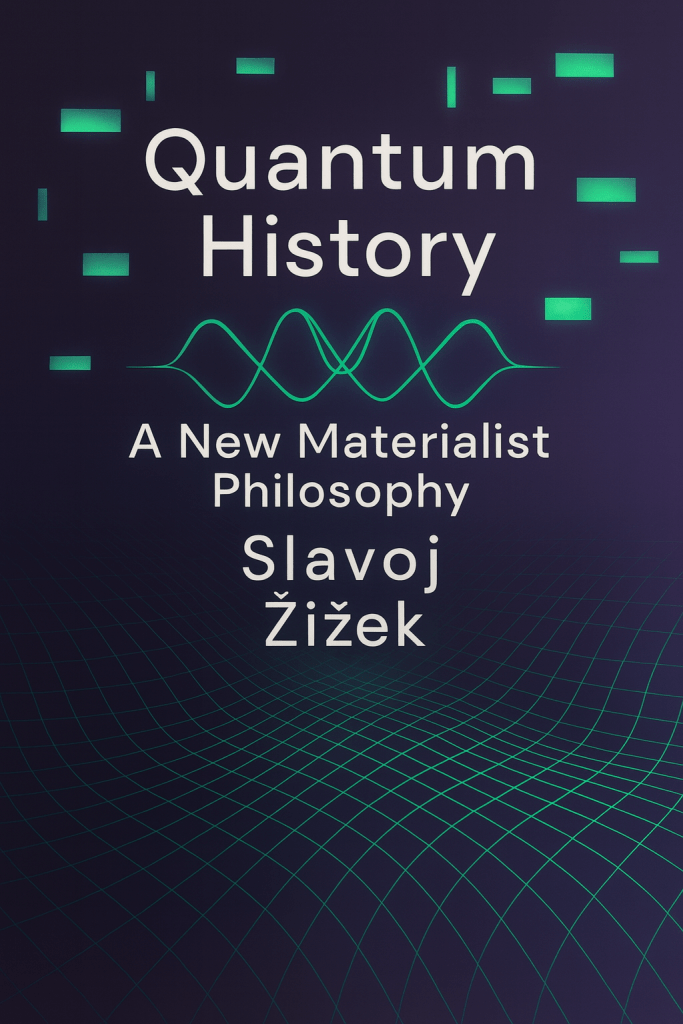
Žižek’s Quantum History: A New Materialist Philosophy stakes its claim on a double front: it proposes a reconstruction of materialism adequate to contemporary quantum physics and, inseparably, a reconstruction of historical and political agency under conditions in which no neutral standpoint outside quantum indeterminacy and symbolic distortion is available. The book’s distinctive contribution lies in the sustained attempt to read quantum mechanics, Hegelian dialectics and Lacanian psychoanalysis as mutually implicated discourses of the void, the collapse and the act, such that cosmology, ontology and politics are articulated on a single plane of immanence. The volume does not simply juxtapose physics and philosophy; it insists that the very form of historical materialism must change when it takes seriously wave superposition, non-commutativity and holography, and it does so by pushing to the limit the tensions between universal structures, finite particularity and singular interventions.
The outer framing of the work is already programmatic. The introductory reflection on materialism and quantum criticism does not approach quantum theory as a neutral body of scientific results to be decorated with philosophical commentary; it treats quantum mechanics as a symptom of a more general crisis of our metaphysical and political coordinates. The reference to Lenin’s injunction that every great scientific breakthrough demands a re-thinking of materialism is mobilized as a methodological maxim: the point is to discern how the formal structure of quantum theory reconfigures the very meaning of matter, contradiction and historical determination. At the same time, Žižek rejects any attempt to domesticate quantum indeterminacy as a vague spiritual resource; what quantum theory exposes is a more radical version of material inconsistency, a cosmos in which the gaps of being and the gaps of knowledge coincide without reassuring synthesis. From the first pages, then, the book inscribes the quantum problematic within a political scene: the cosmic panorama can only be grasped from the standpoint of a determinate antagonism, a contingent struggle, a situated impasse.
The introduction constructs this frame by way of a characteristic montage of examples that range from popular scientific imagery to literary and cinematic allusions. The image of a flat, two-dimensional world that secretly encodes a higher-dimensional reality functions as a figure for the holographic universe. Žižek is less interested in the technicalities of holographic dualities than in the way they destabilize naive intuitions about substance and background. The world appears as a projection of information inscribed elsewhere, yet this elsewhere is not a transcendent beyond; it is another configuration of the same immanent field. This interplay between surface and depth, between projection and inscription, foreshadows the central claim that history itself has the structure of a hologram: each local configuration of antagonisms, each concrete political situation, encodes the tensions of the whole. Materialism therefore becomes quantum-historical when it recognizes that there is no privileged vantage point from which the hologram could be surveyed in its entirety; the only access to the universal lies in partial, distorted, situated projections.
A key methodological gesture in the introduction consists in recasting the measurement problem of quantum mechanics in the terms of dialectical negativity. The puzzle of wavefunction collapse—of a multiplicity of simultaneous possibilities giving way to a determinate outcome when a measurement is performed—serves as a conceptual bridge between physical indeterminacy and the Lacanian notion of the act. Žižek does not approach the collapse as a purely epistemic transition from ignorance to knowledge, nor as the brute insertion of a classical apparatus into the quantum domain. He interprets it as a genuine event in which the ontology of the system is reconfigured, and he insists that this event cannot be disentangled from the symbolic framework in which it is registered. In the same way, a political act does not simply reveal an already existing constellation of social forces; it imposes a new structure of visibility and invisibility in which past potentials appear as if they had been there all along. The quantum vocabulary thus becomes a way of formalizing the retroactivity of dialectical determination.
The tripartite composition of the volume—Universal, Particular, Singular—translates this theoretical ambition into a logical movement. The first part elaborates an ontology of the universal in which collapse, non-commutativity and holography are treated as structural features of reality. The second part interrogates the particularization of this ontology in the problem of finitude, using Hegel and Heidegger as principal antagonists. The third part turns to singularity, to the site where universal structures and finite conditions intersect in concrete political and techno-cultural configurations. It is crucial for Žižek’s strategy that the movement from universal to particular to singular is not a simple descent in abstraction; each level displaces and reinterprets the previous one. The universal articulated by quantum physics is itself affected by the finitude of the subject that grasps it, and singular acts retroactively re-define what counts as universal and particular in the first place.
In the first chapter of the Universal section, the question “why a Hegelian needs quantum mechanics” is posed in a deliberately provocative form. The aim is not to add a fashionable scientific gloss to an already self-sufficient dialectic, but to show that certain impasses in the Hegelian system only become fully legible once the structure of quantum phenomena is taken into account. Žižek focuses on the problem of contradiction and determinate negation. Classical metaphysics treats contradiction as a sign of conceptual error, whereas Hegel recognizes it as the motor of self-movement in the concept. Quantum superposition gives this logic a new material configuration: a particle can occupy mutually exclusive states, and this coexistence is not merely a sign of ignorance but a structural feature of the system’s description. The collapse of the superposition under measurement can then be read as an instance of determinate negation, in which the indistinct multiplicity of potential outcomes is sublated into a concrete result that retroactively endows the previous state with meaning.
The chapter develops this analogy with care. Žižek emphasizes that the superposition is not an indeterminate muddle; it is a precisely articulated mathematical object described by a wavefunction. The multiplicity of possibilities already has a structure; it encodes interferences and correlations that cannot be reduced to a simple disjunction of options. This attention to structure allows him to resist any temptation to celebrate quantum indeterminacy as a formless freedom. The Hegelian needs quantum mechanics because quantum theory offers a formal vocabulary for a reality in which contradiction is inscribed at the most fundamental level, yet in a way that remains rigorously constrained. The dialectic of essence and appearance, of potentiality and actuality, finds a new setting: the underlying amplitude distribution is the field of essence, and the measured outcome is the appearance in which essence expresses itself only through the very constraint of measurement conditions.
The second chapter reverses the direction of the argument by asking why quantum mechanics needs Hegel. Žižek’s concern is that many standard interpretations of quantum theory oscillate between instrumentalism and an unexamined realism; either the formalism is treated as a mere tool for computing probabilities, or it is projected directly onto reality without an account of how subjective and symbolic mediation enters the picture. Drawing on contemporary cosmological debates, he discusses attempts to ground the origin of time and the emergence of classical spacetime from quantum fluctuations. In these accounts, the universe begins in a state of extreme symmetry and indeterminacy, and structure arises through symmetry breaking and decoherence. Žižek aligns this narrative with the Hegelian motif of the primordial void as absolute contradiction. The origin is neither a substantial One nor a balanced nothingness; it is a restless instability that contains determinate structures in a virtual, self-negating mode.
Hegel becomes indispensable when one asks how this void can generate a self-relating totality that includes the subject who theorizes it. Quantum cosmology often struggles with the place of observation; if the entire universe is the system, what does it mean to speak of measurement? Žižek uses the Hegelian concept of the concept itself as that which includes its own conditions of articulation. In a similar way, a consistent account of quantum reality requires that the subject’s act of measurement be treated as an internal moment of the process, not as an external intrusion. The cosmological model therefore needs a dialectical supplement: the universe does not first exist in a fully objective state and then accidentally generate observers; the very consistency of its quantum history implies the possibility of beings whose interventions retroactively “select” the path the universe has taken. The suggestion is not that consciousness causes collapse in any naive sense, but that the logical structure of collapse anticipates the emergence of symbolic agents.
The third chapter in the Universal section pursues the analogy between quantum non-commutativity and Lacanian structures of the symbolic. In quantum theory, the order in which observables are measured matters; the product of operators depends on their sequence. This mathematical feature serves Žižek as a model for the fact that the sequence of acts and utterances within the symbolic order is irreducible. Once an act has occurred, subsequent acts cannot simply return to a previous state; they must take into account the new configuration of meaning. The chapter develops a series of examples in which a symbolic intervention “measures” a social situation and thereby transforms the space of possibilities. A political proclamation, an artistic gesture, a psychoanalytic interpretation: these are treated as operators whose non-commutativity expresses the way they alter the field on which they operate.
Here the notion of the Real in Lacanian psychoanalysis becomes crucial. The Real is not a pre-symbolic substratum; it is the dimension of inconsistency that emerges from the limitations of the symbolic itself. Žižek aligns this with the quantum real in the sense of the non-commutative order that no classical picture can fully capture. The attempt to conceive the Real as a positive beyond of language corresponds to the classical fantasy of hidden variables that would restore intuitive coherence to quantum phenomena. A properly materialist approach accepts that the Real is the irreducible remainder generated by the symbolic apparatus, just as quantum indeterminacy is bound to the formalism that describes it. Non-commutativity thus marks the internal torsion of reality, and seeing this torsion requires a dialectical sensibility.
The second large bloc of the book, the Particular section, begins from the recognition that universality as such never exists in isolation. The universal only appears in the finite modes of its inscription, and the primary category that organizes these modes is finitude. Žižek stages a complex confrontation between Hegel and Heidegger around this category, with Pippin’s reading of Hegel serving as a contemporary reference point. The question at stake is whether finitude should be thought primarily as a limit inscribed in being itself or as the structural incompletion of a subject that never coincides with its essence. In Hegel, finitude is overcome in the movement of the concept, yet the overcoming itself is finite and mediated; in Heidegger, finitude is elevated into an ontological principle under the name of being-toward-death. The chapter on names for finitude reconstructs these divergent paths and examines the political consequences they entail.
Žižek’s strategy is to show that Hegel already internalizes the insight that Heidegger presents as a philosophical rupture. The Hegelian subject is not an omniscient spirit; it is constituted by its inability to master the contradictions in which it finds itself. At the same time, Heidegger’s elevation of finitude risks transforming historical contingencies into necessities of being. The shift from logical finitude to existential finitude opens the door to a politics of destiny in which concrete choices appear as responses to an originary call. Žižek reads this gesture in a quantum key: the temptation lies in imagining a primordial wave of being that collapses into a particular historical destiny for a people or a nation. Heidegger’s own political engagement becomes an exemplary case of such a dangerous collapse, where finite historical decisions masquerade as the articulation of being’s truth.
The chapter on the night of the world radicalizes this line of argument by returning to Hegel’s famous image of the human being as a night in which all cows are black, a turbulent interior in which determinate forms flicker and disappear. Žižek connects this image to a psychoanalytic account of the unconscious as a domain that is neither biological nor spiritual, but rather constituted by symbolic failures and excesses. The night is not a mystical depth behind appearances; it is the inner side of the symbolic order itself, the space in which signifiers lose their grip and new associations arise. Quantum indeterminacy returns here as a metaphor and more than a metaphor: just as the quantum state sustains incompatible possibilities, the unconscious supports mutually exclusive identifications and fantasies. The transition from this night to a stabilized identity occurs through an act that selects a specific configuration, but the background oscillation never disappears.
Heidegger’s attempt to ground this night in an originary mood of anxiety about being-toward-death is therefore subjected to critical scrutiny. Žižek argues that the anxiety in question presupposes a more fundamental inconsistency of the symbolic network, an inconsistency that Hegel’s logic of negativity is better equipped to think. If one approaches finitude exclusively through the lens of mortality, the historical and political determination of life and death risks slipping from view. The analysis of Heidegger’s political involvements is framed in this perspective: the philosopher’s error is not simply a moral failure, but a symptom of a deeper tendency to naturalize historically produced antagonisms. A genuinely quantum materialist approach insists that finitude is inseparable from the contingent configurations in which it is inscribed; there is no pure ontological finitude untouched by political struggle.
The third chapter of the Particular section pursues the politics of finitude in concrete terms. Žižek considers how finite subjects involve themselves in historical processes that exceed their comprehension, and he explores the dangers of both voluntarist activism and quietist acceptance. Finitude, in this sense, is not only a limit but also a resource: the impossibility of total knowledge forces subjects to act on the basis of incomplete information, and this necessity opens space for genuine decisions. Quantum mechanics once again supplies a formal analogy: one cannot wait for a fully transparent picture of the system before performing a measurement; the very act of measurement constitutes the system in a new way. The finite agent is a kind of measuring apparatus within history, and its interventions create paths that were not predetermined.
The book’s third major movement, the Singular section on politics in a quantum world, draws together the ontological and finitudinal analyses and relocates them within a series of concrete debates. The opening chapter on the hologram of conflicting universalities elaborates the earlier holographic motif within the sphere of ideology. Every political order claims to embody universal values—justice, freedom, security—yet these universals never appear except through particular forms of life that contradict one another. Žižek’s contention is that the conflict among universals is not an accidental clash of interpretations; it manifests a structural feature of universality itself. The universal is only accessible through partial perspectives that obscure as much as they illuminate. The holographic metaphor expresses this: each point of the hologram contains an image of the whole, yet each image is distorted in a characteristic way.
This chapter analyses various contemporary configurations of universality: liberal human rights discourse, nationalist sovereignty, religious universalism, capitalist market rationality. In each case, the universal claim is sustained by a particular way of managing antagonism, and quantum concepts serve to formalize the mutual implication of universals. Non-commutativity appears in the way different universals cannot be realized simultaneously without generating unexpected by-products; the attempt to maximize individual freedoms through market mechanisms, for example, interacts in non-trivial fashion with calls for collective equality or cultural recognition. Superposition and collapse reappear in the way political subjects inhabit multiple universal claims at once until a crisis forces them to choose. The singular act that resolves such a crisis—an uprising, a legislative decision, an ethical stand—performs the quantum collapse of incompatible commitments into a determinate stance that retroactively shapes the perceived history of the struggle.
The following chapter turns to the much-debated question of artificial intelligence. Žižek asks whether an artificial system can think in the strong, dialectical sense of the term. The discussion does not dwell on technical details of machine learning architectures; instead, it interrogates what kind of negativity is at work in artificial processes. Current AI systems excel at pattern recognition and probabilistic inference; they process vast datasets and infer correlations that escape human intuition. Yet for Žižek, thinking involves more than the manipulation of patterns; it entails the capacity to confront inconsistency in one’s own symbolic coordinates. The subject thinks when confronted with an impasse that exposes the inadequacy of existing concepts and forces a reorganization of its desire.
Quantum mechanics enters the argument insofar as some proponents of quantum computing claim that superposition and entanglement will allow machines to explore a vast space of possibilities in parallel. Žižek raises the question of whether this quantum parallelism can, by itself, produce the kind of reflexive negativity associated with human thought. A quantum computer traverses a superposed landscape of states, and the collapse upon measurement yields a result drawn from a probability distribution; yet there is no sense in which the machine experiences the tension of incompatible commitments. The human subject, by contrast, invests libidinally in certain symbolic configurations and is wounded when these configurations fail. The difference is not a simple matter of consciousness; it concerns the way in which lack and excess are inscribed. For a quantum history of materialism, this difference implies that artificial systems inhabit the same ontological field as humans, yet without sharing the same mode of access to the Real.
The chapter on the politics of vocation brings together several threads. Žižek explores the idea that subjects are called to occupy certain positions or perform certain tasks within the social order. Traditional notions of vocation suggest a stable correspondence between an inner essence and an external role; one discovers one’s true calling and aligns oneself with it. Quantum materialism undermines this picture. The subject’s identity is understood as a series of collapses of superposed potentials, each triggered by contingent encounters and symbolic interpellations. There is no pre-existing essence that the subject unfolds; there is only the retroactive perception of a trajectory that makes sense of previous acts. Vocation thus appears as a fiction that stabilizes a fundamentally contingent history.
Rather than dismissing vocation as an illusion, Žižek analyses its ambivalent political function. On one hand, vocational narratives can naturalize hierarchies and justify exclusion; on the other hand, they can articulate a commitment to tasks that transcend immediate self-interest. The quantum perspective insists that the subject’s fidelity to a vocation involves an ongoing negotiation with the void of undecidability at the heart of identity. In political terms, this means that genuine commitment does not eliminate doubt; it assumes it as a structural precondition. The singular act is not a leap into certainty but a decision undertaken in the absence of guarantees. The hunger to be something, which the conclusion will later elaborate, remains operative within every vocation, keeping it open to further transformation.
After this tripartite systematic development, the book introduces a sequence of Variations that function as both an extension and a displacement of the preceding arguments. These variations are not marginal appendices; they perform a structural role analogous to the variations in a musical composition. Each one takes up a motif from the main body—the void, collapse, universality, finitude, the act—and explores it in a new medium: physics again, but also literature, music, painting, cinema, sexuality, and political anecdote. The first variation engages Carlo Rovelli, Deleuze and the Stoics under the heading of frozen beauty. Rovelli’s relational interpretation of quantum mechanics, Deleuze’s emphasis on multiplicity and Stoic notions of fate are woven into a meditation on temporal structure. The idea of a frozen tableau that nevertheless contains within itself the traces of movement resonates with the quantum picture of a wavefunction that encodes a multiplicity of possible histories. The aesthetic figure of frozen beauty becomes a way to think how the universe can be described in time-symmetric equations while lived experience unfolds irreversibly.
The second variation, devoted to the theme that there is no substitute for true universals, revisits the earlier discussion of conflicting universalities from a different angle. Here Žižek stresses that universals are not abstract generalizations that stand above concrete struggles; they are the names for antagonisms that traverse the social body. Attempts to replace universal claims with local narratives or identity-based particularisms fail precisely because the universal dimension reasserts itself in distorted forms. Quantum metaphors intervene at the level of logical structure: universality appears as the entanglement of particular positions that cannot be disentangled into independent units. To posit a purely local politics without universals is analogous to imagining a quantum system whose subsystems have completely separable states; the very attempt to isolate destroys the phenomenon under scrutiny.
The third variation, on pure voice and pure sound with references to Beethoven and Globokar, transposes the quantum problematic into the register of music and the voice. Žižek distinguishes between the voice as bearer of semantic content and the voice as a drive manifestation, an excessive material remainder. In musical terms, this remainder appears in dissonances, noises, or extreme timbral effects that resist integration into harmonic structure. Quantum theory again supplies a conceptual resonance: the voice as pure sound is akin to the Real that escapes symbolic capture, much as the quantum real eludes classical visualization. Yet the point is not to glorify this remainder; it is to show that the very constitution of structured music and articulated speech requires such a leftover. The act of listening, like the act of measurement, brings forth an ordered object but leaves a residue that attests to the incompleteness of the ordering.
The fourth variation, on acts of reconciliation, articulates a delicate balance between the necessity of conflict and the possibility of forgiveness. Traditional dialectics often envisages reconciliation as the final sublation of antagonism into a higher unity. Žižek, drawing on the quantum conception of irreducible randomness, treats reconciliation as a contingent act that does not erase the past but interrupts its repetition. In human relations, this can mean that the gesture of forgiveness does not retroactively transform an injury into a moment of pedagogical growth; it introduces a new symbolic framework in which the injury persists but loses its binding power. Analogously, in politics, acts of reconciliation can establish a new order without claiming to have resolved the structural contradictions that gave rise to conflict. The quantum metaphor here is the collapse that does not exhaust the underlying state; decoherence produces classical behavior, yet the quantum substratum remains.
The fifth variation, under the provocative heading of moderately conservative communism, explores a paradoxical political stance that refuses both revolutionary voluntarism and complacent reformism. Žižek suggests that a certain conservatism is intrinsic to communism insofar as it values shared institutions and collective forms of life, while a certain radicality belongs to conservatism insofar as it demands fidelity to principles that transcend market pragmatism. The quantum dimension emerges here in the conception of social order as a metastable configuration sustained by ongoing fluctuations. A politics that aims at emancipation must respect the fragility of these configurations; reckless interventions can trigger collapses that open the door to reactionary forces. At the same time, the very metastability of the order makes emancipatory transformations possible. The moderation in question is therefore less a matter of temper than of structural insight into the quantum character of social reality.
The sixth variation, on the painted void, turns to visual art. Žižek analyses works that represent emptiness, darkness or monochrome expanses and shows how these images never present a simple nothing. The void that painting evokes is already framed, textured, shaped by the medium. Quantum physics provides an illuminating parallel: the vacuum is not an absence of particles but a seething field of virtual fluctuations. The painted void thus becomes a figure for the way in which nothingness is always minimally something, a structured potentiality. This dialectical insight has consequences for theology and atheism as well; the “void” left behind by the retreat of traditional images of God may be more densely structured than the images themselves. The variation therefore feeds back into the book’s underlying project of a materialist ontology in which absence, gap and inconsistency are positive categories.
The seventh variation, on the many monsters of the cinema, revisits Žižek’s long-standing fascination with horror and science-fiction films. Monsters, in this reading, are embodiments of displaced antagonisms and repressed desires; they materialize the Real that the symbolic order excludes. The quantum twist consists in treating the monster as a superposed entity: it often oscillates between multiple identities or states (human and non-human, living and dead, individual and swarm). The filmic narrative performs the collapse of these superpositions, deciding what the monster “really is,” yet traces of the uncollapsed possibilities linger. Cinema thereby stages, in a condensed aesthetic form, the play of quantum history itself: each monster story is a speculative exploration of alternative paths the symbolic order could have taken.
The eighth variation focuses on sexual superpositions. Žižek examines the way sexuality involves overlapping identifications, fantasies and practices that rarely align into a coherent identity. Subjects inhabit multiple sexual roles and imaginaries simultaneously, and they often oscillate between incompatible desires. Quantum superposition offers a suggestive formalization of this multiplicity: the subject’s sexual being is a wavefunction spread across a space of possibilities. The social demand for clear, stable identities functions as a measurement that collapses this spread into a determinate position. The point is neither to celebrate indeterminacy as pure liberation nor to denounce fixation as pure repression; it is to show that sexual subjectivity is structurally quantum-like in its dependence on contexts and interventions. The variation thereby extends the book’s materialist program into the most intimate domains of human life.
The ninth variation, titled Make the kitchen maid king, returns explicitly to the revolutionary motif of the elevation of the oppressed into positions of power. The phrase evokes the Leninist slogan that even a kitchen maid could govern the state. Žižek reads this dictum through the lens of quantum politics: the kitchen maid is a low-probability configuration within the existing distribution of roles, yet the act that propels her into kingship performs a radical collapse of social superpositions. The universe of political possibilities is reshuffled; roles that seemed fixed reveal themselves as contingent. At the same time, the new king remains marked by the past position; the event does not erase history. The variation thus encapsulates the book’s conviction that radical emancipatory acts are both unlikely and structurally inscribed; they arise from the intrinsic instability of the order they contest.
The conclusion, titled The hunger to be something, gathers these dispersed threads into a final reflection on subjectivity and history. The hunger in question is neither a simple drive for recognition nor a desire for possession; it is the structural urge of a being that arises from the void of inconsistency to assume a determinate shape. Hegelian dialectics and Lacanian psychoanalysis converge here: the subject is the result of a negativity that never coincides with any of its positive determinations. Quantum mechanics adds a further twist: the subject’s being is an emergent pattern of collapses, a history of selections among superposed potentials. To be something is to bear the scars of these selections, to embody the contingencies that could always have turned out differently.
Žižek is careful to insist that this hunger cannot be satisfied by any final reconciliation. There is no ultimate state in which the subject would fully be what it is; the very structure of the universe resists closure. The Historical Absolute, if one wishes to use such a phrase, is a totality that remains inconsistent at its core. Quantum history therefore names not a completed narrative of cosmic evolution but the ongoing interplay of void, oscillation and collapse at all levels, from subatomic processes to global politics. The absence of a neutral vantage point from which this interplay could be surveyed does not entail relativism; rather, it implies that every account of history is itself a partial collapse, a situated inscription that leaves the underlying oscillations intact.
The book’s composition sequence reinforces this perspective. The path from the introductory framing through the Universal–Particular–Singular triad builds a quasi-systematic architecture, one that appears to approach a comprehensive theory of materialism in the age of quantum physics. Yet the subsequent Variations and the open-ended conclusion displace this aspiration. Each variation undermines the illusion of closure by showing how the motifs of the system proliferate in unforeseen directions. The conclusion refrains from offering a master formula; instead, it accentuates the restlessness of the desire that drives philosophy itself. The outer framing thus enacts the very logic it describes: the panoramic vision of cosmos and history begins and ends in a determinate political and existential impasse, in a contingent situation that resists subsumption.
Methodologically, Quantum History distinguishes itself by the density of its cross-references and the precision with which it handles the analogies between physics, psychoanalysis and German idealism. Žižek does not treat quantum concepts as loose metaphors; he repeatedly returns to their formal features—superposition, collapse, non-commutativity, holography—and tests their philosophical yield. At the same time, he accepts that the philosophical use of these concepts inevitably displaces them from their strictly scientific context. The tension between fidelity to the physics and speculative extrapolation is not a defect to be eliminated; it is a structural feature of any attempt to think the implications of science for ontology. The book thus constantly oscillates between expository passages that explain the scientific background and speculative passages that push beyond the letter of the theory.
This oscillation generates a series of concept tensions that the book does not seek to dissolve. The relation between the quantum real and the Lacanian Real remains deeply problematic: are they simply analogous structures, or is there a deeper identity between physical and symbolic inconsistency? The status of the subject within quantum history is equally fraught: at times the subject appears as a particular kind of quantum system, at other times as a distinct order emerging from the symbolic. The interplay between Hegel and Heidegger raises the question whether finitude is ultimately a logical or an ontological category. Žižek’s treatment of artificial intelligence leaves open whether machines might one day participate in the same negativity that defines human thought. These unresolved issues do not weaken the book’s argument; they mark the points where its materialist ambition encounters its own limits.
In this sense, Quantum History is a work that performs its thesis in its very mode of exposition. It acts as a series of measurements on the conceptual field it traverses, collapsing the superpositions of Hegelian, Lacanian, Heideggerian, Deleuzian and quantum-theoretical lines of thought into determinate configurations. Each configuration is contingent; another selection of emphases, examples or analogies would yield a different philosophical image of quantum materialism. Yet the book’s wager is that these collapses, taken together, trace the outline of a new configuration of materialist philosophy. This configuration rejects both reductive naturalism and spiritualist appropriation; it affirms a universe whose ultimate stuff is inconsistency, whose history is a sequence of acts that emerge from a void that is never simply empty.
The closing clarity of the book lies precisely in its refusal of a serene, reconciled clarity. It clarifies that there will be no final clarity. The hunger to be something, whether in science, in politics or in individual existence, remains structurally unsatisfied. From this unsatisfaction arises the need to act in the midst of uncertainty, to commit oneself in sadness and doubt, without any guarantee that history bends toward justice or reason. Žižek’s Quantum History gives conceptual shape to this condition. It proposes that the only truly materialist philosophy today is one that lives with quantum contradictions, that accepts the non-commutativity of our acts, that understands universality as a holographic entanglement of conflicting perspectives, and that finds in the very impossibility of a neutral viewpoint the ground of a defiant, fragile, and necessary politics.
 Simon Gros
Leave a comment