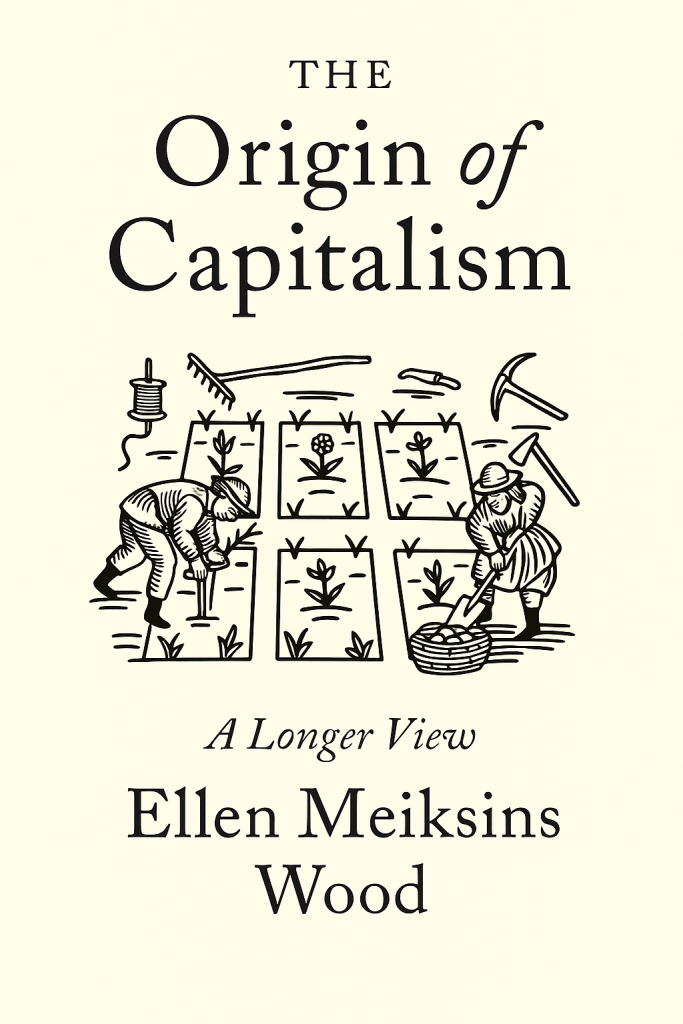
Capitalism, in Ellen Meiksins Wood’s account, acquires determinate form within history rather than it being a timeless inevitability. The distinctive stake of The Origin of Capitalism: A Longer View is to replace narratives of smooth “commercial evolution” with a precise specification of the social property relations that generated uniquely capitalist imperatives—market dependence, competitive accumulation, systematic productivity growth—and to show how these emerged first in the English countryside and then reorganized the modern state, imperial expansion, and everyday life. The contribution is methodological as much as historical: a rigorous disentangling of market opportunity from market compulsion, a reconstruction of compositional sequences that bind agrarian transformation to the formation of a national market and to a novel kind of imperial reach, and a carefully argued refusal of teleologies that present capitalism as the latent fulfilment of human exchange.
Wood begins from the polemical clarity that “the market” has long been imagined as the universal scene of human choice. Historical writing then treats capitalism as the long-delayed emancipation of this scene, the arrival of what had always already been present in embryo. Against that common sense she draws a tight conceptual line: capitalism exists where market dependence governs access to life and labour, obliging all classes—appropriators and producers alike—to reproduce themselves through competitive exchange. The market therefore operates as an imperative, not a field of discretionary opportunities; its laws are specific and historically bounded—competition, profit-maximization, accumulation, the continual raising of labour-productivity—rather than transhistorical expressions of rational bartering. This shift of emphasis undermines any account that explains origins by assuming the very phenomenon to be explained.
From this vantage point the classical “commercialization model” appears circular. By portraying exchange as a universal human propensity that matures into “commercial society” when fetters are lifted, such narratives erase the qualitative break that creates a world systematically compelled to compete, reinvest, and innovate. In Wood’s reconstruction, the old model dissolves into a paradox: it celebrates freedom while presupposing an impersonal mechanism whose advance is as inexorable as any law of nature. The appearance of continuity—from ancient merchants to medieval burghers to modern capitalists—rests on conceptual slippage; what is missing is the specification of a new mode of dependence and discipline, where the grammar of social life is rewritten by price signals that actors cannot ignore without risking dispossession.
The alternative history that Wood offers proceeds by tightly coupling conceptual distinctions to empirical sequences. The first move is to disaggregate commerce from capitalism: long-distance carrying trade and even dense urban markets can persist for centuries without generating the coercive logic of capitalist reproduction. Polanyi’s famous contrast between societies with markets and a properly market society is acknowledged for the clarity with which it marks a rupture, but Wood presses further: the decisive novelty does not flow from technological inevitabilities that finally require commodified “factors”—land and labour—as if machines demanded markets; rather, the novelty is instituted by changed property relations that create a new kind of compulsion to specialize, cheapen, and expand. The chronology of technique follows the logic of those relations, not the other way around.
The core of the book is an agrarian reconstruction: England’s countryside supplies the determinate micro-mechanism by which market compulsion takes hold. Demilitarized landlords consolidated unusually concentrated holdings and, lacking broad extra-economic powers of direct coercion, oriented their income to economic rents—rents governed by lease markets and the commercial performance of tenants. Tenants, for their part, competed both for consumers and for the land itself, paying rents priced by market conditions. This twofold exposure rendered access to the means of production itself a market relation. Success therefore selected for farmers who raised labour-productivity, lowered unit costs, and accumulated to extend their holdings, while others slid toward dispossession. The effect was a self-reinforcing selection for “improvers,” a countryside divided into capitalist tenants and landless wage-labourers, and a landlord stratum whose reproduction depended on the tenants’ competitive success.
Wood’s eye for paradox makes palpable how this transformation inscribes itself in the landscape: parliamentary enclosure and the eighteenth-century ideology of “improvement” married profitability to aesthetics, erasing villages to open vistas while perfecting a property regime that hid poverty behind picturesque order. The aesthetic idyll registers a class victory; the garden path overlays the track of expropriation. The point is analytical rather than lamentational: “improvement” names a bundle of incentives and calculations—surveyors’ differentials between customary and economic rent; lease terms that reward cost-reduction; literature that codifies “best practice”—through which a logic of accumulation invests soil, tenancy, and local regulation.
In positioning this English sequence, Wood is exact about counter-cases. Dutch commercial pre-eminence—dense urban networks, logistical supremacy, sophisticated finance—did not automatically instantiate capitalist discipline at the point of production. To the extent the Republic remained oriented to circulation, luxury markets, and urban merchant interests, its famous “modernity” exhibits the limits of pre-capitalist commercial logic rather than the onset of general market dependence. Commerce can be global in reach and dazzling in technique while leaving the social relations of production governed by old forms of appropriation. The diagnostic criterion remains whether social reproduction is compelled by competitive imperatives rooted in access to means of subsistence and production.
The book’s middle movement situates this agrarian origin within a theory of the nation state. Here Wood refuses two tempting simplifications: that capitalism is produced by “the state,” and that the modern state is merely an effect of markets. Instead she unfolds a braided history: England’s relatively unified legal-political order—common law, early territorial centralization, a London-centered market—co-evolved with property relations that had displaced parcellized sovereignty as a primary means of surplus extraction. A nationally integrated, competitive internal market emerges as both condition and consequence of agrarian capitalism; this is the matrix in which a distinctive state-form reaches maturity, capable of mediating the separation of “economic” and “political” moments that characterizes capitalist exploitation.
This separation—appropriation via the wage relation, coercion delegated to formally distinct political-legal apparatuses—confers both power and contradiction. Capital’s reach can exceed the arm of any single state, yet capital’s everyday conditions of existence—property enforcement, labour regulation, infrastructural coordination—rely persistently on nation-states. The much-advertised antinomy of “global markets” and “waning states” thus misdescribes a functional interdependence: transnational circuits of accumulation still require local institutional guardians; globalization widens the gap between economic scope and political grasp rather than abolishing the latter. The historical reason lies in the way capitalism first cohered within a sovereign territorial frame and then propagated its logic across that frame by modeling national organization rather than dissolving it.
This same framework reframes imperialism. Once accumulation depends on productivity growth and competitive reinvestment, expansion acquires a distinctive economic grammar. Early modern powers certainly conquered, taxed, and carried goods; England’s capitalism transforms these activities by projecting economic compulsions beyond direct rule. The ideological alibi sharpened accordingly: “improvement” travels overseas as a moralized arithmetic of value-creation, legitimating expropriation as the addition of wealth to the common stock and recoding religious or civilizational justification in the language of economic creativity. Empire becomes a vehicle through which market dependence and the search for surplus value reorganize distant social relations even without continuous coercive presence.
The long-view subtitle announces a double refusal: Wood declines both Eurocentric triumphalism and its mirror-image, the claim that non-European commercial sophistication was “on the way” to capitalism until Europe blocked the path. By treating accumulation of merchant capital as sufficient, such anti-Eurocentric inversions inadvertently inherit the old model’s naturalization of capitalism. Wood’s argument is that the specific social relation that institutes market dependence arose in determinate English conditions; this is neither a story of civilizational virtue nor of stolen inevitability. It is an account of divergent paths produced by differences in property, polity, and the loci of extra-economic power, in which the English case shows how dispossession and lease markets could convert landlord and tenant alike into vehicles of compulsion.
The book’s internal debates are staged with exemplary economy. The Dobb–Sweezy exchange—the classic “transition debate”—is introduced for what it clarified: the insufficiency of trade and towns to dissolve feudalism by themselves, and the centrality of class relations on the land. Within Marxism, Wood tracks how commercialization narratives persisted, sometimes under demographic or technological banners, precisely where the stake was to explain why capitalist laws of motion appear at all. The crucial intervention she distills from Marx’s critique of “so-called primitive accumulation” is to define capital as a social relation, not a quantum of wealth; the transition is the establishment of a property regime that requires accumulation and productivity gains to reproduce itself. Where historians begin with wealth in motion, they tend to end by presupposing capital. Where Wood begins with coercive dependence, she ends by specifying the motion that follows.
Within this architecture, “modernity” and “postmodernity” cease to be philosophies of time and become names for institutional articulations. Wood links the self-expanding dynamic of capital to new temporalities—accelerating cycles, generalized uncertainty—and to new spatialities—national markets, imperial networks, global production—but resists any dissolution of political form into economic process. The nation state remains structurally indispensable even as it mediates its own partial obsolescence in specific domains. At the same time, ecological and social consequences follow directly from the governing imperative to cheapen and expand, a point already implicit in the agrarian narrative of improvement that made beauty and profit a single calculus.
The compositional sequence of the book reinforces these claims. Part I analyses inherited explanations and exhibits their circularity; Part II distinguishes commerce from capitalism and establishes the agrarian mechanism; Part III extends the mechanism outward—first across England’s social topography, then into imperial relations, and finally into the institutional architecture of the sovereign territorial state and contemporary debates about globalization—before Wood returns to the normative horizon announced in her introduction: challenging the naturalization of capitalism is an intellectual and political necessity. By demonstrating that capitalism had a beginning in a specific configuration of social relations, she clears conceptual space for imagining an end.
A few features display the book’s distinctive contribution. First, the insistence on internal compulsion as the discriminant of capitalism allows Wood to marshal comparative materials—Dutch urbanism, French absolutism, composite monarchies, city-state “collective lordship”—without dissolving differences in a general story of “commercial growth.” The comparative upshot is stark: where politically constituted property persists as the main mechanism of surplus extraction, markets remain enclaved and competition is bounded by local privilege; where lease markets and economic rents prevail, the social metabolism reorganizes around price movements that no class can safely ignore.
Second, the linkage of agrarian capitalism to a single integrated national market clarifies why England’s “internal development” mattered more than sheer trade volume. The decisive transformation lay in intensive expansion—increasing productivity in production—rather than extensive expansion of carrying trade. Once that intensive dynamic matured, it conferred new advantages in commerce and war, compelling rival states to promote industrialization by motives that were often geopolitical before they were capitalist, thereby turning the European state system into a conduit for the diffusion of capitalist imperatives.
Third, the analysis of imperialism rescales agency. It is not merely that a capitalist power took colonies; it is that the market’s compulsions became portable, reorganizing distant labour processes and land tenure even where the flag was absent. This is why the language of improvement becomes an ethical technology: dispossession wears the mask of value creation, and domination arrives as productivity counsel. Such an account explains both the reach of capitalist social relations and the tenacity of national states as guarantors and translators of those relations.
Finally, the outer frame. The “longer view” signals that a critique of triumphalist narratives is inseparable from practical horizons. If capitalism’s emergence required centuries of conflict over land, law, and the meaning of productivity, nothing in the nature of markets secures its permanence. The same clarity that separates commerce from capitalism allows a sober reckoning with contemporary claims about globalization: capital’s global scope coexists with a structural reliance on territorial states; ecological attrition and social inequality reflect not accidental excesses of “globalization” but the working out of productivity imperatives that were legible in the English hedgerow. To rethink futures demands that we first recover the contingency of origins.
Wood’s book does not rest content with revising a timeline. It strengthens concepts so that history can become genuinely explanatory: capitalism is rendered as a relationship whose compulsion can be located, dated, and traced as it reorganizes institutions and landscapes. When market dependence appears, the shape of social life reorients around accumulation and competitive productivity; when it does not, commerce remains circulation without the inner necessity that makes capitalism a distinctive form of social power. That distinction, rendered with argumentative patience and documentary concreteness, is the book’s lasting achievement—and the source of its critical promise.
 Simon Gros
Leave a comment