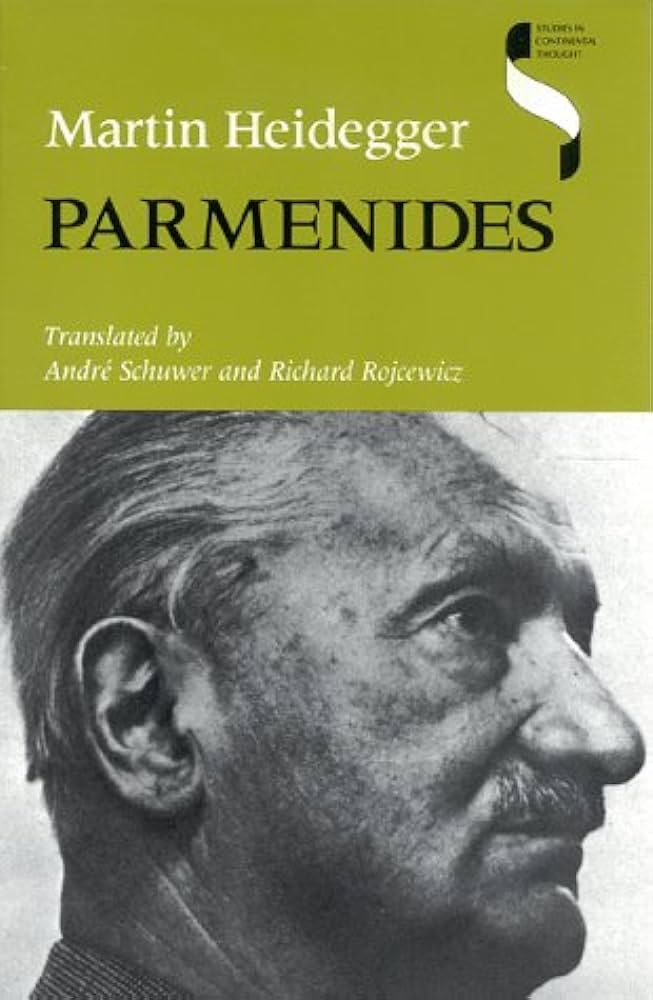
Parmenides, the lecture course Martin Heidegger delivered at the University of Freiburg in 1942–1943, stages a decisive and at times unsettling confrontation with the inception of Western thinking. Far from offering a merely historical commentary on a pre-Socratic text, Heidegger treats Parmenides’ so-called didactic poem as a privileged site where the primordial experience of truth is first articulated and, at the same time, already placed in danger. The course thus forms an essential moment in Heidegger’s ongoing engagement with the Greeks, in which Parmenides appears less as a museum figure of the history of philosophy and more as an interlocutor in a philosophical conversation that continues to determine the possibilities and blind spots of the present. It presents the poem of Parmenides as the decisive site where the Greek inception of truth as aletheia—unconcealment—both comes to word and is already exposed to a decline that culminates in the modern world’s fixation on correctness, representation and calculability. The book’s distinctive contribution lies in the way it joins a phenomenological reading of early Greek language to a critique of the Latinization of the West and to a diagnosis of contemporary “uprootedness” in an age of planetary technology. The course does not simply interpret Parmenides as a doctrine of being; it reconstructs, through a methodically staged engagement with Greek words, the original belonging-together of truth and untruth, concealment and unconcealment, thinking and being, and shows how this belonging is progressively covered over while still silently guiding our present.
The guiding problem of the lectures is the essence of truth and its original Greek determination as the event of unconcealment (aletheia), rather than as correctness of statements or conformity of representations to objects. Heidegger reads the poem as an attempt to think truth in its belonging together with untruth, concealment, and errancy, and he shows how this belonging is progressively obscured in the subsequent development of Greek philosophy. As reflection turns toward orthotes and propositional correctness, the original experience of truth as a clearing in which beings emerge and withdraw fades from view. The course patiently traces this decline in the understanding of truth—and equally in the understanding of untruth—as a long, intricate process whose consequences extend into the metaphysical tradition and into the everyday self-interpretation of the contemporary world.
Within this overarching trajectory, Heidegger gives special emphasis to the difference between Greek and Roman worlds and to the manner in which this difference is sedimented in language. The Latin translation and transformation of Greek key terms does not merely change vocabulary; it introduces a distinct way of experiencing and organizing reality. The Latinization of Greek thought, and with it of the West, becomes a historical event in which the originary openness of aletheia is narrowed into a conceptual apparatus geared toward rule, representation, and technical control. In Parmenides (volume 54 of Heidegger’s Collected Works), this philological and conceptual analysis remains inseparable from a far-reaching diagnosis of the contemporary age. The lectures deliver an unyielding critique of a world that Heidegger characterizes as out of joint, a world in which the forgottenness of the question of truth manifests itself in the domination of calculative thinking, the leveling of historical experience, and the loss of any attunement to the primordial disclosure in which both truth and untruth first become possible.
From the outset the lectures organize themselves around a single guiding problem: how does truth as aletheia first come into view for Greek thinking, and how does this origin already bear within itself the seeds of a transformation in which truth turns into correctness of representation, certainty of consciousness and objectivity of judgment? Instead of treating Parmenides as a primitive metaphysician who asserts a static realm of being, Heidegger constructs him as a privileged witness to a more originary understanding of truth and of the relation between human existence and being. The course insists that Parmenides’ poem cannot be approached as a storehouse of propositions, opinions, or theses; it must be approached as a saying that enacts an event. The journey described in the proem, the chariot ride to the goddess, the encounter at the gates, the paths opened and refused, are taken as the poet’s own enactment of the transition from everyday concealment into an exposure to the openness of being. The poem becomes a path along which thinking is escorted into the region where truth happens, and where untruth reveals its own essence as refusal and covering.
This orientation already indicates the methodological decision that governs the entire course. Heidegger proceeds through a patient, sometimes painstaking, retrieval of Greek words as hints of an unconceptualized experience of being. The guiding words—aletheia, pseudos, noein, legein, einai, physis—are not treated as detachable concepts that can be translated into Latin or modern equivalents without remainder. Each word is examined in its internal structure, its verbal form, its connections to verbs of coming-into-presence, of lying-forth, of gathering, of remaining. The course thus performs a kind of phenomenological etymology, yet with a clear intent: to let the Greek word, in its unforced usage, guide thinking back to the experience that first demanded such a word. This procedure simultaneously clarifies the Greek inception and displays the decisive effect of the later translation into Latin, above all the shift from aletheia as unconcealment to veritas as correctness or adequation.
The problem of Latinization is not an external addenda tacked onto a philological reading. It forms the horizon within which the entire interpretation of Parmenides is situated. For Heidegger, the key to understanding the decline of the primordial sense of truth lies in the fate of language. The Greek word aletheia names a happening in which beings are allowed to emerge from concealment; it indicates a dynamic interplay of revealing and hiding. When this word is rendered by veritas—the property of a statement that corresponds to things or the rectitude of an act of judgment—truth becomes a predicate of propositions or a quality of an intellect. The movement of unconcealment is replaced by a relation of agreement between representation and object. The lectures argue that this shift already begins within Greek philosophy itself, once thinking becomes oriented toward idea, eidos and orthotes (correctness), and that Latin thinking integrates and intensifies this tendency by fixing truth as adaequatio intellectus et rei. Parmenides stands at the threshold of this development: his saying preserves the older sense of truth as unconcealment, yet his insistence on the “is” opens a path toward a concept of being that later metaphysics will rigidify.
Within this framework, the leitmotif of the course is the unity of truth and untruth. Heidegger takes his point of departure from the remarkable fact that Parmenides’ poem is structured around paths: the path of persuasion that accompanies truth, the path of mere seeming associated with untruth, and the path that mortals typically follow. These paths do not designate logical options that can be freely chosen; they mark the essential possibilities of human comportment in the face of being. The path of truth leads into a region where being and thinking belong together; it is granted by the goddess in the encounter beyond the gates of night and day. The path of untruth is not a mere absence of truth; it has its own essence as the tempting dominance of appearances and opinions, as the self-assurance of mortals who dwell only among beings. In this sense, untruth is not a simple negation of truth but a mode of the concealment through which truth as unconcealment occurs. The lectures develop this insight by showing how pseudos (untruth) and lēthē (concealment, oblivion) stand in a mutual relation to aletheia.
In elaborating this dynamics, Heidegger constantly re-examines the everyday understanding of truth. Truth appears, for ordinary consciousness, as correctness: a statement is true when it accords with what is the case. Philosophical logic recognizes this as its starting point and elaborates conditions for the validity of propositions. Yet for Heidegger, this level presupposes a more original openness within which beings are already accessible as what they are. The correctness of statements rests on the prior event in which beings are disclosed. This disclosure is the happening of aletheia, and it is precisely this happening that Parmenides lets be seen. The central fragments of the poem, especially the identification of thinking and being, are interpreted as indications that for the Greeks, thinking occurs within the open region where being shines, steps forth, and manifests. Truth in this sense is the very clearing that allows beings to show themselves. Untruth, correspondingly, is not simply the mistaken judgment; it is the withdrawal of this clearing, the withdrawal that still belongs to the clearing itself.
The lecture course advances this thesis through a detailed reading of the poem’s proem. Heidegger spends considerable time on the image of the chariot journey, the mares that carry the thinker, the daughters of the sun who guide him, the gates of the paths of night and day guarded by Justice. All of this is interpreted in a manner that seeks to free these images from mythological reduction and recognize them as indications of a transition into the region of truth. The journey signifies the “way” of thinking, a passage out of the ordinary dwellings of mortals. The daughters of the sun and the goddess encountered beyond the gates signal the belonging of truth to a dispensation that exceeds human calculation. The gates of night and day represent the boundary between concealment and unconcealment. The goddess’s injunction to learn both the path of truth and the path of untruth establishes untruth as a dimension that must itself be thought if truth is to become manifest in its essence.
From this hermeneutic of the proem, the lectures proceed to an intensive examination of the famous claim that the same is for thinking and being. Heidegger resists the temptation to treat this as an epistemological thesis about the conformity of thought to its object. He reconstructs the pre-philosophical sense of noein (thinking) as a kind of bearing-toward, a letting-appear, that remains bound to the presence of beings. Thinking is no inner activity of a subject enclosed in its representations; it is a way of standing within the openness of being, of receiving and responding to the appearing of beings. The “same” that unites thinking and being therefore cannot be an identity construed in terms of a concept. It rather names a belonging-together within the event of unconcealment. In this event, being clears itself as the region in which beings appear, and thinking is gathered toward this clearing as its own most possibility. When Parmenides says that the same is for thinking and being, he says that both are taken into a unified happening that grants their relation. The lectures thereby transform the fragment into a clue about the concealed essence of truth.
This transformation depends on a methodological stance that the course articulates repeatedly. Heidegger insists that we cannot bring to the Greek text a set of preformed metaphysical or epistemological categories and then assign the fragments to these headings. Any reading that proceeds by asking whether Parmenides is a realist or idealist, whether he asserts the identity of thought and being or their congruence, has already surrendered to later conceptual schemes. The method must instead attend to the emerging interplay of words and meanings in Parmenides’ own saying. This involves a “step-back” from doctrine to the event of language. Accordingly, the lectures do not survey the poem in linear sequence; they return again and again to key words, circling them, exposing their inner structure, following their echo in other Greek texts and in ordinary usage. The result is a reading that might appear convoluted to the impatient listener, yet gains its force precisely through this repeated circling of the same region.
The question of the Greek world versus the Roman world enters as a further elaboration of the problem of truth. For Heidegger, the Greek language bears within itself a relation to being that the Latin language alters. Greek words such as physis, logos, aletheia, noein speak from an experience in which beings emerge, gather, and shine. When these words are translated into Latin—natura, ratio, veritas, intelligere—the relation to emergence and shining recedes. Natura no longer suggests the self-rising of what appears but indicates the ensemble of things endowed with a fixed essence. Ratio emphasizes calculation and ordering rather than gathering. Veritas focuses on rectitude of assertion rather than unconcealment. The lectures argue that this linguistic transformation indicates a deeper historical destiny: the disappearance of the originary understanding of truth from the horizon of Western humanity, a disappearance that nevertheless remains at work implicitly. The course in this way carries out a phenomenology of translation as fate.
Here the sequence of the composition becomes important. The earlier sessions lay the groundwork by clarifying the Greek sense of truth and untruth, by tracing the way aletheia and pseudos arise from everyday speech and are taken over into philosophical discourse. Only after this groundwork has been laid does Heidegger turn to the more explicit discussion of the Latinization of Greek thought. The order is significant: the reader is first brought into proximity with the Greek experience, in order that the later diagnosis of decline does not degenerate into a romantic nostalgia for an imagined past. The diagnosis has weight only to the degree that the earlier analyses successfully convey the original depth of the Greek words. When the lectures later move into explicit critique of the Latinized West and of the contemporary world, they draw their authority from this prior work of retrieval.
The treatment of untruth forms one of the book’s most distinctive contributions. Heidegger refuses to treat untruth as a merely negative concept defined in opposition to truth. Instead, he follows the indications of Parmenides’ insistence that the path of untruth must also be learned. Untruth is first encountered as pseudos—error, deception, false opinion. Yet pseudos itself rests on a more originary dimension of concealment, lēthē, which stands in intimate relation with aletheia. The lectures unfold this relation by showing that unconcealment always involves a holding-in-reserve: what appears does so on the ground of a greater concealedness. The clearing in which beings show themselves is never transparent in its entirety; it is constituted by a simultaneous withdrawal. Untruth, in this deeper sense, is the refusal of unconcealment, the clogging of the clearing, the dominance of what seems self-evident. This unity of truth and untruth finds echoes in other Greek texts, and Heidegger allows these echoes to resonate without detaching them from the central focus on Parmenides.
This development leads naturally to a rethinking of the human being. In the everyday notion of truth as correctness, the human being appears as a subject that judges and asserts; truth is then a property of subjective acts. In the Parmenidean understanding of truth as unconcealment, the human being finds a different position. Humans are those who undergo the paths of truth and untruth, who can be led by the goddess into the open, who can also remain among mortals distracted by appearances. Human existence thus stands in the middle of truth and untruth. It belongs to the clearing in which being can be revealed and concealed. The lectures, while using the familiar term Dasein only sparingly, clearly retain the fundamental insight from Heidegger’s earlier work: that the essence of the human is its ecstatic standing in the openness of being. In the Parmenides course this insight is translated into the language of Greek thinking and receives an ancient confirmation.
The composition of the course is framed by explicit reflections on the contemporary epoch. Heidegger characterizes the time in which he is speaking as “out of joint,” as an age in which the axes of history restlessly turn around an empty center. The world war, the planetary spread of technology, the uprooting and homelessness of modern man, all form the unspoken background of the lectures. Yet the text does not present itself as political commentary. Instead, the condition of the age is taken as a symptom of a much longer history of the oblivion of being. The Latinization of aletheia into veritas, the transformation of truth into certainty, the rise of metaphysics and then of modern science, are seen as stages in a process whose present consequence is a world in which beings are accessible only as objects of manipulation. The course suggests that a thinking that returns to the Greek inception can help prepare a different relation to being, even though such a return can never be a simple repetition.
The outer framing of the course thus accomplishes a double movement. On one side, it places Parmenides’ poem within the epoch of early Greek thinking, alongside Heraclitus and the tragic poets, as a decisive turning point in the emergence of metaphysics. On the other side, it places the current age within a history that begins with that same turning. The lectures thereby inscribe the present crisis within a broad historical destiny, while still insisting that this destiny is not a blind fate. The possibility of a different beginning emerges precisely through the remembrance of the first beginning. In this sense the course serves as a training in historical reflection: the reader is led to see that truth and untruth belong to a history of being that shapes entire epochs of human existence.
As the lectures progress, the earlier analyses of Parmenides’ poem gradually merge into wider meditations on language. Heidegger becomes increasingly concerned with the essential relation between being and naming. The Greek experience of the word as logos—a gathering that lets beings appear—contrasts with the modern experience of language as a tool for communication and expression. When the Greek says estin (“is”), he does not merely attribute a predicate; he lets the presence of being resound. The course therefore treats the apparently simple word “is” as a clue to the hidden essence of language. In Parmenides’ saying, the “is” resonates with the event of unconcealment; to say “is” is already to draw beings out into the open. The later history of logic, which reduces “is” to a copula linking subject and predicate, testifies to the forgetfulness of this deeper dimension.
These reflections on language eventually displace the narrower focus on Parmenides as author. The poem becomes a prism through which the essence of saying comes into view. Heidegger’s method thus reveals its own tendency: the more closely he adheres to the text, the more the text becomes transparent to something that exceeds it. The individual fragments recede, and what stands out is the unique way in which Greek thinking experiences the interplay of saying and being. This displacement is deliberate. The course does not aim to reconstruct the historical Parmenides as a figure in the history of philosophy. It aims instead to expose the truth to which his poem silently attests. The effect is that the book’s second half reads less like a commentary on Parmenides and more like a meditation on the destiny of language and truth in the West, carried by examples from the poem but no longer confined to them.
Within this displacement, Heidegger introduces an additional theme: the essence of philosophy as a way. In the proem, the goddess speaks of a path that the thinker must follow. The lecture course develops this into an image of philosophy as a journey guided by being itself. Philosophy arises when human existence is seized by the question of being and led away from familiar opinions. This path demands a certain preparedness, a readiness to abandon the security of what everyone knows. The lectures frequently return to the image of the path to underline that philosophy is not a system of propositions but a sustained standing in question. Parmenides appears as the exemplary thinker who submitted to this path and allowed himself to be addressed by the goddess. In this way, the course offers an implicit self-understanding of Heidegger’s own project as a continuation—in another historical situation—of the path first opened by the early Greeks.
The combination of problems, claims and evidence in the book constantly hinges on conceptual tensions that are left deliberately unresolved. One such tension concerns the relation between inception and decline. On the one hand, the lecture course describes the early Greek understanding of truth as a privileged inception that grants access to the essence of being. On the other hand, it is precisely this inception that initiates the path leading to metaphysics and to the oblivion of being. Parmenides’ insistence on the “is” inaugurates a determinacy of being that later thought will objectify. The path of truth and the path of untruth are thus already intertwined at the origin. Heidegger resists any simple narrative in which one could simply separate a pure beginning from a later degradation. Instead, he lets the reader feel how the very greatness of the Greek inception prepares the transformation into metaphysics. The inception contains within itself a latent possibility of decline, and the decline, in turn, carries a hidden reference back to the inception.
Another tension concerns the relation between phenomenology and philology. Heidegger performs close readings of Greek words and phrases, and he frequently pauses to discuss grammatical forms, verbal aspects, and the structure of compounds. This can give the impression of a philological enterprise. Yet the ultimate aim is never philological accuracy for its own sake; it is a phenomenological insight into the experience that speaks through the words. This dual orientation produces a peculiar dynamic. When he argues, for example, that aletheia has the structure of an event of un-concealing rather than a static property, he draws on the negative prefix a- and the root lēth- (concealment, forgetting), but he also brings into play a phenomenological sense of how beings emerge into presence. The interplay between linguistic detail and existential-ontological reflection gives the lectures their distinctive tone. At moments the philological observations seem to overshoot their textual basis; at other moments, they illuminate the text with unexpected depth. The course thus stages its own methodological struggle between fidelity to the words and responsiveness to the phenomena.
A further tension appears between the historical specificity of the Greek world and the trans-historical reach of the question of being. Heidegger insists that Greek thinking occupies a unique place in the history of the West. The Greek language, in its early form, bears an unparalleled proximity to being. At the same time, the question of being, and thus of truth as unconcealment, is presented as the basic question of human existence as such. The lecture course navigates this tension by suggesting that the Greek inception offers a historically singular yet exemplary way in which this question becomes explicit. The universality of the question therefore demands a particular historical path for its exposition. The reader is invited to look through the Greek words toward something that concerns every human being, while acknowledging that this access occurs through a specific historical language and world.
The late-war context of the course adds another layer into these tensions. When Heidegger speaks of the contemporary age as “out of joint,” he does so from within a Germany engaged in total war and subject to a regime that had already appropriated parts of his earlier language. In Parmenides, explicit political references are sparse, yet the mood of the lectures, their insistence on homelessness and uprooting, their critique of the domination of beings by calculation, cannot be separated from the historical situation. The course’s emphasis on the Latinization of the West and on the planetary spread of technology carries implicit reference to the political and military struggle of the time. Yet the lectures refuse any straightforward ideological alignment. Instead, they measure the present by an older measure: the Greek inception of truth. This produces a quiet but insistent distance from current slogans. The true crisis of the West is diagnosed as a forgetting of being that no political program can resolve. In this sense, the book’s critique of the contemporary world acquires a certain severity.
In the final movement of the course, the earlier themes of truth, untruth, language and history converge on the question of how a new beginning might be prepared. Heidegger does not present a positive program. He does, however, suggest that attentive listening to the early Greek words, above all to Parmenides’ poem, can prepare a readiness for another relation to being. This listening requires a loosening of the grip of Latinized categories; it demands that we hear aletheia again as unconcealment, that we understand untruth as refusal of this unconcealment, that we experience thinking as a standing in the clearing of being. The course thereby positions itself as a contribution to a transformative education of thinking. The lectures are not only about Parmenides; they attempt to guide their audience along a path that Parmenides first traversed.
The composition sequence of the book, from the preparatory analyses through the central reading of the poem to the broadened historical and contemporary reflections, reinforces this orientation. The reader is led in stages from an initial familiarity with the everyday notion of truth to a confrontation with a radically different understanding, and then from this confrontation to a renewed comprehension of the present age. Each stage both presupposes and transforms the previous one. The early methodological clarifications about Greek words gain new resonance when the Latinization of the West is brought into view. The reading of Parmenides’ proem gains new significance when the question of the path of philosophy is explicitly raised. The critique of the contemporary age gains depth when the preceding analysis has brought to light the long history of the transformation of truth. In this way, the book as a whole enacts the movement it describes: a passage from concealment through unconcealment and back into a more thoughtful acknowledgment of the inevitable interplay of both.
The effect of this structure is that the various parts of the work continually merge and displace one another. The initial focus on aletheia as unconcealment is gradually widened by the examination of pseudos and lēthē; the focus on Parmenides as an individual thinker is gradually displaced by the emphasis on the Greek beginning as such; the focus on ancient fragments is finally encompassed by a concern with the destiny of the West and the possibility of another beginning. Yet the earlier themes do not simply disappear. They remain as layers beneath the later reflections, shaping them and providing their weight. The trajectory of the book is therefore neither linear progression nor circular repetition. It is rather a spiraling movement that returns to the same issues at higher levels of generality, each time exposing deeper connections.
In closing, one can say that Heidegger’s Parmenides offers a densely woven meditation on truth and untruth as historical events. Its distinctive scholarly stake lies in the affirmation that the early Greek experience of truth as unconcealment has decisive consequences for the entire subsequent history of the West, and that Parmenides’ poem provides a uniquely illuminating access to this experience. Through a method that joins close attention to Greek words with phenomenological reflection, the book recovers the sense of truth as the clearing in which beings show themselves and recasts untruth as the refusal and covering of this clearing. The lectures thereby reorient the interpretation of Parmenides away from doctrinal questions about being and toward the more originary question of how being and thinking belong together in the event of unconcealment. At the same time, the course situates this interpretation within a broad history of the Latinization of Greek thought and the rise of modern technology, so that the reading of an ancient poem becomes the occasion for a critique of the present age.
The book’s contribution stands precisely in the way it complicates and problematizes the familiar narratives. It refuses to oppose a pure Greek beginning to a fallen modernity and instead shows how inception and decline interpenetrate. It refuses to reduce Parmenides to a metaphysical dogmatist and instead uncovers in his poem a thinking of truth and untruth that still speaks to present concerns. It refuses to separate philological rigor from philosophical questioning and instead allows each to call the other into question. In this intricate movement, Parmenides exemplifies Heidegger’s later thinking at a high level of concentration. The course teaches its readers that truth occupies a more originary dimension than correctness, that language carries within its simplest words the traces of a forgotten relation to being, and that the history of the West can be understood only from the perspective of this forgotten relation. Parmenides’ saying, as retrieved here, does not offer comfort. It exposes human existence to the demanding path between truth and untruth, a path that remains open and uncertain, yet in that very uncertainty grants the possibility of a more thoughtful dwelling in a time “out of joint.”
 Simon Gros
Leave a comment