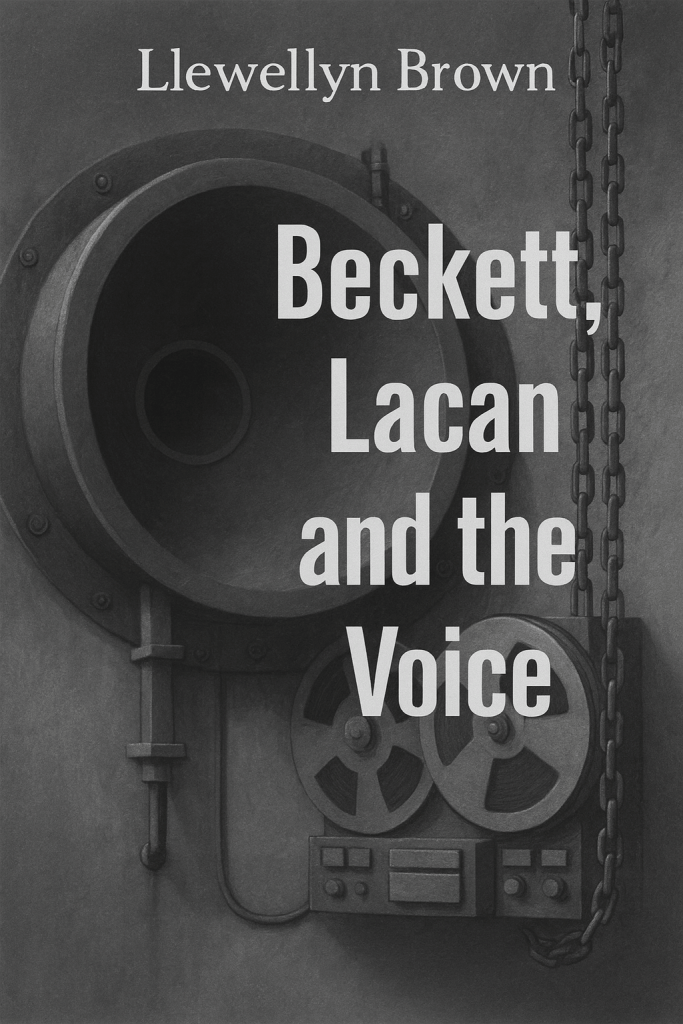
Brown’s Beckett, Lacan and the Voice stakes its claim on a very precise terrain: it proposes that Beckett’s entire œuvre can be re-read if one takes seriously the Lacanian thesis that the voice is a specific psychoanalytic object—neither pure sound nor mere vehicle of meaning, but the residue of language that both grounds and unravels subjectivity. From this angle, Beckett’s prose, theatre and radio plays are less a series of separate experiments in style and genre than a long, painstaking inquiry into what it means for a subject to be founded in language, exposed to a voice that is incessant, intrusive, soothing, unlocatable, and structurally “unowned.” Brown’s distinctive contribution lies in constructing, across the whole corpus, a unified yet deeply paradoxical logic of the Beckettian voice, using Lacanian concepts without ever allowing them to congeal into a rigid apparatus.
The book is framed, first, by the series preface Samuel Beckett in Company and by Jean-Michel Rabaté’s foreword, Lacan with Beckett: Departures, both of which already stage the work of relation and of voice that Brown will radicalise. The series preface places Beckett under the sign of relation and of its failure, circling around the figure of Nemo on the bridge in Dream of Fair to Middling Women and the problem of how any “company” is possible when relation itself oscillates between fragile bridges and disappointed crossings. Rabaté then opens Lacan with Beckett by juxtaposing two French sonnets — one by a young Beckett masquerading as Jean du Chas, one by the equally young Lacan — and showing how both poets already knot together desire, irrationality and a language that seems driven by something other than meaning. The “hiatus irrationalis” that Lacan takes from Fichte and Lukács becomes, in Rabaté’s reading, the name for a constitutive gap between theory and practice, signification and fire, that Brown will translate into the Beckettian domain as a “hell of unreason” and as the ground from which the blank cry and the pure question emerge. The foreword prepares a very specific thesis: Beckett and Lacan inhabit the same problem-field of voice, desire and irrationality, and Brown’s book is conceived as the most systematic working-through of that shared terrain.
Brown’s own introduction, The Voices of Samuel Beckett, begins from an apparently modest observation: the voice is everywhere in Beckett, as motif and as structuring device. From Mercier and Camier onwards, characters explicitly hear voices; The Unnamable is traversed by them to the point where any stable corporeal presence dissolves; in How It Is the narrator ostentatiously “quotes” what he hears; in Waiting for Godot Vladimir and Estragon speak of “dead voices”; Winnie in Happy Days confesses that days with sounds are the only “happy” ones; Krapp listens obsessively to his own taped voice; and the late theatre from That Time and Footfalls through the radio plays seems built around spectral voices as such. Yet Brown’s central initial move is to insist that this inventory, while suggestive, remains superficial if one treats the voice as a thematic embellishment or a phenomenological given. The book’s wager is that the voice must be grasped structurally in relation to language, subjectivity and the Lacanian distinction between utterance and enunciation, and only then can the bewildering diversity of Beckettian voices be seen as variations around a small number of underlying logical tensions.
The introduction patiently reconstructs Beckett’s biographical and aesthetic relation to listening in order to show that voice is not a metaphor for textuality, but the material point of departure of the writing itself. Brown draws on testimonies by Atik, Juliet, Knowlson and others to depict a Beckett who is “fundamentally inhabited by listening”: the man hypersensitive to noises to the point of being tormented by a ticking clock; the writer who can spend hours listening to the minute sounds of the countryside; the reader of Proust who admires the way a hammer blow or a hawker’s cry condenses the entire quality of a day. From such anecdotes Brown extracts a methodological principle: Beckett composes by hearing. The French Watt is recopied by hand after being read aloud, “so that it would all pass via the voice”; vocalisation is the guarantee of the writing subject, the anchoring of text in a bodily rhythm. The point is sharpened by Esslin’s report that Beckett described his own method as entering a state of concentration, “listening” to a voice emerging from the depths, taking it down, and only afterwards submitting it to critical shaping. The author becomes first a hearer of a pre-existing voice, then a scribe, and finally a craftsman — a sequence that immediately recalls, for Brown, the two levels of psychoanalytic speech: utterance and enunciation.
This initial mapping of Beckett’s listening leads into a first conceptual tension that structures the entire study: how to think a voice that is at once material phonation and the mark of an irreducibly divided subject; at once motif within narrative and the very condition of narration; at once “in” literature and, as Beckett himself remarks, something other than literature, since “when one listens to oneself, it is not literature one hears.” The introduction’s section “A Complex Field” lays out the difficulty. On one side stands a broad phenomenology of voice: cries, whispers, birdsong, radio voices, the spectrum from human to animal and from animate to inanimate. On the other stands a Bakhtinian sense of polyphony, the coexistence of multiple utterances, ironically close to the swirling of voices in The Unnamable. Brown shows how each of these perspectives grasps something important, but each misses the distinctive psychoanalytic proposition that the voice is an object — an objet a in Lacan’s sense, a remnant of the signifying operation that cannot be fully integrated into meaning and that thereby acquires an uncanny autonomy.
The introduction’s second half, “Psychoanalysis, Beckett and the Voice,” is where Brown decisively chooses his method. He explicitly rejects approaches that would reduce the voice to a stylistic innovation, a variant of interior monologue, or a modernist play with point of view. To proceed along purely æsthetic lines would mean parceling the voice into descriptive categories — internal vs external voice, quoted vs unquoted, prescriptive vs narrative — and then classifying works according to this repertory. Brown acknowledges the value of such work (Bruno Clément on the ambiguity of inner and outer voice, Sarah West on the performative voice), but he argues that such taxonomies cannot discover the unity of the multiple and paradoxical facets of the voice; they remain at the level of phenomena and miss the structuring logic. Only Lacanian psychoanalysis, he claims, supplies the conceptual resources to see how these facets derive from a single prior fact: the subject is founded in a language that pre-exists him, in discourses imposed by the first Others; the unconscious is “the discourse of the Other”; saying is distinct from what is said; and the voice occupies precisely the place of what the signifier cannot domesticate.
Brown’s exposition of Lacan’s theory of the voice in the introduction is compact but decisive for everything that follows. The voice is located among the “partial objects” (alongside gaze, breast, faeces) which the subject uses to give reality a minimal consistency. This object is not an abstract category; it is a material element at the very heart of existence. It marks the division between utterance and enunciation: when I speak, there is always a surplus beyond meaning — tone, insistence, rhythm, breath — in which the subject manifests himself as subject of the unconscious. Lacan then differentiates between a voice that insists as the hidden side of speech, and a fully externalised voice in psychosis, experienced as an intrusive, commanding Other. The superego appears as vociferation: language’s universal, law-like side returns in the form of an imperative to which no answer can be given, an injunction that culminates, if unchecked, in the subject’s abolition. In response, Lacan reintroduces enunciation as the possibility of “giving voice” in a way that silences, or at least localises, this destructive Other. Finally, Brown stresses Lacan’s late insistence that language is marked by a structural hole; no final naming can close the circuit and extinguish the voice once and for all. From these elements Brown derives his working definition: the voice is the real remainder of signification, experienced both as a torment and as the minimal organ through which a subject carves out a livable relation to language.
Once this preliminary map is in place, Brown outlines the architecture of his own book. After the introduction, four large movements take up the problem from different angles and displace each other in a carefully orchestrated sequence. The first chapter, “The Voice and Its Structure,” elaborates the basic structural logic of the voice in relation to language: utterance and enunciation, dialectic of unity and breach, the notion of the “unborn” subject, and the absent Other. The second, “Disjunction of Pronouns,” turns to grammar and shows how Beckett’s use of I, you, he, she dislocates the ordinary anchoring of discourse in shared space, substituting for intersubjective dialogue a configuration where pronouns float around a voice that binds them in another way. The third, “Continuous, Interrupted, Responses,” studies the topology of voices in terms of continuity, interruption and superegoic persecution, and asks how Beckettian subjects respond to a voice that will not stop. The fourth, “Exteriority and Artifice,” approaches the voice in its technological externalisation — radio, tapes, loudspeakers — and examines how apparatuses and quasi-geometrical structures serve as prostheses to contain the voice. The conclusion, “Singularity of the Voice,” returns to the whole field and argues that the Beckettian voice can only be understood if one holds together its subjective, structural and technological dimensions; the voice is at once existential ordeal and a vast, still open field for investigation.
The first chapter, “The Voice and Its Structure,” begins with what looks like an almost naïve starting-point: Winnie’s declaration that song must “come from the heart,” pour itself out like a thrush’s trill. This conception of the voice as a simple, unified emanation of a living interior allows Brown to show, by contrast, how the Beckettian voice is immediately split by the distinction between utterance and enunciation. The chapter patiently reconstructs Lacan’s fundamental propositions: that the subject is represented by a signifier for another signifier; that accordingly there is no immediate “self-voice,” only an enunciating position that remains structurally absent from what is said; and that the voice occupies precisely this gap between the saying and the said. Brown reformulates this for Beckett’s purposes: the voice is the residue left when names and meanings have done their work; it is what escapes the tight structuring of representation and yet is experienced as insistence within speech.
At this stage, Brown insists on a first dialectic: even when the voice is treated psychoanalytically as remainder, there remains in language an overall capacity to produce an “imaginary unity,” a mirror-like representation in which subject and world appear to fit. The early Beckett of Murphy and More Pricks than Kicks still inhabits such unstable unities; the voice is present as chatter, inner commentary, but the narrative space can still be traversed. The decisive shift, for Brown, occurs when Beckett’s work begins to dismantle systematically the conditions for such unity. Here the introduction’s motif of being “unborn” returns with new precision. Drawing on Beckett’s own remark in 1929 about “the absolute absence of the Absolute” and on later formulations, Brown defines the Beckettian subject as one who has never been instituted in relation to the desire of an Other; this subject therefore finds itself directly exposed to the unlimited dimension of language, without the mediating fiction of a world view. To be “unborn” is to lack symbolic birth into a community; it is to remain pinned to language as such, haunted by voices without the stabilising frame of a shared symbolic order.
This structural definition allows Brown to re-read the famed monologues of The Unnamable, Texts for Nothing and later works as explorations of a subject for whom the act of speaking is both unavoidable and impossible. When the narrator of The Unnamable protests that the voices and thoughts are not his, that they belong to devils who beset him, Brown hears the double structure of the voice: the subject is indeed spoken by an Other, yet the very protest, the refusal to assume the utterance, itself constitutes an enunciation — a “giving voice” that, however fragile, is the only way to keep the destructive Other from swallowing him entirely. The first chapter therefore culminates in a paradox: the voice is the mark of the subject’s mortification (dead voices, persecuting commands), but the same voice, once taken up as enunciation, becomes the minimal organ by which the subject carves out a place in language.
From this structural starting-point, the second chapter, “Disjunction of Pronouns,” shifts the focus to pronominal systems: I, you, he, she, and their role in founding subjectivity. Brown’s central claim here is that Beckett systematically undoes the normal articulation between deictic pronouns (I/you) and anaphoric pronouns (he/she), and that the result is a field in which dialogue collapses, but the voice gains a new, material density. Beckett’s pronouns do not (to use a formulation Brown carefully avoids but that hovers over his argument) organise a community; they rather expose a refusal of reciprocity that leaves the voice as the sole bond among fragments.
Brown shows this disarticulation in different configurations. In Not I, Mouth’s laws are simple and absolute: an almost pure torrent of words, an immense refusal of the pronoun I, an insistent use of the third person she to designate the speaking subject. The body is reduced to a disembodied mouth, the rest of the figure plunged in darkness, while the Auditor stands aside. The text’s force, for Brown, lies in this double movement: the drive of speech tears the subject away from any unified bodily image, and at the same time the furious rejection of I and the looping return of she function as a fierce assertion of being. The voice here is not interiority expressing itself; it is the real of drive, making itself heard through a pronoun that indicates an absence rather than a person.
In Company, by contrast, the pronoun choreography is more intricate. Brown attends to the triad I / you / he that structures the text: a “you” lying on its back in the dark, addressed by a voice that speaks of a “he,” while the possibility of an eventual “I” hovers as hypothesis. The narrative attempts to weave together the you addressed, the he narrated, and a potential I that might claim both positions. Each attempt to let I replace you and he fails, and the book concludes without a stable first person emerging. Brown reads this failure less as a simple negation than as a positive production: the voice that accompanies this repeated attempt is what gives company to the subject, even while any symbolic birth into an I remains impossible. The dislocating pronoun system yields the positive presence of a voice that cannot be assigned to a speaker, yet fills the dark.
A Piece of Monologue provides a third variation. Here the pronoun he dominates: a figure recounts life-episodes that clearly converge on himself, but always in the third person. Brown’s crucial observation is that the staging of the play — the light, the space, the ritual repetition — allows this he to appear, fleetingly, as a subject recognised by an Other. The stage performance, with its oblique address to an audience, functions like a substitute birth: the “unborn” subject, excluded from a consistent I, is granted for the duration of the ritual a temporary place within an impersonal he that is nonetheless his story. Here the theatre supplements what language alone cannot do; the voice obtains a brief, spectral anchoring in a communal space, without this ever becoming fully dialogical.
In all these examples, the outcome is similar: the familiar two-term structure I–you, foundation of ordinary intersubjectivity, is uncoupled from any stable third person; the Beckettian subject is “absolutely alone,” not because others are physically absent, but because pronouns no longer mediate a shared reality. Brown insists again that this is not simply a negative diagnosis. The absence of a dialogical articulation makes the voice itself stand out as what binds these pronouns at another level, what passes from she to you to he without ever becoming I. The second chapter therefore displaces the first: after establishing structurally what the voice is, Brown now shows how Beckett’s grammar disarticulates social bonds so as to make this object manifest.
The third chapter, “Continuous, Interrupted, Responses,” takes up the voice from another angle: its temporal and topological modes. Brown begins by distinguishing two apparently opposed properties of the Beckettian voice, continuity and interruption, only to argue that they form a unity at the level of the real. The early iconic formulation of continuity appears in Waiting for Godot, where Vladimir and Estragon imagine “dead voices” that murmur, whisper, rustle; language is envisaged as a continuous background noise that cannot be stopped. This motif returns in the Trilogy and in Texts for Nothing: the subject is filled with voices, which run on irrespective of his wishes, and which he can neither master nor definitively silence. Brown sees here the experience of a “mortifying” language, in which all speech testifies to the absence of a living interlocutor; voices circulate within a subject who cannot move in any traversable space.
This continuity takes a darker form in Eh Joe, where the inner voice of accusation becomes an insistent external address. Here Brown’s Lacanian reading comes to the fore: the voice that speaks to Joe has the traits of the superego, that imperative that commands enjoyment and demands the subject’s annihilation. The camera’s gradual zoom toward Joe’s face, while the voice enumerates his failures and betrayals, materialises the convergence of gaze and voice, those two partial objects that unmoor the subject from any secure image of himself. The continuity of the voice is experienced as persecution, as a presence no bodily movement can escape. The subject responds by attempting to reduce it, to control its onset and duration, but, as Brown emphasises, any apparent success is precarious. The voice remains a residue that refuses integration; the most that can be done is to negotiate with it.
The chapter then reverses the perspective and considers the voice as interruption. Brown notes how, in many texts, speech is punctured by sudden voices that cut through narration or dialogue. These interruptions cannot be assimilated to ordinary conversational turn-taking; they have the structure of irruptions of the real. The voice breaks discourse, introduces gaps, imposes sudden shifts of topic or tone. From a Lacanian vantage, these interruptions dramatise the fact that language is not a closed system; the subject is never entirely protected by signification. The voice, as object, can always appear where no place has been foreseen for it.
It is here that Brown introduces, drawing on Geneste and others, the crucial notion of the hiatus as Beckett’s own way of handling the superegoic voice. The imperative “You must go on, I can’t go on, I’ll go on” has often been read as pure superego — an unending demand for continuation. Brown, however, insists that Beckett produces a specific gap within this command. The hiatus is an “impossible that cannot be obstructed by obeying the superego’s petitions.” In other words, even total obedience does not suffice; there remains an impossibility that the subject encounters as the limits of language. This impossibility, far from paralysing, opens a space for creation. The command “go on” becomes less a blind order than the edge at which the voice as real forces the subject to invent. Brown sees Beckett’s fragmented syntax, his elliptical punctuation, his stopping and starting, as material ways of inscribing this hiatus: they are not stylistic quirks, but the written trace of an encounter with a voice that is beyond both pleasure and any simple economy of meaning.
The fourth chapter, “Exteriority and Artifice,” brings in yet another displacement: the technological and theatrical externalisation of the voice. Here Brown’s argument becomes more complex, because he has to hold together three layers: the psychoanalytic concept of the vocal object, the history and phenomenology of technologies like radio and tape, and Beckett’s own reflexive comments on his media. The central thesis is that radio, recording and stage apparatuses do not merely represent the voice; they produce it as object and allow Beckett to construct forms that partially circumscribe the unlimited.
Brown starts from Pierre Schaeffer’s term “acousmatic voice,” later taken up by Chion and Dolar: a voice that is heard while its source remains hidden. The radio, in this sense, is the paradigmatic modern acousmatic medium. It separates voice from visible body, detaches it from any localisable source, and disseminates it “to the four winds” — Beckett’s own phrase about All That Fall. Steven Connor’s notion of broadcasting as an address with no clear addressee, always overheard rather than directly received, is mobilised to illuminate the uncanny intimacy of the radio voice: it is felt as if it addressed me alone, yet it is structurally anonymous. Brown then aligns this media phenomenology with the Lacanian object voice: in both cases, the voice is torn from its imaginary anchoring in a person and emerges as something exterior, invasive, oddly intimate.
The crucial step is Brown’s argument that for Beckett, radio and tape do not simply intensify a pre-existing concern with voice; they reconfigure it. In All That Fall, the abolition of traversable space is key: “everything unfolds in the radio set,” Brown notes, and only the sounds are real. Mrs Rooney’s perception of characters “stealing up” behind her is entirely an effect of the acoustic field; voices arise out of the dark instead of lodging themselves in visible positions. In Embers, spaces interpenetrate through sound; Henry’s memories of his daughter’s riding lesson are rendered as sudden intrusions of galloping hooves and cries, edited into the present like film cuts. The radio thus gives material form to what Brown calls the “dream reality” of Beckett’s texts: signifiers that return with the force of free association, unconstrained by visual continuity.
Radio, however, for Brown, is never just an intensification of the uncanny. It also offers a way of localising the voice. In Rough for Radio I, the man attached to the radio set experiences the broadcast as a “need”: he cannot detach himself from it; the voice silences a more tormenting internal voice. The pronoun “that” (ça in French) used to designate the object captures its ambiguous status — neither noble nor meaningful, more like refuse or scrap, precisely what Lacan names objet a. In Krapp’s Last Tape, the tape-recorder becomes an “organ”: Krapp’s body is doubled, and his relation to his recorded voice is at once contemptuous and fascinated. When Krapp denigrates the recorded voice as imbecile, Brown sees the superego’s scorn being replayed; the tape produces an external object on which self-hatred can fasten. Yet the annual ritual of recording is also a desperate attempt to offer something to the Other — to inscribe himself in a sequence that might outlast him.
Brown generalises from these examples: technological devices, as organs, permit the subject to frame the unlimited voice, to give it a local habitation. The radio set, tape-recorder, loudspeaker define closed spaces; they create a topology in which the voice can circulate without immediately flooding the subject. In Embers, the skull-like interior to which characters retreat provides a fragile refuge from an otherwise boundless sea of sound. Technology is thus read as extension of the signifier’s universal reach (science, capitalism, Benjamin’s loss of aura), but simultaneously as a prosthesis through which the singular subject can carve out a minimal living-space.
Alongside these devices, the fourth chapter analyses what Brown, following Lacan, calls discursive “apparatuses.” He notes that many Beckett texts deploy small ensembles of figures arranged in quasi-geometrical configurations, each with a distinct function: subject, witness, scribe, master. These arrangements resemble Lacan’s four discourses (master, university, hysteric, analyst), in which four positions circulate around the object. In Murphy or the MMM sequence, in How It Is, in Molloy, in Rough for Radio II and What Where, Brown detects such four-term apparatuses designed to capture, transmit or torture the voice.
The function of these apparatuses is twofold. On the one hand, they partially circumscribe what Beckett himself calls “the mess,” distributing responsibility for speaking, hearing, writing and commanding. On the other, they reveal their own insufficiency. In Rough for Radio II, for instance, the unseen committee that directs the interrogation acts as an absent “master”; the scribe, the torturer, the victim and the elusive “unborn” brother reported in speech form a structure that never quite closes. The voice appears as torture, as a physical hold of language on the body, but the apparatus designed to master it shows itself flawed, riddled with gaps. Torture, Brown suggests, becomes a way of inscribing the voice in the body, giving the subject a paradoxical sense of consistency; at the same time, the repeated attempts to extract a definitive confession fail, indicating the real’s resistance.
In Play, the spotlight functions as an inarticulate “sound editor”: it cues the three urned figures to speak, organising their monologues but remaining itself mute. Brown is careful to resist a simple image of the spotlight as persecutor. The light, deprived of voice, is as bound to the setup as the figures are; it cannot escape the circuit it animates. The same applies to the Voice of Bam in What Where, relayed through a megaphone: Bam orchestrates permutations of spectral figures in search of an impossible answer, yet his own position is that of a gaping hole in language. In Cascando, Opener performs this editor role more explicitly, switching between “words” and “music,” fearing constantly that the voices may cease, and thus reveal the void they are holding at bay. In all these instances, the subject who cannot create in the usual sense produces his singular position by editing, switching, alternating among voices and sound-tracks; he is structurally implicated in the apparatus he might appear to control.
Across these four large movements, Brown’s procedure is remarkably consistent. He constantly moves between close reading of Beckett’s texts, reconstruction of Lacanian concepts, and reflection on the stakes of creation. The theoretical discussion of the voice as object, of superego, of jouissance (enjoyment beyond pleasure), of lalangue (the body-side of language as sound and equivocation) is never allowed to float free; each conceptual thread is anchored in precise textual situations. Conversely, the readings of Beckett are never purely descriptive; they are always oriented by the question of what kind of subject is being figured here, in what way it is “unborn,” how it negotiates an absent Other and an unlimited language. The composition of the book thus follows a sequence of progressive displacements. The foreword situates Beckett and Lacan together in the shared problem of irrationality and desire; the introduction defines the field and method; Chapter I sets the structural foundations; Chapter II shows how grammar dislocates intersubjectivity; Chapter III exposes the temporal modes of the voice and the possibility of hiatus; Chapter IV explores technology and apparatuses as external supports for dealing with the voice. The conclusion then returns to the beginning — to listening, to the “non-literary” voice that Beckett hears in himself — but now recasts it in the light of the elaborate machinery that has been unfolded.
The concluding chapter, “Singularity of the Voice,” insists that the whole study has focused on saying rather than on the visible world, on the voice rather than on vision. Brown recalls his earlier work on the scission between seeing and saying in Beckett, where he had argued that the visible world in Beckett is often frozen, endowed with a fixed meaning into which the subject cannot inscribe himself, whereas saying reveals a pure subjectivity exposed to the voice. Here he clarifies that the present book has taken up one half of that scission — the voice and its structures — in order to outline the existential importance of voice in the subject’s relation to language.
The conclusion first summarises the conceptual path: psychoanalysis allows us to avoid both sociological realism and purely phenomenological accounts; it lets us treat the voice as object emerging from the division that founds the subject of the unconscious; it shows language as pre-existing the subject, imposing discourses that the subject cannot fully master; and it insists on a structural hole that prevents any final closure. On this basis Brown redefines the Beckettian subject as “unborn,” facing “the absolute absence of the Absolute,” in permanent contact with the unlimited of language. The middle-period works are read under the sign of melancholy: the subject experiences the impossibility of escaping existence, an eternal confinement within language untouched by any vivifying desire; with the phallic, law-giving register critically compromised, the subject is simultaneously “born” and “unborn,” unable to integrate either state.
Having thus condensed the structural picture, Brown recapitulates the specific contributions of each chapter, but always in order to fold them into a single, more intricate figure. The analysis of pronouns showed how the breakdown of I–you–he articulations produces the positive presence of the voice; the study of continuity and interruption demonstrated how dead voices and persecuting commands expose both the mortifying and the inventive dimensions of the voice; the exploration of radio and technological devices revealed how the voice can be constituted as organ and need, while disclosing the subject’s dependence on apparatuses that both constrain and sustain him; the investigation of apparatuses and discourses foregrounded the way an absent master position haunts the Beckettian arrangements and compels a subject to imagine an interlocutor even in the most absolute solitude.
The book closes by returning to the question announced in the blurb and in the series framing: the voice traverses Beckett’s work, emanating from an indeterminate source outside narrators and characters, while permeating the words they utter; it is incessant, sometimes violently intrusive, sometimes calming; literary creation is charged with transforming the mortification it inflicts into a relationship to language that is, paradoxically, vivifying. Brown’s study demonstrates that Lacanian psychoanalysis offers a way to approach these multiple, paradoxical facets of the voice, not in order to normalise them under an abstract framework, but in order to register their singular consistency. The voice is shown to be at once an existential ordeal — the sign of abandonment, of being “unborn,” of being subject to an unlimited language and a capricious superego — and a minimal organ through which a subject invents a mode of survival. Technological media, pseudo-geometrical apparatuses, pronoun games, fragmented monologues and relentless radio murmurs all appear, in Brown’s account, as local and fragile ways of bearing the impossible injunction of the voice.
What distinguishes the book within Beckett studies is precisely this insistence on the voice as object and on jouissance as the register in which Beckett’s writing operates. The voice is not reduced to a metaphor for interiority nor to a sign of postmodern textuality; it is treated as a material scrap that the subject both suffers and uses. Lacan’s later concepts — lalangue, the non-all of the symbolic, the pluralisation of the Name-of-the-Father — enter as indispensable tools for thinking this situation, yet Brown constantly tailors them to Beckett’s singular configurations. The study thereby opens a “potentially vast field of investigation,” as the publisher’s note cautiously suggests, but it also gives that field a rigorous inner organisation: the Beckettian voice emerges, by the end, as a distinct object with its own topology, temporality and apparatuses, and as a privileged site for examining how language, subject and technology merge at the limit where existence itself is at stake.
 Simon Gros
Leave a comment