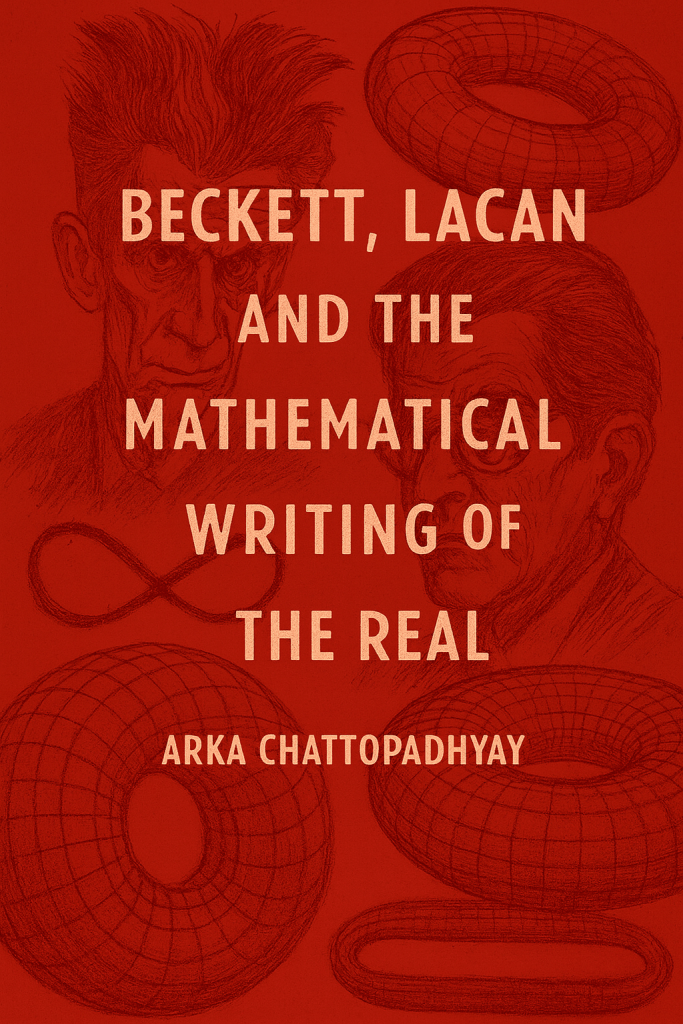
The book’s wager is that the most precise way to think the relation between Beckett’s late prose and Lacan’s late teaching passes through mathematics understood as a mode of writing. Its distinctive contribution is to displace familiar topoi of “Beckett and psychoanalysis” or “Beckett and modernism” by constructing a very closely linked three-term configuration in which Beckett, Lacan, and mathematical discourse ceaselessly exchange positions. Writing appears here as a logical operation that traverses prose, clinic, and formalization; the Real is approached as that point at which this operation falters into an impasse. By following this faltering across number, topology, geometry, counting, motility, and sexuality, the book proposes that Beckett’s late prose constitutes a kind of mathematical writing of the Real unconscious, and that Lacan’s mathemes themselves require Beckettian textuality to show what they do.
The outer frame already stages the stakes. The foreword situates the book against two existing tendencies: work that links Beckett to mathematics and work that links Beckett to Lacan, yet rarely both at once. Beckett has been read through geometry, combinatorics, and infinity; Lacan has been brought to Beckett’s theatre and prose; but, as the foreword stresses, no one has previously undertaken a sustained reading in which “Beckett, Lacan, and mathematics” form a rotating triangle, each side alternately supporting and undermining the others. In this frame, mathematics is no longer simply a reservoir of images or a guarantee of rational clarity. It becomes an aporetic logic of infinities, sets, paradoxes, and incompleteness – a thinking of limits that makes intelligible what would otherwise remain only an opaque “unsayable”. The book, the foreword claims, thus delivers at once: new Beckett readings that become possible through Lacan and mathematical theory; new Lacanian insights generated by Beckett’s writing practice; and a reorientation of mathematics away from a naïve rationalism towards its own internal fractures and modes of uncompletable rigor.
Even before the chapters begin proper, the acknowledgements tacitly align the project with a kind of lived, collective labour of reading. The names – Lacanian comrades and Beckett scholars, members of study groups and psychoanalytic circles – mark out precisely the border the book will later theorize as a littoral: the shifting coastline between psychoanalysis and literature where writing as such becomes the shared medium. This “social” paratext is not anecdotal decoration; it foreshadows the insistence that the subject of the text is never simply the authorial ego, but an impersonal effect of discourses knotted together.
The introduction, “Real Writing in Literature and Psychoanalysis,” then fixes the central problem: how to think writing as the formal operation that simultaneously binds and separates psychoanalysis and literature. The starting point is the observation that both discourses are saturated with writing. In the clinic, speaking is already a form of inscription: the analysand’s body-in-speech “writes” in the act of talking, while the analyst responds by writing – in notes, in mathemes, in punctual interventions that cut across the flow of speech. In literature, conversely, every written text carries a residual or virtual speech; reading converts silent letters into a kind of internal voicing, so that one encounters a speech-in-writing just as the analytic situation exhibits a writing-in-speech. The opening pages shape this into a chiasm: literature speaks writing; psychoanalysis writes speech. The paradoxical unity and difference of these two “typographical” economies is the first formulation of what the book calls Real writing.
Writing, in this sense, is neither a purely semantic operation nor a transparent vehicle for meaning. It is a generalized technology that produces content in and through its own formal envelope. The author emphasizes the material and embodied character of writing: the hand on paper or the fingers on keys, the voice and mouth of speech, the page or screen as a physical or virtual surface carrying Script as matter. Language in an unknown tongue, before signification, appears as a dense sonorous or graphic material that fascinates precisely because it resists understanding. All this leads to a principle: before interpretation, there is the material body of the word. Literature and analysis share this materiality; both host a logic of concrete forms which, once set in motion, “complicates itself endlessly as it goes on.”
From here the text introduces the key Lacanian term that will silently govern the entire book: the Real. Initially, the Real appears as what slips out of the constitutive operation by which we bind images to words, sound to meaning, and thereby construct a coherent “reality”. Reality is an Imaginary-Symbolic composite: a web of images and signifiers that hang together, and in hanging together, exclude something. That excluded remainder – what cannot be caught by meaning, image, or representation – is the Real. The book insists that the Real is not a mystical beyond, but an impasse within formalization itself, the point at which logical, mathematical, or linguistic systems encounter their own impossibility.
It is here that mathematics enters decisively. Following Derrida’s remark that mathematical writing is a “non-phonetic inscription,” the author emphasizes that mathematics is a discourse where writing does not depend on speech at all. The steps of a calculation may be spoken, but they exist primarily as written operations. Mathematics fascinates literary modernists precisely because it seems to promise a formalization that continues where ordinary language fails, a way of writing that could touch that “unspeakable” which obsesses modernist aesthetics. Yet the book immediately displaces any naïve equation of mathematics with clarity or control. Modern mathematics, it argues, is itself traversed by aporias: contradictions, infinities, incompleteness theorems, paradoxical sets. The mathematical is therefore marked by an aporetic logic that, far from opposing the irrational, gives a rigorous form to it.
The introduction proceeds through a dense historical and conceptual mapping. It recalls Beckett’s mini-prose “The Way,” in which the lemniscate – the sideways figure eight – is mobilized to think infinity as a path between two zeroes, a path whose surface alternately preserves and erases footprints. The narrative explores how zero can function first as a pure absence of sign, then suddenly as a sign of absence: zero as “zero knowledge” becomes, under changed material conditions, zero as “one” piece of knowledge. The movement from sand to bedrock, from erased to preserved trace, becomes an allegory of how mathematical form arises from the oscillation between nothing and one. Already we see the book’s style: rather than extracting abstract theses, it lingers on small textual details and reads them as sites where mathematics and corporeal inscription converge.
The introduction also situates itself vis-à-vis contemporary debates in the philosophy of mathematics. It cites Lakoff and Núñez’s doctrine of “embodied mathematics” – the thesis that mathematical concepts arise from bodily and cognitive interactions with the world – and Connor’s notion of “vernacular mathematics,” where number saturates culture, language, and everyday practices. At the other pole stands Badiou’s neo-Platonic assertion that mathematics is ontology, and Gray’s account of a “mathematical modernism” in which twentieth-century continental mathematics develops its own modernist sensibility, complete with weird objects and unstable foundations. The book does not arbitrate among these positions once and for all; instead, it uses the tensions between them to sharpen its central concern: mathematics as writing does not passively mirror a world, nor does it float in a transcendent heaven. It participates in the production of worlds and subjects, in a process that remains structurally incomplete.
On this basis the author proposes that Beckett’s late prose and Lacan’s late teaching together form a distinctive strand within this wider “mathematical modernism.” The detailed excursus through Oulipo, Calvino, Perec, and Roubaud shows how constrained writing and combinatorial procedures attempt to harness mathematical autonomy as a model of textual autonomy. Yet Beckett’s relation to this tendency is oblique: he rarely adopts explicit Oulipian constraints; his combinatorics emerge retroactively, as hidden rules that critics reconstruct from the textual surface. Similarly, Lacan’s own engagement with number, topology, and set theory – from coin-toss sequences in his reading of “The Purloined Letter” to the later fascination with Möbius strips, Klein bottles, and Borromean knots – arises from the need to formalize certain impasses encountered in the clinic, rather than from any desire to ground psychoanalysis in a pre-existing mathematical system.
At this point, the introduction executes a crucial move: it defines Real unconscious writing as the place where these three lines meet. There is, the author says, a writing of the unconscious at work in both psychoanalytic speech and literary texts – a writing that is doubly unconscious. It is unconscious in a weak sense, in that the speaking or writing subject does not know what they inscribe; but it is also unconscious in a strong sense, in that this inscription is the unconscious. It takes place in the gap between signifier and signified, between word and image, in the glitches of syntax, the repetitions of number, the stubborn materiality of letters that seem to turn into pure “litter.” The Real, for later Lacan, is exactly this minimal, fragmentary inscription: a logic that pushes itself to an impasse and registers that impasse in a mark.
The book’s method follows from this. It refuses both psychobiographical reduction (reading Beckett’s texts as symptoms of his life) and a simple application of ready-made Lacanian concepts. Instead, it constructs a “Lacanian Beckett” and a “Beckettian Lacan” through a mutual implication. Beckett’s prose is read as staging operations – of counting, knotting, subtracting, rotating bodies and pronouns – that produce Real impasses; Lacanian mathemes and topologies are then used to articulate the structure of those impasses. Conversely, the texts feed back into Lacan: they push his notions of the Real, of non-relation, of parlêtre (speaking-being) to their extreme, corporeal consequences, revealing a dimension that his own seminars intimate but never fully thematize.
This double construction is already rehearsed in the rich pages on Beckett and Lacan’s “missed encounter.” We learn of Beckett’s psychotherapy with Bion, of his “Psychology Notes,” of his reading of Freud and of journals which may have contained early Lacanian essays; we see Beckett circling Lacan in the Parisian milieu via Blanchot, Mannoni, Roudinesco, Kristeva and Sollers, Barbara Bray’s translation work, and anecdotal remarks about Lacan’s unreadable later writings. Conversely, Lacan’s scattered references to Beckett – Godot as the missing third term of a “pseudocouple,” the dustbins of Endgame, the “admission” or “having” in Lituraterre – establish a minimal but suggestive network of allusions. The book treats this historical non-encounter as symptomatically meaningful: the two figures are “alone-together” in the same discursive space, precisely the configuration the later chapters will theorize under the sign of the Real One and the Borromean knot.
Having laid out this framework, the book moves into its sequence of concentrated readings. The composition is highly deliberate. After the theoretical opening on Real writing and mathematical modernism, three chapters take up, in order, How It Is, Company, and Worstward Ho; the final chapter then “breaks chronology with logic,” looping back and forth across the Beckett canon around the question of love, sexuality, and the mathematized body, before returning in the conclusion to How It Is and the question of the One. The argumentative movement is thus itself “Borromean”: each textual strand re-enters and re-knots the others, and no single line can be cut without dissolving the whole.
The reading of How It Is is organized around the formula “One … All … Alone.” The problem is how Beckett’s text incessantly oscillates between solitude and company, between the insistence that “there is no one” and the equally insistent proliferation of others – tormentor, victim, processions, series of bodies and voices. The chapter proposes that How It Is dramatizes a Real contradiction, in which solitude and company coexist without synthesis. The voice that speaks cannot be securely owned or disowned; it is never simply “mine,” yet there is no one else there to whom it could belong. This unresolved attribution activates what Lacan calls the field of the Other, but here that field is stripped of its familiar symbolic guarantees and pushed towards a bare Real.
To formalize this peculiar coexistence of One and many, the book mobilizes Lacan’s Borromean knot. A Borromean chain, as the text patiently explains, consists of three rings such that no two are directly linked, yet all three fall apart if any one is cut. It thus stages a logic of non-relation and relation at once: each ring is “all alone,” yet they are also in a global rapport. Lacan uses this topology to articulate the interplay of Real, Symbolic, and Imaginary. The author transposes it into Beckett’s milieu: the solitary subject, the other bodies in the mud, and the chain of words and numbers that narrate them form a triadic knot in which no dyadic relation is secure, yet the whole configuration hangs together as a fragile One.
Within How It Is, this structure is given a specifically numerical and geometrical figure. The text is obsessed with counting: sacks, steps, partitions, the serial order of fragments. It stages, as the book emphasizes, a “swarm of Ones,” each fragmentary unit insisting on its solitude yet belonging to a sequence that implies a potentially infinite progression. This raises a central question: what is the status of the One here? Is the One a simple element within a series (1, 1, 1…)? Is there a “One of solitude” that stands apart from the countable series? How does the zero that conditions the series relate to this solitary One? Building on earlier remarks about zero and one in “The Way” and Lacan’s own reflections on zero as the condition of a series in Seminar XII, the book suggests that Beckett’s text deduces an “infinity of Ones” from a finite triplicity, and thus converts a finite configuration into an infinite extension by a kind of negative supposition.
The composition of the chapter reflects this logic. It first reconstructs the “algebra” of the text’s mud-world – the sequencing of parts, the permutations of tormentor and victim, the hypothetical knots that never quite get tied – and then shows how these operations never quite settle into either a stable One or a stable plurality. The Borromean topology becomes a way of grasping this unresolved status of the subject as simultaneously alone and in “company”. The last pages of the chapter thus prefigure the book’s ultimate thesis: that the Beckettian subject emerges as a break in being, a discontinuity inscribed within the Real, where writing and counting coincide.
The following chapter on Company pushes this logic into a different register by foregrounding motility. The epigraphs from Beckett – “Not count! One of the few satisfactions in life!” and “Extraordinary how mathematics help you to know yourself” – set the scene: counting and mathematics are both a torment and a satisfaction, both an exhaustion and a mode of self-relation. The chapter proposes that Company presents a Real unconscious subject whose thinking is fundamentally corporeal and mathematical. The prone figure in the dark, subject to a voice that recounts scenes of childhood and love, is caught in an alternation between addition and subtraction, between the desire to have “company” and the insistence of solitude.
The key move here is to re-read Descartes’s cogito through Lacan: “I think therefore I am” contains a break at “therefore”; the thinking subject and the subject of being do not coincide. Thinking is itself a movement, a kind of inner motility which opens an implicit company – an internal plurality of positions, times, and voices. Company literalizes this: the triadic structure of “he” (narrated figure), “you” (addressed second person), and the anonymous narrating voice fractures any simple “I”. The text counts: steps, breaths, nights; it enumerates and deletes memories; it stages a suspended oscillation between one and two. The book argues that this oscillation is the writing of the Real unconscious: thinking as counting, counting as a bodily act, the body as the site where mathematical operations occur as movements in space.
Here topology again plays a role. The author insists that it is not helpful to oppose mind and body; instead, one must think their border as a topological surface that can twist, turn, and fold. Motility means that the body thinks, and thought moves. Geometric schemas – rotundas, rectangles, paths – are attributed to the mind, while counts and rhythms are carried by the body; but the topological reading shows that each side is always already the other’s border. The “company” the subject seeks is therefore not simply interpersonal; it is the company of his own fragmented positions under the pressure of an Other’s demand. The Real unconscious subject here appears as an undecidable point between addition and subtraction, between being in company and being “all alone”.
The chapter’s latter sections illuminate this through remarkably fine-grained readings of specific images: the mother pointing to the distant church through the window; the later beloved’s swollen abdomen; the montage that dissolves father, beloved, and boy into a single, partial image; the division of gloves between two lovers, turning a simple pair into a complex three-term relation (hand–glove–hand). These scenes are treated as small mathematical diagrams, where bodies are decomposed and recomposed through partial drives, where grasping and letting-go are counted and recounted as operations of attachment and detachment. The concept of the drive as montage – a series without head or tail – frames these montages as Real inscriptions rather than symbolic narratives.
If How It Is concentrated on the series of Ones and Company on the motility of Real unconscious, the fourth chapter, on Worstward Ho, turns directly to language itself as a material substrate that can be progressively “worsened.” The guiding Lacanian concept here is lalangue, the dimension of language in which sounds, rhythms, and micro-forms carry affects irreducible to articulated meaning. The book suggests that Worstward Ho performs a systematic sabotage of “knowledge” by pushing language toward lalangue and by exposing what remains when semantics are progressively stripped away.
The Lacanian essay Lituraterre supplies the conceptual hinge: literature, in this late text, is defined as writing that bores holes into the symbolic order and thereby creates a littoral between knowledge and jouissance. Worstward Ho enacts this boring as a project of “worsening.” Its lexicon is extremely limited; words are ceaselessly repeated, recombined, and turned back upon themselves. The famous triad “Ever tried. Ever failed. No matter. Try again. Fail again. Fail better” is only the most popular index of a pervasive procedure in which subtraction, negation, and diminishment become operators of a rigorous, almost algorithmic movement. The text explicitly seeks the “inane word,” the one that would be pure matter without sense, yet admits that words can never be entirely inane: they always retain a “true ring,” an echo of meaning that cannot be eliminated.
The author interprets the piece as a theatre of Real jouissance. Jouissance, as elaborated here, is an affect that combines pain and pleasure, located beyond the pleasure principle and tied to repetition and death drive. The worsening of words is not mere negation; it is an attempt to approach the Real by “leastening” semblance, that is, by reducing the share of meaning until one arrives at a minimal residue: least never to be naught. The syntactical knots of “least never to be naught. Never to naught be brought. Never by naught be nulled” are treated as mathematical formulas that specify properties of a minimal positive quantity which cannot be cancelled, an “unnulable least” that is the Real remainder of language.
This linguistic calculus is paralleled by a geometric and topological one. The void, the dim, and the three “shades” that populate the void obey precise rules of appearance and disappearance. Shades one and two may come and go; the third shade, along with the dim and the void, can only “go for good”. The void is “most” when it is “almost” – that is, when it is partially filled by shades – and “less worse” when they are gone. The text thus organizes a system in which worsening the shades and worsening the void pull in opposed directions, creating Real impasses where the logic of worsening reaches points of undecidability. These points, the book argues, are the textual sites where Real writing is registered as failure: the project cannot complete itself, and it is exactly in this structural failure that the Real appears.
Throughout this chapter, the author keeps returning to the theme of littoral: the border between knowledge and jouissance, between sense and non-sense, between symbolic law and the “stone”-like inanimate that attracts characters in Ill Seen Ill Said and Company. The gravestones of Worstward Ho, the “universal stone” that draws the old woman, and the entombed figure at the end of Company are woven together as variants of a single motif: the convergence of Real jouissance with matter, where the subject approaches the limit at which life tends toward inanimate being. Mathematical writing, in this context, is the disciplined repetition that drives toward that limit without ever coinciding with it.
The last substantive chapter, on “Mathematized Body and Sexual Rapport,” explicitly shifts the critical context to sexuality, while looping back to the mathematical and corporeal themes already developed. The initial methodological gesture is telling: the chapter “breaks chronology with logic,” re-opening earlier texts (How It Is, Company, Worstward Ho) in the light of the sexual, while also bringing in shorter prose pieces such as “Imagination Dead Imagine,” All Strange Away, and Enough. This break is itself a structural motif: sexuality, as Lacan formulates it, is precisely a site where the usual relational logics break down.
The key Lacanian axiom here is “there is no such thing as a sexual rapport.” Sexuality cannot be written as a simple mathematical relation between two wholes; instead, it is inscribed by a double negation – “does not stop not being written” – in which something is written only under the sign of an impossible non-relation. The book takes this logical formula very literally and asks: how, in Beckett, are bodies arranged and moved so as to inscribe this non-relation? What is the geometry and topology of the sexed body in his prose?
The answer involves an exploration of what the author calls “moterealism”: a composite of mot (word), matière (matter), Real, and materialism. In this moterealism, language tends toward the status of a mathematical letter – rigid, self-identical, minimally meaningful – while the body itself becomes a kind of geometric figure whose parts can be rotated, folded, and re-combined. Lacan’s late discussions of anatomy, cuts, and erogenous zones are brought into contact with Beckett’s obsessively detailed positional descriptions: bodies bent at right angles, wedged together in semicircles, lying “side by side” in rotundas where one hemicycle must remain empty. The rotunda scenes of “Imagination Dead Imagine” and All Strange Away are treated as explicit diagrams of para-being: two sexed bodies occupy two semicircles of a toroidal space, with a third, empty semicircle functioning as a Real void that prevents their union from becoming a full rapport.
Topology again proves decisive. The chapter gives a lucid account of Lacan’s use of the torus as the model of a Real body: a sphere drilled through by a central hole, whose very perforation creates the possibility of further internal holes. The body, in this perspective, is no longer a compact Imaginary unity but a multiply holed, twisted surface whose borders – the erogenous zones – are precisely the sites where it opens to the Other. This body of fragments is also the field of the drives; drives trace circuits that skirt these borders without ever attaining a harmonious whole. In Beckett’s prose, this is visible whenever the sexual encounter is described only in terms of partial objects – hands, abdomens, hair, mouths – and whenever the text foregrounds the difficulty, effort, and awkwardness of bodily contact.
One of the most striking readings concerns the love affair in Enough. The two lovers share a single pair of gloves – one glove each – so that their clasped hands are mediated by an object that both unites and separates them. The narrator’s remark that the male lover “does not like to feel against his skin the skin of another” and the enigmatic comment about “mucous membrane” introduce a subtle displacement: the gloves literalize a non-rapport at the level of hands even as they allude to another, more intimate contact elsewhere. The chapter reads this as a miniature matheme of sexual non-relation: two partial bodies, plus a mediating third term, arranged in a way that never quite yields a stable unity.
Here the author also mobilizes Beckett’s own vocabulary of “apartness,” as in his comment on Joyce’s Exiles: “All exiled in one another from one another.” For Beckett, non-relation in art means that figures are forever held at a distance they cannot bridge, yet this distance is the very medium of their coexistence. The chapter argues that this apartness is the aesthetic equivalent of Lacanian “para-being”: two beings that run alongside one another in parallel without ever forming a whole. When in “Imagination Dead Imagine” two bodies lie “side by side” in semicircles of a rotunda, the locus stultifies sexual union even as it writes their relation as a precise geometric parallelism. The Real of sexuality is thus inscribed as a permanent misalignment, a gap that never stops being written through the positional and motile arrangements of bodies.
Throughout this chapter, love is treated less as an affective theme than as a specific mode of writing: an attempt to supplement the absent sexual rapport by organizing bodies, words, and spaces in patterns that give some contour to an irreducible division. Badiou’s notion of the “twoness of love” is briefly invoked but re-inscribed in the Lacanian framework, so that love appears as a process in which two subjects confront the impossibility of becoming One and instead persist in their divided, para-being existence. Beckett’s lovers, whose bodies form strange composite letters – like the triply bent “Z” figure in Enough – enact this process as a mathematical writing in space.
The conclusion does not simply summarize but returns to the beginning in a recursive gesture that mirrors the book’s own object. It re-affirms that what remains, after the subtraction of symbolic fantasies and imaginary wholeness, is a minimal Real unconscious subject: a subject reduced to a speck, a scrap, a letter, or even a litter – a residue of writing. This subject is what emerges when the failures of formalization are themselves formalized, when geometric movement, numerical logic, and diacritical marks are pushed to the point where they reveal their own impossibility.
In that sense, the book’s overarching claim is that Beckett’s late texts are laboratories in which mathematical writing is used to halt, constrain, and channel the endless proliferation of meaning. Counting becomes a way to arrest signification; topology becomes a way to stage non-relations that cannot be absorbed into narrative; the body becomes a surface where Real cuts and holes are written by motion and contact. Lacan’s mathemes and topologies, far from standing above literature, are shown to participate in the same struggle: the effort to write the Real knowing that the Real is by definition what cannot be fully written.
The book’s distinctive scholarly stake, then, is to have followed this effort across both discourses and to have shown, in painstaking detail, how the operations in one displace and reconfigure the other. The conceptual exposition is inseparable from close textual work; the method is to let problems proliferate rather than close them prematurely; the evidence is drawn from small lexical choices, positional descriptions, and formal constraints that reveal, under a mathematical lens, their status as Real inscriptions. In closing, the argument returns to the image of the Borromean One: a knot in which each ring is “all alone,” yet the knot is also a fragile unity whose very consistency depends on the possibility of its collapse. That knot names both the relation between Beckett, Lacan, and mathematics, and the condition of any subject that tries to write the Real.
 Simon Gros
Leave a comment