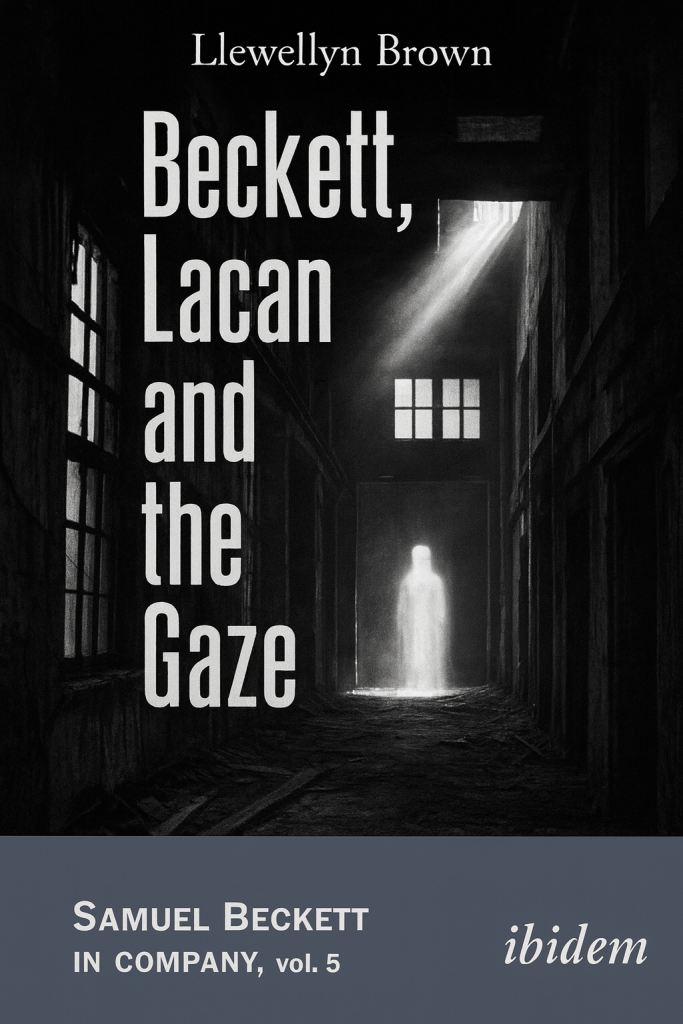
The book advances the claim that Beckett’s visual universe can be described neither through a general theory of “modernist perception” nor through a simple psychoanalytic allegory of seeing, but only by reconstructing the specific way in which the gaze functions as an impersonal, structuring dimension where subject and world fail to meet. In forming a pair with Brown’s earlier study of the voice, this volume argues that Beckett’s writing, theatre, and audio-visual works revolve around a primal absence of any originary exchange of gazes that could install an ego-ideal and open a traversable world of desire. Through a Lacanian reconstruction of the gaze, supplemented by a history and philosophy of visuality, Brown presents Beckett’s oeuvre as the sustained exploration of that absence in the registers of space, light, and technical media.
From the outset, the study situates itself against two immediately tempting simplifications: the tendency to treat Beckett’s visual forms as transparent supports for a philosophical content articulated elsewhere—in language, voice, or narrative—and the tendency to read his minimal stages and darkened spaces as symptoms of a generalised modern melancholy. Brown insists instead on a method that takes the visual dispositif as a self-articulating system, one that already folds together seeing, being-seen, and saying. The introduction reconstructs Beckett’s increasingly painterly sense of staging, his manner of “painting with light” on stage and screen, and the way verbal art gradually assumes the function of revealing the visible in its own right. Testimony such as Billie Whitelaw’s recollection—that Beckett was drawn toward configurations where the look of the scene mattered at least as much as what was spoken—serves here as an empirical index of a deeper conceptual claim: the Beckettian text is always already composed as an experiment in framing, in the delimitation of a visual field whose internal laws cannot be reduced to illustration of an external meaning.
In order to specify those laws, Brown turns first to the problem of “collective reality,” which he approaches through the history of perspective and the philosophical notion of adequatio. Conventional narrative realism presupposes a transparent correlation between world and representation, and perspective since the Renaissance offers the paradigmatic model of such correlation: a unified space organised around a vanishing-point, with objects harmoniously situated in relation to a privileged standpoint. Brown recalls naturalist set-pieces such as Zola’s Saint-Lazare, where every part of the scene appears securely lodged within an ordered continuum. The Beckettian universe, by contrast, appears to the subject as a frozen, stereotyped reality that no longer supports desire: the “big world” of social exchange, with its tawdry realism and its quid-pro-quo reciprocity, is experienced as a caricatured domain of bad imitation, a pompier decor whose pathos lies in its earnestness rather than its force.
The reason for this failure of collective reality is not merely historical. Brown seizes on Beckett’s recurring polemic against Weltanschauung to identify a structural disaffiliation from any worldview. This disaffiliation is then read through Lacan’s “mirror stage.” In the normal case, the infant’s jubilant identification with its mirror image becomes structurally stabilised only through the desire of another: the mother or caretaker confirms the image by a look that grants a kind of proto-assent. The ego-ideal that emerges from this operation functions as an invisible frame: the subject internalises a point of view from which it can appear lovable, whole, and situated among its fellows. Brown reconstructs, by way of the first chapter’s conceptual architecture, the consequences of a failure at precisely this juncture. In Beckett’s world, the founding Other is presented as impassive: there is no primal gaze that invests the child’s image with desire. The reflected figure remains detached, impersonal, a mere configuration among others. The result is a subject who experiences no affective bond to the world, who feels reality as a mass of ready-made forms, a past that never becomes properly “his” because the gaze that would inscribe him in it never arrived.
The conceptual wager of Brown’s book emerges clearly here: to show that Beckett’s famous dissolution of world and self is not an abstract scepticism about representation, but the consequence of a very precise scopic configuration. If the ego-ideal remains external and opaque, then the world appears either as a tawdrily unified decor or as a disarticulated series of fragments. Brown therefore re-reads the destruction of common reality in the Trilogy and later prose as the subjective correlate of this failed mirror stage. The characters’ estrangement from “traversable space” and their compulsive return to certain visual scenes—streets, windows, banal interiors—testify to an effort to reconstruct, in the work, a frame that never functioned in life.
Once the insufficiency of collective reality is established, the study advances to the question of mirrors, frames, and windows, which Brown treats as the first articulations of a new scopic order. He turns to the Lacanian distinction between mirror and tableau: in the tableau of classical perspective, the frame organises a scene for a subject posited at a determinate point; in the mirror, by contrast, the decisive element is the structuring presence of the Other, whose gaze guarantees the subject’s image. Brown’s detailed engagement with Gérard Wajcman’s account of painting as a surface that both hides and shows allows him to reconstruct how the frame functions as a locus of loss: to open a window is to pierce a continuous wall, to create a breach that is experienced as a hole, the mark of an extracted object-gaze that cannot itself be represented. The window, in this reading, is less a transparent medium than the trace of a subtraction.
Beckett’s windows and frames are therefore never simple architectural features. Molloy’s reminiscence of the windows in Lousse’s house—windows that may or may not exist in the world, but certainly “open” in his head when he gropes among those days—becomes exemplary: Brown insists that these are subjective windows, indices of a memory structured by the absent gaze. They testify to a peculiar status of the visual field: neither a neutral given, nor a purely inner fantasy, but the site where an Other’s look would have inscribed a unary trait, a minimal line that both designates and distances the subject. Lacan’s later definition of the fundamental fantasy (fantasme) as the “window” through which the subject apprehends the world is here recast in Beckettian terms: fantasy appears less as a comforting screen than as a precarious frame that continually threatens to collapse into the wall or to dissolve in the indistinction of light and dark.
Within this reframed scopic field, light and darkness no longer function as simple opposites, but as unstable operators that redistribute the relations between subject, object, and gaze. Brown’s chapter on light and darkness takes seriously Beckett’s interest in painting, especially Caravaggio’s “spotlight effects” and Rembrandt’s rendering of fragments bathed in an enveloping obscurity. From Wilenski’s art-historical observations about objects emerging from a limitless dark, Brown extracts a conceptual schema: illumination and obscurity comprise a single field whose totality remains fundamentally unrepresentable; highlighted bodies float in a boundless mystery.
Krapp’s Last Tape becomes the paradigmatic scene where this schema is staged in its most economical form. The table and its immediate surroundings are flooded with strong white light, while the rest of the stage lies in darkness. Krapp’s movements thus enact a continual passage between a space of harsh visibility—where objects, ledger, machine, and body are exposed under an unforgiving ego-ideal—and an encompassing dark that promises a bodily enjoyment without representation. Brown is careful to describe this dark neither as simple refuge nor as metaphysical beyond. Darkness lacks materiality, yet it surrounds and undercuts the lit zone, suggesting a dimension that the gaze registers without being able to master. The alternation between Krapp’s pacing in the dark and his reluctant returns to the light demonstrates the fundamental oscillation of Beckett’s scopic universe: no stable synthesis emerges, no final hierarchy subordinates darkness to enlightenment or light to night; the subject is compelled instead to “mingle” opposed values without resolving them.
Yet this alternation, Brown argues, entails another figure: the double. Once the frame of collective reality has disintegrated and the interplay of light and darkness no longer supports an integrated field of vision, identity itself becomes unstable. The subject begins to see himself as an other, in ways that exceed any ordinary reflexive self-consciousness. Brown’s chapter on doubles and spectres approaches this problem by tracking the repeated splitting of narrative voice—between I and he, you and he, or voice and hearer—and the dramatic multiplication of textual doubles: the division of Molloy into Molloy and Moran, the spectrally multiplied tormentors and victims in How It Is, the mysterious boy figures in Endgame, Godot, and Ghost Trio.
Drawing on Marie-Claude Lambotte’s work on melancholia, Brown insists on the radical nature of this splitting. In ordinary neurosis, the ego oscillates between its empirical fragility and the stabilising ideal ego; in melancholia, by contrast, the loss of the loved object cannot be mediated by idealisation, and the ego collapses into an accusatory identification with the lost object. In Beckett, this process occurs on a more originary plane: the double embodies a “never-born” or “unconceived” being who retains the status traditionally accorded to the soul, a shade that serves as veil over an otherwise unbearable hole. The hallucinated double—boy, Eye, spectral figure—returns as a repetition of the mirror image that never received symbolic confirmation. The subject’s true existence, Brown suggests, resides in this “nothing” that speaks, rather than in any socially recognisable identity.
Ill Seen Ill Said then becomes the key text in which this spectral logic is both condensed and laid bare. Almost every paragraph contains an allusion to the eye or to sight, yet the scene is dominated by a female figure who is at once “so dying” and “so dead,” ceaselessly coming and going between cabin and tomb. Brown reconstructs the “visual discursive system” of the text: a drivelling scribe, an Eye that functions as a device or mask, and the woman who herself gazes at sky, void, or stone. This triangulation binds seeing and saying around an absolute hole. The void here is not the symbolic lack that sustains desire, but a full nothing whose presence produces hallucinatory effects. No naming, no fictional integration of the elements into a coherent story, manages to suture this hole. Spectral existence becomes the mode in which the speaking-being insists as written absence, a presence that can only appear through the failure of any complete image.
At this point the question of the ideal returns with renewed urgency. Brown’s chapter on “variants of an ideal” gathers together those images where an impassive, unreachable Other appears in its purest guise: the clear azure sky set at an incalculable distance, or the human face reduced to an inexpressive mask whose eyes are empty cups. These motifs mark the point where the gaze of the Other appears only as petrifying power. The mask, in particular, testifies to the absence of any exchange of gazes: it presents a sculptural surface that offers no response, no sign of life. The Beckettian subject dreams of lodging himself in the darkness of the eye sockets, in the hollow where the Other’s own powerlessness to escape this all-invading gaze becomes tangible. Courtly traditions of absolute, unmediated love are silently reconfigured here as relations in which the woman assumes the role of statuesque figure, while the fundamental absence of any sexual “rapport” asserts itself as an impossible that saturates the field.
From this constellation emerges Beckett’s idea of the “pure object,” whose iconic form is the skull arising in empty space. This object unites perfection, petrifaction, and death; it condenses the impassible ego-ideal. Creation, however, consists in introducing a “stain” into this ideal: words and world are reduced to trash, white surfaces are plunged into darkness, and an interior refuge is sought where the blinding whiteness can no longer be seen. Brown is careful to present this gesture as more than a romantic revolt against purity; it constitutes a calculated attempt to bring into existence the part excluded from the mirror image, to bore holes into the ideal so that the subject can inscribe himself where no place had been prepared for him.
The movement from masks and pure objects to “closed places” then appears almost inevitable. Brown’s chapter on the monad shows how Beckett’s spaces are repeatedly figured as interiors of skulls, sacks, bones, and cylindrical structures that evoke both architectural and anatomical forms. From Murphy’s garret and Mr Endon’s padded cell, through Malone’s room, the stage of Endgame, and the rotundas of Imagination Dead Imagine, to the self-contained cylinder of The Lost Ones, Beckett elaborates variations on a single visual schema: a uniform, windowless enclosure that offers complete visibility and excludes any opening to traversable space. Even seemingly open settings like Waiting for Godot are, as Beckett insisted, better staged as closed boxes.
Brown reads these spaces alongside Foucault’s analysis of Bentham’s panopticon. In the panoptic schema, the subject internalises a gaze that watches from everywhere and nowhere; the surveillance continues even when no observer is physically present. Similarly, the Beckettian monad offers a field of visibility that excludes the figure of the watcher. Mr Endon’s cell, upholstered on every surface so that one becomes a “prisoner of air,” gives striking expression to this condition: in the absence of any perceptible breach, the subject cannot locate the source of constraint or the direction of escape. The space appears unlimited in its very closure. Beckett’s letters confirm that this enclosure corresponds to an existential stance: he claims no wish to be freed or helped, and imagines himself caught somewhere in unutterable space and time.
The Lost Ones provides Brown with his central monadic model. Written in the mid-1960s as Le Dépeupleur and later expanded by an additional section, the text describes a cylindrical world populated by a “little people,” ladders, niches, and an arena, all meticulously arranged, yet continually eluding definitive interpretation. Brown emphasises the temptation toward allegory—toward reading the cylinder as a microcosm of humanity or a dystopian social diagram—and simultaneously shows how the text itself resists such closure. The cylinder can be understood instead as an imaginary expansion of fundamental solitude, as though the speaking-being projected his own isolation into a small universe whose every detail remains subject to the laws of visibility. The inhabitants’ frantic search for an exit becomes an avoidance of a more terrifying liberty that might lie outside, a liberty without coordinates.
Crucially, Brown insists that the monad is not a geometrical form but a topological configuration anchored in a cut. The apparent uniformity of the closed place conceals an indispensable breach, a “without” that appears as endless dust, the pain of existing produced by alienation in the signifier. At times, this “without” manifests itself as the hallucinated appearance of a boy, a figure who occupies the place of the gaze that never confirmed the subject’s image at the mirror. The closed place thus represents the imaginary attempt to view oneself with the eyes of the Other, while the breach marks the articulation to language, the symbolic anchoring that prevents the monad from total self-enclosure. Worstward Ho radicalises this process: the skull becomes the place that is its own origin, peopled by shades that are said and seen only in the movement of worstening; the eyes are “clenched staring eyes,” simultaneously open and closed, fixed on a domain beyond sight yet bound to a saying that cannot be exhausted.
With the monad, the question of seeing and unseeing can be posed in its full complexity. Brown’s seventh chapter begins by recalling Lacan’s reading of Oedipus, who continues to “see” after blinding himself, and whose fault lies in his will to know, his cupio sciendi, rather than in his crimes. The invisible does not simply name a beyond of the visible; it marks the point where the subject becomes object under an inscrutable gaze that annihilates any image he might have of himself. Seeing and non-seeing thus compose an open structure that borders on the real, rather than a binary opposition.
Endgame provides the exemplary theatre of this structure. Hamm is blind, yet surrounded by glasses, microscopes, telescopes, and windows: an arsenal of seeing devices that emphasise the weakness of vision rather than its power. These prostheses can be misplaced or lost, much as the phallus depends on the possibility of castration; vision and mastery are structurally precarious. Hamm relies on Clov to report what he sees through the windows, thereby externalising his relation to the world. But Clov refuses to “name” certain objects (“nature,” “pain-killer”), withdrawing symbolic support from the scopic field. Active seeing is reduced to the mechanical locating of domestic objects; what matters is the dialogue that sustains the very scene of vision. Brown shows how this arrangement enacts a split between presence and visibility: there may or may not be a world outside, but the subject’s relation to it is mediated entirely by the fragile play of speech.
The chapter returns repeatedly to the idea that one can look through the eye instead of with it. Brown draws on Paul Davies’s reading of Beckett’s formulation “re-examined rid of light,” according to which the “eye of flesh” sees nothing essential, while the “eye’s master,” the soul, understands by having seen through the organ. This correlates with Lacan’s geometrical intuition that the point of view is not symmetrically opposed to the vanishing point, but participates in a line that runs beyond the screen and behind the spectator, closing at infinity. To “see through” is to be seized by the gaze that occupies this impossible place, a gaze that renders ordinary vision both insufficient and dangerous. Here the risk is that the subject might attempt to pass through the window-frame, to join the gaze as real, and thereby fall into a form of psychotic collapse.
It is only at this stage that technology can appear as more than an external context. Brown’s final substantive chapter explores Beckett’s use of film and television as a way of putting the gaze itself to work as an invisible object that strips the subject of autonomy. In an era where science tends toward a universalisation that suppresses the singular subject and capitalism fills every breach with commodities and commands to enjoy, Beckett’s recourse to audio-visual media enables him to expose a manipulating gaze that lies behind the spectacle. The camera becomes a “savage eye,” fixed, unblinking, adopting a single point of view and observing incessantly. This technical eye produces an experience akin to torture: a devouring gaze that pierces without respite, forcing the spectator to watch, trapped by the slowness and duration of the shots, or the repetitions that bind him.
Film, Beckett’s first venture into the medium, functions as a manifest allegory of this persecuting gaze. The narrative pits O, the object, played by Buster Keaton, against E, the eye of the camera. The pursuit from street to room stages the impossibility of escaping a gaze that emanates from outside the “angle of immunity” allowed by perspective constructions. The eye appears as a motif stripped of desire, the sign of an impersonal Other. The room that O believes will shelter him becomes a visual trap, saturated with images and “eyes” that spy on him from every corner. For Brown, the final recognition in which O confronts his own double E can be read at once as hallucination and as a non-dialectical assimilation of the gaze-object: O acknowledges the inescapability of the gaze, which is his own, without thereby achieving reconciliation or narrative closure. Death remains unverifiable, a name for the ex-istence of a part that no fiction can integrate.
The television plays refine this exploration. “Eh Joe” takes place in a closed monadic room, where Joe is pursued by the camera’s slow advance and by a female voice that castigates his incapacity to love. The camera’s high-angle shots recall the mother’s stooping over the cradle; the implacable descent has the precision of a bird of prey. The unbroken shot of the voice’s monologue, made possible by television’s technical conditions, produces an impression of an impassive gaze that regards the subject as an object to be inspected sub specie aeternitatis. Brown associates this with the ego-ideal’s position and with the subject’s own recourse to a gaze by which he attempts to know himself, to become his own Other. Yet the experience remains one of radical asymmetry: the camera eye does not respond; it simply bears down, extracting a minimal saying from the subject.
Subsequent plays—Ghost Trio, “…but the clouds…”, Nacht und Träume, What Where—are read as variations on the monadic and spectral spaces already analysed in the earlier chapters, but now processed through the specific capacities of television: fixed or minimal camera movement, controlled lighting, the possibility of filming in extreme durations without cuts. Brown traces a progression in Beckett’s work with the gaze: from Film’s residual reliance on narrative pursuit, through the monadic imprisonments of “Eh Joe” and Ghost Trio, to the dreamlike darkness and quasi-liturgical gestures of “…but the clouds…” and Nacht und Träume, and finally to the abstract permutations of What Where, where bodies appear as almost pure visual functions. The technical medium becomes the place where Beckett’s long elaboration of the gaze’s impersonal, real dimension finds its most stripped-down articulation.
Against this background, Brown’s conclusion clarifies the book’s systematic character. The eight chapters do not form a simple progression from the breakdown of reality to technology; each step displaces the previous one by re-situating its motifs within a broader or more radical frame. Collective reality collapses, and in the breach mirrors and windows appear as instruments for renegotiating the subject’s place. These instruments then give way to a more elementary dialectic of light and darkness, within which doubles and spectres emerge as symptomatic figures. The ideal crystallises in masks and pure objects, which in turn generate closed monadic spaces whose apparent hermeticism is undermined by cuts and breaches that anchor them in saying. Seeing becomes inseparable from unseeing, and the final recourse to film and television shows that the gaze has always already functioned as an invisible, real object that manipulates and persecutes, but also makes singular creation possible.
The outer framing of the book itself mirrors this movement. As volume five in the Samuel Beckett in Company series, and as the companion to Beckett, Lacan and the Voice, Brown’s study positions the gaze alongside the voice as one of the two privileged modalities in which Beckett’s work encounters psychoanalysis. The bibliography and index reveal a patient weaving together of French and Anglophone criticism, Lacanian seminars, art history, and philosophical sources. The method is neither pure exegesis of Lacan applied to Beckett nor a free-floating thematics of seeing; it proceeds by reconstructing scopic dispositifs out of close readings of texts, drafts, stage directions, and camera scripts, and then testing them against Lacanian concepts such as the mirror stage, the object a, the unary trait, the Borromean knot, and the sinthome.
In the end, the study’s distinctive contribution lies in the way it forces a redefinition of the imaginary. Rather than conceiving the imaginary as a domain of images opposed to the symbolic or subordinated to the real, Brown, following Lacan and Wajcman, treats it as a register rooted in the fundamental opacity of existence. Beckett’s characters inhabit images that fail to cohere, frames that refuse to disappear into transparency, and lights that never stabilise a scene. The gaze that traverses this world does not belong to any subject; it is the lost object whose effects we experience as shame, stupefaction, or cold fascination. By pursuing this gaze across Beckett’s entire oeuvre, from early prose to late television plays, Brown’s book composes something akin to a topology of visibility without origin: a space where subject and world continually attempt to meet in the look, and where each attempt leaves behind only a frame, a stain, or a spectral remainder that insists from the side of the real.
 Simon Gros
Leave a comment