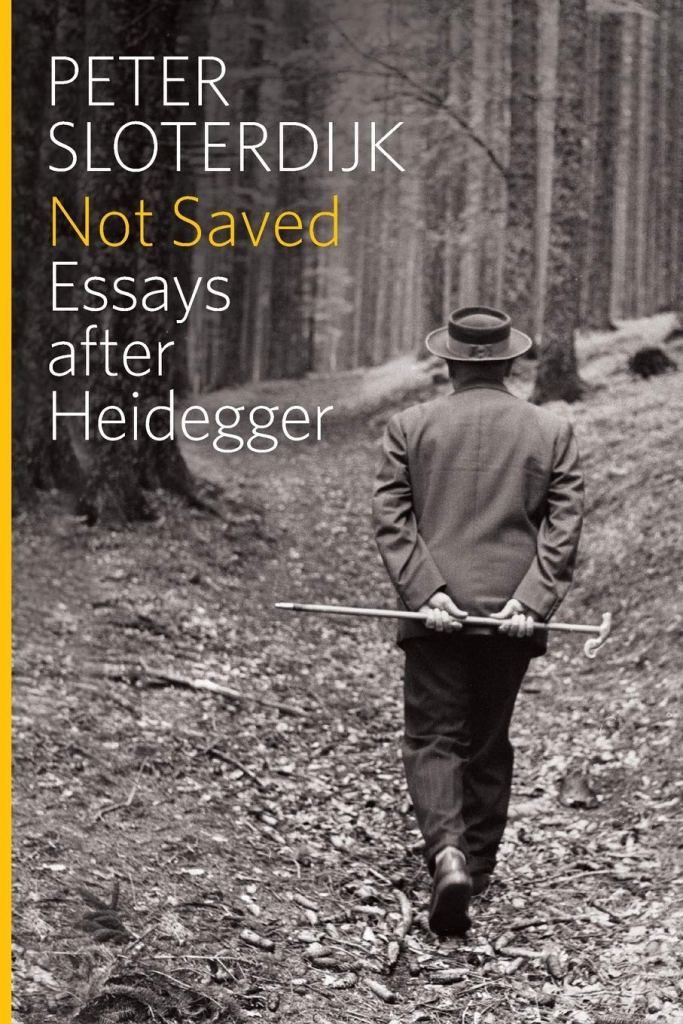
In order to situate Heidegger’s thought in the history of ideas and problems, Peter Sloterdijk approaches Heidegger’s work with questions such as: If Western philosophy emerged from the spirit of the polis, what are we to make of the philosophical suitability of a man who never made a secret of his stubborn attachment to rural life? Is there a provincial truth of which the cosmopolitan city knows nothing? Is there a truth in country roads and cabins that would be able to undermine the universities with their standardized languages and globally influential discourses? From where does this odd professor speak, when from his professorial chair in Freiburg he claims to inquire into what lies beyond the history of Western metaphysics?
Not Saved: Essays After Heidegger stakes a precise claim: Sloterdijk reorganizes the post-Heideggerian terrain by treating “Heidegger” less as a doctrine than as a mobile field of problems in which anthropogenesis, technics, and truth-procedures continually recompose one another. The collection’s distinctive contribution lies in showing how a rigorously phenomenological attention to places (clearing, park, clinic, theater, globe) becomes method for diagnosing modernity’s anthropotechnical drift—breeding, pedagogy, bio-operation, media, systems—and for redescribing the ontological in kinetic, institutional, and historical registers at once. Its wager is that a philosophy that accepts the plunge of our situation, travels through its drifting experiences, and risks decisive turns can still speak with the sobriety of research while acknowledging the elliptical and sometimes scandalous form that thought after Heidegger must assume.
The outer frame matters. We are told, with methodological candor, that these are “collected renunciations of exhaustive detail,” precipitate essays composed mainly between 1993 and 2000 (with an Adorno piece reaching back to 1989), written for lectures and symposia, and subsequently reassembled so that adjacent texts illuminate one another in their intended constellation. The editor-authorial arrangement explicitly sets the micro-historical critique of humanism in “Rules for the Human Park” beside the macro-anthropological scale of “Wounded by Machines,” and it marks “The Domestication of Being” as the central, most systematic statement—first delivered for a biotechnology colloquium at the Centre Pompidou—whose concluding section on “the operable human being” had a quasi-independent reception. The two opening portraits, on Heidegger and on Luhmann, debuted on an actual stage (Freiburg City Theater), a fact Sloterdijk flags to help us grasp both their rhetoric and their program: thinking that performs, but resists becoming theater. This composition history is not paratextual trivia; it is itself a thesis about the form that post-Heideggerian inquiry must take to traverse our present media, institutions, and emergencies.
The translators fix terminology so that the conceptual relief remains crisp across essays. “Being” is capitalized to distinguish it from beings; Seyn is rendered “beyng” only where the archaic valence matters; Dasein remains untranslated; Gelassenheit becomes “releasement”; and “anthropotechnics” keeps the broad, pre-instrumental sense of Technik that exceeds apparatus. A small but telling decision: “Rules for the Human Park,” not “Zoo,” because the German Park ranges across civic, ecological, and political theme parks in addition to zoological enclosures; Sloterdijk’s argument needs that range. These choices are not merely lexical; they are part of the book’s claim that the anthropological and the ontological cross one another in concrete sites of cultivation, care, and control.
The prefatory gesture—“essays after Heidegger”—names three intertwined strategies. First, a strictly temporal one: to take both man and work historically and to compare them with other twentieth-century formations (systems theory; Critical Theory). Second, a topical one: to pursue Heidegger’s indications where they remain productive or provocative, especially in the anthropological and techno-philosophical registers. Third, a distancing one: to free oneself from the “master’s hypnosis” by thinking with and against Heidegger so as to arrive at positions that, by the author’s measure, would likely have displeased him. This triple orientation supplies the book’s constant motion between intimacy and distance, fidelity to problems and refusal of discipleship, portraiture and traversal.
The opening essay, a “speech on Heidegger’s thinking in motion,” takes as its emblem two graves: Arendt’s on a campus, and Heidegger’s in a rural churchyard. Against this quiet tableau Sloterdijk reads a physiognomy: philosophy born from the polis becomes, in Heidegger’s case, a critique issuing from a stubborn proximity to the provincial—a thinker in motion who personally refuses the urban move. The scene is not a biographical curiosity; it inaugurates the book’s most persistent question: by what spaces—campus, theater, parish, hut, clearing—does thinking orient itself, and what happens when the kinetic schema of thought runs cross-grain to the institutional stages that would host it? From here Sloterdijk proposes Heidegger as the “thinker in motion” whose founding act is a leap into a condition in which nothing is secure except movement itself—the plunge, the experience, and the turn. The kinetic primacy of the plunge—being held into the incursion of movement—displaces any fantasy of an unmoved, contemplative distance; resolute existence is not an exit from contingency but an intensification and re-appropriation of the fall as project. The diagnosis is deliberately ambivalent: the normal case is dispersion into “hustle and bustle,” yet precisely there the counter-movement of gathering can occur as a jolt. The point is methodological: a discourse of movement must show its own serious case; it must not pretend to speak from the stage but from the wings, or better, from backstage work where preparation sustains any moment in the light.
If the plunge-turn schema establishes the tone, the book’s middle essays translate that kinetics into distinct diagnostic grammars. “Luhmann, Devil’s Advocate” figures systems theory as a secular re-inscription of original sin, a vocabulary for the egotism of systems and the ironies that flow from closure and environment selection. Sloterdijk’s wager is delicate: allow Luhmann’s anti-humanist coolness to function as a devil’s advocate without granting it the last word about persons, practices, or parks. The devil’s advocate is the proper antagonist inside an inquiry that wants to keep open both the anthropological and the ontological without either collapsing them or allowing one to police the other. Even in the table of contents, the argumentative adjacency already proposes a sequence: Aristotle’s question of place, the social forms of irony, the clarification of the clearing, the crisis of metaphysics, unconcealment, the park, the clinic, the monstrous, the pessimist, the nearness of Dasein. The order is an itinerary, not a miscellany.
“The Domestication of Being: The Clarification of the Clearing”—the central essay by the author’s own admission—deepens the book’s most charged claim: the clearing is not only a topological feature of truth but the historically variable scene of human self-tending, breeding, and education. To clarify the clearing is to bring into view the long arc by which humanism understood itself as a project of taming through texts (reading/sitting/pacifying), while the new anthropotechnical horizon widens that project into explicit design and selection—biocultural, biomedical, biopolitical. Here the park metaphor becomes an analytic: every city, nation, or theme park is a design for self-regulation, a script for keeping humans in spaces they fashion for themselves. The essay acknowledges, and courts, scandal because it thinks directly about the transitions from taming to breeding to engineering, and demands that philosophical discourse shoulder responsibility for speaking clearly where the euphemisms of culture and the alarms of technophobia short-circuit thought. The compositional note—written for a biotechnology colloquium, discussed in Cambridge, Los Angeles, Madrid, Le Mans—belongs to the argument: philosophy must enter the institutional circuits where its objects are designed and debated.
“Rules for the Human Park” has the strongest contour lines because it takes Nietzsche’s rhapsodic anthropology of Zarathustra as theoretical mine and makes explicit the breeding-political horizon that humanism only ever tacitly presupposed. The aphoristic images of the “last men,” the domestication of wolves into dogs, and the sand-grain conviviality are reread as condensed discourse on selection: a long, unnoticed “artful linking of ethics and genetics” by which moderns have bred themselves small in the name of harmlessness. To call politics a rule-set for operating human parks is not a provocation for its own sake; it is a description of the zoo-political fact that human collectivities design environments for the ongoing tending of their own kind, by schooling, sorting, immunizing, and now—in principle—selecting. The essay’s scandal consisted less in its content than in its clarity: it states what all pedagogy and policy already do under other names and asks that the rules be discussed openly, under philosophical pressure and with historical memory.
The strength of that clarity rests on a reconstruction of humanist presuppositions. Humanism presupposes the human and addresses itself to taming through letters; Nietzsche sees a second horizon, the inevitability of breeding conflicts once powers of selection become explicit. Sloterdijk follows the line back to Plato’s Statesman, read as Magna Carta of a pastoral politology in which a Stranger, not the ordinary Athenian citizen, conducts a conversation fit only for those licensed to plan the herd of the city. This is not an antiquarian gesture; it is a genealogy of the conviction that parks—schools, cities, states—are self-tending devices, and therefore that dignity today involves openly acknowledging that humans keep themselves, and then specifying the limits and ends of such self-keeping.
If “Rules” incited controversy, “Wounded by Machines” redeploys the same frankness with respect to technicity. The essay does not rehearse a moralizing opposition of human to mechanism; it instead inventories specific woundings—indignities of reduction to means, affronts to corporeal integrity, affronts to personhood—that modern mechanisms once inflicted almost axiomatically, and then argues that the empirical scene has shifted. As cybernetic systems acquire organismic complexity, as prosthetics ceases to be wooden legs and iron hands, as devices simulate spontaneity and play, the old humanist accusation loses its footing. What remains is not an alibi for the machinic but a relocation of dignity: the human advantage now shows itself in the capacity to share “the disadvantage of being a human being” under conditions where technics can never be merely instrumental, and where “knowledge is power” must be read as the historically concrete program of mechanical sovereignty over nature, others, and ourselves—from the mechanical engineering of the state to the school, the army, the hospital, the opera, the academy. The point is evidential: to describe modernity is to track where mechanical knowledge became operational and how its sovereignty shaped the very sites where we learn, heal, labor, and perform.
“The Time of the Crime of the Monstrous” expands the scale from clinic and school to globe and millennium. Here the signature thesis is modern complicity: the monstrous of our time is man-made, neither sent by old gods nor represented by classical monsters; to be modern is to lack an alibi. Theory, accordingly, becomes a sublime echo of the immeasurable that humans now produce, and metaphysics—formerly sworn to equate cosmos and home—gives way to an analytic of exits from the house of Being. The essay’s architecture cuts the man-made monstrous into three planes: space (the globe as geodicy), time (the millennium as end time without end), and object (the artificial as art/technique/apparatus). The result is a compositional triad that holds together the phenomenological, the historical, and the technological without dissolving their tensions. The monsters we face are our own projections, hence our confessions—projects, plans, markets, infrastructures—require a discourse at once less pious and more demanding than critique in its conventional key.
“Alētheia or the Fuse of Truth” precedes “Rules” in the order of presentation for good reason. The calendar of unconcealment—the ways Western culture has timed truth—reframes debates about anthropotechnics: one cannot speak responsibly about breeding, pedagogy, or selection without situating them within the historical regimes of unconcealment that license or forbid certain disclosures. In the Preface Sloterdijk names this adjacency directly, insisting that remarks on anthropotechnics must be recontextualized by the West’s calendars of truth and its continuum of phantasms of imitation. The link is decisive: only by seeing how a culture times truth can one judge what counts as scandal or as belated honesty.
“What Is Solidarity with Metaphysics at the Moment of Its Fall?” places the project against Critical Theory and its hyperbolic dynamics, not to score polemical points, but to specify a criterion of measure: if “exaggeration” is a proper rhetoric of truth under conditions of monstrosity, then the task is a proportioning of intensities—when to name, when to magnify, when to restrain—so that thought neither trivializes nor mythologizes its object. The problem is less whether one “overstates” than how to calibrate description so that it remains diagnostically exact at scales that outstrip ordinary language. In that sense the book’s confessed “elliptical” form—the art of precipitousness—already functions as a method: the Versuch (attempt, essay) is the right unit where phenomena demand both speed and nerve.
The Cioran note, “The Selfless Revanchist,” and the closing marginalia on the “essential tendency toward nearness in Dasein” round the itinerary without closure. Cioran sharpens the pessimistic contour so that the diagnoses of park, clinic, and globe do not lapse into progressivism; the marginalia on existential place recollect the book’s earliest question—what places thinking inhabits—and reassert that even in a world of networks and systems, nearness is an existential vector, not a metric distance. If modernity is an exit from the house of Being, its survivable disciplines will depend on how we redraw nearness without nostalgia for temple or hut, and without yielding all space to logistics.
Taken together, the book assembles a layered argument. At the most general level: after Heidegger, philosophy must learn to speak in the same breath about ontological motifs (clearing, truth, nearness), anthropological practices (taming, breeding, educating, operating), and technological dispositifs (systems, apparatuses, prosthetics), because the space in which humans keep themselves—parks in the broadest sense—is now the same space in which unconcealment happens, sovereignty is exercised, and wounds are inflicted or borne. At the level of method: description should be problem-first and site-specific, willing to take its rhetoric from the scale of its object (hyperbole when the field is monstrous, sobriety when the stakes are rules), and composed as a sequence of Versuch that are individually elliptical yet jointly clarifying. At the level of judgment: dignity today neither denies convergence with machines nor baptizes it; it seeks compromises that share “the disadvantage of being a human being” and argues publicly about rules for our own self-keeping.
The translators’ apparatus is integral to the book’s intelligibility. By keeping Dasein and Lichtung stable and reserving “beyng” for marked contexts, they preserve the tight weave among ontological vocabulary, anthropological scene, and technological analysis. By insisting on “park,” they keep the civic-political dimension of self-keeping in view; by glossing Technik broadly, they secure the book’s claim that technology is as much a set of practices and disciplines as devices or applications. In a collection trading constantly between theater, campus, clinic, and laboratory, these decisions ensure that names—of places and procedures—carry their proper weight.
The sequence itself generates conceptual pressure. The portrait of Heidegger as “thinker in motion” forces one to grapple with the paradox that the most mobile thought attaches to a rural address; the Luhmann essay then models a stance of measured proximity to a grand system that evacuates persons while illuminating structures; the central domestication essay reworks the clearing as socio-technical habitat; the solidarity piece recalibrates the pathos of critique; the aletheia essay retimes truth; the park essay names zoopolitics without euphemism; the wounds piece rebuilds dignity after mechanism’s affronts; the monstrous essay refuses alibis and redraws the sublime at human scale; the Cioran note immunizes against consolations; the nearness marginalia return us to place at a new pitch. The argument forms a spiral: each pass gathers material from the previous one and displaces it under the pressure of a new site, until the book closes less with a solution than with a clarified itinerary for questioning.
Sloterdijk states in the Preface the pedagogical ethos that underwrites the whole: to rejoin a “bond of common learning” beyond accusation and apology, and to do so by analyzing how the age of extremes stamped both grand politics and grand theory. The upshot is a call for a theory of participatory relations joined to a critique of emergency reason—a logic of commitment preceding any division of ontology and ethics. This is why the book’s central parlance is not virtue or value but participation: what we join, what joins us, and under what rules. The essays model the stance they recommend: they neither shrink from scandal nor trade in it; they name the park and then ask for its ordinances; they confess complicity and then argue for better designs.
Not Saved does not promise redemption; the title is exact. It proposes, instead, a way of remaining intellectually upright inside institutions, media, and machines that we neither chose nor can simply refuse. Its contribution is to show that a post-Heideggerian phenomenology can be rigorously worldly—attentive to stages, clinics, laboratories, parliaments, theme parks—without surrendering the seriousness of ontological questioning; that a philosophy of the clearing must become a philosophy of rules, of wounds, and of monstrous scales; and that the measure of our dignity may now lie in how lucidly we speak about the parks we keep, the machines we share, the truths we time, and the nearnesses we can still compose.
 Simon Gros
Leave a comment