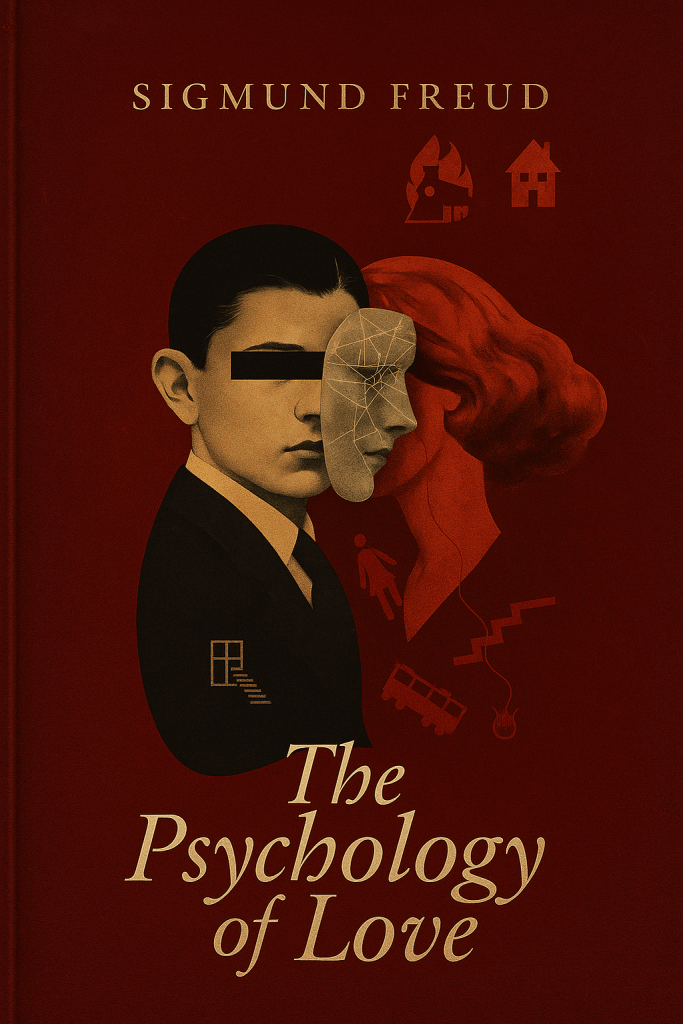
The Psychology of Love gathers, in a single, carefully sequenced volume, Freud’s principal inquiries into how erotic life is constituted by fantasy, conflict, and the vicissitudes of development. Its scholarly stake lies in showing—with clinical and metapsychological precision—that human sexuality is always already symbolically mediated, that desire is organized by scenes and substitutions rather than by instinct alone, and that the norm of love forms itself through the same mechanisms that generate symptoms. The book’s distinctive contribution is compositional: it frames the classic “Dora” analysis with later essays on object-choice, debasement, virginity, beating fantasies, the genesis of perversions, and female sexuality, while anchoring these with the systematic scaffolding of the Three Essays on Sexual Theory. What emerges is an argument for erotic life as the moving resultant of infantile histories, cultural interdictions, and unconscious scenarios.
The volume is architected as an arc from clinical narrative to theoretical generalization and back again. It opens with the case of Dora, a young woman whose hysterical symptoms condense complex family entanglements, disappointed love, and the transferential intensities characteristic of analytic treatment. The case is prefaced by a methodological foreword that clarifies why dreams, symptomatic acts, and the dynamics of Übertragung (transference: the displacement of feeling from prior figures onto the analyst) provide the most reliable access to unconscious formations. The narrative of Dora’s treatment is given its objectivity by a disciplined adherence to the analytic rule of attending to associative chains rather than to conscious explanations; yet it is equally given a theoretical horizon by the analytic processing of two dreams and by a post-hoc afterword that interrogates the very conditions under which a case study can claim evidentiary force. This opening thereby establishes the text’s governing premise: that erotic conflict makes itself legible at the point where an individual’s symptom-compromise tries to reconcile incompatible demands of tenderness, sensuality, loyalty, and the interdictions of kinship.
Within this frame, the book returns to the developmental and structural basis of sexuality through the Three Essays on Sexual Theory. They articulate the basic claims that the sexual drive (Trieb: a pressure that seeks satisfaction via changing objects and aims) is polymorphous in childhood, that adult choice of object and aim crystallizes through a series of renunciations and substitutions, and that cultural prohibition redirects rather than abolishes the imperative to seek pleasure. The prefaces to successive editions, reproduced here, testify to a gradual consolidation and clarification: in them, Freud refines the thesis that perversions are not foreign excrescences but displacements and fixations along normal developmental lines, and he increasingly emphasizes the cross-cutting axes of object (whom one desires) and aim (how satisfaction is sought). The essays are most decisive where they establish the methodological bridge between clinical observation and hypothesis: for example, the identification of infantile sexual organizations—oral, anal, phallic—rests on convergent evidence from symptoms, dreams, and fantasies, and the theory of puberty’s transformations follows from the observable reorganization of the drives around genital primacy and the revaluation of objects under the sign of love.
The book then moves from general theory back into focused explorations of erotic life’s characteristic impasses, beginning with the papers on object-choice and debasement. Here the analysis of a “particular type of object-choice in men” isolates a paradox: the idealization of the beloved as sacred and untouchable (tenderness) coexists with a displacement of sensual desire onto debased objects (sensuality), producing a split in which the subject cannot fuse respect and passion in the same person. The claim is not moral but structural: the beloved’s purity carries the residue of infantile incest prohibitions, while the sought-after degraded object bears the permission to desire in defiance of law. In this way, the erotic dyad repeats the fundamental cultural event of interdiction, and the symptom—impotence with the respected woman, compulsive ardor for the devalued one—functions as a compromise formation. The evidence for this claim lies in converging clinical materials: admissions of disgust in the presence of the idealized partner, histories of oscillation between fidelity and transgression, and the strong affective coloration of jealousy and humiliation that accompanies such oscillations. The method is diagnostic and reconstructive: it traces the layered associations that bind sexual aims to scenes from childhood, especially those in which authority, prohibition, and the infant’s own speculations about adult sexuality enter into a durable configuration.
The adjacent essay on the “most universal debasement” extends the same structure: the erotic economy turns repeatedly on the impossibility of uniting tenderness and sensuality, and the price of that impossibility is paid in symptomatic compromise. The subject seeks an object who is sufficiently “other” to escape the tabooed space of incestuous proximity, yet sufficiently marked as transgressive to permit the release of desire. The evidence again derives from clinical constellations rather than single cases, and the method is one of comparative typology: Freud isolates recurring patterns across different lives and then relates them to the same nexus of developmental tasks—renunciation, sublimation, and the binding of aggression to love. At the same time, the analysis leans on the distinction between the choice of object and the path of satisfaction, drawing attention to how fantasies specify the latter even when the former appears socially conventional.
The discussion of the “virginity taboo” then turns from male ambivalences to female initiation. The essay’s thesis is that cultural valuations of virginity are not mere conventions but carriers of unconscious meanings—fear of revenge from the woman’s first partner, anxiety about the woman’s fidelity, and the tested capacity of a male partner to confront symbolic blood and pain. The claim does not rest on folklore alone, but on clinical evidence of how the first coital experience, and the narratives attached to it, leave durable marks on the ability to integrate tenderness with desire. The method here is interpretive and anthropological at once: customs are read as condensations of unconscious attitudes, and individual anxieties are traced to their roots in scenes of early curiosity and dread. The tension between cultural ritual and individual symptom is sustained rather than dissolved: the essay demonstrates how collective forms persist because they map onto individual fantasies, and how individuals find in those forms a permission to stage their conflicts without acknowledging their origin.
The section on the sexual theories of children secures these later claims by showing how early thought situates the child within a world charged by adult sexuality and birth. The child’s answers—about where babies come from, what adults do at night, why bodies differ—form compact theories that carry both desire and defense. The evidence is gathered from remembered scenes, child patients’ questions, and the symptomatic formations that crystallize around misconceived but affectively saturated constructions. The methodological wager is to treat children’s speculations as theories in their own right: consistent, pragmatically adequate to the child’s perception, and capable of generating both knowledge and neurosis. Such theories enter adulthood disguised as rationalizations; they also structure the grammar of later fantasies, shaping what counts as exciting or terrifying. The tension is evident: error protects and injures; knowledge liberates and endangers. The point is not to correct children’s theories in the name of later science but to recognize in them the first drafts of the fantasies through which adult desire will circulate.
The famous paper “A Child Is Being Beaten” advances the analysis of fantasy formation with exemplary clarity. The essay reconstructs a sequence in which an initial sadistic phantasy directed at a rival (“my father is beating the child whom I hate”) gives way to a transformed scene in which the subject herself becomes the beaten one (“a child is being beaten”), while the figure of the father remains the implied agent. This sequence discloses the logic by which guilt, ambivalence, and desire compose a durable script. The evidentiary base is the clinical process of eliciting fantasy variants, observing affective intensities attached to each, and demonstrating the regularity with which these phases succeed one another even when only the later, more enigmatic form is consciously remembered. The methodological achievement here is twofold. First, the paper shows how fantasy is a sequence rather than an isolated tableau; second, it shows how transformations in grammatical person—who acts, who suffers—index transformations in psychic economy. The tension that sustains the fantasy—between punishment and pleasure, love and hate, identification with the aggressor and submission to him—becomes an engine of repetition in erotic life. In adult sexuality, scenes of mastery, humiliation, and staged helplessness are not simply preferences but the afterlife of this sequence, now eroticized and partly rationalized.
The essay on the “origin of sexual perversions” consolidates the metapsychological status of such scenes. Perversion is treated as a fixation or regression at a developmental station, or as an overvaluation of a partial drive at the expense of genital organization. The evidence lies in the constancy with which particular aims—scopophilic, sadistic, masochistic—dominate the subject’s life and resist integration; the method is differential: the same partial aims operate in so-called normal love as components, whereas in perversion they are sovereign. The essay refuses any categorical disjunction between the normal and the pathological; instead it produces a spectrum in which the same elements, recombined, yield tenderness, cruelty, ravishment, delicacy, or degradation. The tension is crucial: cultural integrability versus intransigent fixity. Where the partial drive can be bound to love it becomes the spice of intimacy; where it breaks the frame it becomes destiny.
“On Female Sexuality” returns to the central developmental problem with a directness that justifies the volume’s title: how does a girl reorganize infantile investment to arrive at a specifically female position within erotic life? The claims are several: that the pre-Oedipal tie to the mother exerts a lasting influence; that the so-called castration complex (framed minimally here as the painful recognition of anatomical difference and the interpretations it generates) initiates a turn from mother to father; and that the path to the woman’s mature sexuality involves complex routes through envy, renunciation, and revaluation. The evidence is clinical rather than speculative, drawn from the analysis of women whose symptoms trace back to disappointed love for the mother, ambivalences toward the father, or a constitutional difficulty in integrating tenderness and sensual passion under the sign of femininity. The method discloses how ambivalence toward the mother and father alike gives rise to inhibitions in love, to a compulsion to prove or test male fidelity, and to an oscillation between jealousy and coldness. The tension in the essay is disciplined but present: the theoretical need to speak in general developmental terms is brought into check by careful attention to individual pathways; the very category of “female sexuality” is treated as the endpoint of reorganizations rather than an innate essence.
The place of the Three Essays within this composition requires emphasis, because they silently shape how each later paper frames its evidence. The first essay’s mapping of sexual “deviations” isolates the axes along which love later falters—the object (same or different sex, near or distant kin, socially suitable or taboo) and the aim (tender union, voyeuristic mastery, sadistic control, masochistic abandonment). The second essay on infantile sexuality provides the historical grammar of desire: thumb-sucking as earliest satisfaction, anal erotism as a site of control and gift, the primacy of phallic organization before the advent of true genital primacy. The third essay on puberty specifies the grand synthesis that adult sexuality will attempt: to bring tenderness and passion into a single act and to replace autoerotic satisfaction with an other-oriented aim. The recapitulation that follows does not merely summarize but demonstrates how a theoretical edifice consolidates itself across editions: each preface marks a developmental history of Freud’s own theory, in which claims are not replaced but deepened, and counter-evidence becomes the occasion for refinement.
Against this scaffold the “Dora” case now reads differently than it does when encountered in isolation. Dora’s sudden break in treatment, her cutting reproaches, and her celebrated dreams are no longer idiosyncrasies but exemplary documents of a conflict that binds love to prohibition. The dream of the burning house and the rescuer figures desire and danger entwined; the dream of the unfamiliar city and missed train figures separation, lateness, and the deferred grasp of meaning. Each dream’s associations lead not to an external culprit but to a lattice of identifications and substitutions: the father’s infidelity with a family friend, the friend’s appeal to Dora, Dora’s own indignation mixed with attraction, and the triangulation that forces tenderness and sensuality apart. The case’s clinical picture thereby functions as a laboratory in which we can watch the mechanisms that later essays theorize: displacement of desire to safer objects, moralization of anger to defend against longing, and the turn to somatic complaint to anchor an otherwise intolerable ambiguity. The afterword’s self-critique—about the limits of a treatment that did not secure Dora’s sustained participation—becomes, within the volume’s architecture, a meta-evidentiary gesture: it shows that analytic knowledge is inseparable from the conditions of its acquisition, including the analyst’s own position in the transference.
The essays on contributions to erotic life extend these insights from the clinic to patterns that recur across persons. The study of a particular type of object-choice shows how idealization can produce impotence; the analysis of universal debasement shows how collective customs mirror individual ambivalence; the virginity paper demonstrates that initiation rituals crystallize unconscious meanings about blood, pain, and the capacity to “face” the woman as sexual partner and subject. These are not loosely connected observations; they interlock around a few clear theses. First, erotic life is intrinsically historical: each adult’s present draws its grammar from infantile scenes and from puberty’s reorganizations. Second, sexuality is intrinsically fantasmatic: there is no pure drive without a scene that scripts it; no arousal without an image of who acts, who is acted upon, and who looks. Third, love is intrinsically conflictual: tenderness and sensuality may coincide, but only through labor—renunciations, sublimations, and negotiations with prohibitions both internal and cultural.
Two pivots structure the volume’s argumentative force: the centrality of fantasy and the logic of transference. Fantasy is never treated as decoration; it is the medium in which the drive acquires object and aim. Even where the volume tightens its rhetoric—say, in the typological assurance with which it discusses perversions—the path of evidence runs through fantasies elicited, reconstructed, and shown to carry a developmental sequence. The “beating” paper is decisive here: its reconstruction of successive fantasy phases shows that what appears fixed and enigmatic is in fact the end product of transformations that bind guilt and gratification into a single scene. Meanwhile, transference is the clinical proof that fantasy structures reality: Dora’s outrage at the analyst repeats the earlier outrage at betrayal, and her withdrawal from treatment repeats earlier defeats staged as a moral victory. Transference thereby offers both obstacle and instrument: it misdirects speech to the wrong addressee, but in doing so it stages the very drama that requires interpretation. The case’s foreword asks us to read the analysis as a process in which evidence is not found but produced, under conditions that threaten its clarity even while making it possible.
A narrower focus on “female sexuality” achieves internal counterpoint with these more general claims. The essay insists that the girl’s path to love cannot be codified by projecting the boy’s onto her; the girl’s attachment to the mother, her interpretation of bodily difference, and the reorientation toward the father do not simply replay the boy’s Oedipal scenario. The wager is that the difficulty—envy, ambivalence, jealousy—is not reducible to character, morality, or social role; it is developmental and structural. The evidence for this wager consists in the repeated analytic finding that inhibitions in love, insistence on proofs, and sudden frigidity trace back to conflicts in the pre-Oedipal tie and to the interpretations that solidify around difference and loss. The method respects idiosyncrasy: there is no schematic path; instead there are families of solutions in which the woman’s capacity to bind tenderness and sensual pleasure depends on whether the early tie to the mother can be mourned without being repudiated, and whether the father becomes an object of love who can later be displaced onto a partner without reawakening the whole chain of rivalry and guilt.
By returning to the Three Essays after these clinical-typological studies, one can see how the book’s outer frame displaces and reabsorbs its inner parts. The essays on object-choice and debasement, along with the “beating” paper and the study of female sexuality, initially seem to multiply particularities. Yet each particularity confirms the Three Essays’ program: that adult love is the achievement and failure of a synthesis in which partial drives are subordinated to genital primacy without being extinguished, and in which infantile scenarios persist as organizers of satisfaction. The closing recapitulation of the Three Essays thus functions as a hydraulic center: the later papers pour their clinical detail into a reservoir of general claims, and in return the general claims irrigate specific diagnostic judgments. In this sense the book’s composition performs the very process it studies: a dialectical alternation between the singular scene and the general law, between Dora’s dream and the theory of dream work, between the individual’s symptom and the species’ developmental itinerary.
Methodologically, the volume is consistent and candid. It does not pose as a compendium of established facts; it presents an evidentiary practice. The clinical material is treated neither as anecdote nor as brute data; it is processed in the analytic situation through free association, the interpretation of resistance, and a disciplined neutrality that allows the patient’s words to disclose their own latent structure. Dreams are not taken as mystical revelations but as constructed texts whose mechanisms—condensation, displacement, representability—mirror the very mechanisms that shape symptoms and erotic choices. Customs, taboos, and collective valuations are read neither as arbitrary nor as transparent but as condensations of unconscious meanings with which individual fantasies articulate themselves. The book therefore displays a single method across domains: reconstruct the scene that binds affect, representation, and prohibition; show how the scene arises from earlier scenes; and track how it persists as the law of present love.
Central tensions give the book its constructive convolution. The first is the tension between biological maturation and psychic organization: puberty delivers anatomical capacity and hormonal pressure, but desire is shaped by remembered scenes and by prohibitions internalized as law. The second is the tension between tenderness and sensuality: the highest ideal of love seeks their union, yet clinical experience shows their frequent disjunction. The third concerns knowledge: the analytic method promises to know desire, yet the very act of knowing risks displacing or foreclosing it. The afterword to the Dora case exemplifies this: self-critique becomes integral to method, acknowledging that analytic insight depends on maintaining an alliance with the patient that interpretation can itself endanger. A fourth tension concerns the boundary between normal and pathological: the book insists on a continuum, yet it must demarcate perversion as a structure. It resolves this neither by moralism nor by laissez-faire, but by asking whether partial aims are subordinated to love or dominate it as tyranny.
It is in the combination of these tensions that the volume’s argument takes its final form. The thesis that sexuality is psychosexuality means that no instinctual push reaches satisfaction without having passed through a fantasy; that no beloved is simply chosen, but is overdetermined by a history; and that no culture’s norms are merely external, since they are taken into the subject’s structure as prohibitions that shape desire’s very itinerary. The book makes this claim neither as metaphysics nor as a sweeping sociology; it makes it by assembling case narratives, developmental hypotheses, and interpretive readings of customs into a joint demonstration. The demonstration proceeds by small gains: a dream interpreted here, a fantasy sequence reconstructed there, a clinic-wide pattern of object-choice articulated as a type, an initiation rite read as a scene of dread and proof. The amplitude of the whole does not dissolve the grain of the particulars; if anything, the particulars exert a pressure on the general statements, forcing refinements from edition to edition, and from one paper to the next.
The Dora case remains the privileged document for the book’s thesis that love and symptom share a grammar. The clinical picture shows, with painful clarity, how indignation can mask disappointed tenderness, how bodily complaint can stage intractable ambivalence, and how refusal can be both protest and reproduction of an earlier abandonment. The dreams, positioned at the heart of the case, display a structure that finds echoes in later essays: the danger of fire and the figure of rescue prefigure the later elaborations of being beaten and of the wish for punishment; the missed train prefigures the repeatedly missed conjunction of erotic partners. The afterword’s frankness about analytic limits does not weaken the argument; it protects it from triumphalism and clarifies that analytic knowledge is always knowledge of a process, never of an essence.
The collection’s center of gravity then shifts to the contributions on erotic life. The paper on a particular object-choice in men traces how an overvaluation of the beloved’s purity cripples sensuality, splitting the subject’s love life into a cult of respect and a praxis of secret transgression. Devotion becomes defense; rebellion becomes a displaced protest against the impossibility of desiring within the precincts of filial tenderness. The paper on universal debasement formalizes this observation into a general law of erotic compromise in cultures where prohibition takes a particular shape. The virginity essay, seemingly antiquarian, shows how a custom can serve as a theater for unconscious meanings, how blood and pain demand acknowledgment from the male partner, and how fidelity anxieties can be seduced into ritual affirmation. The cumulative impression is not of isolated curiosities but of a system whose parts press on each other: the same conflict—desire seeking legitimacy without forfeiting intensity—appears in different guises.
“A Child Is Being Beaten” supplies a micro-grammar of this conflict’s scene-structure. The sequential reconstruction of fantasies is not a clinical curio; it is a general model for how desire binds itself to scenarios. The sequence’s middle term—impersonal, enigmatic—concentrates enjoyment precisely because it allows the subject to hover between identification with the aggressor and submission to him; it condenses guilt and gratification without admitting either fully. In adult love, beats of this scene repeat: proof-seeking tests, flirtations with danger, dramatized helplessness, moral complaint that is also an invitation. The paper on the origin of sexual perversions reads these repetitions as structural possibilities rather than pathologies alone, while the essay on female sexuality asks how the same mechanism plays out differently given a different developmental itinerary and a different grammar of loss.
Across these parts, the role of Besetzung (cathexis: the investment of psychic energy in an idea or person) is assumed rather than foregrounded. Yet the analytic of love depends on it: to love is to cathect an object with energies redirected from infantile attachments; to hate is to maintain cathexis in negative form; to be indifferent is to withdraw investment. The reader can track, without technical jargon, how shifts in cathexis appear as shifts in loyalty, jealousy, contempt, sanctification, and sudden coldness. The ambition to unite tenderness and sensuality always exposes these investments to strain; where the object is too saturated with filial past, sensuality retreats; where it is too marked as transgressive, tenderness cannot root.
Because the volume reproduces prefaces to successive editions of the Three Essays, it carries its own editorial history as part of its argument. We see Freud moving from initial formulations to more settled claims, from tentative typologies to firmer developmental sequences. The presence of the prefaces matters: it demonstrates that psychoanalytic theory is historically responsive, tested against clinical accumulation, adjusted from confrontation with counter-examples, and clarified by the necessity to teach. That necessity to teach, finally, shapes the collection: it proceeds from an exemplary case to general essays, then back to specific knots of conflict; it is pedagogical in the best sense, since it makes its readers witnesses to a method rather than mere recipients of doctrine.
The book’s internal economy thus mirrors the economy of love that it describes. Its parts are relatively autonomous—case study, developmental theory, typology of object-choice, cultural reading of taboos, genetic account of perversion, analysis of fantasy sequence, developmental pathway of female sexuality—yet each part borrows energy from the others and returns energy to them. The “Dora” analysis without the Three Essays would risk anecdote; the Three Essays without Dora would risk abstraction; the typologies without the fantasy papers would risk moralization; the fantasy papers without the cultural readings would risk solipsism. Together they enact an exchange in which desire is always more than biological push and always less than conscious intention; it is an achievement precariously poised between infantile memory and cultural demand.
If the book’s short description gestures to novelty—first unification of these writings, the famous Dora case, the essential essays on women, debasement, and fantasy—the long description that this review has attempted makes a final clarification. The originality of The Psychology of Love does not consist merely in bringing canonical pieces together. It consists in a deliberate composition that allows the reader to observe how the clinical picture generates the need for theory, how theory returns to illuminate the clinic, how cultural forms secure individual conflicts by lending them ritual, and how fantasy sequences impart a temporal structure to the seemingly timeless compulsions of love. The collection thereby offers a single, cumulative demonstration: erotic life is a history of scenes. To understand it is to reconstruct those scenes; to treat it, when treatment is needed, is to allow new scenes to form where old ones tyrannized; to read it, as this volume invites us to do, is to follow the passage by which tenderness and sensuality sometimes meet without mutual cancellation and, just as often, miss their appointment by a minute that belongs to childhood rather than to the clock.
 Simon Gros
Leave a comment