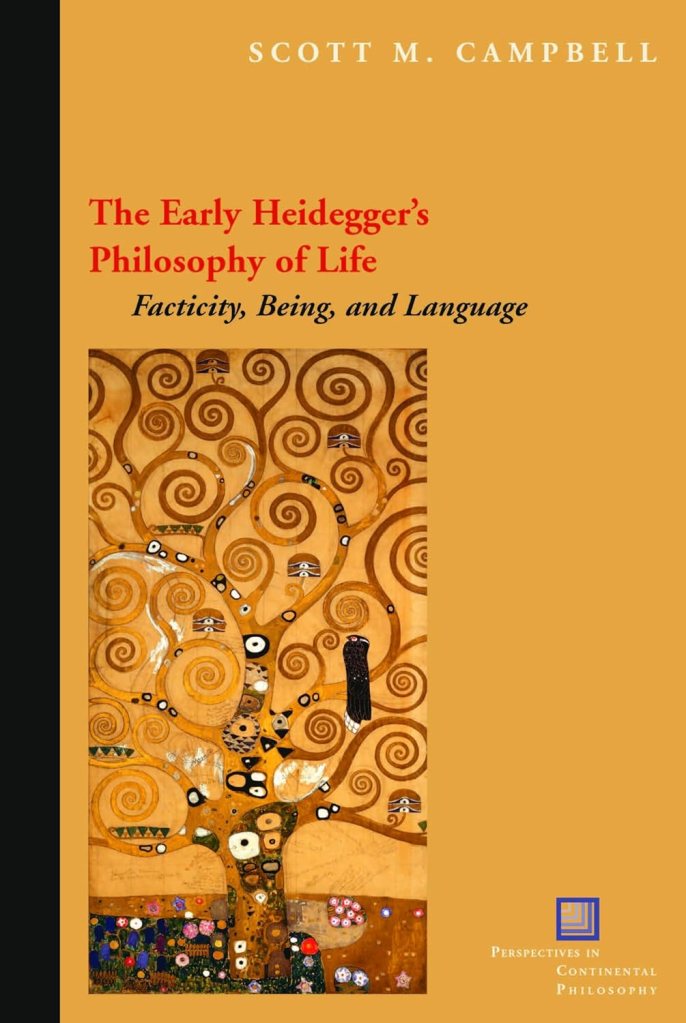
The book’s scholarly stake is exacting and distinctive: it reconstructs, from close readings of lecture courses and manuscripts between 1919 and 1925, how facticity—life in its lived and spoken enactment—serves as the medium through which the early Heidegger makes the question of Being pertinent to human existence and to language. Scott M. Campbell’s contribution lies in demonstrating, with unusual precision, the mutual transposition of existential and ontological motifs whereby concerns about life and about Being crystallize in the emergence of Dasein as Being-in-a-world, and in showing how the early program progressively retools science, theology, historiography, and linguistic theory by returning their concepts to the historical vitality of living and speaking. In this account, worlding and logos-as-speaking come to name the very conditions under which life reveals and conceals itself.
Campbell’s argument develops from a basic orientation: philosophy becomes faithful to its object when it allows life to show itself in its enactment and language to show itself in its speaking, rather than when it secures theoretical vantage points exterior to experience. The sign under which this fidelity proceeds is facticity: a name for the dimensions in which human beings participate in living and speaking and thereby understand themselves as such. The early Heidegger’s stated resolve to “catch life in the act of being lived and language in the act of being spoken” functions here as methodological ground bass, and Campbell pursues its consequences without diluting its rigor. The book’s opening pages frame the program succinctly: the analyses of life and language are reinserted into the Being-question to exhibit how Being bears on existence through historically constituted enactments.
A decisive claim follows from this orientation: the early project treats the question of Being neither as a superadded theme nor as merely postponed; it is rather carried in the retrieval of the temporal-historical situations in which life and speech acquire sense. Campbell gives this claim both a genealogical and a structural contour. Genealogically, the book tracks a sequence—Freiburg to Marburg; 1919 to 1925—in which vitality, factical life, hermeneutics of facticity, and the language of life successively name the dominant emphases of distinct periods. Structurally, the same materials are shown to merge into and finally be displaced by later articulations: factical life is continuously clarified until it becomes Dasein; the diffuse attention to life’s contexts condenses into the integrated phenomenon of Being-in-a-world; the scattered insights into speech converge on a hermeneutic clarification of logos as the enacted revealing and concealing of beings. The table of contents and the chapter scaffolding already exhibit this compositional logic of intensification and displacement.
The wager of reading life and language under the sign of facticity requires an exact sense of how life is approached. Campbell amplifies Heidegger’s determination to refuse an exclusively theoretical comportment toward experience—an attitude that abstracts a deworlded, devivified givenness—and instead to pursue the pre-theoretical meaningfulness within which human beings already live among others and among things. Hence the repeated contrast between the question for “real” objects and the phenomenon of worlding: what shows itself in ordinary comportments is a unity of contexts, orientations, and practical references, a layered intensity of significance that cannot be reassembled from intersecting surfaces or from the inventory of neutral properties. The task is to break the primacy of the theoretical in order to describe those intensities in which life is already at home in meaningful relations—though that home is always at risk of unhomeliness.
Within this frame, Campbell emphasizes two coordinated movements that give the book its argumentative spine. The first is retrieval: a disciplined return that reopens the original motivations sedimented in doctrines and methods by reenacting the historical situations that first made them intelligible. The second is exposure to concealment: every disclosure of world comes bound to distortions, prattle, objectifying closures, and modes of avoidance. Campbell’s insistence that deception belongs to the negativity of Being as it bears on factical life gives the work its problem-laden texture. Factical life is always both in truth and in untruth: revelation is structurally coimplicated with disguise, and speaking, because it opens beings, simultaneously provides the medium for self-concealment. The book thus resists moralized dichotomies of ordinary life as simply fallen versus resolute existence as a permanent station; authenticity, on the reconstruction presented here, names an intermittent clarity that illuminates the shadows it requires, rather than a purified condition that abolishes them.
One hears these themes first in the 1919 reflections on philosophical vitality. Campbell traces the early critique of the theoretical attitude as a critique of any approach that treats experience as accumulated data. Where theoretical seeing tends to isolate properties and to abstract from enactment, the phenomenological description seeks the levels of vitality characteristic of lived experience. What becomes decisive is the articulation of worlding as a phenomenon of meaning-structures in which things are accessible in their orientation, background, and affordance. The well-known lectern example is not a reductive relativism; it shows that significance is not added by perspective, but is the way beings are given within historically articulated ways of life. The analytic therefore begins from intensities of meaningful involvement.
From here Campbell tightens the connection between facticity and temporality by attending to the early courses on religious life. The experiential center of gravity in the Pauline materials becomes the expectation of the second coming as a mode that temporalizes existence and gathers it into decision and vigilance. Campbell’s point is not doctrinal; it is phenomenological: the temporal immediacy of faith enacts historical life instead of theorizing it. Thus, when he says the originality of life first takes on a decidedly temporal-historical character in these analyses, he is drawing out the shift in which the early program learns to read history as a structure of living. The relevance of Being to life begins, in this construal, precisely where enactment’s time-pressure discloses finite orientation.
The book’s central chapters, on factical life in 1921–22, are its conceptual hinge. Campbell carefully reconstructs the methodological gesture by which the inquiry proceeds through language—through the ordinary use of the word “life”—to the phenomenon of world. The crucial turn is that grammatical analysis, if well handled, becomes a path back to the immanent speaking of life; grammar is neither the terminus nor the sovereign measure but a conduit to the enacted sense of living and speaking. The result is a programmatic thesis: facticity is where life and language meet, where the human being’s worldly relatedness becomes accessible as a field of movement. In that field, meaningfulness is categorically structured, which is to say that it can be indicated in directions of sense that belong to life’s own enacted orientation. The movement in question is not an overlay; it is the very concreteness of existence.
A powerful tension animates Campbell’s reading of ruinance—the precursor of fallenness—as a constitutive possibility within this same field. Ruinance names the life-tendency to objectify itself, to identify with distracting commerce among beings, and thereby to cover over its historical-temporal constitution. Campbell’s insistence that ruinance belongs to facticity is not a pessimistic doctrine; it is a reminder that the very openness that lets a world appear provides the channels through which distortion circulates. The later vocabulary of thrownness and fallenness can thus be heard as a deepening of this earlier insight: dependence on beings, absorption in dealings, and the ease of average intelligibility are marks of how world grants significance—and of how significance risks ossification.
From this vantage point, the transition marked in Ontology: The Hermeneutics of Facticity (1923) becomes legible: factical life becomes Dasein as Being-in-a-world. Campbell highlights the conceptual compression: what had been traced as multi-stranded patterns of worldly relatedness is now named by the phenomenon whose very essence is this openness; in Dasein, the world encounters Being. The transition is not a change of subject but a refinement of the same problematic in which facticity is recognized as the mode by which life has access to Being. The retrieval of temporality intensifies accordingly, for the dynamizing nothingness that temporalizes factical life is thematically clarified: no annihilating void, but no-thingness—the non-objectual character of the origin within which limit, finitude, and disclosure belong together.
It is at precisely this juncture that language becomes an indispensable theme. Campbell organizes the final movement of the book around factical speaking, rhetoric, and sophistry. He extracts from Heidegger’s lectures a consistent thesis: logos is not primarily ratio or logic but speaking—a speaking that shows and hides, that discloses a world in the very medium that lends itself to disguise. To make the point, the analysis revisits Aristotle and Plato, but always by way of retrieving their concepts to their factical sources: the lived situation of Greeks who “lived in speech,” and for whom logos is a way of being with others in a shared world. Factical speaking thus becomes the ground on which deception is possible and on which truth appears with motile vulnerability.
Campbell emphasizes the methodological consequence of this linguistic turn by analyzing the 1924 course on Aristotle’s Rhetoric. There the philosophical facticity of logos is made concrete, and rhetoric is reconstructed as an interpretation of Dasein itself—a hermeneutics of existence in its everyday speaking. Aristotle’s intentions are taken to be recuperative: to “take speaking back” from sophistical entanglements by retrieving possibilities of existence latent in Greek life itself. The result, on Campbell’s reading, is that language’s average uses are neither philosophically negligible nor merely obstacles; they are the very terrain on which authentic possibilities can be pried open. In that setting, to separate pathos from logos is to misunderstand both; persuasion, decision, and conviction do not stand in opposition to truth so much as mark the modes in which truth must find passage when speech is worldly.
Against this Aristotelian horizon, Campbell’s reconstruction of Heidegger’s attitude toward Platonic dialectic is pointed and clarifying. The issue is not whether dialectic was incomplete; it is what end it strove toward—theorein, pure seeing—that, in this reading, extricates thinking from the human situation and from speaking’s worldly burden. By contrast, the appeal to rhetoric, and to the logos enacted within life, serves as a counter-movement: philosophy is returned to the acoustical and pathetical medium of ordinary interlocution in which beings become manifest for finite speakers. The deconstruction of theoretical “pure seeing” back into logos is not the abolition of clarity; it is the recovery of the conditions under which clarity can be wrested from concealment by those who speak to and hear one another.
In elaborating these contrasts, Campbell takes considerable care to avoid two temptations. The first is to convert rhetoric into a mere ladder toward theoretical heights—an instrumental view that would reinstate the very abstraction under critique. The second is to romanticize average discourse. Instead, he keeps the analysis keyed to the ambiguity of factical speaking: its capacity for prattle and for revelation; its susceptibility to sophistry and its readiness for retrieval; its intimacy with world and its readiness to cover the world over in clichés. Because speaking belongs to Dasein’s basic structure, because it is how beings show themselves in and through the world, rhetoric becomes a privileged discipline for discerning the conceptuality of concepts in their worldly genesis and for hearing how philosophical grammar grows from living speech.
What emerges from the book’s cumulative exposition is an unusually coherent account of worlding. Early analyses of science and religion are reread as attempts to resituate those practices within the meaningful contexts that first sustain them: science is grasped from the phenomenon of taking-notice rather than from theoretical certainty; early Christian life is recovered as the horizon in which temporality becomes urgent without becoming calculable. The same gesture then reappears, more sharply focused, when hermeneutics of facticity is named: philosophy and theology are grounded by retrieving Aristotle’s situation; ethics is returned to ethos, the bearing of life in a shared world; and ontology itself is articulated as a practical ontology in which the question of Being is advanced through the hermeneutics of logos.
Campbell’s compositional sequence reinforces the through-line. Part I (1919–21) establishes vitality and the experiential intensities of worlding; Part II (1921–22) makes factical life explicit, thematizes its movement, and draws out ruinance as an intrinsic possibility; Part III (1922–23) gives the name Dasein to the phenomenon that had already been analyzed and thereby installs the hermeneutics of facticity at the center of ontology; Part IV (1923–25) develops language as the element of worldliness, first in the abstract (factical speaking), then in its civic and ethical textures (rhetoric), and finally in its derangements (sophistry) which, because they are internal to speaking, must be retrieved rather than simply excluded. The book’s outer frame—introduction through conclusion—therefore documents not a change of topic but a disciplined shift in focus: from lived intensity to categorial description to ontological naming to linguistic articulation, each stage merging into and then being displaced by the next as the same problem-complex gathers itself into new, more exact forms.
Two clarifications, central to Campbell’s reconstruction, deserve emphasis. First, nothingness is not a speculative abyss; it is the no-thingness correlated to the finitude of existence and to the non-objectual character of the origin in terms of which life temporalizes. This is why the analyses of limit, finitude, and anxiety belong to the same arc as the analyses of disclosure and understanding: the power to open a world is inseparable from the privations that contour it. Second, authenticity functions as a luminous intensification internal to average life rather than as an external ideal. The figures of vigilance, distress, urgency, and uncanniness that Campbell accents are not moral provocations; they are phenomenological indications of how, at the edges of routine, speaking and living can wake to their own ground and thereby retrieve their measure.
The book closes—fittingly—by returning to speech. Because logos is the place where showing and concealing are cooriginal, because pathos belongs to the articulation of significance, and because persuasion and decision are forms of comportment through which beings matter, the philosophical dignity of everyday interlocution is restored. The revaluation is not sentimental. It subjects speech to a more exacting demand: to hear its own tendency to ossify; to listen for the conceptuality that animates its uses; to take back, again and again, the word from those automatized circuits in which it circulates without revealing. In this way, the early program does not abandon the question of Being in favor of humanistic themes; it rather passes through the hermeneutics of life and language so that Being can become relevant. On Campbell’s showing, that is the inner law of the sequence he reconstructs.
If one asks, finally, what the work secures as its distinctive gain, the answer is twofold. It secures a vocabulary—facticity, worlding, Dasein, logos-as-speaking—in which existential and ontological concerns are inseparable without being conflated. And it secures a method—retrieval through lived speaking—in which conceptual history is practiced as phenomenology and phenomenology is practiced as conceptual history. The achievement is to show how analyses of science, faith, history, and rhetoric belong to one and the same project: the ongoing effort to let life and language return to their origin so that the question of Being can be asked where it matters—in the midst of living and speaking with others, under the finite pressures of time. That this question is both revealed and distorted by the very media that bear it is no defect; it is the very reason the analyses must continue.
Throughout, Campbell remains closely internal to the lectures and manuscripts he canvasses: 1919’s critique of theoretical primacy in science and the turn to worlding as meaningful intensity; 1920–21’s Pauline temporality as enacted life; 1921–22’s categorial explication of factical life and introduction of ruinance; 1923’s renaming of life as Dasein and explicit thematization of Being-in-a-world; 1923–25’s development of language through factical speaking, rhetoric, and sophistry; and the programmatic insistence that logos—as the medium of both disclosure and disguise—must be retrieved as the place where world comes to word. In this, the book’s scholarship and its philosophical posture are aligned: it shows how the early Heidegger presents a way of grasping human life as riddled with deception yet charged with meaning and open to insight, and it offers a vocabulary and a method for continuing that grasping without abandoning the question that animated it from the first.
 Simon Gros
Leave a comment