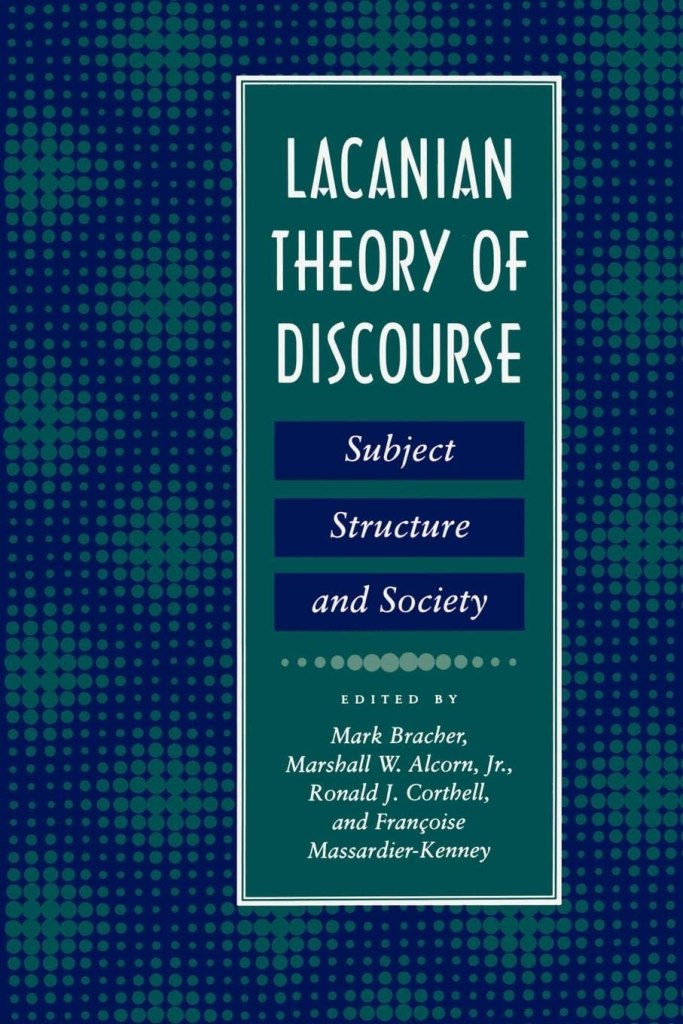
The volume stakes a precise claim: by reconstructing Lacan’s concept of discourse across clinical, social, and cultural registers, it offers a model in which language and what exceeds language are locked in a structured reciprocity—so that subjects are formed in discourse and yet sustain modalities of resistance through it. The distinctive contribution lies in formalizing this reciprocity as a circular causality between the Symbolic and the Real; in showing how subject-structures (hysteric, obsessional, analyst) are isomorphic with discourse-structures (university, master, hysteric, analyst); and in demonstrating, via concrete sites such as education, gangs, religion, and political terror, how discursive forms manufacture social effects and symptomatic attitudes. The book thus reorients “discourse analysis” by binding it to psychoanalytic metapsychology and a rigorously non-reductionist social theory.
Edited by Mark Bracher with Marshall W. Alcorn, Jr., Ronald J. Corthell, and Françoise Massardier-Kenney, the collection is organized in three movements: the Real and the subject of discourse; discourse structures and subject structures; and discourse and society. Its outer frame is explicit: the editors intend neither a totalizing exposition nor a single method, but a demonstration of how Lacanian psychoanalysis can account for constitutive and transformative functions of discourse. The composition is also historical: several chapters first appeared in Prose Studies (1988) and in the Navarin volumes on hysteria and obsession—an editorial decision that already stages the central thesis that discourse traverses both textual criticism and clinic.
The book’s methodological wager is set in Bracher’s introduction. Against the false alternative between reflectionism (language as mirror hurled against “the rock of the real”) and idealism (a social world devoured by signification), Lacan is read as articulating a circular vector: discourse orders the field of experience while the Real installs limits, pressures, and returns that reconfigure the order that tried to subsume it. This circularity allows the editors to state two linked claims that will guide the whole: subjects are produced by discourse and can resist within discourse; ideologies interpellate and are themselves ideologically produced by subjects. The political stakes are immediate: the analysis of rhetoric without metapsychology misses resistance; the analysis of psyche without discourse misses social efficacy.
Alcorn’s opening essay thus clarifies the phrase subject of discourse. Poststructuralism had treated the subject as an “effect” of signifying systems; classical psychoanalysis had often treated discourse as the subject’s instrument. The Lacanian solution refuses the disjunction: discourse situates and splits the subject; subject-functions (desire, repression, temporality, fantasy) operate on discourse. On this bidirectional model, agency is not the triumph of a sovereign ego but the capacity—internally divided—to misrecognize, to displace, to resist interpellation, and to produce ideological formations that then act back upon the subject. The consequence is a non-naïve account of political efficacy: resistance is not an external stance but an effect generated within and by discursive structures themselves.
The collection’s central tension is named by the Lacanian term extimacy, explored with exemplary clarity by Jacques-Alain Miller. The most intimate kernel of the subject is structurally outside—that object a which both grounds alterity and knits the Real into the Symbolic field. Miller’s didactic fable of the shouted “Bomb!” demonstrates this extimate logic twice over: bombs are products of scientific discourse and therefore of the Symbolic; and even a non-existent bomb, once posited, produces real effects. The efficacy of a signifier lies precisely in housing a surplus-real that no verification cancels. This is why religious belief and racism appear here as discursive economies of jouissance: religion covers the subject’s own extimate enjoyment; racism maps imagined jouissance onto the Other and thereby anchors hatred in what argument cannot reach. The point is not a psychologizing reduction but a structural one: race is a discourse of jouissance, not a biological datum.
Žižek’s contribution dramatizes extimacy by staging ethics and aesthetics on the same scene. The Kantian moral law presses as an unbearable demand, signaling a Thing in the subject that resists the Good and binds ethical rigor to a prior radical evil. The dialectic of the Beautiful (symbol of the good) and the Sublime (manifestation of the law in us) makes visible the fissure where the moral law both institutes and derails the subject. Cinematic figures—Hannibal Lecter as the obscene double of the analyst; the monster as gaze incarnate; the end-of-film reduction of the hero to a mere object in the picture—serve as diagrams of extimacy, in which desire (narcissistic, Imaginary-Symbolic) yields to drive (circuiting the Real object lodged in the field and never assimilated by it). The argument provides a phenomenology of how cultural forms stage the Real’s surplus in Symbolic frames without ever mastering it.
Serge André presses extimacy into the body. The paradox he works is double: the subject’s body is a weave of signifiers and an unnameable Real; sexual relation is patterned by phallic speech-jouissance and yet traversed by a surplus enjoyment that exceeds Symbolic capture. The “Otherness of the body” is then homologous with the Otherness of woman and with the subject’s own body as Other: Zeno’s paradox becomes the figure of an eternally missed encounter where the signifier “One” commands unity that cannot—without abolishing alterity—ever be realized. The clinical consequences are stark: perversion here appears as a staging designed to experience the Other’s otherness while keeping it circumscribed; religion functions as a symptom that both enacts and defends against psychotic collapse by invoking a being beyond the law of the phallus. The theoretical payoff is a non-naturalized account of sexuation: what the Symbolic organizes as knowledge always signals a remainder it cannot include.
The volume’s central engineering feat is Bracher’s formalization of Lacan’s four discourses. He sets out a general schema of message exchange that allows one to track how the positions of agent, other, truth, and production permute, yielding the discourses of the University (educating), the Master (governing), the Hysteric (protesting), and the Analyst (revolutionizing). Two methodological consequences follow. First, discourse is not a mere overlay on psychology; it is the matrix in which affect, thought, identity, and enjoyment are determined. Second, the schema affords not only diagnostics but intervention design: by reconfiguring positional relations, one can calculate how to produce new social and psychic effects. The model thereby fuses rhetorical analysis with a clinical theory of transformation.
A set of essays then exhaustively works the neurotic field by mapping subject-structures onto discourse-forms. The hysteric appears as the subject who demands from the Other the missing S₁ that would name her truth and who simultaneously venerates the signifier of Woman while refusing masquerade, seeking an essence that the Symbolic cannot supply. The obsessional occupies the Master’s chair while refusing its risk, attempting to unify knowledge under the phallic signifier, erotizing thought in a bid to compute jouissance and banish the Real—an operation that must fail where the object a returns as the failure of knowledge. The difference is not a typology for its own sake; it is a demonstration that neurotic suffering is a structural response to the non-rapport between Symbolic forms and Real enjoyment. Analysis then implies a shift of discourse: the analyst’s position must be introduced to lead the obsessional to division and the hysteric to the object around which her demand circles.
Néstor Braunstein crystallizes the distinctiveness of analytic interpretation by contrasting it with the Master’s command, the University’s exposition, and the hysteric’s validating demand. In the first three, interpretations are propositions that claim truth and thereby impose or solicit assent; they are metaphoric substitutions that risk installing a new symptom. The analyst’s utterance, by contrast, is non-propositional: by withholding verb conjugation, by citing the analysand’s own signifiers, by aphoristic compression, it does not say what is; it presses the analysand to articulate the object cause of desire. The logic mirrors the fantasy’s structure ($ ◊ a): no suturing verb closes the gap between subject and object; the utterance functions as a structural provocation to encounter the cut rather than cover it. In this sense, analytic discourse is “without words”: it creates a social link in which the analysand can speak the remainder rather than adopt an imposed meaning. The upshot is methodological: psychoanalytic discourse is not content but form; not explanation but arrangement of positions that enable truth-effects irreducible to knowledge.
The book’s third movement vindicates its subtitle by showing how these formal invariants govern concrete institutions. Renata Salecl’s analysis of schooling is exemplary. Against the commonplace that the classroom is a Master discourse, she shows that the teacher, bound to give reasons and to refer to a knowledge outside herself, occupies the agent’s place in the University discourse. This explains both the power and the indirectness of pedagogical speech-acts: “Could you please…?” is not mere politeness but a performative deference to the Great Other—the normative Symbolic order whose “objective” codes structure perception and bind subjects beyond inner intention or external institutional backing. The Master reappears here, but not where one expects: in law, the judge is the University’s agent, while the jury—with its unargued verdict—occupies the Master’s place and “guilts” the normative field. Education, therefore, achieves its aims only as a by-product; wherever it aims directly to form the ideal citizen, it produces cynicism that nonetheless secures the true aim: the reproduction of power under the fiction of deference to the Great Other.
The force of Salecl’s account is double. First, it corrects both speech-act and Marxist theories by specifying the symbolic dimension they miss: the Other is neither mere mental background (Searle) nor mere external institution (Bourdieu), but the quasi-transcendental frame within which institutions and intentions alike gain efficacy. Second, it reframes the teacher’s authority: the teacher is not a sovereign but a responsible subject who must continually stage the Other’s knowledge in order to secure obligation. This is why the school’s prohibitions are uttered indirectly and why the “subject-supposed-to-know” resides in the teacher only as a function of her relation to an impersonal code. The analytic payoff is clear: to transform schooling is to transform the discourse that authorizes teachers and students, not to exhort good intentions.
Luz Casenave’s case of political terror shows the inverse: how the Master discourse, saturated with the signifiers of death, installs amnesia where the subject cannot position a signifier for the void that opened in an event. The phrase “I don’t know what happened” condenses both a prohibition (the Master’s demand not to know) and a regression to originary scenes of impotence; the symptom is a discourse-effect as much as a trauma-effect. The structural conclusion is unsettling and necessary: ideology inscribes itself not only by persuasion but by organizing the very possibility of narration. In such contexts, analysis must aim at reattaching speech to the void—allowing a speaking of not-knowing that is not simply a capitulation to terror’s signifiers.
Miguel Bassols and Germán García examine blasphemy to show how subjects confront the unspeakable by assaulting the signifiers that pretend to speak it. Where the Symbolic fails to account for a surplus enjoyment—exemplified by Schreber’s delirium of non-phallic jouissance—two paths seem available: death, or an invented cosmos in which a new signifying network grants support. Blasphemy here functions as a paradoxical safeguard of desire by hollowing out the end that theology posits, reintroducing lack where completion was promised. The theoretical yield is again general: the point of extimacy is the pivot where discourses either ossify into delusion or open a space for desire’s articulation.
Willy Apollon’s anatomy of gangs threads the model back into masculinity and institutional form. A group distributes equivalent positions through formal rules; a gang replaces those rules with a local sociohistorical identification enforced by the insult. The triad “fag—coward—cuckold” is not merely an inventory of slurs but a structure that maps absolute invalidation—impotence—which only “the word of a woman” can ascribe. From the negative code one infers the positive injunction: “you must have at least one son”—that is, reproduce the paternal name as the ground of male existence. Hence the gang’s structural exclusion of women: “mother, wife, daughter” are positions allowed; “whore” as the censored point designates the foreclosed remainder of feminine desire, which the gang reintroduces as the object of its fantasy—Woman as absolute. This is why gangs resist “group” formalization: the attempt to introduce rules is experienced as castrating, since it dissolves the imaginary supports of prestige that cover the void. The institution is then precisely an organization of censorship sustained by a fantasy that hides the fact that male desire desires the desire of Woman.
The sociological consequences are exacting. Because gang discourse is organized around the denial and staging of feminine desire, intervention that imposes formal group rules will be felt as an attack on being itself and will fail. The only lever is discursive: displace the fantasy-supports by rearranging positions such that the extimate object appears—and appears as produced by the discourse that excluded it. Without this, the masculine ideal stabilizes itself at the point where hate of the Other guards against the limitless, and where the phallus intensifies the passion for a prestige that ends, as Apollon grimly notes, in a fascination with self-loss.
Across these analyses, the book advances a central thesis: discourse is a necessary structure in which psychological, intersubjective, and worldly relations are constituted and transformed. It explains why science constructs new realities rather than simply discovering them; why law and school function with different discursive engines; why neurosis is not a repertoire of symptoms but a discursive stance toward the non-rapport; why political terror installs silences that are themselves signifiers; and why religion can be either a cover for extimacy or a medium for desire’s re-entry. The argumentative rhythm is consistent: each essay identifies a discursive configuration, locates the point where the Real insists, and shows how that insistence both sustains and undermines the configuration’s efficacy.
The book’s outer frame returns in the closing editorial gesture: these essays are demanding because they require the reader to work through the disjunctions they stage—between Symbolic form and Real remainder, subject-position and social link, interpretation and fantasy, knowledge and truth. But this is not a stylistic difficulty; it is the object’s own resistance, and the demonstration that the only scientific approach to discourse here is one that treats the subject’s division, the object’s extimacy, and the social bond’s form as a single problem. In that sense, the volume’s composition—moving from conceptual clarification, through formalization, into situated analyses that then reopen the formal issues—enacts the very circular causality it theorizes: the introduction frames; the case studies displace; the framing returns, enriched and unsettled. The final clarity is therefore not a synthesis but a method: to analyze any discourse, articulate its positions; to intervene, permute them; to sustain resistance, let the extimate object appear where the Other claimed completeness.
The book’s singular achievement is that it makes clear that language is neither a mirror nor a prison but a practice whose forms—master, university, hysteric, analyst—are the hinges by which society moves; that subjectivity is neither sovereign nor dissolved but structurally split in a way that both enables and limits political action; and that the Real is neither mute matter nor mystical excess but the precise differential that renders discourses efficacious and keeps them from closing over the very enjoyments they mobilize. By binding these three, the collection does exactly what its title promises: it gives us a Lacanian theory of discourse that is at once a theory of subject, of structure, and of society.
 Simon Gros
Leave a comment