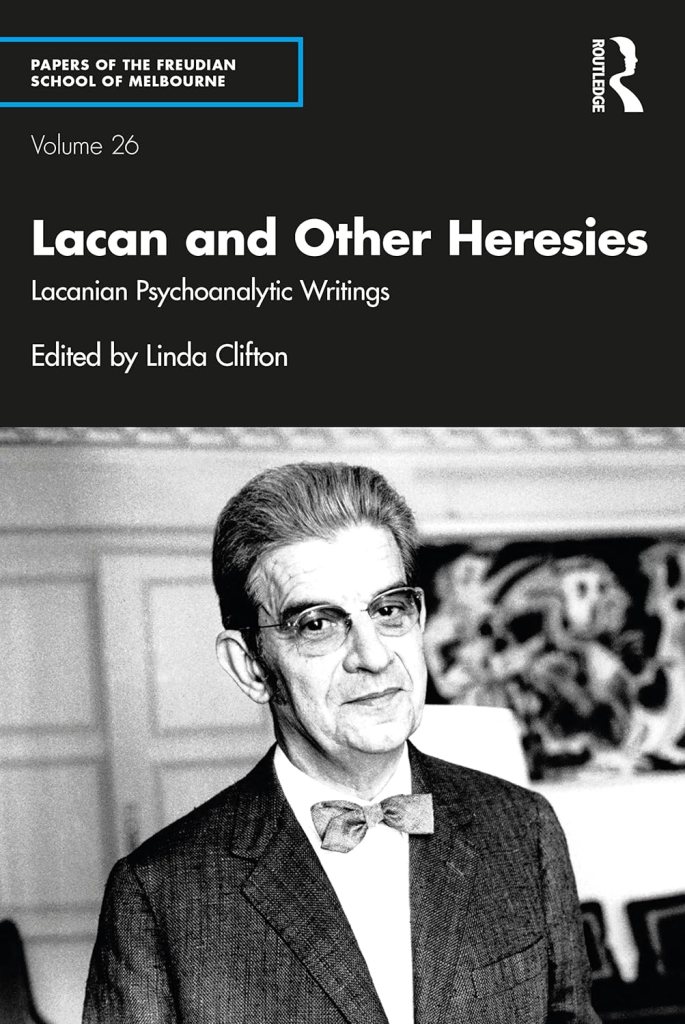
The volume’s distinctive contribution lies in its rigorous effort to reinscribe Lacanian psychoanalysis within a living practice of collective invention, rather than a doctrine of settled theses. Framed by the Freudian School of Melbourne’s long experiment with institutional forms proper to psychoanalysis and catalyzed by the Melbourne seminars of the Belgian analyst Christian Fierens, the book assembles inquiries that test how analysis transmits itself as discourse, how it sustains “heresy” without lapsing into mere contrarianism, and how its cardinal propositions—there is no sexual relation, the structure of the discourses, the school, the cartel, the pass—bear on the child, on psychosis, and on artistic production. Its wager is clear: psychoanalysis advances when its own conditions of speech, institutional devices, and canonical complexes are placed under exacting, internally motivated pressure.
The outer frame is explicit. Edited by Linda Clifton and published as Volume 26 of the Papers of the Freudian School of Melbourne, the collection situates itself in a series devoted to “invention” and sustained interrogation of Freud and Lacan. Its remit is laid out in the book description and in Clifton’s Logos: the Melbourne School fosters a reading that runs against the grain of prior readings, a cultivated practice of what Malcolm Morgan later names “sustained heresy,” and it acknowledges a decisive impetus from Fierens’s visits and seminars (2015 and 2019), where logical and structural exactitude are fused to clinical tact. In this overture, truth is approached neither as a picture of reality nor as a convenient explanation, but as the very lack of a convenient explanation that compels speech—a formulation that already aligns method, clinic, and discourse.
Compositionally, the book moves from axiomatic pressure points to institutional inventions and then to clinical and cultural edges. Part I takes up Oedipus and the inexistence of the sexual relation. Part II presents Fierens’s Melbourne seminars, whose compact, lapidary theses become touchstones for the rest of the volume. Part III turns to Lacan’s institutional inventions—the school, the cartel, and the pass—where the stakes of transmission and the status of the analyst are reworked. Part IV gathers work on the psychoanalysis of the child and of those who speak at the limits of signification. Part V stages the crossings with painting and writing, including a meticulous re-reading of Sabina Spielrein. Part VI isolates “spaces of madness,” a term that invites rethinking the relation of discourse to psychosis and to those places where speech either fails or speaks too much. The sequence is not additive; each section refracts and displaces the preceding one, so that propositions about Oedipus and sexuation double back when the school, the pass, and child-speech are discussed, and are again inflected when the arts and psychosis are brought into analytic address.
The book opens its conceptual conflict around the term heresy. Morgan’s argument for “sustained heresy” is not a license for novelty but a rule-bound way of remaining duped enough by psychoanalysis to work within its discourse and thereby reconfigure it from the inside. He stages the problem in Lacan’s own institutional crises: how to steer between encroaching orthodoxy and “material heresy” (error born of ignorance). The path Lacan marks out is austere: one plays the game “according to the structure of a discourse”; one “monstrates” and “de-monstrates” the real indexed by that discourse; and, if one would found something new, one must first be “a little duped” by what is already in play. Morgan links this to Lacan’s remarks on varity—truth as variable—and to the sinthome roule, the “rolling sinthome,” the image of a choice that must be carried through to its saturation, whereupon it is no longer clung to as identity but consumed as work. The methodological consequence is exact: the collection’s essays do not oppose Lacan from outside, nor do they repeat him from within; they use his devices until their limit appears, and, at that limit, they reconfigure the terrain.
The first arena of testing is Oedipus. David Pereira’s interrogation of the injunction “Let no one enter here who does not believe in Oedipus” treats Oedipus not as the master key to the human but as a complicated device whose domestications conceal a surplus. He isolates two myths that operate under the heading “Oedipus”: the cultural-theatrical complex that sutures sex to familial positions and yields a grid of understanding; and the Freudian Totem and Taboo myth, whose impossible father concentrates an enjoyment beyond the familial signifiers. The clinical proposition is rigorous: an analysis that reiterates Oedipus as a grid converts saying into said, retrieves statements that stabilize identity, and thereby blinds itself to the surplus enjoyment that lives in language as such and that often manifests as symptom, drive, or stumbling speech. For Pereira, what is crucial is not a normative pedagogy of restraint but the exposure of that “impossible real of enjoyment” that cannot be domesticated into human relations and that makes language itself worthy of analysis. In this light, belief in Oedipus becomes the price of admission to domesticated speech; analysis worthy of the name must move beyond that threshold to where speech compromises the speaker.
Rodney Kleiman’s elaboration of there is no sexual relation radicalizes this displacement. He insists that the axiom does not announce the futility of relations but discloses the structural impossibility that organizes complaint, fantasy, and invention at the level of saying. The pathos of the clinic is there: men and women complain of one another; subjects of every position organize around impasses; but the analyst’s task is not to reconcile, nor to restore a pre-given rapport. It is to make the structuring commandment audible and to discern how a subject exploits—or is exploited by—the signifier at this point, how enjoyment is knotted into the modes of address and silence that analysis can pry open. The force of the axiom is methodological: it forbids the analyst the comfort of theories that explain relations and obliges attention to the speaking that finds its own limit.
The book’s inner hinge is Part II, the Fierens seminars, presented and introduced by Michael Gerard Plastow. Fierens’s sequence—on “how to do something with only the saying,” on cogito and the psychoanalytic discourse, on the failure of the phallus and the question of sexuation, and on interpretation without meaning—organizes a set of theses whose common feature is a tough minimalism. To “do something with only the saying” reorients interpretation away from a hermeneutic extraction of meanings toward an operation on the signifier’s act as act. To pose the cogito within the discourse of analysis is to shift the question of subjectivity from a philosophy of inwardness to the place where speech produces the subject’s division. To mark the failure of the phallus is not to denounce phallic function but to specify where sexuation fails as principle of relation and how analysis can operate in that failure. And an interpretation without meaning does not celebrate nonsense; it functions as a precise cut that relocates the subject with respect to the enjoyed signifier. The Melbourne seminars thus supply the book with a procedure: make the discourse itself work in the analytic encounter.
From this hinge, the book turns to Lacan’s inventions concerning the collective. The school, the cartel, the pass—all three are neither mere institutional arrangements nor administrative conveniences; they are discourse devices designed to keep psychoanalysis from coagulating into a church. Essays here press on a recurrent dilemma that Morgan has already theorized: how to invent forms that generate analysts and analytic knowledge without conferring doctrinal authority on any “said.” The school is not a pedagogical ladder; the cartel is a minimal group structured by a shared work and a place for the “plus-one,” designed to prevent mastery from hiding in collegial consensus; and the pass is an exposed procedure for bringing the end of an analysis into the discourse in a way that both produces analysts and tests the discourse itself. The point is not institutional purity; it is the maintenance of the analytic discourse’s specificity in the place where the temptation to educationalize or professionalize is strongest.
The move to the child analysis is methodological, not thematic. The essays on child analysis treat the child neither as a special species of analysand nor as an object of developmental theory. They ask what becomes of saying—and of the analyst’s address—where vocabulary is small, where silence is thick, and where the names “Papa” and “Mama” belong to the domain of language rather than to the tranquil scenery of family romance. The essays rethink the analyst’s position toward the child’s breath and cry, toward the words that are first given and only later uttered, and toward the sites where speech collapses into mutism or mania. The wager, consistent with the book’s method, is that the axiom of the inexistence of sexual relation and the discourse’s devices are no less decisive at this limit-case of speech; indeed, they are often clearer there, where the analyst’s reveries about “understanding the child” most tempt an evasion of the analytic act.
The volume’s most striking act of historical re-reading concerns Sabina Spielrein. Here Spielrein is not reduced to a psychoanalytic anecdote; her writings are read as theoretical and poetic interventions that register how destruction and becoming are bound in analytic experience. The essay does not merely honor a neglected figure; it tests how psychoanalysis reads its own archive. The guiding question is whether the School’s cultivated heresy—its insistence on reading again and otherwise—can alter the way the canon is transmitted, so that figures like Spielrein are neither romanticized nor footnoted but engaged where their writing meets the analyst’s speech. This logic of re-reading continues across contributions on signature, on the painter’s saying, and on the image that binds—all of them concerned with how art does not illustrate theory but exposes analytic invariants at the level of gesture, line, and name.
The approach to psychosis, gathered under “spaces of madness,” exemplifies the book’s refusal of both clinical bravado and institutional nihilism. Madness is neither the romantic outside that redeems analysis nor the pathological exception that cancels it. It is a pressure on the discourse that shows what analysis depends on: a certain economy of address, a minimal structure of the Other, a way of binding the image to speech. The analyses here study places—the speaker’s corner, the edge where a “wild child” appears—in which discourse either becomes too open or seals itself. The interest is again methodological: what does an analyst do with only the saying, when the said has vacated the scene or flooded it? The answers—careful, situated, unprogrammatic—are consistent with the book’s general line: there is no general recipe; there is a discourse to be made to work, a cut to be found, a signature to be borne.
To track how the work develops is to see how the early insistence on “sustained heresy” returns in the later reflections on the school and the pass; how Pereira’s de-evangelizing of Oedipus sets the conditions under which the child’s speech is saying and not only as developmental sign; how Fierens’s interpretation without meaning finds its aesthetic counterpoint in the essays on painting and writing, where cuts and names do the work that meanings cannot; and how the discussions of the inexistence of the sexual relation reappear in the psychosis section as the problem of binding enjoyment without a ready-made relational schema. Each passage is a displacement: the conceptual kernel migrates, is re-inscribed in a new field of practice, and returns altered—as if the volume itself had been organized as a working-through of its own axioms.
This compositional logic is mirrored in the contributors’ profiles, which make clear that the School’s unity is neither doctrinal agreement nor biographical homogeneity. Analysts, psychiatrists, psychologists, and scholars of literature and music carry the work across clinics, public services, private practice, and the classroom. The “school” that emerges in these pages is not a building but a discourse, a set of devices for producing analysts who can transmit what they do without converting it into a catechism. The editorial apparatus—the series frame, the notes on contributors, the placement of the Fierens seminars inside the volume as both hinge and provocation—makes the book itself a minor institutional invention.
The book’s argumentative logic can now be stated with precision. First, psychoanalytic truth is not an explication of reality but the very lack of a convenient explication that moves speaking bodies to speak. Second, the axiom that there is no sexual relation functions as a structural injunction on method: analysis must not substitute relational pictures for the work of the signifier, nor may it comfort itself with the Oedipus that guarantees understanding; it must accompany speaking to the point where its enjoyment is at stake. Third, the discourse of psychoanalysis is maintained via inventions—the school, the cartel, the pass—that are themselves analytic operations designed to prevent knowledge from settling into “the said,” and to return it to “the saying” that made it. Fourth, clinical edges—the child, psychosis, the domain of art—are not thematic annexes; they are the arena in which the above axioms prove their necessity or are exposed as hollow. Fifth, the archive of psychoanalysis is not a museum; it is a site of re-reading where figures like Spielrein can alter the present of analysis when read under the discipline of the discourse rather than as monuments.
The volume’s distinctive style is to render its problems constructive. It lets concept tensions stand so that method can do its work. The tension between Oedipus as normative grid and Oedipus as access to surplus enjoyment compels a redefinition of interpretation; the tension between institutional endurance and institutional sclerosis compels rethinking of the school and the pass; the tension between understanding the child and hearing the child’s saying compels an ethics of address; the tension between meaning and act compels the practice of interpretations that operate without meaning yet with maximal precision. In each case, the editors and contributors resist the temptation to settle dilemmas prematurely; instead, they demonstrate how psychoanalysis remains faithful to itself precisely where it refuses the comfort of an already-formed explanation.
If one clarifies at the end the scholarly stake, it is this: the book offers a model of analytic transmission that neither sacralizes doctrine nor dissolves into private idiom. It sustains a space in which being “a little duped” by psychoanalysis—enough to play its discourse—permits a practice of heresy that is serial, disciplined, and creative. The reader is not asked to join a camp; the reader is asked to try to read. That procedure sets the analytic axiom in motion across fields, subjects, and signatures; it exposes the institutional devices to their own limits; it rereads the archive so that what is living there can be heard; and it keeps faith with a truth that cannot be said without lying in being said, yet that is nevertheless pursued. In that sense the book is exemplary. It does not add to Lacan; it does something with the saying Lacan made possible, and in doing so, it renews the conditions under which psychoanalysis can continue to exist.
 Simon Gros
Leave a comment