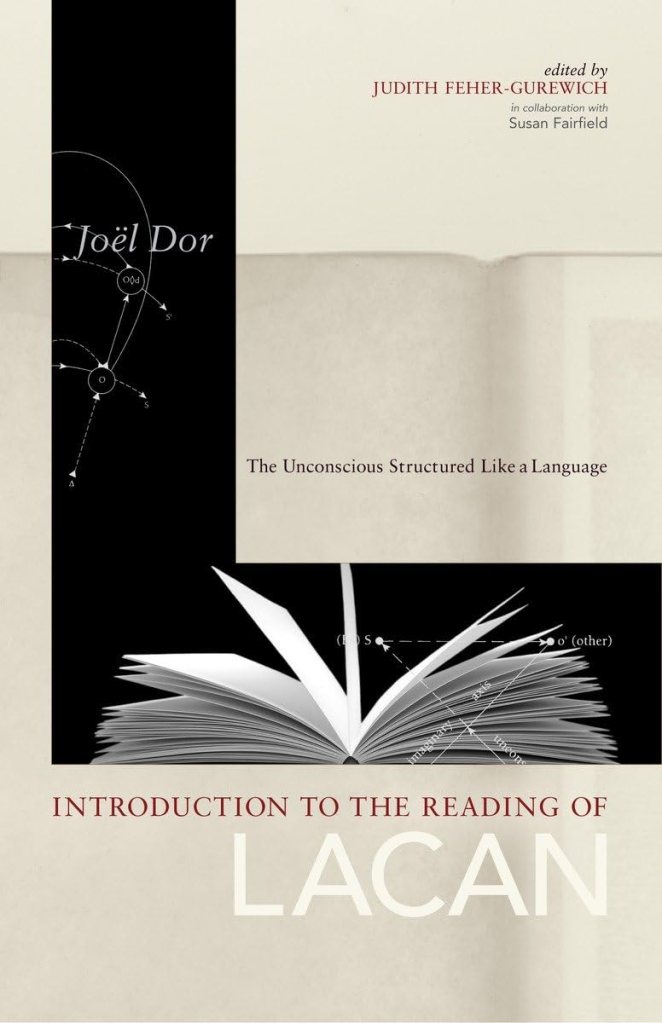
Introduction to the Reading of Lacan: The Unconscious Structured Like a Language stakes its claim by demonstrating, with didactic patience and analytic precision, how Lacan’s structural re-founding of psychoanalysis can be reconstructed from within the field that grounds it: the speaking subject’s formations of the unconscious as they are anchored in language and staged in transference. Its distinctive contribution lies in integrating the decisive lexicon—mirror stage, Name-of-the-Father, metaphor and metonymy, phallus, foreclosure, splitting of the subject, and the graph of desire—into an internally coherent clinical-theoretical method. The volume proceeds as a guided reconstruction of Lacan’s return to Freud that makes explicit, step by step, the inferential transitions by which Saussurean linguistics, structural anthropology, and logic are articulated to clinical evidence, such that the unconscious as discourse of the Other becomes not a slogan but a working, testable framework.
The book opens by delimiting the Freudian terrain to which Lacan continually returns. The arena is not a museum of doctrines; it is a set of operations that generate knowledge in and through the analytic situation: dreams, parapraxes, symptoms, jokes, and the transferential bond. The initial clarification, consistently emphasized, is methodological rather than merely historical: the unconscious is not a metaphysical substratum nor a thematic repository of instinctual contents; it is a mode of articulation that can be accessed only where speech is put to work and where interpretation modifies speech’s effects. Two poles, recurring throughout the exposition, demarcate the field: language, as a differential system whose effects are observable in the material of speech, and transference, as the scene in which the subject’s relation to that material is experimentally re-organized. This dual anchoring prohibits any temptation to treat Lacan’s formulations as speculative theses detached from the phenomena that authorize them; the reference point is always the analytic clinic, where the unconscious must show itself under the specific conditions of the analytic setting.
The orientation called a return to Freud thus means a return to Freud’s method, in which the meaningfulness of formations of the unconscious depends on the differential play of signifiers and on the function of the analytic address. The text therefore installs, at the outset, a criterion of non-metaphysical concreteness: the unconscious bears a seal—a recognizable signature—discernible only where language works, and works in a transferential structure. From that vantage, the book continuously tests whether a given conceptual advance remains subordinated to the site that lends it its objects. Each time a notion is introduced, it is re-submitted to the clinic: what does it predict, explain, or render newly legible in the patient’s discourse, and by which operations does it do so?
The transition to the structural perspective is organized with clarity. Structure is not invoked as an ontological depth, but as a set of transformations that conserve certain invariants while generating variations. Such a definition immediately fits the Freudian archive: symptoms transform and displace, dreams condense and transfer, jokes re-cut the signifying chain—all operations that presuppose a combinatorial space and rules of transformation. The move to structural linguistics is then not a disciplinary importation for its own sake; it answers a specific demand: how to describe the workings of those transformations without reducing them to content psychology. The decisive Saussurean contribution, introduced in precise steps, is the synchronic point of view: the present meaning of an element depends on its place in a system of differences that is, at any given moment, structured. Through this lens, the signifier no longer names a vehicle for pre-given meanings; it marks a position in a net of oppositions, substitutions, and chains. Such an account immediately clarifies why unconscious formations exhibit effects—condensation and displacement—that are legible only when the signifier’s autonomy is respected.
The book’s pedagogy extracts from Saussure a strictly delimited set of tools: the signifier/signified distinction; the arbitrariness of the sign; the value of an element as a function of oppositions; and the diachrony/synchrony distinction. Each tool is re-phrased in terms appropriate to analytic work. The autonomy of the signifier—its relative independence from the signified—finds clinical warrant in phenomena where the signifying articulation races ahead of any stabilized meaning: slips, neologisms, equivocations, homophonic condensations. The reader is shown how the “value” of a signifier depends on oppositions internal to a given speaker’s idiolect, highlighting why interpretation must sometimes privilege a minute phonemic detail that seems irrelevant to meaning but proves decisive for the subject’s desire. By foregrounding the structural determination of value, the exposition equips the analyst to hear in a patient’s sequence not merely what is intended, but what is produced by signifying adjacency, substitution and iteration.
From these generalities the book moves to the pivot that will guide the entire reconstruction: signification does not float freely; it requires anchoring points—points de capiton—where a master signifier knots a portion of the chain, fixing provisional meaning and halting slippage. The analytical import is double. First, the subject’s experience of consistency in meaning depends on these points, which are historically acquired and revisable; second, an analytic intervention can displace such a point, thereby re-ordering a whole sector of the subject’s discourse. The text patiently shows how this function solves a practical riddle: why some stretches of speech come off as empty chatterbox while other moments precipitate decisive insights. The answer is that the chain, without anchoring, produces a circulation of signifiers that never quite hooks into desire; with anchoring, a new economy of meaning emerges that gives the subject’s speech a trajectory oriented by what the subject unknowingly seeks.
Out of this account of value and anchoring the book derives the necessity of distinguishing metaphor and metonymy as the two primary vectors of signifying work. The metonymic vector regulates displacement along a chain—linking through contiguity; the metaphoric vector effects substitution, whereby a signifier takes the place of another, producing a leap of sense. Both processes, read structurally, exceed conscious intention and are visible across Freudian phenomena: in symptom formation, dream work, and jokes. The argument is cumulative: once the primacy of the signifier is established, and once anchoring points are shown to stabilize meaning only locally, the theory of the unconscious requires a mechanism by which unbound signifiers either slip along the chain (metonymy) or coalesce into condensed nodes (metaphor). The book demonstrates how symptom formation is metaphoric in its structure: a signifier, barred from direct articulation, re-emerges as the signifying kernel of a bodily sign that condenses and encrypts a conflict—an encryption that can be deciphered only by following the logic of substitution. Conversely, the insistence of desire manifests metonymically as a restless movement—an incessant sliding—that skirts satisfaction because the object it pursues is structurally displaced by the very chain that speaks it.
This is the point at which the paternal metaphor is introduced with special care. The paternal metaphor is not a sociological thesis about fathers; it is a structural operation in which a signifier—Name-of-the-Father—takes the place of another signifier that had occupied the privileged position in the infant’s universe, namely, the signifier of the mother’s desire. Through this substitution, the phallic signification is instituted as the rule of the game: the child’s access to desire becomes mediated by a law that inscribes limitation and possibility at once. The problem Lacan names here has two sides. On the one hand, the substitution anchors the maternal field, preventing the child’s immersion in an unbounded imaginary dyad; on the other hand, it inaugurates lack as a structuring principle, since desire is henceforth articulated within a system where something is always other than what it seems. The book shows, with textual patience, how the paternal metaphor re-cuts the terrain such that desire can be symbolized, and thereby spoken, without being exhausted by any particular satisfaction.
This preparatory clarification makes possible the tightly argued treatment of foreclosure and psychosis. If the paternal metaphor is the operation by which the Name-of-the-Father is inscribed in the symbolic, then one can conceive the analytical situation in which the Name-of-the-Father is not merely absent but not inscribed at all in the subject’s symbolic battery. The consequence is not simply a deficit; it is a structural hole, a place where the signifier that would stabilize the field cannot be called upon when needed. In such cases, the invasion of the signifier—words that unmoor themselves from their usual values, proliferations that submerge meaning—testifies to an order where substitution fails at the crucial point, producing characteristic psychotic phenomena. Without pathologizing metaphors, the exposition stays faithful to the textual record: foreclosure is a mechanism discernible where stabilization via the paternal metaphor does not occur, leading to a relation to language in which the subject is exposed to the signifier in an unmediated way. The effect is a speaking that is overrun by language rather than a speaking that puts language to work.
The treatment of the phallic function, often a field of misunderstanding, is then re-situated: the phallus is a signifier—the privileged signifier of lack—whose function is to index, in the symbolic, the place of desire’s structuring limit. It is not a biological organ nor a melancholic symbol of domination; it is a regulator of value that renders possible the circulation of desire between speaking beings. The book’s clinical tact surfaces here: without the phallic function, one cannot explain the ubiquitous equivalences and substitutions that subjects mobilize to secure recognition; with it, one can track why certain substitutions count—why a seemingly trivial sign in one subject’s discourse becomes decisive, while in another subject the same sign passes unnoticed. The phallic signifier thus designates the point where the law of substitution touches the economy of recognition: its “predominance” is not a metaphysical thesis but a regularity in the way meaning and desire are knotted.
Having set these coordinates, the book returns to the formation of the subject. The mirror stage is introduced not as a once-and-for-all episode but as a structural phase in which the subject’s identification is organized by an image that confers form and coherence on an organism experienced as motile and discordant. The identification is jubilant because it promises mastery; it is alienating because the coherence comes from without. The imaginary, thereby, is neither error nor residue; it is the register in which form, rivalry, and mimicry structure the ego’s defenses. The Oedipal process overlays this field by linking it to the symbolic—via the paternal metaphor—and to the phallic function that sets limits and enables desire to circulate beyond the dual dyad. The reader is given the means to see how, developmentally and structurally, the subject acquires a position from which to speak, desire, and be represented.
At this juncture, a decisive methodological distinction is installed: the subject of the enunciation and the subject of the utterance. The subject who speaks as “I” is not identical with the subject whose desire is inscribed in the chain; the statement “I desire X” may stage a defensive organization that conceals a desire that does not coincide with the ego’s avowal. This splitting is not an incidental pathology; it is the structural condition of being a speaking subject. Speech, in representing the subject, simultaneously eclipses the subject in its very representation; in Lacan’s formula, the signifier represents the subject for another signifier, and in this relay, the subject fades. The analytic consequence is central: interpretation must target not only what the ego states but also how the chain, in its differential construction, produces another subject whose truth is at variance with the ego’s self-presentation. The text’s strength lies in showing that this is not a hermeneutic flourish; it is a consequence of the formal features of signifying representation.
The book then binds these strands into a diagrammatic synthesis through Schema L and the graphs of desire. Schema L lays out, in a rigorous quadrilateral, the relations between the imaginary axes (ego and other) and the symbolic axes (Subject and Other), clarifying how misrecognition in the imaginary can capture the subject unless a symbolic articulation punctures the specular loop. The demonstration is pedagogical: the axes are not static lines but vectors of misrecognition and rectification; the counter-part mirror relation stabilizes the ego at the cost of eclipsing desire, while the symbolic relation allows desire to address the locus where signifiers originate—the Other—thereby freeing the subject to be represented in a manner that does not collapse into egoic semblance.
The transition to the graphs of desire exploits the previously established anchoring point, the metaphor/metonymy distinction, and the subject/enunciation split. The first graph shows how the demand addressed to the Other necessarily misfires in relation to desire: desire, grounded in lack, precedes demand and exceeds it, yet must take on the material of demand in order to be spoken. The book’s analysis of the chatterbox clarifies how, in the absence of anchoring, the metonymic drift produces meaning effects that seem abundant yet hollow, because desire has not found a metaphorical point of arrest. The second graph introduces the creation of meaning via metaphor, taking as exemplary the witticism whose force derives from a substitution that makes palpable, in a single stroke, the truth of a subject that could not otherwise be stated. The third graph couples desire with the signifier, showing how formations of the unconscious—symptom, dream, joke—are at once recognition of desire and desire for recognition. The argument is direct: since the subject’s truth is spoken without the subject’s knowledge, recognition must assume a coded form; interpretation’s task is to locate, in the chain’s topology, the place where decoding has structural leverage.
The book’s clinical sections put this apparatus to work on vignettes where surprise and anxiety mark a breach in the subject’s defensive economy. Surprise is not a psychological curiosity; it indexes a prior inscription—an earlier registration of excitation—that the current event merely re-activates. Anxiety serves as a signal: it alerts the subject that the metaphor that had stabilized a sector of meaning is slipping, or that a metonymic sequence is approaching the site of a barred signifier. The reader is shown how, session by session, the analyst can track the points at which metaphor is installed or undone, where equivocation indicates a bifurcation, and where a correction to the anchoring point opens a new segment of the chain to interpretation. There is an insistence on method: examples are not anecdotes but controlled demonstrations of how signifiers function in discourse.
The elaboration of need—demand—desire consolidates the clinical thread. Need concerns biological satisfaction; demand translates need into the address to the Other and, thereby, solicits love; desire emerges as what is left over when need has been articulated as demand. This remainder is not an accidental, it names the structural dimension of lack that the signifier introduces into the living being. Hence desire’s eccentricity with respect to any satisfaction achieved at the level of need. The rigor of this articulation is that it predicts specific formations: a symptom can be read as the subject’s way of maintaining desire beyond the consumable satisfactions of need; a fantasy can be read as the subject’s construction that stabilizes the place from which desire can be sustained without collapsing into demand for love. The text’s fidelity to Freud is thereby re-inscribed at a deeper level: the pleasure principle’s regulation is never purely energetic but is mediated by signifiers that re-cut the terrain of what counts as satisfaction.
In this entire development, interpretation is given a precise status. It is not translation from latent content to manifest content; it is an intervention in the signifying chain that modifies anchoring, exposes a substitution, or halts a metonymic drift at a decisive point. The method privileges equivocation, homophony, and the minimal phonemic difference as sites where the subject’s truth is lodged. Such a method coheres with the thesis that the unconscious is structured like a language: what is unconscious is not concrete content, but the rule of the signifier’s use that the subject deploys without knowing that it does so. Accordingly, the analyst listens for rule-effects rather than for meanings alone, and the efficacy of the cure is measured by whether a re-ordering of rules produces a new distribution of desire and symptom within the subject’s speech.
The exposition’s sequence moves from the return to Freud as methodological imperative, to the structural definition of language, to value and anchoring, to metaphor and metonymy, to the paternal metaphor and its foreclosure, to the mirror stage and Oedipus as structural operators of identification, to the split of the subject and Schema L, and finally to the graphs that formalize the path by which desire threads through demand. The composition is cumulative: later sections retroactively displace earlier ones by revealing presuppositions that, once formalized, refine what had been provisionally introduced. For example, the early introduction of anchoring is given a sharper contour once the paternal metaphor clarifies the status of master signifiers; the subsequent theory of the split subject then re-reads the mirror stage, showing that its alienation is not merely imaginary but rooted in the representational function of signifiers; finally, the graphs of desire integrate all previous elements, giving a map of the paths along which interpretation can work.
The treatment of the Name-of-the-Father in this composition is exemplary of the book’s general strategy. Initially introduced as the operator that stabilizes the maternal field by instituting phallic signification, it later returns as the crucial test case for structural failure in psychosis, then returns again as the model for how a signifier stands in for another to generate an entire economy of value. Each re-entry displaces the previous perspective without contradicting it, revealing a method of exposition that honors the layered way in which psychoanalytic concepts show themselves in practice. The same holds for the phallic function: first the privileged signifier that indexes lack, then the regulator of exchanges of recognition, then the pivot around which symptom and fantasy crystallize differently in different speaking positions. These iterative returns manifest the outer framing declared at the outset: the project is an introduction that is also a training in method—learning to circle a concept until its clinical purchase becomes precise.
A striking virtue of the book is the way it addresses both the analytical and clinical part without reductive formalism. The signifier represents a subject for another signifier: this axiom is not content with itself until it predicts, for example, the fading that accompanies every act of representation; it must further predict how slips occur, why jokes succeed, and how a symptom obtains its enigmatic insistence. The reader learns, thereby, to expect that the smallest formal difference can alter a psychic economy—not because the patient had intended a different meaning, but because the difference reorganizes the chain’s topology.
The text’s systematic use of Freud’s cases, particularly the Schreber material, grounds the more elaborate claims about foreclosure. The Schreber phenomenon—the invasion by signifiers that detach from stabilized signifieds—exemplifies the thesis that in the absence of the paternal metaphor’s anchoring, the signifier’s primacy becomes too real, overwhelming the subject. The point is not that psychosis equals failure of metaphor in general; it is that a very specific substitution—Name-of-the-Father for the signifier of the mother’s desire—fails to be available in the subject’s repertoire, thereby depriving the subject of the signifier that would regulate the field at crucial junctures. By keeping close to textual details, the book protects this structural account from inflation and preserves its precision for clinical use.
The volume’s insistence on the subject of the enunciation is likewise methodologically fertile. Once one guards against conflating the ego’s “I” with the speaking subject whose desire is inscribed in the chain, one understands why analytic speech so often unfolds through paradox, indirectness, and misdirection. The ego speaks in order to secure recognition; the subject—split and represented by signifiers—speaks without knowing that it speaks. The double register mandates a double listening: to the request for love (demand) and to the mark of lack (desire) that the request betrays despite itself. The best pages of the book train this double listening, showing in vignettes how equivocation is the node where the two registers cross.
If one asks what is gained by the superstructure of graphs, the answer is clarity about motion. The graphs force the analyst to follow a path: from the enunciation to the utterance, from the chain to its anchoring, from demand to the deadlock of satisfaction, from this deadlock to the emergence of desire in a coded formation, from there to the position of the subject in relation to the Other’s locus. The sample analyses of jokes and witticisms show how a single metaphorical substitution can, in a flash, exhibit the very rule that the subject had been following without knowing it. The power of the method is that it can be falsified by the clinic: if an interpretation that follows these paths produces no shift in the distribution of surprise, anxiety, and meaning for the subject, then the reading must be re-worked; the graphs direct the re-working.
The book’s compositional arc closes by returning to its opening wager: that Lacan’s sentence, the unconscious is structured like a language, is a working axiom only when it is progressively re-translated into clinical operations. The as here is not analogical; it indicates identity of structure, and therefore identity of method: the same reasons that make signifiers differentially valuable in language make formations of the unconscious decipherable in a rule-governed way. Likewise, the same conditions that secure meaning in discourse—anchoring points, master signifiers, substitution and contiguity—secure or destabilize the subject’s psychic economy. Such identity of structure accounts for why the analytic situation—a speaking addressed to the locus of the Other under transference—is the sole space where the unconscious can be both produced and interpreted.
In this sense, the volume’s outer frame—its status as a series of lectures converted into a pedagogical introduction—visibly shapes its inner movements. Early chapters take care to install minimal tools; middle sections widen the compass to paternal metaphor, mirror stage, Name-of-the-Father, psychosis and foreclosure; later sections formalize what has been tacitly employed and then show how the formalization compels a rereading of the earlier expositions. The composition sequence thus exemplifies its thesis: meaning is the result of a retroactive sealing; the later signifier confers value on earlier segments. The book practices what it teaches, allowing its last chapters to function as anchoring points that retroactively determine the sense of its opening.
The closing clarification the text invites is twofold. First, by treating Lacan’s corpus as a field organized by a set of formal problems—the representation of the subject by signifiers; the anchoring of signification; the substitution that institutes law; the relation of desire to demand; the topology of discourse—the book extracts a coherent method from what can otherwise seem like scattered importations from linguistics and logic. Second, by keeping the clinic in view, it ensures that the reconstruction remains answerable to what analysts hear and do. Its principal achievement is to convert the statement the unconscious is structured like a language into a complete set of instructions for seeing, in the most ordinary sequences of speech, the minimal differences by which a subject’s desire is articulated, concealed, and, at times, alive.
 Simon Gros
Leave a comment