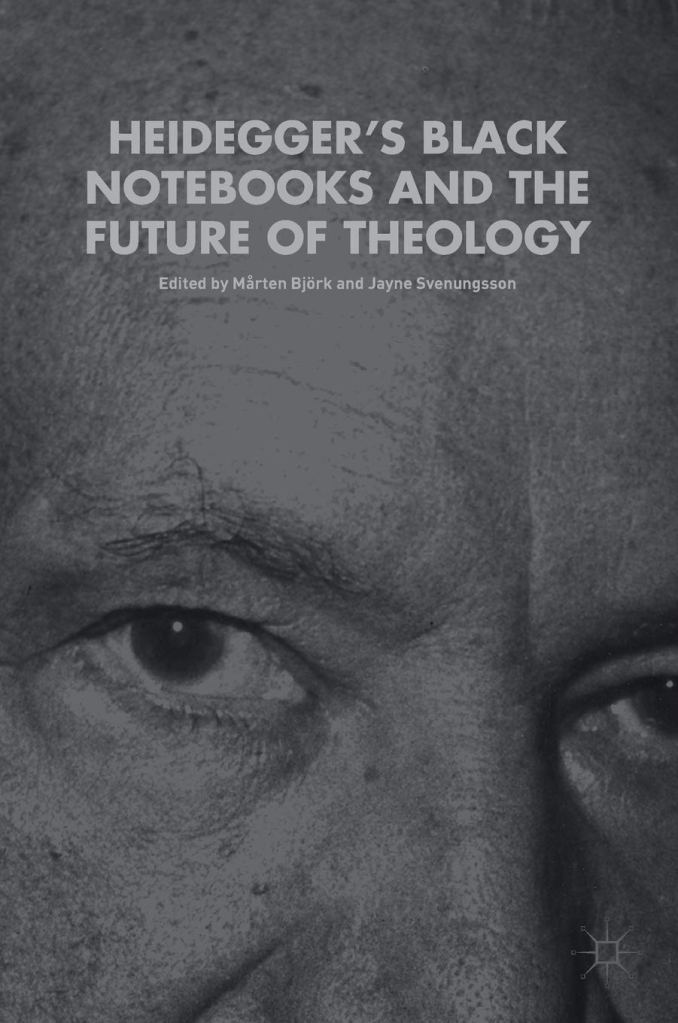
The volume’s explicit wager is that any future, intellectually honest conversation between Christian theology and Martin Heidegger must pass through the Black Notebooks—not around them—and that this passage will reconfigure both the archive of Heidegger’s texts and the very self-understanding of theology. Its distinctive contribution lies in staging, within a single book, a sustained diagnostic of the Notebooks’ eschatological, anti-Christian, and Antisemitic logics alongside constructive proposals for a post-Heideggerian theological discipline. The editors assemble philosophers and theologians who treat the Notebooks less as an embarrassing appendix and more as the evental matrix in which familiar Heideggerian motifs—facticity, destruction, the last god, world-earth strife, Hölderlinian theopoetics—are disclosed as theologically and politically charged. In doing so, the book seeks criteria for reception that neither exculpate nor simply discard.
The outer frame is frank about historical stakes and disciplinary complicities. Jayne Svenungsson’s introduction reconstructs the long entanglement of twentieth-century theology and Heidegger, from the early Freiburg lectures on religious life to the Bultmannian demythologizing project, the Marburg networks, Ott’s post-Kehre rapprochement, and the late twentieth-century “theological turn” in phenomenology. The Notebooks intensify rather than originate the political question; yet for theology they represent a special trial because the newly explicit Antisemitic tropes and the pervasive anti-Christian polemics are philosophically integrated rather than incidental, dismantling the familiar defense that 1933–34 was a merely biographical aberration. Svenungsson therefore reopens Hans Jonas’s mid-1960s charge—that Heidegger’s thought offers no theological norm for discerning spirits—under the pressure of the Notebooks, and she sets the volume’s twofold task: critical engagement with Heidegger’s texts as they stand and retrieval of counter-narratives internal to Jewish and Christian sources. The table of contents maps this agenda into studies of Pauline inheritance, Catholic interlocutors (Guardini), metapolitics of monotheism, apocalyptic grammar, the “last god,” Augustinian time, and the anthropology presupposed by Heidegger’s zoological and vitalist contrasts.
The composition sequence matters for how the argument unfolds. The book grows out of a 2015 Lund symposium devoted to “Heidegger and Theology—after the Black Notebooks,” and it preserves the scene of encounter: introductory orientation, analytic overviews, case studies, and constructive closing reflections. Svenungsson’s opening frames the relation between Heidegger’s early Christian facticity analyses and the formalization achieved in Being and Time, then juxtaposes that genealogy with the Notebooks’s hardening opposition to Christianity and the idea of a Creator God as the metaphysical ground of calculative modernity. The opening thus already signals the dual movement the essays track: first, the absorption of Christian and Jewish materials into Heidegger’s method, and second, their displacement by a world-historical narrative in which “Judeo-Christian monotheism” functions as the metaphysical operator of domination. The editors’ insistence that theologians have too often ignored the political–ideological critique when mining the “late Heidegger” for resources is a programmatic thesis that governs the whole.
Judith Wolfe’s panoramic survey of religion in the Notebooks supplies the book’s methodological lever. She reconstructs, with care for chronology and diction, the shift from the early eschatological interest (Pauline vigilance, Augustinian inwardness) into a 1930s idiom in which Christianity becomes the proximate vehicle of the West’s forgetting of being, and “World Jewry” becomes a cipher for the planetary mobilization of calculative mastery. Crucially, her analysis insists that Heidegger’s own “world-historical drama of being” is integral to the late counsel of attentive Gelassenheit so often abstracted from its eschatological script; thus any reception of the late work must reckon with the Notebooks’ idiosyncratic apocalypse rather than treat it as marginal lyricism. From this angle, the Notebooks do not simply append ideology to ontology; they reveal how the ontological narrative itself encodes a theology of history that assigns Christianity the role of metaphysical operator and positions Jewishness within an economy of occlusion and calculative power. The upshot is methodological: theological receptions that lean on “the last god,” Ereignis, or Erschlossenheit must disclose the eschatological frame that funds these concepts.
What makes the volume compelling is that it tests this claim in concrete dossiers rather than in generalities. George Pattison’s chapter on Romano Guardini shows how the Notebooks target a specific Catholic style of intellectual modernity. Heidegger’s 1932 entries worry that Catholicism, by creatively appropriating German Idealism and existential motifs, could become the “intellectual-political centre,” and he singles out Guardini as the “sharpest” seducer who offers the appearance of modern struggle without risking essential questioning. Pattison reads this less as mere personal ressentiment and more as an index of Heidegger’s fear of a disciplined, liturgically formed, and culturally confident Catholic counter-modernity that refuses both crude antimodernism and dissolving liberalism. Pattison’s reconstruction of Guardini’s intellectual profile—the Berlin chair in “Philosophy of Religion and the Catholic Weltanschauung,” the liturgical movement, the Letters from Lake Como on technology—then discloses a paradox: on several dispositive themes (technology’s essence, culture as formation, the limits of voluntarism), Guardini sounds strikingly close to the late Heidegger the theologians have loved to cite. The Notebooks’ invective thus emerges as a sign that the most acute Catholic adversary is precisely the one whose diagnoses overlap and thereby threaten to provincialize Heidegger’s singular philosophical posture. The chapter exposes how “world-view” polemics in the Notebooks function as boundary work around Heidegger’s claim to a unique access to Frage and to the West’s “other beginning.”
Christoph Schmidt turns to the Notebooks’ metapolitical axis and formulates, with a clarity rarely achieved in debates over “Heidegger and the political,” the antagonism that structures the decade’s thinking: the struggle between Greek theopolitics—poetic polytheism figured via Hölderlin and the pre-Socratics—and “Jewish-Christian monotheism” construed as the metaphysics of sovereign power, representation, production, and, ultimately, planetary technology. In Schmidt’s reconstruction, Heidegger now identifies the ground-metaphysics that enables subjectivist modernity with “monotheism,” while Greek gods name a “non-violent” comportment toward being; the Notebooks then codify this into a metapolitical program of substitution, displacing Christic truth-claims with Aletheia personified as a goddess who counters the Johannine “I am the truth.” The force of Schmidt’s essay is to show that the later Antisemitic remarks presuppose this anti-monotheistic theology of history; the Notebooks’ occasional invocations of “World Jewry” acquire their “meaning” only within the apocalyptic logic of a monotheism fated to self-destruct, where National Socialism and the Jewish principle are imagined as antithetical instantiations of the same metaphysical power. The political consequence is chilling: perpetrator and victim are collapsed into a gnostic symmetry of self-annihilation, and the concentration camp becomes, in Heidegger’s aphoristic shorthand, a paradigm of modernity rather than a moral singularity—a displacement that theology must name precisely because it trades on theological figures.
Elliot R. Wolfson situates the elusive “last god” within this horizon as a decisive de-divinization. He tracks the motif across the Contributions to the junctures of echo, play, leap, grounding, the ones-to-come, and the last god, emphasizing that the “sending of beyng” bears the imprint of earlier Christian eschatological grammar even as it negates any revelatory positivity. The last god is neither transcendent nor immanent, marks neither a return to myth nor a crypto-theology, and is bound to the strife of world and earth in which refusal is the highest nobility of bestowal. Wolfson’s reading is rigorous in its refusal to sentimentalize this figure into a theology of cultural renewal: those who would build a new edifice atop the last god, he argues, “have not grasped the collapse of the polarity of theism and atheism” intimated here. For reception this matters: to lift “the last god” as a theological resource without the discipline of this negating apophasis is to miss both the methodological talons and the historical complicities embedded in the very naming.
The book’s middle stratum works internally to the archive of Christian–Jewish sources. Hans Ruin re-reads the Pauline dossier that decisively shaped Heidegger’s early hermeneutics of facticity and then followed divergent trajectories in Bultmann and Jonas. The point is neither to retrieve a “true” Paul nor to adjudicate exegetical questions; it is to show how Heidegger’s appropriation of Pauline vigilance and affliction provided the existential grammar later formalized in Being and Time, while Bultmann reversed the vector by re-situating the existential analytic back into proclamation (kerygma). Jonas, for his part, returns to Paul after Heidegger’s betrayal, reclaiming the Jewish ethical pathos in a way that uncovers the unspoken debt and the exposed nerve: that Heidegger’s “decisionism” lacks a criterion where biblical address is irreducibly second-person and binding. The construction is careful to display cross-contaminations: Jonas’s ethical Paul bears Heideggerian traces, and Bultmann’s formal structures owe to Heidegger even where he recalibrates them against totalitarian seductions. In the book’s argumentative economy this dossier functions as a living test of Svenungsson’s opening claim: a relation of deep indebtedness that, when traced back through the Notebooks, yields criteria for theological resistance.
Ward Blanton’s essay names “the Christian problem” of the Notebooks: the desire for a “new beginning” that would free thought from Christian determinations ends by reproducing supersessionist structures. The Notebooks iterate the dream of an origin anterior to Christianity; yet the very staging—of an inaugural rupture that abolishes the “old”—replays a Christian dialectic vis-à-vis Judaism. In Blanton’s hands, this is not an anecdotal observation but a structural point about how “break” and “beginning” function in modern European imaginaries. The payoff is double: it exposes how Heidegger’s most radical gestures remain trapped in the very logic they seek to overcome, and it proposes a way for contemporary theology to inherit a critical impulse toward “the open” without reinscribing the zero-sum Christian/Jewish narrative. The chapter thereby positions the Notebooks as an archive from which to learn how not to inherit—precisely by seeing inheritance at work in an author most invested in disowning it.
Agata Bielik-Robson extends the counter-inheritance by relocating finitude. Against a Heideggerian finitude organized by readiness-for-death and the solitary heroism of authenticity, she mobilizes Jewish sources—Rosenzweig’s star of redemption, Arendt’s natality, Bloom’s poetic agon—to construe finite life under the sign of love as strong as death. In that register, Mitsein is not a marching-in-step of isolated selves toward annihilation but a passionate being-with whose ethical force interrupts the glamour of fate. The Notebooks’ fixation on death, apocalypse, and the demonic is thus not only politically catastrophic; it is a distortion of finite life’s positive temporality. If Wolfe showed why theologians cannot extract a purified late serenity from an eschatological matrix, Bielik-Robson shows how a Jewish grammar of desire and relationality renders that matrix contestable from within the very tradition Heidegger dismisses. The result is neither a polemical score-settling nor a reconciliation; it is the proposal that theology’s future lies in a re-education of finitude away from death-centrism and toward covenantal attachment.
Marcia Sá Cavalcante Schuback’s study pushes back into the architecture of the Notebooks’ apocalypse. Her central claim is that the famous “other beginning” and the “end as endless end” are not peripheral tropes but the engine of Heidegger’s confrontation with Judaism and Christianity alike. Because both traditions are inscribed, in his narrative, within the metaphysical epoch of representational power, the apocalyptic motif functions to evacuate their revelatory content in favor of an eschatology proper to being’s history—and it is only on that stage that the Jews can be demonized as agents of calculative mastery and Christians indicted as metaphysical consolidators. Schuback’s point matters because it defends a basic hermeneutic: one cannot understand the ideological scandal of the Notebooks without understanding their apocalyptic logic; conversely, one cannot responsibly engage Heidegger’s “history of being” without testing its apocalyptic grammar against the apocalyptic textures of the biblical traditions he caricatures. The chapter thereby equips theology with a refined sense of where to insert its counter-speech: at the level of end-figures and their ethical entailments.
Marius Timmann Mjaaland’s parallel reading of the earliest Black Notebook and the 1930 lecture on Augustine offers a micro-philological window into the confessional voice of the Notebooks and the conceptual afterlife of Augustinian time. Fascination with the Confessions—and the form of confession—carries into the Notebooks’ meditations on the “future god,” which Mjaaland profiles as a counter-confession to Augustine: an affirmation of an unknowable, content-less “last god” that absolutizes estrangement and withdraws any norm that could orient judgment. Even a charitable reading as “trembling hope” leaves untouched the political fact that such an apophatic confession furnished no foothold against the regime’s perversions. With this dossier the book turns the Augustinian debt into a criterion: where Augustine’s interrogatives—quid est tempus?—are embedded in prayer, narrative, and ecclesial life, the Notebooks’ interrogatives float untethered and thus risk becoming available for any fateful decision. The point is not that theology must recover pietism; it is that the nexus of confession, norm, and community cannot be substituted by a poetized apocalyptics without ethical loss.
The closing chapter by Mårten Björk—tellingly titled “The Irritability of Being”—returns to the anthropological hinge. Mining Heidegger’s famous 1929/30 lectures (The Fundamental Concepts of Metaphysics) where the stone “lacks world,” the animal is “poor in world,” and the human is “world-forming,” Björk contrasts the implied anthropological hierarchy with Hans Driesch’s neo-vitalist “philosophy of the organism.” He then traces how, in the Notebooks, the exaltation of a certain human exceptionalism is sutured to a myth of Occidental destiny, an anti-Semitic coding of “uprooting,” and a theology of the “last god.” Driesch’s insistence on the sensuous integrity of all living beings functions here as an ethical counter-proposal; it cultivates perceptions—of suffering, of organismic form—that generate hope for the redemption of all life and that thereby resist mobilization toward sacrificial politics. The argumentative point is sharp: the path from animality contrasts to political theology is not accidental; an anthropology that de-sensitizes the living can be swiftly aligned with a history-of-being in which the human is authorized to endure the abyss as a vocation even when endurance becomes complicity. Theology’s future, on this reckoning, will be as “vitalist” as it is apophatic—attentive to life’s textures as to being’s destining.
Across these dossiers the book’s internal movement becomes legible. Early chapters disclose the Notebooks as a force field in which the reception habits of theology—Bultmannian formalization, post-Kehre hermeneutics, late poetics of letting—are shown their genealogies and their limits. Mid chapters map the conceptual engines: the metapolitics of anti-monotheism, the last god’s de-divinization, the apocalyptic grammar that makes ideology thinkable as destiny. Later chapters return to concrete sources—Paul, Augustine—and to alternative anthropologies to demonstrate where constructive theological thinking can begin anew without naiveté. Parts merge and displace one another: Wolfe’s insistence on eschatological framing dislodges complacent uses of the late work; Pattison’s Guardini study displaces easy anti-Catholic generalities and reveals uncomfortable proximity; Schmidt’s metapolitics displaces purely “ontological” readings by restoring theological content to Heidegger’s polemics; Wolfson’s last-god analysis displaces resource-appropriations that ignore de-divinization; Mjaaland’s Augustinian parallel displaces pious appeals to “confession” by exhibiting its politics-proofing when detached from normed address; Björk’s vitalist contrast displaces heroic authenticity with a sensus vitae. The editors’ opening claim—that theology must enter a new, more critical phase vis-à-vis Heidegger—thus becomes, by the end, a composite method: contextualize, reconstruct, then receive under constraint.
A few conceptual tensions deserve to be made explicit because they index the book’s scholarly rigor. First, the tension between genealogy and normativity. Much of the volume’s force comes from tracing Heidegger’s debts to Pauline eschatology, Augustinian inwardness, Lutheran destruktion, and Hölderlinian poetics; yet the authors refuse to let genealogy serve as absolution. Instead, they ask whether the Notebooks’ apocalypticization of history—its refusal of second-person address, its re-coding of monotheism as power—voids the very “norms” theology needs in order to answer history’s calls rightly. The Jonas thread, resumed from 1964, is here decisive: the Notebooks’ pathos of destiny yields intensity without criteria. Svenungsson’s careful placement of Jonas early and Wolfson’s cautions later make this tension the book’s hinge.
Second, the tension between apophasis and anti-Judaism/anti-Christianism. The volume’s most subtle insight is that an apophatic posture—de-divinizing the god, resisting representational capture—need not entail, and in the Notebooks in fact abets, a polemical logic in which living scriptural traditions are reduced to metaphysical engines of domination. That is, a posture meant to humble theology is made to justify a civilizational sorting where Greek gods are imagined as non-violent proximity and “Judeo-Christian” monotheism as planetary technique. Schmidt’s exposition of this substitutional logic is the key exhibit; Bielik-Robson’s counter-finitude then shows that an apophatic theology grounded in love as strong as death can resist both representational metaphysics and death-heroics. The net effect is to prize apart apophasis from ideological anti-monotheism so that theology can keep what is precious in Heidegger’s late counsel without importing its polemical cargo.
Third, the tension between poetics and politics. The book neither despises nor romanticizes Heidegger’s poetic diction. Pattison’s reading of Guardini, Schuback’s reading of apocalypse, and Wolfson’s reading of the last god together demonstrate that the Notebooks’ diction is not a neutral aesthetic; it is a medium in which political concepts travel. “Aletheia versus Christ,” “other beginning,” “vicinity of the gods,” “planetary technology,” “World Jewry”—these are poeticized names for a theory of sovereignty, community, and enmity. To pretend that the late idiom permits a clean separation between thinking and acting is, on this book’s evidence, a category mistake. The methodological lesson for theology is again simple and hard: take Heidegger’s poetics seriously enough to read through them to their politics, and take biblical poetics seriously enough to let them instruct counter-politics.
By the time we reach the index and the aftertaste of the closing argument, “future of theology” is no longer a slogan. It indicates a worked practice: theology that acknowledges its modern academic indebtedness to phenomenology while repairing that debt by re-learning its own sources under pressure from the Notebooks. Concretely, that means four tasks. First, sourcing: re-situate Heidegger’s formal structures where they arose—in Pauline vigilance, Augustinian temporality, Lutheran de-struktion—so that theological speech can distinguish address from fate. Second, screening: identify where the metapolitics of anti-monotheism, the apocalypticization of history, and the gnostic symmetry of perpetrators and victims enter under ontological cover, and refuse them explicitly. Third, selective reception: retain a chastened apophatic discipline—the resistance to “world-view” capture, the critique of calculative thinking, the summons to attentiveness—only where it can be articulated within normative, communal, and ethical forms of life. Fourth, counter-poetics: cultivate biblically and liturgically schooled imaginaries of finitude, love, lament, justice, and hope that can rival the seductions of destiny-language without sliding back into representational triumphalism. The book shows these tasks in motion rather than issuing a manifesto; that is its philosophical seriousness.
The strongest pages of the volume, finally, are those that clarify why the Black Notebooks cannot be treated as an archival curiosity. Wolfe’s insistence that the later serenity is born within an eschatological narrative; Schmidt’s demonstration that the anti-monotheism program grounds the Antisemitic notations; Pattison’s showing that Heidegger’s fiercest Catholic adversary stands near him on technology; Wolfson’s argument that “last god” de-divinizes beyond theological recuperation; Mjaaland’s display of apophatic confession without norm—all converge on a single meta-proposal: that theology’s only honorable engagement with Heidegger after the Notebooks is one that re-enters its own scriptures, traditions, and practices with new vigilance, willing both to receive the discipline of questioning and to name, without euphemism, the ideological formations that rode into philosophy there. On that path, the “future of theology” is neither a disentangled phenomenology nor a repudiating purity; it is a craft of reading and judging that learns to abide in facticity under address, to keep watch without enthroning fate, and to speak of God without enthroning a metaphysics of power. The book’s achievement is to make this craft imaginable, and to make it exigent.
If one asks what remains “usable” for theology after this reckoning, the book’s implicit answer is demanding and precise. There remains a vigilance over speech and method that refuses both Weltanschauung apologetics and technocratic capture; there remains a humbled patience before what gives that does not legislate outcomes; there remains an attentiveness to world and earth that can educate perception. But these remain only on the condition that theology re-bind them to revealed address, communal discernment, and the neighbor’s claim—precisely those places where the Notebooks supply no criteria. In that sense, the Black Notebooks do not close the conversation; they set its standard.
 Simon Gros
Leave a comment