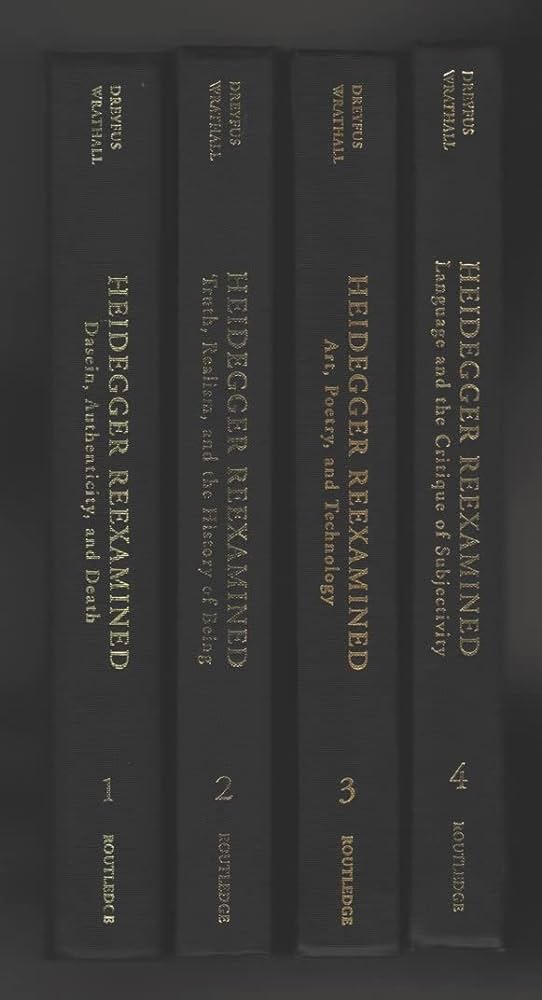
Heidegger and the study of his thought have earned wide acceptance, extending beyond philosophy to influence an array of other disciplines. Critically selected by leading scholars in the field, the articles in this new collection bring together the most essential and representative scholarship on Heidegger. Focusing on the major phases of his work which attracted most attention from contemporary thinkers, as well as exploring new and important areas of Heidegger scholarship, this four-volume set is an invaluable resource for any curriculum supporting philosophy, as well as political theory, literature, classics, anthropology, and cultural studies. The collection was first published in 2003.
The four volumes propose that the long arc of Heidegger’s thinking cannot be described adequately by either a single problematic (for example, Sein und Zeit’s analysis of Dasein) or a single transition (a neat “early to late” break), but only by a multi-centered field of inquiries whose internal tensions spur ongoing rearticulation across domains—existential analysis, truth and realism, historical ontology, art and technology, language and subjectivity. Their distinctive contribution lies in presenting a curated topography in which each center of gravity both completes and displaces the others. The set achieves this by arranging essential papers so that concepts first anchored in existence and finitude migrate toward history, poiēsis, and language, until the very stance of a subject gives way to a linguistic and world-forming address.
The outer framing of the collection is programmatic. The volumes do not merely collate scholarship; they guide a composition sequence from the analytic of Dasein and Eigentlichkeit (authentic existence) to the question of truth, realism, and the history of being; then to the nexus of art, poetry, and technology; and finally to language and the critique of subjectivity. That sequence functions as an argumentative itinerary: it begins with the existential structures that disclose worldhood and ends by placing language before any subject-position that would claim to master disclosure. In this sense the architecture of the set mirrors what many readers discover in Heidegger’s corpus—thematic centers whose radii overlap and whose overlaps generate crises that call for a new vocabulary. The editorial act is therefore also a conceptual claim about how to read Heidegger’s development without flattening the plurality of problems that drive it.
The first volume anchors the entire edifice by elaborating Dasein as the being that we ourselves are, whose self-understanding is inseparable from world, care, and temporality. The focus on authenticity and death compels a form of phenomenological description whose rigor does not depend on theoretical deduction but on tracing how being-in-the-world is articulated through concern, significance, and the anticipatory grasp of one’s own finititude. Papers clustered here show that being-toward-death is not a morbid culmination but a methodological fulcrum: it individuates existence in such a way that the everyday dispersion of the they is interrupted, and with that interruption the conditions for truth as un-concealment are prepared. The argument is cumulative: analyses of anxiety, conscience, and resolution do not yield doctrines; they specify a mode of access in which the how of understanding is already a transformation of the what understood. The volume’s center of gravity is thus an existential-ontological cartography that legitimates later displacements by demonstrating how a fundamental problem—how beings come into view for the one who is such that its being is an issue for it—cannot be exhausted by a psychology of attitudes or a logic of propositions.
Within this first center, authenticity is articulated as a form of temporal gathering. The papers make clear that any appeal to an inner core of selfhood is a category mistake; the phenomenon at issue is the mode in which possibilities are owned as finite. The analysis of death thus functions as an index of limit and as an operator that compresses dispersed possibilities into a singular horizon. The set’s editorial choice to juxtapose discussions of authenticity with close reconstructions of everydayness, idle talk, and ambiguity gives the reader a double instruction: existential structures are evidenced precisely where they are effaced, and the shift toward authenticity must be read as a precise modulation within the same field rather than as a leap to a second terrain. The conceptual stakes are methodological: phenomenological evidence here is the clarified experience of how significance hangs together, and this evidence authorizes the later move to the truth-history problematic without presupposing a metaphysics of essences.
The thematic pressure produced by this existential cartography drives the second volume’s central question: if truth in the existential analytic already exceeds correctness by operating as disclosure, what follows for realism and for the history of being? The collected studies engage this by construing truth as an event that occurs within an already operative clearing; realism is then interrogated in the key of how there is a world for human beings rather than whether there is a world outside the mind. This pivot reorganizes the conceptual terrain: the problem of correspondence becomes a regional question within a larger ontological horizon in which beings show themselves as available only within historically variable configurations of meaning. The investigation of the “history of being” reframes historicality: history ceases to be a sequence of opinions and becomes a sequence of ontological articulations in which the as-structure of disclosure shifts. The volume’s design suggests a measured claim: the existential analytic warrants realism at the level of worldly involvement, yet this realism remains indexed to historical epochs of intelligibility whose emergence and decline are themselves phenomena for thought.
This measured claim intensifies into a structural tension. If disclosure is always historically inflected, then any appeal to invariants risks occluding the very event-character of truth that the existential analytic uncovered. The contributions negotiate this by distinguishing between formal-indicative structures—which remain stable as conditions of intelligibility—and their historical concretions, which vary. The notion of a clearing functions here as both a limit-concept and a heuristic: its invariance is not a neutral frame but the very happening of openness. The consequent view of realism is subtle: it becomes realistic to acknowledge that entities are encountered within normative fields of significance that we do not legislate, and also realistic to acknowledge that those fields have a history. Realism so understood no longer competes with idealism; it takes as its object the fact that intelligibility arrives prior to theoretical positing and does so with a temporally situated style.
These pressures set the stage for the third volume’s passage to art, poetry, and technology. If truth occurs as disclosure, then works of art are no longer decorative examples; they become privileged enactments of world-forming. The included essays thematize the work of art as the setting-into-work of truth, whereby earth and world enter a strife whose stability is never stasis. The word poiēsis acquires its full philosophical weight here: bringing-forth names an event in which beings step into the open with a determinate stance that gathers a world around them. The essays often place exemplary works—temple, painting, poem—into this frame, not as illustrations, but as occurrences in which the happening of truth becomes visible in its contested unity with concealment. This recasting of aesthetics into ontology also generates a critique of technology understood as Gestell (enframing), that mode of revealing in which beings show up primarily as resources. The volume’s composition solicits a single readerly insight: technology is a revealing, therefore it belongs to the same field as art; yet the style of revealing at issue in enframing narrows the meaning-space by standardizing disclosure under availability. The resulting analysis demonstrates that danger belongs to revealing as such because any showing can harden into a monotone.
Within this terrain the status of saving power emerges as more than a rhetorical counterweight. The papers argue, each in its way, that the work of art does not provide an escape from technology; it provides an alternative practice of revealing capable of reopening the play between world and earth. The poetic word is exemplary because it exposes the irreducible strife that sustains meaning: words do not label entities, they let a region appear where entities can take measure. Here the careful curation of texts on poetry and technology does conceptual work: it exhibits how the mind-forming tendencies of enframing tempt thinking toward control, while the counter-tendency of poiēsis returns thinking to the freeing-up by which any measure becomes possible. The result is a non-moralized critique of technology: the problem is not the presence of devices but the dominance of a mode of revealing that compresses all showing into calculable order. The argument motivates a philosophical practice attuned to letting-be, which involves a discipline of restraint rather than withdrawal.
The fourth volume consolidates and then transposes the preceding developments by thematizing language and the critique of subjectivity. If art stages the happening of truth and technology standardizes its style, language is where the field of sense is first given as sayable. The essays here reposition language as the house of being, which means that subjectivity—understood as an interior source of representation—cannot serve as the ultimate site of meaning. Language speaks, in the central Heideggerian formula, and the subject is re-described as the addressee or steward of an address that precedes any discretionary act of signification. The critique of subjectivity undertaken in these studies has a delicate compositional role: it neither dissolves the existential findings of the first volume nor abandons the historical and poetic insights of the second and third; it shows that the very structures of selfhood those inquiries presuppose are grounded in a linguistic clearing that exceeds proprietorship.
The set’s concluding emphasis on language brings into relief its governing dialectic. The existential analytic had discovered that understanding is always as-structured, which already implicates language. The examination of truth and realism had insisted that disclosure unfolds historically, which implies that styles of saying delimit styles of appearing. The turn to art and technology had dramatized the conflict of revealings, which implies that saying is not only propositional but world-creative. The final focus on language clarifies that these implications are not auxiliary; they are foundational. Subjectivity is thus reinterpreted as a crossing-point of addresses: conscience, poetry, tradition, thinking. The critique accomplishes a de-centering that protects the phenomena first brought to light in the analysis of Dasein by situating them within a speech that no “I” commands.
When the four compositional centers are read successively, a single through-line appears: the inquiry migrates from an analysis of the how of existence toward a meditation on the that of revealing, and then finally toward the where of language in which revealing occurs. Each migration is motivated internally. The existential structures are compelling because they describe how being becomes an issue: this initiates a question about truth beyond correctness. The re-description of truth as disclosure calls for an account of its styles and epochs: this opens the problematic of realism within historical ontologies. The recognition that styles of disclosure sometimes constrain appearing calls for a domain in which disclosure can be put to work: this leads to art, poetry, and technology. The convergence of these domains around the logic of saying then demands a rethinking of the subject who says: this yields the linguistic decentering of subjectivity. The set is therefore not only a collection but a crafted relay in which each volume’s solution generates another problem whose burden is assumed by the next.
It is essential to emphasize how the first volume’s concentration on death as the limit-operator already installs the necessity of the later developments. Being-toward-death compresses dispersed possibilities into a singular horizon, which is to say that it forms time. Formed time then clarifies why propositional correctness is an abstraction from a richer process of uncovering; finite existence uncovers by taking over possibilities in a temporally structured way. The compression also explains the appeal of enframing: where finitude is burdensome, availability promises relief. The temptation of control is thus intelligible as a response to anxiety; the saving power of art is intelligible as a response that transforms anxiety into measure. The linguistic critique of subjectivity can finally be seen as a transformation of the call of conscience into a generalized structure of address: the call does not originate in me, yet it individuates me. This multi-stage dependence gives the set its inner necessity.
A parallel dependence orders the second volume’s central contrasts. If truth is aletheic, then realism must be argued from within involvement, not from a view from nowhere. The essays draw on the worldly skills and practices through which entities show up as what they are; practice and understanding couple to yield ontic realism (entities encountered as independent in involvement) that is underwritten by an ontological account of how independence appears. That undergirding is historical because the sense of independence—what counts as resistance, adequacy, fulfillment—varies with the configuration of significance. The history of being is therefore neither a record of changing opinions nor a grand narrative of progress; it is a sequence of articulations of the open region that lets any commitment to realism take content. The effect is neither skeptical nor triumphalist; it is diagnostic, attentive to the manner in which epochs solicit certain theories of truth by pre-structuring the field within which theories gain plausibility.
The third volume’s pairing of art and technology uncovers a methodological lesson that bears directly on interpretation itself. Reading is a practice of revealing; it can enact enframing by reducing phenomena to manageable variables, or it can enact a more generous revealing by letting the thing show its measure. The best of the essays on poetry model this generosity: they linger, attend to rhythm, spacing, and naming, and thereby let the poem institute a world rather than treat the poem as a container of propositions. The correlative essays on technology teach vigilance: any apparatus of analysis, however indispensable, risks becoming a universal grid. The practice of thinking thus acquires an ethos that aligns with poiēsis—Gelassenheit as disciplined letting—rather than with domination. The collection thereby makes a claim about scholarship: interpretive method is already part of the phenomenon under study.
In the fourth volume, language is neither a conveyor of pre-formed meanings nor an arbitrary play of signs; it is the event in which meaning first occurs. The critique of subjectivity follows. If language grants the place from which beings can be addressed, then any self that would be origin must be reconceived as an addressable locus. Essays in this section demonstrate how pronouns, deixis, naming, and silence each participate in the formation of a clearing. The upshot is an ethics of speech implicit in the ontology: to speak well is to keep open the play of revealing and concealing, to avoid compressing language into a mere instrument of control. This is why poetry receives a privileged place: it makes visible the thresholds of saying where domination would pass unnoticed.
Across the whole collection, the role of evidence deserves emphasis, since evidence here cannot be modeled on empirical generalization. The evidential standard is phenomenological Befund: scrupulous description that allows the reader to recognize the structures claimed. The success of the volumes lies in the way arguments are secured on two fronts—by close attention to Heidegger’s own formulations and by demonstrations that those formulations illuminate the structures of everyday understanding, artistic production, technological life, and linguistic practice. These are not two kinds of evidence so much as two sites in which the same structures are legible. The scholarship assembled is essential and representative because it showcases this double anchoring; it invites the reader to test claims both in Heidegger’s texts and in the texture of worldly experience.
The set’s editorial intelligence is felt also in the way apparent cul-de-sacs are re-routed into new problems. The much-discussed theme of authenticity risks fixation on heroic subjectivity; when placed against the history-of-being problematic, it becomes a probe of how singular resolve relates to epochal disclosure. The concern that aletheic truth dissolves realism into discourse is reworked by attention to involvement and resistance in practice. The fear that technology’s critique romanticizes pre-modern art is countered by emphasizing technology’s status as a revealing with its own dignity, to be negotiated rather than escaped. The suspicion that the critique of subjectivity erases agency is disarmed by showing how responsiveness intensifies the task of answerability.
One can also trace how each thematic center carries a distinctive risk, which the next center is designed to mitigate. The existential analytic risks interiorization; the history of being relocates structures in a shared clearing. The history of being risks abstraction; art and poetry dramatize revealing in determinate works. Art and poetry risk aestheticism; technology shows how revealing governs everyday material life. The analysis of technology risks melancholy; language opens a way of thinking in which saying can be cultivated as a shared measure. The movement is therefore pedagogical. The volumes teach a practice of philosophical measure-taking that moves among centers without enthroning any single one.
The set’s reach beyond philosophy is intelligible within this architecture. Political theory encounters here an account of world-formation and epochal disclosure that reframes institutions and law as articulations of revealing. Literary studies find a non-reductive poetics where form and world are co-implicated. Classics receives a model for interpreting ancient texts through historically situated revealings rather than through anachronistic categories. Anthropology is offered an ontology of practices and artifacts that treats technology as a style of revealing embedded in life-forms. Cultural studies gains an analysis of enframing attentive to media and standardization without forfeiting the possibility of renewal through artistic practices. The volumes’ value for curricula follows: they exhibit how a single philosophical problematic—how beings become intelligible—radiates across disciplines because it underlies practices of making, governing, narrating, and speaking.
An important compositional feature is the recurrence of limit-concepts—death, truth, world/earth, language—whose treatment requires both descriptive patience and conceptual invention. The papers show that Heidegger’s thinking remains alive at these limits, precisely because each limit names a site where the pressure of the phenomenon exceeds received grammar. The collection honors this by grouping essays that respect the phenomena while taking risks with interpretation. The best contributions exemplify a twofold method: they listen—a sustained phenomenological attention—and they answer—a responsible rewording that tests whether the phenomenon can endure new articulation.
The cumulative effect of reading through the four volumes is a recalibration of what it means to study Heidegger. Study is here less the gathering of theses and more the acquisition of a style of attention. One learns to mark the difference between correctness and disclosure, to hear how saying shapes what can appear, to sense how works set worlds to work, and to register the drift toward enframing within one’s own analytic habits. The set thus performs what it describes: the scholarship itself enacts a revealing that either tightens or loosens the field of sense. Where it loosens, it creates room for further thought; where it tightens, it offers clear lines along which debate can be joined. The reader finishes with a clarified sense that method in this domain is inseparable from ethos.
The set’s argument-like movement can be stated in a compact way. Beginning from the existential structures of Dasein, the inquiry extracts a conception of truth as disclosure; that conception requires both a historical ontology and a revised realism; the pressure of historical ontology directs attention to practices where disclosure is enacted most visibly—art, poetry, technology; the analysis of these practices returns, finally, to language, the site where disclosive practices take their measure and where subjectivity is reconceived as responsive stewardship. The outer framing—four centers, one movement—brings the reader to the threshold at which philosophical thought can proceed without the scaffolding of inherited oppositions. The distinctive contribution of Heidegger Reexamined is to have arranged the field so that this threshold becomes traversable, and to have done so by assembling scholarship that treats Heidegger’s problems as live problems whose tensions continue to make thinking necessary.
 Simon Gros
Leave a comment