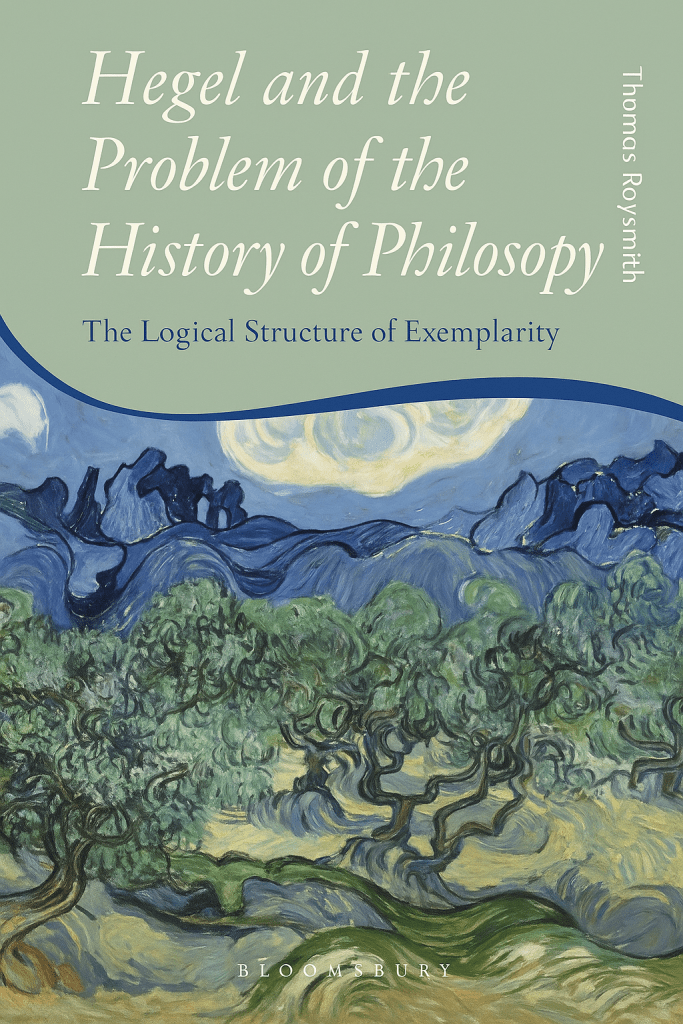
Hegel and the Problem of the History of Philosophy: The Logical Structure of Exemplarity stakes a precise claim at the juncture of systematic logic and historiography. Raysmith proposes that Hegel’s wager—that philosophy has a history and yet aims at the one truth—can be rendered intelligible only if one reconstructs the Idea as a concrete, developmental logical structure whose inner articulation is the very grammar of exemplarity. The book’s distinctive contribution lies in fusing close, source-bound reconstructions of Kant, Fichte, and Schelling with a technical reading of Hegel’s Logic so as to show how the triadic play of universality, particularity, and singularity yields a model of philosophical historiography in which systems count as determinate exhibitions of the Idea’s moments. The result is a rigorous, problem-laden account of how logic underwrites a history of philosophy.
Raysmith frames his investigation explicitly as an answer to Hegel’s “problem of the history of philosophy”: the apparent conflict between philosophy’s claim to discover eternal truth and the historical spectacle of discordant systems. The book’s outer frame and composition sequence already indicate how the author intends to hold these opposed pressures together. Originating as a 2022 Humboldt dissertation under the title The Exemplarity of Thought: Kant, Fichte, Schelling, and Hegel, and first published in 2025, the monograph announces its program in an introduction whose sections move from the problem itself, through Hegel’s conception of philosophy and a proposed solution, toward the methodological claim that logic and metaphysics are coextensive, before turning to criticisms, the historical lectures, and, finally, the book’s internal architecture. This outer paratext commits the study to a double itinerary: a historical reconstruction (Kant→Fichte→Schelling) and a systematic ascent through Hegel’s Logic to the Idea and its method. The paratext thus anticipates the book’s principal rhythm: earlier parts are not merely prerequisites for the later systematic exposition, but are taken up by it, then displaced by the final methodological vantage from which the history of philosophy can be seen as a structured whole.
The opening claim is as stark as it is classical: Hegel means by philosophy the comprehending of the Idea’s self-manifestation in the element of thought. Philosophy is historical because the Idea is concrete and developmental; it manifests not all at once but in staged determinations that are culturally and temporally conditioned. This is neither an empirical relativism nor a historicist dilution of truth; it follows from the nature of the Idea as a purely logical, atemporal structure that nonetheless articulates itself in diverse elements—nature and Geist—and therefore appears historically in the forms of thought available to an age. Hence the methodological demand that we bring prior knowledge of the Idea to the history of philosophy: without a grasp of the logical sequence of determinations we could not see earlier systems as philosophical expressions at all, only as a series of opinions. The upshot is a strict criterion: a past system counts as philosophy if and only if one can exhibit, without anachronistic distortion, which moments of the Idea it articulates and where it fails to unify them; limitation is itself a marker of philosophical relevance because it locates the precise point at which a system ceases to be an expression of the Idea’s development.
To make this criterion work, Raysmith rearticulates Hegel’s Concept as the structure of exemplarity. Universality is not an abstract container into which particulars are filed; it is a living process that produces singulars with determinate constitutions, such that universality, particularity, and singularity are mutually determinative. The universal is nothing over and above this productive activity; the singular, with its constitution, feeds back to determine the universal as the specific process it is; the particular—the field of determinate features—mediates their reciprocity. Raysmith’s heuristic comparison to a factory process that outputs tubs of ice-cream displays this point with unusual clarity: if the output changes, the (universal) process must have changed; conversely, the produced constitution determines what the universal has become. This is the deep sense in which exemplarity is logical, not merely pedagogical: a concrete universal exhibits itself in an exemplar whose particular constitution both instantiates and shapes the universal’s self-determination.
It is here that a decisive argumentative hinge appears: a Wittgensteinian sample—say, a chip of sepia—makes explicit in ordinary representational practice what Hegel’s Concept articulates at the level of logic. To call an object sepia is to display its likeness-relation to the sample; the sample’s particularity is the very content of the universal, which thus determines the sample as this singular that functions as a standard. In such cases the universal is active: it produces many particular “sepias” by determining objects through the relation of likeness to the sample. The point is not that samples create objects ex nihilo, but that they structure intelligibility: they make possible the recognition and use of a universal by embedding it concretely in practices of comparison. As Raysmith stresses, a sample is a concrete concept; its singularity, particularity, and universality are inseparable in the structure of exemplarity. This is why predication in its apodictic form does not merely subsume a singular under a genus by an external rule but measures the singular’s constitution against what the universal determines itself to be—hence the predicate “good/bad” expresses agreement or mis-fit with the Concept’s inner ought. Exemplarity, in this strong sense, names the apodictic unity of concept and object.
From this vantage, the book’s middle movement—Kant, Fichte, Schelling—appears as a carefully staged approach to the conditions under which such exemplarity could ground a history of philosophy. Kant provides the inflexible foil. In Kant’s own self-understanding, the Critical system is the only genuine philosophy because there is only one human reason and thus, objectively, only one system of a priori principles; at most, there is a history of philosophizing, not a history of philosophy. Any apparent historical narrative of metaphysics is a propaedeutic account of errors and ruins that clear the way to Critique; what has history is the labor of reason’s attempts, not the system itself. Raysmith shows Kant explicitly distinguishing the legislator of reason from the talented imitator of Wolff: philosophy is the self-generation of principles from reason, not learned repetition; as a result, there can be “no new philosophies,” only possible additions to a fixed system. The strong ahistorical consequence follows cleanly from Kant’s premises.
Yet Kant’s own notes for the Progress Essay open a narrow door. There he proposes a “philosophical history of philosophy,” not contingent but a priori: a schema that displays how human reason should have progressed from dogmatism through skepticism to Criticism, guided by the need of reason to move from the sensible to the supersensible. Such a schema is still governed by the Critical system, but it recasts “metaphysics” as progress rather than a static table of principles. The paradox, as Raysmith’s reconstruction shows, is that this a priori “archaeology” can only count as history if the development it narrates is internal to reason itself; it cannot ground the historical plurality of philosophies as philosophies because it takes Critique as the sole measure and therefore drains earlier systems of intrinsic truth. The route out of this impasse must lie beyond Kant’s architecture.
Fichte’s Wissenschaftslehre is the first decisive turn. Philosophy becomes a self-produced derivation, an infinite striving of the I that must be reenacted in each thinker. The system admits temporal expositions and historically different formal expressions while maintaining identity of principle; hence a genuine, principled history of philosophy becomes possible insofar as the same system can be produced under new conditions and shown as development. Raysmith is careful, however, to separate this historicizing gain from the viability of Fichte’s derivation: as the chapter’s internal critique argues, the later Jena versions generate tensions that compromise the promised closure of the deduction. Nevertheless, two innovations survive and prove decisive for Hegel: philosophy is developmental, and its expositions can be formally diverse across ages while remaining one in principle. These two theses will become the backbone of Hegel’s solution.
Schelling’s Identitätsphilosophie extends the terrain. He admits as philosophies even those systems Fichte had excluded, provided one can show them as expressions of identity—materialism itself becomes, under this optic, a historical expression of the one true philosophy. Raysmith reconstructs the operative technique: through reduplicative predication and “seeing-as,” Schelling tries to reconcile the seemingly contradictory requirements that absolute form and absolute essence are different (form appears as manifold archetypal shapes) and that they are identical or indifferent (essence is everywhere the same). But the very conditions for “seeing the archetypes” corrode the claim: if archetypes do not exclude one another as particulars, then the difference that is supposed to secure the form/essence distinction vanishes into a dark unity; if they do exclude, then identity collapses. Raysmith’s verdict is uncompromising: the Identitätsphilosophie undermines its own historiographic promise, since to see past systems as philosophy one must see their archetypal difference, but to see archetypes as such is to see all difference vanish—either way, the criterion defeats itself. At the same time, the chapter marks a crucial Hegelian advance: one must not distort past systems by importing foreign concepts; philosophy must be read in the inner form of its time.
All this prepares the work’s systematic core: a reconstruction of Hegel’s Logic from beginning to actuality, then to Concept and Idea, under the sign of exemplarity. The beginning from pure being through determinate being and into essence is not, on Raysmith’s Hegel, an ascent conducted under presupposed canons of judgment or norms imported from language or empirical practice; the development must be immanent, presupposing nothing outside its own movement. The decisive turn comes with actuality and the transition to the Concept, where the relation of reciprocity yields the genesis of the Concept as the structure within which universality produces singularity with a particular constitution, and where the apodictic judgment measures singulars against the Concept’s inner “ought.” This is not an external subsumption but the disclosure that the singular is an exemplar—a paradigm that is what the universal has determined itself to be. Hence the strong formulation: thought and being are structured by samples. The sample’s role in practice and the Concept’s logical structure illuminate one another: what counts as a sample is culturally decided, but the form by which it counts is logical, and it is this form—exemplarity—that shows how the Idea can be the fundamental structure of everything while still appearing historically.
On this basis, Raysmith articulates Hegel’s proposed solution. Philosophy, as the Idea’s self-exhibition in the element of thought, is necessarily historical because conceptual forms are the products of their age, and yet every philosophy, by expressing a moment of the Idea’s development, contains truth. The history of philosophy and the logical science are the same development in different registers: history displays the Idea’s moments in time-bound forms; logic presents those same moments free of historical exteriority, “purely in the element of thinking.” The two sequences are the same and different: the same, because each historical system, where properly understood, expresses determinate logical moments; different, because historical life is contingent, discontinuous, and multiform—later expressions may arise without a visible genealogy through all earlier moments, and earlier sequences may stall or be arrested by circumstance. The burden, then, falls on the historian who has already run through the logic: only with the Idea in view can one identify what is philosophical in the past, explain its limits, and assemble the unity that is not present within the systems themselves but “in us, the observers”—that is, in the Idea’s contemporary exhibition as conceptual comprehension.
The claim invites immediate objections, and Raysmith does not shirk them. Against “post-Kantian” readings that construe Hegel’s logic as an account of the conditions of judging or the norms implicit in empirical conceptual practices, the book insists on Hegel’s own strictures: the logical development cannot presuppose anything external to it; neither the activity of judgment, nor inferential norms, nor an embodied agent’s life-world may be smuggled in to drive the transitions. To do so would invert Hegel’s order and erase the primacy of the Idea. The metaphysical consequence is not a lapse into pre-Critical substance doctrine but a defense of intelligibility: logic coincides with metaphysics because the Idea exhibits itself as the structure through which everything can be comprehended in thought. This is not a proof that a world-substance posits all being; it is the claim that the realm of objects that can be known by concepts is unbounded because being and thought share the form of exemplarity. The history of philosophy is thereby redeemed from arbitrariness: it is the field in which this form becomes visible in determinate shapes.
Equally, Raysmith confronts the temptation—associated with readings that “lift” logic from the historical lectures—to treat the order of Logic as derived from the chronological order of doctrines. The book’s reply tracks Hegel’s own caution: one cannot take the necessities of logic from the contingencies of history. If sequences occasionally line up, this is because both are expressions of the same development at different levels, not because history grounds logic. Conversely, logic equips us to read history without distortion; it does not license us to force recalcitrant materials into a Procrustean bed. Precisely here Raysmith’s earlier constraint—avoid importing alien concepts into past systems—does double duty as a philological and a systematic norm. The method demands reconstructions of Kant, Fichte, and Schelling in their own terms, followed by an internal critique to locate limitation, before the logical vantage is brought to bear. Only then can an historical configuration be seen as a necessary moment in the self-articulation of the Idea.
The book’s argumentative arc is thus self-consciously cumulative. Early chapters build an archive of structured tensions—Kant’s legislating reason versus historical plurality; Fichte’s self-production versus the closure of deduction; Schelling’s identity versus the visibility of difference—that the Hegel chapters then absorb and recast. But the recasting is not a serene synthesis; Raysmith insists on an internal critique of Hegel as well. If the solution turns on the necessity of the transitions between logical determinations, the exposition shoulders an exacting burden: to show that no step is merely asserted, that no appeal is made to empirical supports, and that necessity is visible from within each moment’s immanent instability. In that light, the extended treatment of the apodictic judgment and the syllogism—especially the insistence that in apodictic form the subject and predicate share one and the same concept—plays a crucial role: it displays a locus where the claim to necessity is testable against a fine-grained account of how singulars can be paradigmatic rather than merely subsumed. If the account holds, exemplarity is the bridge between logic and history; if it fails, the bridge collapses.
The conclusion returns to the opening stakes. If philosophy is the Idea’s self-exhibition, then philosophy is both time-bound and truth-bearing. Its history is not a graveyard of refuted systems but the living unity of determinate exemplars whose limitations are precisely the clues by which their place is fixed. The historian’s task is neither to flatten this plurality into identity nor to dissolve identity into plurality; it is to cultivate the kind of conceptual vision that discerns, in the singular with its constitution, the universal’s productive activity—the sense in which this system is exemplary. The argument closes by clarifying the risk: Hegel’s solution stands or falls with the Logic. Raysmith does not endorse the solution unreservedly; he articulates its dependence with unusual precision and develops a measured skepticism about whether the logical narrative can always secure the necessity it claims. But that measured reserve does not blunt the achievement. The book leaves the reader with a deeply worked model of how one might read the history of philosophy as a structured intelligibility without sacrificing the concretion, contingency, and internal difference that make that history worthy of thought. It is, in short, a rigorous demonstration that the “logical structure of exemplarity” is more than a metaphor: it is the key by which Hegel’s paradoxical claims about history and truth can be made to cohere—even if, in the end, the key also sharpens our sense of how hard the lock is to turn.
 Simon Gros
Leave a comment