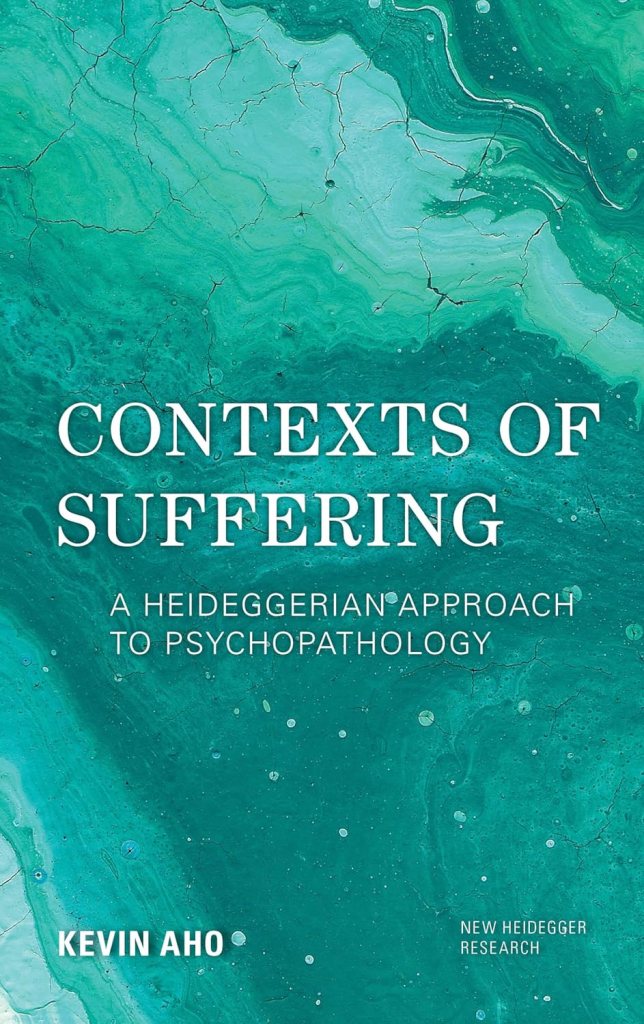
Contexts of Suffering: A Heideggerian Approach to Psychopathology presents a rigorous phenomenological and hermeneutic reorientation of psychiatric understanding that challenges the dominance of contemporary biopsychiatry while remaining clinically attuned and methodologically exacting. Its distinctive stake is twofold: to articulate how mental illness manifests as disruptions within the constitutive structures of human existence—mooded attunement, embodiment, spatiality, temporality, self-understanding—and to situate these disruptions within historically mediated practices of interpretation that govern diagnosis, treatment, and lived experience. The contribution is not a wholesale rejection of biomedical knowledge; it is an excavation of the ontological presuppositions that make mechanistic accounts appear sufficient. The book thereby reframes suffering as alterations in ways of being rather than as properties of isolated brains, and it reconstructs psychiatry as a disciplined human science oriented to dialogue, context, and the patient’s first-person world.
The book’s outer frame is precise. It belongs to the New Heidegger Research series and bears Rowman & Littlefield’s imprint; its paratext locates it explicitly amid work that treats Heidegger’s thought as a set of paths, not doctrines, and this avowed path-character governs the exposition from the first page to the afterword. The introduction announces the practical crisis of modern psychiatry—diagnostic inflation, managed-care time pressures, polypharmacy (even in pediatrics), and the often unexamined alliance with pharmaceutical marketing—and immediately links those developments to a deeper crisis of self-understanding: the tendency to conceive persons as neurochemical objects and suffering as intracellular error. The scene thus set is not polemical throat-clearing but the book’s existential occasion: scientific successes are acknowledged, yet the operative paradigm is shown to narrow vision to the point of missing what is given in suffering, how it is given, and where it is lived.
The historical and biographical anchoring is deft. Aho traces a line from Jaspers’s and Binswanger’s attempts to secure a non-reductive clinical science to Heidegger’s own exposure to Daseinsanalytic practice after his postwar collapse and, above all, to the Zollikon seminars with Medard Boss, where clinicians and physicians probed the presuppositions of their craft with philosophical care. This archive matters because it displays the shift Aho presses throughout: away from the gaze that treats mind as an inner space subtended by physiological determinants and toward the phenomenon of being-in-the-world—the lived unity of self, others, things, and practices that furnishes the very field of meaning within which illness appears as illness. In this transposition, the patient ceases to be a silent bearer of lesions and becomes a way of being whose world has altered—tightened, collapsed, or become opaque.
The composition divides into two interpenetrating movements—phenomenological and hermeneutic—whose relation is neither additive nor merely sequential. The first movement articulates the experiential structures that make psychic life intelligible at all; the second situates these structures within historical discourses that contour what counts as normal or disordered, believable or incredible, and treatable or refractory. Yet the movements repeatedly displace one another. Phenomenological description discloses how depression or anxiety modifies embodiment or time; hermeneutic analysis returns to show how diagnostic regimes and cultural ideals prefigure what sufferers and clinicians can even recognize; phenomenology then re-enters to rescue singular experience from the weight of type and code. The result is a dialectical weaving in which description and interpretation alternately lead, correct, and complete each other.
The opening polemic against medicalization is careful in its evidentiary posture. The book grants that psychotic disorders—schizophrenia, bipolar illness—bear patterns that, cross-culturally and pharmacologically, justify viewing them as bona fide disease entities, whatever the current limits of neurobiological specification. By contrast, many nonpsychotic syndromes—the expanded terrain of the DSM’s “neuroses”—vary with context, respond non-specifically to medications, and are often defined by symptom counts rather than by demonstrated etiologies. The point is not to deny the reality of suffering but to de-reify diagnostic creations that proliferate under administrative and economic pressures; what changes, in Aho’s reconstruction, is the ontological grammar of the field itself.
At the heart of the phenomenological analysis lies a reconceived affectivity. Moods are not inner colorings appended to neutral perceptions; they are world-disclosive attunements through which anything like significance can come to presence for a subject in the first place. A mood “assails,” not from inside or outside, but from within being-in-the-world; it functions as an atmospheric horizon in light of which entities can matter at all. Hence the clinical difference between being anxious about a definite threat and being in an anxious world, where determinate concerns cannot take hold because the very field of meaning quivers, recedes, or swamps. This distinction grounds the book’s sustained claim: many psychiatric presentations are better grasped as shifts in the background conditions of intelligibility rather than as discrete cognitive or affective events.
That claim acquires concretion through a disciplined account of embodiment. In health, the lived body (Leib) recedes into transparent capacity: one moves, speaks, reaches, and copes; spatiality is practical, tempos are tuned, tools are at hand. Illness shows itself when that transparency fractures: the body stiffens into a Körper—an object that resists, misfires, becomes obtrusive—and the previously cohesive space of activity turns segmented, too-near or too-far, heavy, inert. By holding fast to this phenomenological distinction, the book prevents a slide from experience to imaging and back as if nothing had occurred. The body is not denied to science; its meaning is withheld from reduction.
Temporality is treated with equal care. Depression is not merely sadness amplified; it is a disturbance in the ecstatic unity by which the past is appropriated as having-been, the future is projected as possibility, and the present is sustained as a meaningful “now.” When projection collapses, the future loses its hold; when appropriation fails, the past cannot be gathered as one’s own; when presence thickens, the “now” congeals into an opaque stasis. Anxiety, by contrast, can explode the everyday order not by fixing upon a particular danger but by exposing the precariousness of sense as such, revealing an any-moment capacity for the world’s coherence to give way. The clinic encounters, then, not simply negative affects but breakdowns of the temporal synthesis that makes selfhood possible.
From these analyses, Aho advances a striking reframing of death. The book distinguishes perishing (the organism’s end), demising (the lived anticipation and experience of that end), and dying as an ontological phenomenon—episodes in which the ability-to-be itself collapses because the meaningful world no longer holds. In severe mental illness, the patient can undergo such ontological death repeatedly within a single lifetime. That is why medication, however beneficial, cannot by itself address what has broken: pharmacology cannot supply a world. The therapeutic task becomes twofold—acknowledge the finitude and fragility of identities as narratively sustained forms of life, and cultivate the flexibility to relinquish an unliveable self-interpretation in the name of a possible one. This is the book’s hard, emancipatory insight: healing often demands a readiness to let go, not as resignation but as the ethical openness of resoluteness—a willingness to recompose one’s life-story in fidelity to what can still be.
The point resonates most forcefully in the reading of critical illness. Illness narratives testify to the terror of world-collapse and to the estrangement that follows when clinical discourse recognizes only it, the diseased object, and not me, the existent whose world is falling away. Aho gathers these accounts neither as anecdotes nor as arguments from authority but as phenomenological warrants that display, with extraordinary clarity, the contrast between corporeal description and lived breakdown. The book’s wager is that authenticity—understood here as lucid acceptance of finitude and flexibility in self-understanding—is not a heroic possession of a few but a possibility that can be coached, especially where publicness and technique conspire to conceal our vulnerability from us.
The hermeneutic movement now overtakes the phenomenological. If mental illness is disclosed within historical horizons of sense, then contemporary nosology is as much a mirror of culture as it is an index of disease. The book argues that psychiatry, construed as a human science, belongs with interpretive arts that seek understanding (Verstehen) rather than explanation (Erklärung) when dealing with meanings, self-interpretations, and worlds; dialogue, not measurement, is the primary vehicle of truth here, because only in understanding with—in the fusion of horizons—can the phenomena be faithfully grasped. This is not methodophobia; it is a critique of methodologism, the victory of technique over insight. The DSM retains utility; medicines remain in play; but the norm becomes attentiveness to the patient’s dwelling in a world, to history’s grip on the self, and to the fact that the facts of suffering are inseparable from the meanings that bear them.
Three exemplary case-studies anchor the hermeneutic thesis. First, shyness. By tracking the normalization of the gregarious, assertive American extrovert, Aho shows how a temperament becomes a deficit once a culture programs itself to read reserve as pathology and to medicalize silence. The reclassification of introversion as social phobia—despite its profound variability of meaning across times and milieus—illustrates how diagnosis can crystallize around an ideal of self that is historical, not neutral. Second, stress and the revisiting of neurasthenia: what vanished nosologically persists as functional somatic conditions whose uptake is inseparable from the infrastructures of work, time, and measurement that modernity installs. Third, rage: the DSM category of intermittent explosive disorder is read against an American self-image of radical independence, authenticity as preference-sovereignty, and a thinning of shared moral frameworks, so that violence appears as a symptom not only of individual dysregulation but of an ethos that loosens communal bonds and disorients aspiration. In each case the wager is the same: our classificatory regimes are not merely medical registries; they are modern self-portraits that act upon those who must inhabit them.
Because the book is philosophically exacting, it is equally clinical in its prescriptions. The aim is not to replace selective serotonin reuptake with selective Heidegger intake. It is to insist that whatever else we do—prescribe, refer, code, reimburse—we must take the patient as an existent whose suffering is intelligible only within a nexus of practices, roles, memories, expectations, and norms. The clinic thus reconfigures itself as a site of shared interpretation: anamnesis becomes a hermeneutic interview that listens for structural disturbances in embodiment and time; formulation becomes a narrative negotiation over which self-interpretations still fit; treatment planning becomes the art of opening possibilities and sustaining transitions rather than the perpetual stabilization of a single identity. In this sense, diagnosis is least misleading when it functions as a provisional bridge to understanding rather than as a metaphysical verdict.
The argumentative rhythm of the book follows a consistent sequence. It begins by laying bare a conceptual mistake: the reduction of persons to mechanisms and of meaning to causes. It then articulates an alternative ontology of the human as a way of being structured by care, attunement, embodiment, spatiality, temporality, and self-projection. It tests this ontology in the crucible of psychopathology, showing how depression and anxiety are not external invaders but internal distortions of the very structures that constitute a world. It deepens the analysis by interpreting dying as recurrent ontological collapse rather than as a terminal event, and it grounds the clinical imperative to cultivate resolute flexibility in identity. Finally, it turns hermeneutically to the institutional forms that deploy diagnostic language, discloses their historical contingency, and argues for psychiatry as an interpretive practice whose truth emerges in dialogical encounter. At each step, the second movement corrects the first: a phenomenology without history would reify structures; a hermeneutics without structures would dissolve experience into discourse. The book’s poise consists in keeping both in view.
Two tensions animate the whole. The first concerns science. Aho grants that psychiatry rightly seeks reliability, predictive value, and causal traction; he resists the idea that such aims exhaust what can be asked of human suffering. The Zollikon maxim—science is itself grounded in a way of being-in-the-world—undercuts scientism without fostering anti-scientific romanticism. The second concerns authenticity. Read as heroic self-possession, authenticity can harden into another ideal of mastery and so betray its own insight into fragility. Read as resolute openness to the instability of identity, it becomes a discipline for patients and clinicians alike: to relinquish the comforts of fixed narratives and to remain answerable to what the situation asks. The book maintains this latter sense by tethering authenticity to the clinical work of letting go, re-composing, and trying again.
Thus the volume’s final framing returns to its first. Contexts of Suffering does not legislate a new orthodoxy; it offers a path. It advances an approach that honors the gains of biological research while refusing to collapse existence into circuitry; it specifies where meaning originates and where it fails; it shows why the self’s fate in illness is neither merely private nor merely public but worldly. Its concluding clarity is simple and demanding: to treat mental illness well is to meet a person in the midst of a world that has changed. This calls for pharmacology, where indicated; for diagnostic categories, where helpful; and for something rarer and more difficult—the patient and the clinician together learning to interpret what remains possible when familiar meanings no longer hold, and to cultivate the disciplined flexibility by which a livable identity can be composed again.
If there is a single thesis beneath the work, it is this: mental illness is an alteration of being-in-the-world before it is an alteration of what is in the brain, and because histories and institutions shape that being, the clinic’s most exacting task is to keep experience and interpretation together—refusing the comfort of reduction and the vagueness of mere talk—in order to make suffering intelligible enough for healing to begin.
 Simon Gros
Leave a comment