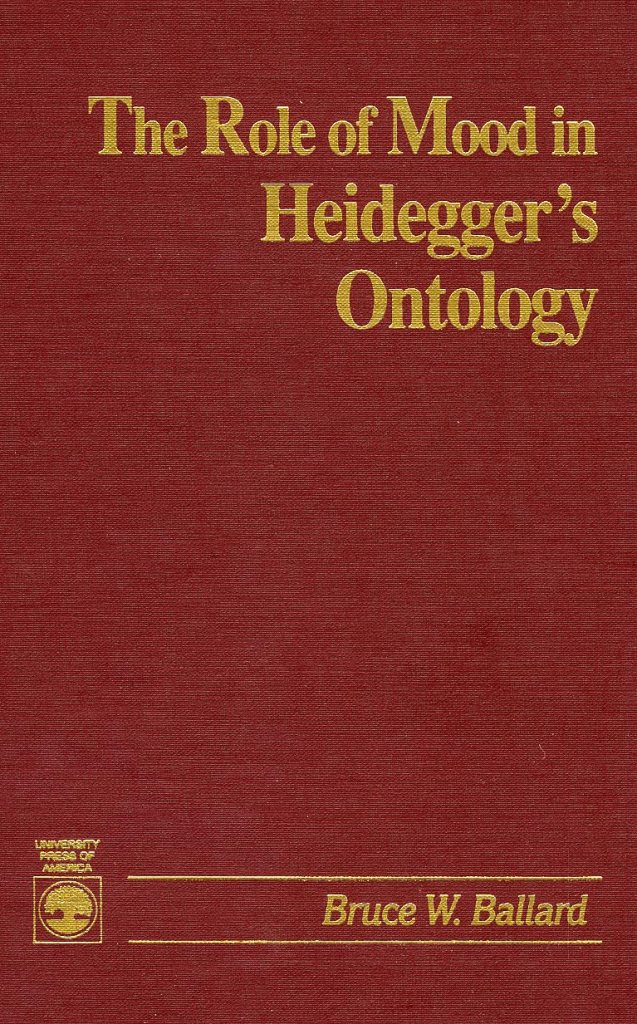
The Role of Mood in Heidegger’s Ontology makes a precise and ambitious scholarly wager: if one follows Heidegger’s phenomenological-ontological method to its roots, then mood—formally thematized as Befindlichkeit (situatedness)—must be read as a constitutive condition of how human existence (Dasein) is first opened up to itself and its world. Bruce W. Ballard’s distinctive contribution is to reconstruct, with unusual care, the exact logical place of mood among the existentials; to argue for the epistemic and ontological priority of affective disclosure; to test anxiety’s special role in authenticity against major Marxist objections; and finally to extend the analysis into a phenomenology of religious awe in dialogue with Rudolf Otto. The result is a single argumentative arc that moves from strict exegesis of Heidegger’s Section 29 to a calibrated re-grounding of numinous feeling.
Ballard’s outer frame declares a double task: to give a detailed account of mood’s constitutive role in Heidegger’s thought and to employ that account as a basis for an existential-phenomenological ontology of religious awe. The programmatic statement is explicit: scholarship has largely neglected the central notion of mood in Heidegger; this study both repairs that omission and leverages the recovered account to reinterpret Otto’s classic analysis of the numinous. The guiding claim is stringent: mood is not psychological ornament but the original tuning in which human experience is constituted as a there; hence the analysis of mood implicates the whole of Heidegger’s fundamental ontology. Ballard’s composition sequence mirrors this wager. An initial chapter establishes the status of Befindlichkeit among the existentials and rehearses the ontological/ontic distinction, the category/existential contrast, and the lexicon through which Section 29 of Being and Time is to be read. The second chapter turns to anxiety as a privileged disclosive mood, including anxiety’s relation to authenticity and its world-disclosive scope. A third chapter confronts Marxist criticisms by Lukács, Adorno, Marcuse, Kolakowski, and especially Karel Kosík, testing whether Heidegger’s analysis collapses into an asocial subjectivism. A final chapter extends the ontological grammar of mood into religious experience, arguing that Otto’s phenomenology of awe fits Heidegger’s own criteria more completely than Heidegger’s later recourse to metaphysical dread. In brief: part one lays the existential grammar, part two exercises it in anxiety, part three stresses the grammar with social critique, and part four reorients the analysis toward the holy.
The argumentative center of gravity is the clarification of Befindlichkeit as an existential rather than a category. Ballard keeps Heidegger’s methodological line sharply drawn: ontical inquiries deal with entities and their factual traits, whereas ontological analysis asks after the modes of Being that first make any encounter with entities possible. Mood belongs to the latter register because mood is how a human situation is first there for a subject who is never merely present-at-hand, but always already involved, caring, and answerable. Within this frame, Ballard emphasizes the equiprimordiality of mood and understanding in the constitution of the there: a situation comes to be as a unity of attunement and interpretation, each intrinsically threaded with discourse. The correlative thesis is momentous for method: because attunement and understanding are equiprimordial, the origin of sense cannot be allocated to cognitive representation alone; it is first the work of affective orientation. The “there” is constituted in existing, and existing is attuned. Thus mood bears priority not as an accidental color upon cognition, but as the a priori condition for the very possibility of any explicit knowing.
Ballard’s reconstruction of Heidegger’s vocabulary secures the distinction that organizes the whole book: existentials are the a priori structures of human existence (Being-in-the-world, understanding, situatedness, discourse, care), whereas categories are conceptual forms proper to non-human things. To treat mood as a category would be to misrecognize its work: mood is not a property we have; it is the way we are made present to a world that already matters. In a deft conceptual bridge, Ballard shows how, once one refuses to import the grammar of properties from the present-at-hand, the primacy of mood is not a thesis about feelings, but about the field-form of experience. The upshot is an ontological claim with transcendental ambition—but bounded transcendence. Existentials have an a priori function relative to our ordinary, socially embedded existence, yet their application is historically open-ended; they do not achieve the universality of Kantian categories, and they must be handled hermeneutically. Ballard’s formulation of Heidegger’s “compromise” precision-marks this point: fundamental existentials are broad enough to be presupposed by any ontical interpretation of human life, even while their concrete inflections vary across histories and worlds. Mood, then, is a necessary constituent of any lived there, while its contentful tones and cultural formations are historically variable.
With the grammar set, Ballard turns to Section 29’s core claims about situatedness. He clarifies the lexical stakes: Stimmung carries the primary sense of tuning; Befindlichkeit—rendered as situatedness—emphasizes “how one finds oneself” and thus tacitly embeds the spatial-relational nuance of a context that always exceeds and shapes the subject. This philological work is not decorative. It supports the thesis that mood is constitutive of a world: the attuned subject is in the world in the mode of dwelling, not containment; the “in” of Being-in-the-world is the “in” of familiarity, involvement, and care. Ballard thus justifies why translation choices matter for ontology: to avoid state-of-mind’s Cartesian overtones and to preserve the context-laden, world-forming force of mood.
From this vantage, a decisive epistemological reversal comes into focus. Whereas ordinary theory claims that moods merely color cognition, Heidegger insists—and Ballard repeats with care—that moods precede and make possible the distinction of subject and object upon which such theory depends. The affective “tuning” both opens a field and selects saliences; it is because one is already attuned that reflection can retrieve “experiences” at all. Ballard calls this the priority of figurative over reflective affective understanding: the “bare mood” discloses the there more primordially and, precisely because of that primality, also resists the clarifying grasp of representational analysis. Knowledge, in this register, is a development out of a prior attunement; and the discursive concept does not exhaust, but only partially articulates, what attunement already achieves.
The turn to anxiety is thus less a thematic shift than a sharpening of the general thesis. Anxiety is exemplary because it strips away the ontic referents that ordinarily absorb our care. In fear, the object can be named; in anxiety, the object recedes, the world withdraws into insignificance, and Dasein finds itself uncanny, unhomelike. Ballard’s reconstruction of this analysis underscores its double disclosure. First, anxiety lays bare thrownness: one finds oneself delivered over to a responsibility for one’s own Being that cannot be transferred, outsourced, or stabilized by routine roles. Second, anxiety discloses the not-at-home character of Being-in-the-world: the everyday comfort of significance collapses, and the naked “that it is and has to be” of existence becomes affectively patent. The point is not morbidity but clarity: by simplifying the field (no “what,” only the that), anxiety foregrounds exactly those existential structures that ordinarily remain concealed by projects and tasks.
Ballard traces a third movement implicit in anxiety’s structure: the relation to authenticity. If authenticity names a unity of existence in which Dasein owns its thrown-projection with anticipatory resoluteness, then anxiety is the paradigmatic mood that makes such owning possible. The affinity is structural, not moralistic. Anxiety does not supply content; it prepares an opening in which the content can be chosen. On Ballard’s reading, the very criteria Heidegger sets for a primordial disclosure—start from the whole, simplify the phenomenon, and display its unity—are satisfied in anxiety: it brings to light the structural totality of Being-in-the-world by subtracting distractions and revealing the existential “between” of world and self. Anxiety’s disclosure is thus ontological before it is psychological; the mood truths, in Heidegger’s sense of aletheia: it uncovers what everydayness covers over.
The book’s argumentative center then subjects these claims to a battery of Marxist counter-arguments. Ballard’s discussion is fair and pointed. He takes seriously the accusation that Heidegger’s analysis ignores the mediation of experience by social and historical structures, and he grants the force of the claim that alienation is intelligible only in relation to concrete forms of production, technology, and ideology. Yet, in rehearsing and answering Lukács’s charge of tacit idealism, Adorno’s suspicion of authenticity’s jargon, Marcuse’s political critique, Kolakowski’s hybrid attempts, and especially Kosík’s dialectic of the concrete, Ballard shows that the charge of asocial subjectivism lands only if one conflates ontic and ontological orders. Heidegger’s project concerns the existential structures that must be presupposed by any social analysis; it is not a rival empirical sociology. In this sense, the Marxist critique can be integrated up to a point—as a needed insistence on the historical formation of the contents of mood—but it does not dislodge the claim that there is an a priori form of attunement without which no experience (including socially mediated experience) would appear as meaningful at all. Ballard’s careful treatment of Kosík is exemplary: Kosík rightly presses for an account of how people become alienated; yet, in offering his answer, he tacitly relies on the very structures of thrownness, care, and worldhood that Heidegger elaborates. The disagreement, then, is not over whether social mediation exists, but over explanatory priority.
At this point, Ballard executes a final turn that gives the volume its distinctive ending: a systematic extension of the analysis of mood into the field of religious experience, staged as a patient dialogue with Rudolf Otto. The pivot is disciplined: Otto’s Idea of the Holy distinguishes rational and non-rational aspects of the divine, elaborating the numinous through mysterium and tremendum—awefulness, majesty, and the fascinans—and charting an intrinsic development in numinous feeling from daemonic dread toward purified awe. Ballard draws two convergences with Heidegger’s account. First, just as Heidegger argues that cognition is a later, derivative mode of understanding founded in mood, Otto insists that the conceptual grasp of the holy does not subsume the felt core; it indicates it symbolically without exhausting it. Second, Otto’s account of dread resonates with Heidegger’s analysis of the Nothing in What Is Metaphysics? and with the uncanny reduction of significance in anxiety: the numinous is experienced as the wholly other, a non-object that nonetheless commands orientation, and it develops dialectically as its felt depth is taken up into clarifying forms. Ballard’s conclusion is deliberately pointed: for the task of articulating the most primordial human questioning, Otto’s phenomenology of awe may finally be better fitted than Heidegger’s anxiety-centered frame, precisely because it holds together an irreducible affective core with a history of rational-moral permeation.
This last claim rests on a repeated methodological scruple that governs the whole book: the primacy of keeping the whole phenomenon of human existence in view and grasping it in the unity of its structures. Ballard argues that Otto’s layered, developmental account—whereby the non-rational is neither dissolved into rational theology nor fenced off against it—meets Heidegger’s own hermeneutic criterion of wholeness more completely. For Otto, the numinous cannot be conceptually mastered, yet it is not beyond articulation; for Heidegger, the existential structures cannot be phased into a psychological list, yet they must be systematically exhibited. In both cases, mood is the beginning of intelligibility: it opens the field within which “religious” and “philosophical” determinations can be made at all. On Ballard’s showing, the coupling of Heidegger’s ontological grammar with Otto’s phenomenology of the holy yields a more comprehensive description of the range and depth of attunement than either offers alone.
If one asks, at the end of Ballard’s composition, what has been decisively established, two theses stand out. First, mood is equiprimordial with understanding in the constitution of a world; there is no neutral, pre-affective plane of givenness from which the subject might then color things with feeling. Discourse and cognition are developments within a field already tuned. This is both a phenomenological and a transcendental claim: phenomenological, because careful description shows mood’s priority in everyday life; transcendental, because without that priority, explanation cannot account for how entities show up as mattering in the first place. Second, anxiety functions as a privileged, simplifying disclosure that exhibits thrownness and the not-at-home structure of existence; it is the clearing in which authenticity is even conceivable, because it reveals the very unity of existence that authenticity would own. Against sociological reduction, Ballard shows why this claim, rightly delimited, does not deny social mediation but rather makes it visible as mediation. Against theological rationalism, his concluding synthesis with Otto makes clear how the non-rational core of awe can be both irreducible and historically articulate.
One can draw from Ballard’s book an exacting methodological lesson about reading Heidegger. The ontological/ontic distinction must be patrolled at every step; the category/existential contrast must determine one’s explanatory grammar; and the rigor of phenomenological description must be matched by a patience about history that refuses to fix existential structures into ahistorical abstractions. Ballard’s handling of Section 29, his insistence on translation that preserves the world-forming force of mood, and his repeated return to equiprimordiality prevent the reduction of Befindlichkeit to inner states or to psychologistic inventories. If the project at times risks a tension of its own—an aspiration to transcendental necessity yoked to a hermeneutic openness—Ballard makes that tension explicit and productive: the existentials are a priori for us precisely as historically formed beings whose worlds are always already underway.
The book’s distinctive scholarly stake thus comes into full view. Where much commentary treats mood as a colorful footnote to understanding, Ballard reverses the vector: understanding is legible as a mode of an always-already attuned existence. Where some critics collapse anxiety into a bourgeois psychology of unease, Ballard insists on the ontological scope of its disclosure. Where an exclusively secular frame would bracket religious feeling as derivative, Ballard’s dialogue with Otto shows that the non-rational core of awe can be handled with the same ontological seriousness as the analysis of everydayness and anxiety—indeed, that it may be better attuned to the most primordial human questioning. As a whole, the book succeeds in merging detailed conceptual exposition with source-based warrants: Section 29’s lexicon and claims anchor the early chapters; the anxiety analyses in Being and Time and What Is Metaphysics? supply the middle; and Otto’s Idea of the Holy furnishes the capstone conversation. The narrative not only unfolds these parts but also displaces each by the next: the general grammar of situatedness is reinscribed by the singular disclosure of anxiety; the anxiety-analysis is reframed by social critique; the social critique is overarched by a widened phenomenology that includes the religious mood.
To close with clarity: Ballard demonstrates that mood is not an appendage to an otherwise cognitive ontology but a founding power of disclosure without which neither science, nor ethics, nor politics, nor religion could get any purchase on a world. Anxiety’s stripping effect is exemplary because it brings into relief what is structurally always the case: we find ourselves delivered over to living, having to be, in a world that is at once ours and not at home. That finding—our Befindlichkeit—is as close as Heidegger comes to naming the place where the question of Being first takes hold of a life. Ballard’s study gives that place philosophical articulation, withstands forceful criticism without retreating to subjectivism, and shows how the same ontological grammar can house even the dark shimmer of religious awe. In doing so, it secures mood’s role at the heart of Heidegger’s project and offers a refined path for future work that would think human existence from its attuned beginning.
 Simon Gros
Leave a comment