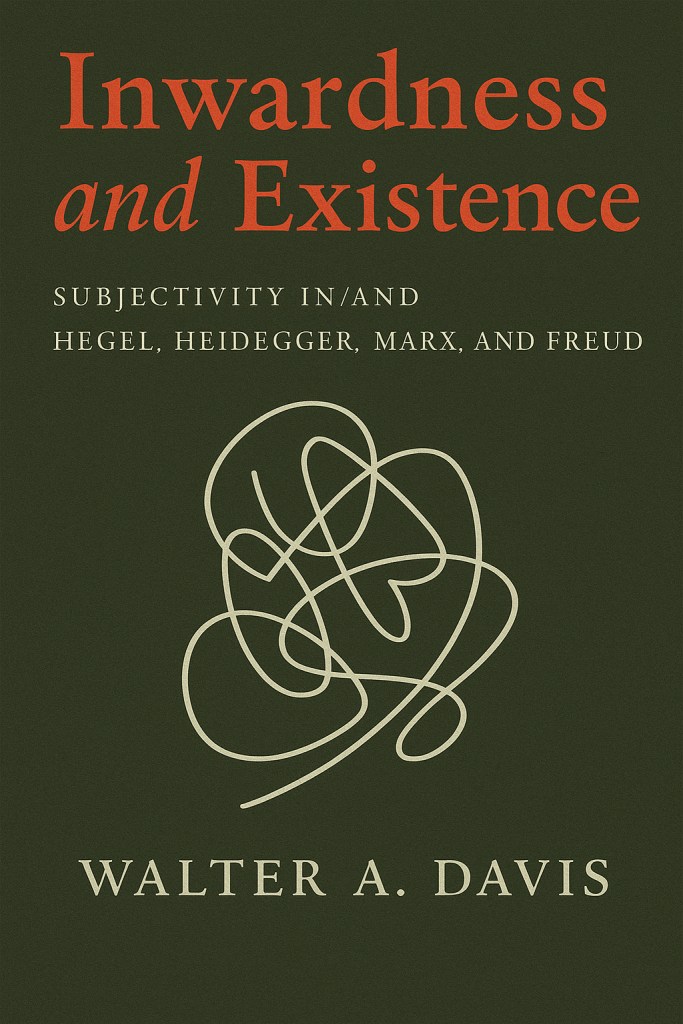
The scholarly stake of Inwardness and Existence is exacting and unambiguous: to reconstruct a rigorous concept of subjectivity adequate to modern experience by staging a principled dialectical integration of four usually antagonistic traditions—Hegelian phenomenology, existential analysis, historical materialism, and psychoanalysis—under a single methodological demand that reading must itself become an experiment in transformation. Walter A. Davis names this demand a hermeneutics of engagement: a way of interrogating texts that exposes their contradictions, retrieves their living core, and tests their claims against the drama of situated life. The book’s distinctive contribution is to show, with sustained concretion, that methodology is ontology: the dialectical procedures by which we inquire are also the structures by which the subject exists, suffers conflict, and changes. The result is a map of inwardness as a field of determinate negations—logical, historical, and clinical—that yield an account of agency irreducible to abstraction or dissolution.
The composition sequence and outer framing sharpen that stake. A compact introduction situates the problem within the polarities of humanism and deconstruction and defines the project as a quarrel with each of its sources; what follows are four long interrogations—Hegel, existentialism via Heidegger, Marxism, psychoanalysis—completed by a methodological finale in which dialectic is itself put on trial. The unity of the book is announced programmatically in its table of contents and enacted by the cross-references that make each chapter answerable to the others; the final chapter returns to the beginning by arguing that only a dialectic grounded in the living subject can vindicate dialectic at all. Even the epigraphs—Hegel on recognition, Kafka’s ice-axe, Sartre on hardness and shame, Hölderlin on loving what is most alive—serve as an external proscenium that prepares an audience to undergo what the text demands rather than merely to assent to it.
The methodological turn that sets everything in motion is the decision to replace commentary with interrogation. Commentary reconstructs doctrines, secures official intentions, and smooths over the rough ground on which real thinking takes place; interrogation identifies contradictions, retrieves unrealized possibilities, and measures concepts by their capacity to reorder experience. Davis names this stance a hermeneutics of engagement and makes two commitments that guide the argument: first, that reflection is not a barrier but the very medium of entry into a text; second, that the measure of reflection is the degree to which it transforms the one who reflects. The introduction therefore frames each reading as a rescue operation: Hegel is freed from hypostatized Geist, Heidegger from formalism, Marxism from guarantees, psychoanalysis from scientism. Together these rescues are said to yield a single position—situated subjectivity—whose meaning emerges only when the chapters are superimposed as one comprehension.
The first rescue sets the ontological stakes. Beginning from the inner structure of natural consciousness, Davis accentuates Hegel’s radical insight that consciousness is a triple relation—intending an object, aware of its own activity, and comparing these moments in reflection—whose unity is a power of determinate self-negation. Reflection is thus neither a pale “mirror” nor an external tribunal but the concrete infinite by which consciousness continually remakes both itself and its world. The phenomenological sequence from sense-certainty through understanding is read as the labor by which immediacy is stripped of its positivities and disclosed as a field structured by negations; the real transition, however, occurs when epistemology exhausts itself and desire enters as the first form of self-consciousness. At that point, the object is no longer a target of knowledge but a scene on which the subject discovers the question it always already poses to itself: what does desire desire? In this revised beginning, the subject’s history is obligated to pass through recognition, conflict, and unhappiness as intrinsic modes of its self-relation rather than detours to be overcome.
From here the life of reflection and the life of desire are woven into a single thread. Desire exposes the non-coincidence of the subject with itself; reflection turns that exposure into a procedure that cannot rest. The consequence—central to Davis’s appropriation—is that knowledge as correspondence is displaced by a more demanding correspondence: the world must be brought into accord with the inner dynamic of reflection, and the subject can be satisfied only by correspondence with itself. By foregrounding this demand, Davis also names an irony that governs the reception of Hegel: once radical reflection is liberated, the absolutes that would pacify it lose credibility; Hegel becomes the contemporary of the future precisely because what survives of his thought is the principle that consumes its own guarantees. That is the condition under which the rest of the book proceeds.
The existential interrogation takes up this condition at its most acute site: anxious attunement. Davis accepts Heidegger’s insistence that ontological questioning cannot be reduced to regional disciplines and that anxiety has methodological primacy, then argues that the attempt to formalize the existential analytic into invariant structures contradicts this primacy. The decisive move is to restore the experiential implications of being-towards-death and kindred motifs—fear, authentic decision, exposure to the other—by collapsing the formal/existentiell divide. Thus existential inwardness is defined as the internalization of recognition into a standing imperative by which the subject weighs itself; feeling ceases to be private reflex and becomes the initial act in which a situation is assessed by the burden of existence it imposes. The vocabulary of existential categories is consequently recast as principles of drama: the subject does not have moods, it enacts them; anxiety is not merely disclosed, it is staged and sustained as the condition of truth-telling. In this recoding, “action is our only way of giving ourselves being,” and the analytic of Dasein is reconnected to the lived conflicts for which it was first invented.
The extension to a social register requires a second rescue. In the Marxism chapter, Davis endorses Stuart Hall’s call for a marxism without guarantees because it exposes the conceptual armor—economic determination in the last instance, base/superstructure schemas, class reductionisms, a providential historicism—by which the tradition has protected itself from the very contradictions it discovered. The point is not to abolish determination but to specify how, under late capitalism, the economic insinuates itself as motive into domains where other ends still claim authority; the result is the production of a mass subject whose “precious individuality” functions as the most reliable form of social reproduction. The dialectic of individualism and collectivism thus collapses into a single paralysis: a subjectivity pitched to opinion and immune to self-criticism mirrors a social order that organizes consumption as a way of life. Here Davis’s wager is that contradiction inside the subject—experienced as dissatisfaction, blockage, or shame—can be mapped as a site of struggle rather than dismissed as a humanist remnant. The task is to place the subject in history by describing, in one movement, how we are determined and how we suffer this determination.
On this view ideology is not simply false belief; it is the process by which consciousness is acquired and disciplined. The demystification of immediacy accordingly requires an internal turn: “if the task of ideology is to create the very inwardness of subjects, then it is in our own inwardness that we must track ideology down and root it out.” The recovery of subject is neither an appeal to a suprahistorical essence nor a sociological reduction of agency to structure; it is a dialectical movement within ideological situatedness that learns to register and organize contradictions. In this sense, Marxism regains its Hegelian power to conceptualize unhappy consciousness under modern conditions, while its “scientific” temptations are curbed by an insistence that the only knowledge that matters is knowledge borne by lives capable of self-overcoming.
The clinical turn then furnishes a grammar equal to that ambition. Davis’s psychoanalytic reconstruction begins in medias res, where experience actually begins: with trauma. Trauma is neither a privileged event to be located once and for all nor a mere trigger; it is a point of reversal in which a buried history—lived as a sequence of defenses, disavowals, and repetitions—catches up with the subject and demands a new narrative of itself. Because trauma discloses conflict as identity, the explanatory form proper to psychoanalysis is neither linear causality nor genetic reduction; it is dramatic composition. The unconscious is redefined accordingly: not an impersonal substance anterior to the person, but the missing term in the most complete description of motives and intentions constantly enacted yet persistently refused. Psychoanalytic concepts—defense, anxiety, emotion, the structuring of id/ego/superego—are accordingly rewritten as roles and scenes in a drama that can be described with rigor; the clinic is a method of making these connections audible and survivable. This dramatistic turn not only rescues Freud from scientism; it also disciplines the appetite for textual games that would reduce sexuality to sign-play and leave the suffering subject untouched.
An important consequence of this reframing is the revision of love and mourning. Erotic attachment returns us to the original sensual affirmation that grounds psychic integrity, which is precisely why anxiety, loss, and grief surround the act; the sadness disclosed here does not primarily concern the loss of the maternal object, but the loss of oneself—the measure of how far one has failed to live the possibilities inaugurated by that first affirmation. The lesson is methodological as well as ethical: every enactment stages the whole, nothing is ever finally lost or sublated within the psyche, and the narrative that heals is one that can bear the ripening of conflict as conflict. To keep faith with these lessons, psychoanalysis must put itself on trial, submit its own metapsychology to dramatistic reformulation, and acknowledge that personal analysis is the sine qua non for interpreting its texts—an extension of the book’s governing principle that reading is itself a mode of self-change.
These four rescues culminate in the methodological chapter, where dialectic itself is subjected to dialectic. Here Davis offers a compact history of dialectic’s internal development and argues that the only principle adequate to its task, after Hegel, is the subject in its situatedness; transcendence is canceled, and system is refounded as procedure. The exposition moves through three moments—dialectic as discourse, process, and system—each dependent on what follows because in dialectic “the only context is the whole of things.” The characteristic procedures—comprehensive opposition, determinate negation, and the primacy of the whole—are recast to show that “abstract dialectics” dissolves into schema unless carried by lives that can sustain the oppositions they articulate, whereas “concrete dialectics” is inseparable from experiential transformation. When Davis identifies “the unconditioned first principle” with the logic of the subject’s internal structure, he is not smuggling back an Absolute; he is specifying that the only unconditioned ground dialectic may claim is the disciplined practice of reflection that changes its practitioner. This is why “methodology is ontology.”
It is essential to see how the chapters actively superimpose. Hegel is read with a psychoanalytic ear for defense and dramatization; psychoanalysis is rewritten with a Hegelian logic of negation and recognition; Heidegger’s existential analytic is revised by a Marxian attention to situation and worldliness; Marxism is returned to its Hegelian core and constrained by an existential criterion of authenticity. The introduction makes this circularity explicit: each chapter is a distinct illustration of the hermeneutic, and their interdependence is the argument. In this superposition the book enacts the very totality it defends: no framework holds a privileged position, and each becomes intelligible only within the evolving whole.
Within this evolving whole, several claims deserve emphasis because they sharpen the book’s distinctiveness. First, the commitment to a principled dialectical integration of traditions is motivated by a concrete perception: that experience outruns any single vocabulary we have inherited. When the object of knowledge is a subject who suffers conflict, every reduction—to rationalism, to formal ontology, to scientific materialism, to textual semiotics—misses the object by design. Second, the insistence that reflection is a creative unrest restores the scandal of Hegel’s greatest insight—the ubiquity of unhappy consciousness—without reinstating the closure of absolute knowledge; the “system” that results is a system of tasks, not of guarantees. Third, the redefinition of existential categories as dramatic principles, together with the reconstruction of psychoanalytic theory around trauma and narrative, provides an operational grammar for mapping conflicts without either psychologizing the social or socializing away the psyche. Fourth, the repositioning of Marxism under the sign of contradiction within the subject secures a concept of political intelligence that neither despairs of agency nor sanctifies it; ideology is tracked in the place it most effectively hides—our own ways of feeling—and class struggle is extended as a struggle for the terms in which inwardness can be lived. Taken together these claims specify situated subjectivity as the ground-concept that lets the interdisciplinary project cohere.
The outer frame of the book keeps this ground in view. Dedication, epigraphs, acknowledgments that register a sixteen-year gestation—all of these belong to the same ethos: philosophy counts only where it has the authority to “wake us … as with a fist hammering on our skull,” to shame complacency, and to teach love of what is most alive. The epigraphic triad—Hegel’s recognition, Kafka’s ice-axe, Sartre’s hardness—compresses the itinerary: recognition as the condition of satisfaction, a violent pedagogy of reading, and an aesthetics of severity adequate to truth. The chapters begin where philosophy must now begin, in medias res; they end where dialectic must now end, with a subject strong enough to endure contradiction without the anesthesia of the Absolute.
To clarify: the book advances a single thesis through many scenes. The thesis is that subjectivity exists as a hierarchy of integrations made possible only through acts of experiential self-overcoming, and that the right name for the method that follows such integrations is dialectic. This is why the consummating chapter refuses to leave method in the ether of meta-talk: categories must be comprehensive enough to reach the clinical, the social, the existential, and the speculative at once, because the subject passes through them at once. The book’s wager is that certain old words—desire, anxiety, recognition, ideology, defense, mourning—can be restored to their living force if they are allowed to speak across the registers that have disciplined them into separate discourses. When that happens, conceptual exposition becomes a form of source-based warrant: each rescue shows, within the inherited text, the resources for its own transformation.
The practical import is double. On the one hand, philosophy is reclaimed from detachment: inwardness names a style of attention that refuses premature reconciliation and measures its own adequacy by whether it can bear the conflicts it uncovers. On the other hand, inwardness is insulated against privatization: it is where ideology is most at work, where history takes hold, and where the possibility of a different life must be prepared. The proof condition for the theory Davis constructs is therefore existential and political at once: whether the reflective practices it prescribes can be lived through without guarantees, whether they can register trauma as reversal rather than as fate, whether they can organize the dissatisfaction produced by consumer capitalism into the kind of contradiction that generates thought. That is the force of the closing claim that methodology is ontology: if our methods leave us unchanged, they were descriptions of something other than human reality.
Inwardness and Existence does not propose a synthesis as a decorative overlay; it composes an argument in which each vocabulary is modified by having to do work it was not originally designed to do. Hegel’s reflection is made to carry the weight of anxiety and defense; Heidegger’s existential analytic is made to answer the question of ideology; Marxism is driven back to the level of feeling where it either learns to diagnose modern unhappiness or forfeits its claim to truth; psychoanalysis is forced to rewrite its metapsychology in the dramatic key its clinic requires. The success of that composition is measured by the degree to which the reader can follow the movement by which parts merge into and are finally displaced by other parts—the recognition, for instance, that the dialectic does not culminate in a meta-position but returns to the work of interpretation under the pressure of life. On that return the book insists, and in that return its argument closes: to be adequate to subjectivity is to keep the question open and to live the procedures by which openness is sustained.
If one needs a final sentence to mark the contribution without softening its demands, it is this: Davis retrieves the dialectical tradition for a time skeptical of subjects by showing that situated subjectivity is the only standpoint from which dialectic, existential truth-telling, social critique, and psychoanalytic transformation can be thought together without guarantees—and that the cost of such thinking is the acceptance of inwardness as a place of work.
 Simon Gros
Leave a comment