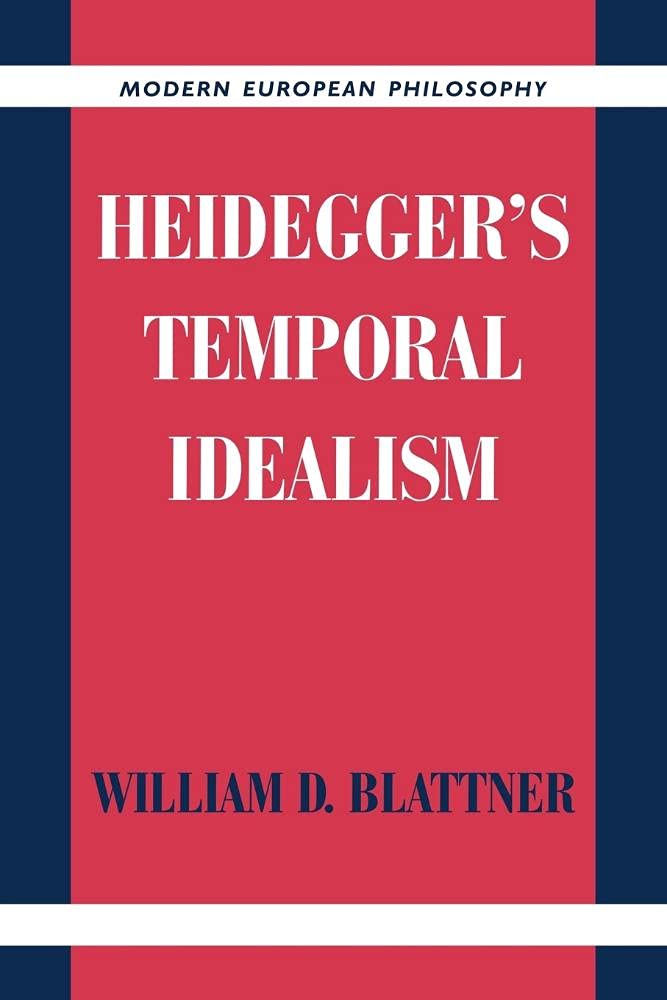
Heidegger’s Temporal Idealism advances a rigorous, intricately argued reconstruction of the temporal architecture at work in Being and Time, and wagers a precise thesis: time as ordinarily understood arises from, and is dependent upon, a more basic manifold—originary temporality—that is constitutive of Dasein’s being. Blattner’s distinctive contribution is to treat this wager as a systematic position, to situate it within a long lineage of “temporal idealism,” and to pressure-test each inferential bridge from Dasein’s existential structure to world-time and to ordinary, leveled-off time. The result is a book that clarifies the explanatory tasks Heidegger set himself, identifies where those tasks require more than phenomenological description, and shows how the argument’s success conditions touch the very possibility of ontological idealism and of unifying Dasein and world (and why, as Blattner argues, those conditions are not met).
The work frames itself methodologically by reasserting the basic orientation of Being and Time: ontology must proceed phenomenologically, yet the phenomena to be described are not objects but the frameworks that let beings be as the kinds of beings they are. Blattner accepts Heidegger’s insistence on “letting what shows itself be seen” but insists that, in the temporal domain, description becomes explanation: if ordinary time is to be derived from the existential structure of Dasein, phenomenology must not only display but account for dependence relations that run from the originary to the derivative. The book’s composition mirrors this demand. It moves from an interpretation of care as the being of Dasein, through the reconstruction of originary temporality, to the derivation of world-time and the ordinary conception of time, and finally to a historical-systematic placement of Heidegger’s thesis in the Plotinian–Leibnizian–Kantian tradition, before assessing its collapse and its consequences. The table of contents already signals that architecture and the promised dependency claims—unity of care via originary temporality; world-time derived from originary temporality; the leveling that yields ordinary time; and, at the end, the status of Heidegger’s temporal idealism itself.
Blattner begins with the ontological groundwork in Being and Time: Dasein’s being is care. Care articulates as existentiality (the ahead-of-itself structure that projects possibilities), facticity (the already-in that assigns determinate thrownness), and falling (the absorption in the everyday that levels differences). He emphasizes that Heidegger’s own formula—“ahead-of-itself-in-being-already-in-(the-world) as being-amidst (intra-worldly encountering entities)”—is already temporally inflected; it prefigures the later temporal explication of care by explicitly marking a futural directedness and a past-like givenness. Blattner’s interpretive wager is that originary temporality makes thematic the structural heart that those phrases indicate: a nonsequential manifold whose ecstases—future, past, present—do not name a series of “nows” but name, respectively, purposive directedness, determinate givenness, and presence-in-person within comportment. Thus the exposition of care is not anterior to time but calls for the temporal articulation by which its unity can be displayed.
The central claim here is subtle. If originary temporality were just “time” in the folk or physical sense, it would be merely a medium in which Dasein happens to be. Heidegger’s point, which Blattner reconstructs with care, is that originary temporality is the sense of the being of care, the form of activity by which existentiality and facticity are unified. Because the originary future is an aiming that is not a future “now,” and the originary past an already that is not a past “now,” their unity cannot be borrowed from any sequential flow; it arises from their belonging together as moments of practical orientation and situated determinacy. The future manifests as purposiveness, the past as givenness, and the present as the mode of “being-there-with” in enactment. This is why, on Blattner’s reconstruction, the unity of care is clarified by the unity of originary temporality. Yet precisely at this juncture he enters a methodological tension: because the temporal elements already saturate Heidegger’s official formula for care, the move from care to originary temporality risks looking like a redescription rather than an explanation. Blattner grants the proximity and then argues that the explication nonetheless “draws out and brings into view the structural heart of care,” thus making the unity intelligible as temporal.
With that manifold in view, the book turns to world-time. World-time is not the homogeneous succession of instants; it is the time of public practice: datable, public, spanned, significant, sequential only in the mode of concernful orientation—the “time for” that is coordinated with tasks, deadlines, calendars, and the measured intervals of everyday life. World-time has “datability” because the when is indexed to worldly there’s—meeting times, harvest seasons, train schedules; it has “publicness” because those indices are shared; it exhibits “spannedness” because tasks stretch across meaningful intervals; and it becomes “leveled” in its ordinary use as a standardized medium for coordination. The dependency thesis is explicit: world-time depends on originary temporality; without the practical directedness, givenness, and presence that structure Dasein’s existence, there would be no meaningful patterns to be measured or shared. Blattner gathers Heidegger’s own vocabulary for these features and then undertakes the derivation: the “World-Time Dependency Thesis.”
The next passage in the argument is decisive. If world-time is thus dependent, what of the ordinary conception of time—the familiar “series of nows” treated in physics and common sense? Heidegger’s story, as reconstructed here, is that ordinary time is a leveled-off world-time. Through a twofold “change-over”—from occurrent to available, and in our understanding of time—pragmatic temporality is flattened into disengaged temporality, the public horizon becomes standardized, and the ecstases lose their phenomenological depth in favor of a homogeneous succession. On this view, the empty series of “nows” is a derivative, ontologically thinned result of practical, world-oriented temporality. Blattner embraces Heidegger’s topography but presses the derivational burden: to claim dependence is to shoulder explanatory obligations at each link—originary temporality to world-time; world-time to ordinary time—and to show how each specific structural feature (datability, publicness, sequentiality, spannedness) is produced by the originary manifold.
This is where the book marks its strongest critical intervention. Blattner argues that while the description of originary temporality is philosophically fecund, the derivation falters. The originary manifold is intentionally nonsequential; its future and past are functional roles within practical orientation, not positions in a series. But world-time’s sequentiality and the ordinary conception’s serial “nows” require, at minimum, a story about how succession arises from non-successive roles. Without that story, one has illuminated the temporality of care yet not explained the dependence of world-time or ordinary time upon it. Thus the “World-Time Dependency Thesis” remains asserted more than established; and the move from world-time to ordinary time—via leveling—repeats the issue at a higher register. The derivative forms are said to lean on the originary ones, but the mechanics of that leaning remain elusive.
The stakes sharpen when Blattner turns to temporal idealism. He formulates Heidegger’s commitment succinctly: if Dasein did not exist, time would not obtain. The book then locates this claim in two intersecting traditions. From Kant, Heidegger inherits a transcendental orientation—time as a condition of the possibility of understanding beings. From Plotinus (and, in a preparatory way, Leibniz), he inherits an explanatory orientation—time depends upon a subject-like source. Heidegger’s originality lies in fusing these: he is an explanatory, transcendental idealist about time, but unlike Plotinus and Leibniz, he refuses to posit an eternal “shadow time” (eternity) as the ground; and unlike Kant, he seeks to ground the form itself, rather than accept it as ultimately inexplicable. In Blattner’s telling, this fusion is enabled by the notion of a nonsequential originary manifold, “perhaps inspired by Bergson,” whose ecstases ground world-time and, through it, ordinary time. Yet the attempt to ground time in appetitive or aiming structures—so crucial to Plotinus and Leibniz—faces a regress: desire and aim are themselves intelligible only for temporal beings. Heidegger tries to avoid this by purifying the futural ecstasis into an aiming that is not an attempt at alteration, but the deeper problem of producing succession from non-succession remains.
At this point, the book pivots to the larger systematic frame—what Blattner calls the Temporality of being. If time is the horizon of any understanding of being whatsoever, then every regional ontology—Dasein, available equipment, occurrent nature—must be temporally articulated. Heidegger’s lectures in the months after Being and Time suggest that the unpublished Division III (“Time and Being”) was meant to develop exactly this: a horizonal schema for the ecstases and, especially, a praesens (a Latinate term that distinguishes this horizonal schema from ordinary “presence”) as the temporal sense of availableness, while leading to an account of the ontological difference from the standpoint of temporality. But those lectures only name these tasks; they do not execute them. Thus, the hoped-for completion—the demonstration that being is “shot through with temporal determinations” in a way that could sustain a strong ontological idealism—never materialized, leaving the core dependence claims without the architectonic that was supposed to justify them.
The consequence, spelled out without equivocation, is twofold. First, the argument for temporal idealism—the dependence of time on Dasein—fails; and with it the argument that being depends on Dasein (Heidegger’s ontological idealism). Second, the attempted explanation of a deeper unity of Dasein and world—beyond the transcendence account already available in Division I—is unpersuasive. Section 69c’s temporalization of transcendence promises an identity or at least a tighter unity, but on Blattner’s reconstruction the derivation adds no more than what §18 already secures: practical openness to a world is constitutive of Dasein. The temporal story was meant to integrate that openness more deeply; instead, it fails to thicken the unity in the way the text suggests.
Having argued that the central derivations do not go through, Blattner does not toss out the early Heidegger. Quite the opposite. He distinguishes three layers in Being and Time and assesses what survives. The first and most successful layer is the ontological articulation of Dasein, the available, and the occurrent—the clarifications that made Being and Time transformative. The second is the ambitious attempt to link ontology to the philosophy of time by deriving world-time and ordinary time from originary temporality. The third is the projected philosophy of being, for which the lectures provide only promissory markers. If the derivations fail, the ontology of Dasein can stand almost intact; what drops out is the deepening via temporal idealism, especially the theory of historicality as a modally indifferent structure, which had been tied to the success of the dependencies from ordinary time back to the originary manifold. By contrast, the planned philosophy of being lacks the support it would have needed; without a secured temporal idealism, ontological idealism has no footing. In this sense, the collapse of the derivation does not refute the analyses of care, understanding, affectivity, falling, and discourse; it brackets the claim that those analyses explain time and that time thereby grounds ontology.
The book’s historical chapters show why this outcome matters beyond exegetical neatness. If one cannot derive succession from the nonsequential, one must either accept Kant’s apriority as brute, or return to Plotinian and Leibnizian strategies—which smuggle time back into their grounds by making appetite and striving do the explanatory work—or else reconceive the problem entirely. Heidegger’s own later path—abandoning the project of Division III, loosening the hold of temporal idealism, and relocating the question of being in a different register—looks, on Blattner’s reading, like an awareness of these pressures. The very textual history to which the book attends—the acknowledgment that the intended elaboration of “Time and Being” remained unintelligible in the form Heidegger had composed, the abortive lectures, the shifting emphases—maps onto the philosophical limits that the derivations encountered.
None of this diminishes the insight of the originary manifold itself. Indeed, one can accept Blattner’s negative verdict on the derivations and still affirm the analytic gains of the temporal interpretation of care: it clarifies how purposive projection, thrown determinacy, and enacted presence structure practical intelligibility; it accounts for the specific ways in which discourse tends to temporalize in the mode of enpresenting when oriented to intraworldly things; and it explains why the public coordination of activity yields a time that is dated, shared, and spanned by significance—whether or not these facts depend for their very being upon Dasein. Even the critique of discourse’s “temporal vacuity” serves to underscore the point: where temporality truly bites is not in the grammar of tenses, but in the enacted unity of self-understanding.
The argumentative narrative, then, runs like this. Start from the pre-ontological fact that human existence is already oriented by standards of being; extract, via phenomenology, the ontological framework of Dasein as care; reconstruct its temporal sense as a manifold that is explicitly not a serial succession but a practical articulation; propose world-time as the public, datable, spanned field generated from that articulation; and finally show ordinary time as a further leveling of world-time into a standard succession. If each step held as an explanation (not merely as a redescription), then temporal idealism would follow, and with it a powerful argument for the Temporality of being and for the unity of Dasein and world. But Blattner demonstrates, with textual care and conceptual pressure, that the key step—the production of succession from non-succession—does not receive the demonstration the project requires.
To close, it helps to name precisely what the book secures, what it destabilizes, and what it thereby clarifies. It secures a systematic map of Being and Time’s temporal claims, locating them in a tradition and reconstructing their internal logic. It destabilizes the derivational ambitions that would move from originary temporality to world-time to ordinary time, and, through them, to temporal and ontological idealism. And it clarifies that the philosophical power of the early Heidegger lies, at minimum, in his reconfiguration of ontology around the lived articulation of existence, regardless of whether that articulation can bear the weight of grounding time as such. The composition sequence and the outer frame—the aborted Division III, the lectures that name but do not deliver a horizonal schema of praesens, the explicit remarks that the plan “had to remain unintelligible”—are not mere biographical curiosities; they mark the exact fault-line at which the derivational claim outstrips the phenomenological insight. Reading Heidegger’s Temporal Idealism makes that line visible, and in doing so, it reopens the question of how—if at all—time and being are bound together in the wake of Heidegger’s earliest, most radical proposal.
 Simon Gros
Leave a comment