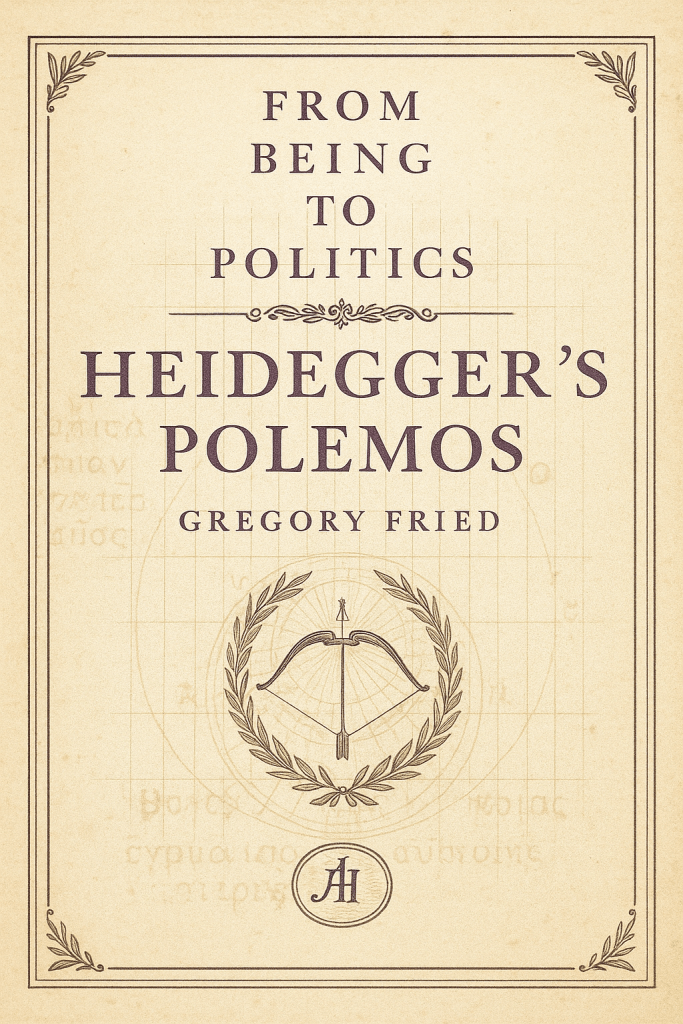
Heidegger’s Polemos: From Being to Politics undertakes a single, exceptionally focused wager: that the most coherent path through Heidegger’s ontology and into his politics runs by way of a reinterpreted polemos—not as mere “war,” but as Auseinandersetzung, a formative confrontation in which beings, worlds, and peoples are set out and apart, disclosed, and bound to answer for themselves. Gregory Fried’s distinctive contribution is to show how this one thread quietly stitches together Heidegger’s analyses of Dasein, truth as a-lētheia, the “turn,” the history of Being, and the revolutionary horizon of a political belonging—and how it continues to organize Heidegger’s later critiques and his vexed proximity to postmodernism. The scholarly stake is to read the politics from within the ontology by following polemos where it leads, and to test that itinerary against the texts themselves.
Fried opens where the problem has proven most volatile: the “Heidegger affair,” and the temptation either to psychologize biography or to seal thought off from life under the rubric of an autonomy of theory. He refuses both reductions while preserving the philosophical center of gravity: the matter that calls for thinking, die Sache des Denkens, demands a confrontation in which biography can occasionally illuminate, but never exhaust, the question. The point is not to adjudicate scandal; it is to ask what philosophical work the scandal names. Fried identifies that work crisply: the politics of identity and difference—belonging and exclusion, particularity and universalism—returns, in our late modern or “postmodern” present, as the Being of our politics. Heidegger’s case, on this telling, becomes a lens for the constitutive strain between exclusive belonging and a universalizing recognition of otherness; that strain continues to structure contemporary debates long after the biographical dossier is closed.
The through-line is polemos. Fried’s first argumentative step is conceptual: polemos is not merely a martial image but the name for the way beings come to matter by being set into a field of opposed determinations that make sense as sense. In ordinary German, Auseinandersetzung names both a logos and a conflict: a laying-out that differentiates and a struggle that tests and bounds; it ranges from spirited debate to trench warfare. Fried leverages the word’s morphology—aus-einander-Setzung: a setting-apart that sets forth—to argue that Heidegger’s preferred gloss marks an ontological structure before it becomes a political trope. Our being is hermeneutic because we stand in this formative confrontation; we come to ourselves by being compelled to “give an account” and to withstand that account in return. Thus “our Being is polemical,” and the scope of polemos expands to the breadth of the question of Being itself.
This ontological register is secured by Fried’s close reading of Heraclitus Fragment 53, the textual hearth of Heidegger’s appropriation. Fried sets out the philological puzzle: polemos pantōn men patēr esti, pantōn de basileus…—“War is of all things father and of all things king,” a provocation heard as a direct challenge to Zeus, father-king of gods and men. The fragment’s paired clauses—father/king, gods/humans, slaves/freemen—array themselves like hoplite phalanxes, and Fried tracks the grammar (men…de), the genitive pantōn (is it “of all men” or “of all things”?), and the difference between edeixe (revealed) and epoiese (made), to argue that Heraclitus plays at once on social-political differentiation and a metaphysical generativity: polemos “lets emerge” and “preserves in rule” by revealing and producing determinate standings. Fried shows why a merely sociological reading cannot carry the fragment’s burden: even the gods/humans division exceeds civic taxonomy, and Heraclitus’ broader teaching about the hidden harmony of conflict (the bow’s tension, high/low notes) pushes toward a principle of ontological differentiation. Heidegger’s choice to gloss polemos as Auseinandersetzung rather than Kampf responds precisely to this dual register.
On this basis Fried reconstructs the internal sequence by which polemos is transposed into Heidegger’s key motifs. Truth as a-lētheia is polemos: to “un-conceal” is to wrest beings from lēthē in a strife that sets their limits and bearings; disclosure is never pacific givenness but a struggleful opening in which a world stands forth. The Kehre—the so-called “turn”—then ceases to be a merely biographical bifurcation and appears, in Fried’s presentation, as a structural “turning between” Dasein and Being within polemos. Being needs Dasein as its Da, its there for appearing and withdrawing; Dasein needs Being for the event in which meaningfulness arrives. The turning is the reciprocity of this belonging-together in confrontation—neither subjective projection nor objective delivery, but a play of bestowal and resistance whose “truth” is the very happening of a world. Fried’s insistence here (and it is the book’s core insight) is that polemos belongs neither exclusively to Being nor exclusively to Dasein; it is neither objective nor subjective—hence the political resonance will be internal to the ontology, not layered atop it.
The composition of the book mirrors this argumentative ascent. An explicit outer frame—introduction and conclusion—presents how to read the intervention and where we go from here; the center of mass unfolds in five movements whose thematic continuity Fried makes overt in his table of contents and internal cross-references: Heraclitus (polemos), polemos as Da-Sein, polemos and the revolution of history, polemos and the revolution of politics, and a culminating confrontation with postmodernism and Derrida. The structure is not additive; it is disclosive. What begins as philology turns into an ontological grammar; this grammar then compels a historical phenomenology, which in turn forces the political question; the postmodern scene becomes the contemporary proving ground; and the conclusion returns to the question of whether a confrontation with Heidegger can be continued without becoming Heideggerian. The work is thus framed as a single Auseinandersetzung that moves by self-displacement: each part opens a field that the next part gathers and re-situates, until the argument has “turned through” its own presuppositions.
Two nodes crystallize Fried’s evidence for this onto-political continuity. First, the documentary hinge of 1933–35: Heidegger praises Schmitt’s citation of the fragment, pointedly noting the basileus that “gives the fragment its full meaning,” and announces that he “now stands in the midst of the polemos” as Rector—an unmistakable signal that polemos will serve as the key for both truth and politics. When, shortly thereafter, in Introduction to Metaphysics, Heidegger translates Fragment 53 directly into the idiom of Auseinandersetzung, the semantic drift away from Kampf (a word saturated by party jargon) both distances and deepens: the political resonance is carried by an ontological term that already does the work of struggle. The turn in diction is not cosmetic; it is the visible seam where the grammar of disclosure fuses with the rhetoric of revolution.
Second, the lectures and writings around Hölderlin and the “neighboring peoples” show how polemos migrates from the existential analysis into a theory of peoples and their destinies. Fried tracks a crucial thread: for Heidegger a people (Volk) becomes a community only if it dares and bears the Other as Other; genuine encounter among peoples requires a “long will to listen” and the “restrained courage for one’s own vocation.” The institutional proxies for a homogenizing peace (e.g., a League of Nations) occlude rather than enable this confrontation; what is needed is a conversational exchange among the “creative ones” in which each tradition brings its most originary questions into play. Fried stresses how this posture rejects both imperial leveling and quietist withdrawal: polemos here names a diplomatic agon that can harden into war or remain a demanding dialogue; either way the criterion is whether the exchange preserves difference in a way that lets each future.
From here Fried returns to the history of Being and the political inflection of its “revolution.” If truth as unconcealment is a strife, the historicity of Dasein must itself be polemical. The destructive retrieval (Abbau) of tradition—already evident in early writings—becomes a method-as-ethos: a text is honored when it is “set in place in its highest power and dangerousness,” for only then can an interpretation become creative. Extending this to the grand arc, Fried reads Heidegger’s confrontation with Nietzsche as an Auseinandersetzung with the entirety of Western thinking—the gathering of a history before its possible other inception. In this transfer, the “turn” marks the interval in which belonging and difference are renegotiated at scale; politics then becomes the practice of preserving finite worlds against the homogenizing metaphysics of liberal modernity while maintaining a reciprocity among finite worlds. The rigor of Fried’s claim is that, on Heidegger’s terms, this is not an optional add-on but the political face of the ontological project.
Fried is at his most incisive when he shows how this onto-political logic informs the programmatic rhetoric of 1933–34. The famous tripartite “bonds” and “services” in the rectoral address—labor to the Volksgemeinschaft, military to the nation’s honor among peoples, knowledge to the Volk’s spiritual task—trace a Platonic ambition for guardianship under a revolution whose criterion is the awakening of a spiritual world that preserves “earth- and blood-bound strengths” by arousing a questioning stance toward a people’s own Being. Fried neither sanitizes nor sensationalizes the proximity of this language to Blut und Boden propaganda; instead, he secures its place inside the polemical ontology he has reconstructed and thereby clarifies why the political temptation was an internal risk, not an external accident. The evidence is textual and conceptual rather than anecdotal.
Having built the interior bridge from Being to politics, Fried turns outward to the contemporary readers most invested in escaping Heidegger’s entanglement with fascism: the postmodernists. The pivot is careful: postmodernism inherits Heidegger’s epochal narrative of modern nihilism, the critique of subjectivism, and the deconstructive suspicion of totalizing identities; yet it seeks to avoid Heidegger’s political temptations by radicalizing difference and dispersing identity. Fried engages this school not as a foil but as an extension of the same Auseinandersetzung—now with Derrida as the exemplary case. Derrida’s own programmatic declarations capture the point: it is necessary to expose, without limit, the text’s adhesion to the possibility and reality of “all Nazisms,” and to refuse reassuring schemas. Fried accepts this demand and tests it against the same logic of polemos: if the very practice of deconstruction depends upon staging maximal oppositions inside a text, then its political efficacy cannot be measured by programmatic outputs alone.
Fried’s discussion of Derrida is diagnostic rather than polemical in any petty sense. He notes the recurrent charge (from Right and Left) that deconstruction stays inside the library, forever textual, unable to “act.” Derrida’s retort—that the demand to go “beyond the text” presupposes an impoverished picture of how politics is mediated—is granted its force; but Fried then asks whether acceptance of Heidegger’s epochal history of Being, even in a critical key, risks an unwitting fatalism about our “late” condition, a democratized nihilism whose exhaustion feeds the very political monsters it would resist. The fate of Weimar serves in Fried’s reading as a caution: under certain cultural-mood conditions, the refusal of binding identities can collapse into mass disaffection or tempt the restoration of binding identities by authoritarian means. The issue is not “guilt by association”; it is whether the structure of polemos has been pushed far enough to recognize where political difference must be institutionally and historically sustained if it is to avoid devouring itself.
The cumulative effect of Fried’s argument is to recalibrate the criteria by which we read Heidegger’s politics. The question “Was Heidegger a Nazi?” is neither ignored nor fetishized; it is respecified as: What features of the ontological project render certain political options thinkable, tempting, even compelling, and under what counter-pressures can the same project be made to yield a different politics? Fried’s answer is demanding precisely because it is immanent: to engage Heidegger responsibly is to repeat the Auseinandersetzung at the level where it lives—logos as strife, interpretation as setting-out, community as the risk of listening long. Any attempted “recuperation” will fail if it refuses to confront the dangerousness of the concepts; any wholesale condemnation will fail if it refuses to see why these concepts continue to solicit us. The proper form of reading becomes a methodological ethic: to “set in place the antagonist in his highest power,” including the antagonist in ourselves.
This is why the book’s internal displacements matter. The Heraclitean inquiry is not left behind when the political chapters begin; it is re-enacted at a different scale. Likewise the analysis of Dasein does not simply precede history; it becomes historical when the question of truth is taken as a communal task; and the revolutionary passages are not the terminus but the test site that the Derrida chapter then re-interrogates. The composition is circular in Heidegger’s sense (a hermeneutic circle entered rightly), but also progressive in Fried’s: each pass gathers a thicker weave of claims and evidence, so that the closing gestures—Where do we go from here?—can afford to be modest without being evasive. The answer is not a platform; it is a discipline of reading and a courage of listening that aims to keep finite worlds plural without dissolving them into paste.
If there is a single sentence that condenses Fried’s thesis, it would be this: polemos is an ontological name whose political consequences must be thought from the inside of the strife that makes truth manifest. To think Being as Auseinandersetzung is already to accept that worlds and peoples are formed and kept only in exacting confrontation; the task is to determine which practices, institutions, and virtues can host such confrontation without surrendering to annihilating enmity or anesthetizing homogeneity. Fried’s reading does not promise that Heidegger furnishes those practices; it insists that any future response will have to face down the same grammar of disclosure. In this sense, the book’s conclusion is appropriately restrained: we can continue our polemos with Heidegger, but only by risking our own positions under the very lights that led him astray. That risk, and the discipline to endure it, is the best warrant Fried can offer that the Being of our politics might yet be otherwise.
To clarify, Fried’s study is not a verdict but a frame for judgment. Its method is to let the concept do the traveling—polemos from fragment to ontology to history to politics to our present—and to measure each station by how well it preserves the double demand of confrontation: the resolute setting-apart that makes sense, and the mutual bearing-with that keeps sense from closing. The book’s originality lies in making that itinerary legible and compelling across Heidegger’s periods, and in showing that the continuity is not a biographical convenience but a conceptual necessity. Read in this way, the politics do not “follow” the ontology; they are its worldly experiment. The question remains whether we can stage that experiment differently. Fried’s answer is that we must, and that the path runs—still—through Auseinandersetzung.
 Simon Gros
Leave a comment