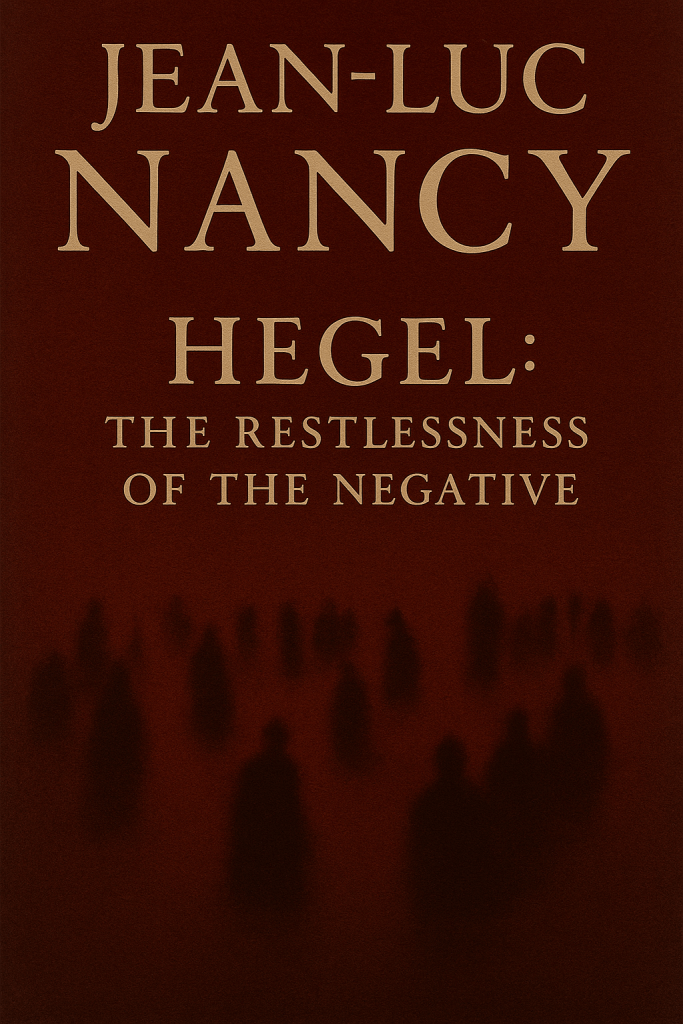
Nancy’s slender book sets itself a very large philosophical task: to exhibit a Hegel whose system breathes as restlessness rather than closure, whose “absolute” is not a perched result but the immanent motion of self-relation, whose politics opens not onto an apparatus of sovereignty but onto the exposed spacing in which being-in-common occurs. Its distinctive contribution is methodological: it recasts Hegel’s work as a practice of presentation—a penetration into the depth of things where ground is a hollowing rather than a foundation—so that the familiar figures of logic, desire, freedom, and we are read as a continuous movement in which thought, world, and community are inseparable because each is only the effectivity of negativity. The book’s argument insists on this: to think Hegel today is to think the concrete restlessness by which sense, world, and we are made present.
Nancy begins from the claim that modern experience is a disenchanted exteriority: the religious bond no longer guarantees meaning, knowledge is procedural, and the world apprehends itself as a sequence of interests and instrumentalities. The keynote is unease: a consciousness that its history is an unpacified succession and that even the death it contemplates may be “without inner signification.” From this diagnosis Nancy extracts less a lament than a criterion: truth must be found in the ordeal, within the world’s own restlessness, not by restoring a lost ground. “Self” accordingly names neither a possession nor an inner sanctuary but a relation that is not given in advance—an infinite referring of self to self made possible precisely by the world’s separations. In this register the Hegelian subject is not an egoistic master-term; it is the act that dissolves all supposed substances, the concrete experience in which the world passes through its negativity and, by doing so, becomes world. That movement is restlessness itself, the concept as self-grasping and self-relation, immanent in and to the finitude it traverses. The absolute, then, is not the terminus of an ascent but the actuality of this unrest.
This opening gesture already fixes Nancy’s general method. He refuses to begin from presupposed principles. The decision to philosophize is a practical act by which the subject decides for its own infinitude: not an abstract infinity beyond the finite, but the finite’s own instability. Hegel “begins” nowhere because nothing needs to be interrupted and refounded; everything has already begun and, equally, everything is already finished in the sense that no figure can function as completion. The absolute is presupposed only as the concreteness of what is—being here, hic et nunc—so that exposition is not a theory about the real but the real’s self-exposition in and as thought. For this reason Nancy speaks of presentation rather than representation: thinking puts things on stage as they expose themselves, and in doing so it negates the givenness of both object and subject in favor of the gift of presence that occurs in and as the passage from one to the other. This is why “becoming” is absolution: every finite thing is intrinsically in excess of its determination, borne away in the absolute restlessness of becoming, while the absolute is at rest only as this very non-repose.
The pivotal figure that binds Nancy’s reading is penetration. To penetrate the thing is to sink into depth where “ground” is not a supporting stratum but the abyssal hollow through which a thing passes into its truth. Foundation, in this sense, is a founding that undermines itself; it is the work of the negative. The “point” at which passage occurs is nothing other than the passage itself, and its truth is always the other into which it moves. Nancy reads Hegel’s transitions in precisely this key: being passes to thought as thought passes to being, not by analogy but by an identity of movement wherein each dislodges the other and, by doing so, dislodges itself. In this sense Hegel’s text neither questions the possibility of knowledge nor searches for ultimate reasons; it explicates the absolute by letting the absolute explicate itself. The concreteness of that self-explication is not a mystical fusion but the reality of manifestation.
Because the same restlessness that defines the world defines thought, Nancy’s commentary constantly shifts the locus of necessity from static determinations to the dynamic of presentation. Knowing is not the positing of an object before a subject; it is the staging of a presence that can only be as the mutual exposure of thing and knowing. Every “given” thus enters the necessity of its contingency—its inability to remain as mere givenness—and thought is the medium of that necessity. Bad infinity (an endless progression toward an always-postponed term) is replaced by the infinity of relation that inhabits finitude itself. This is why Nancy can insist that Hegel is the inaugural thinker of our world: not because Hegel catalogs its contents but because he thinks the form in which contemporary experience must be thought—the non-reposing identity of freedom and necessity as the self-exposure of truth.
Nancy’s lexicon—restlessness, becoming, penetration, logic, present, manifestation, trembling, sense, desire, freedom, we—does not supply topics for a survey; it composes a sequence in which each term is displaced by the next and retains itself only in the movement into the other. “Logic” here is not a doctrine of forms but the activity by which the concept posits and in positing reveals that what is posited is nothing but its own activity. Logic takes on the structure of presentation: it is the measure of how determination gives way to the self-exposition of the absolute, which is to say, to the identity of being and thought in their mutual expropriation. Because concept means grasping, logic in Nancy’s reading is nothing other than the restless grasp that deprives both the grasping and the grasped of independence, transforming the “ground” they thought they had into the depth through which they must pass.
From logic Nancy turns to the present, but again not as a time-slice. Hegel’s famous sobriety about the “owl of Minerva” is for Nancy the sign that philosophy arrives with dusk because the present, taken as a self-sufficient fullness, is already gone. Yet the present is also the only site at which the absolute happens. Its “now” is the point of passage; presentness therefore appears as deprivation and as the epoch of the concept. This does not make the present empty. It makes it the time in which presentation must occur: a time that is nothing other than the self-exposure of form as it loses the saturated sensuousness of poetry and takes up the poverty—and power—of thought that “produces thoughts.” The present is thus the test of whether thinking can be equal to the finitude in which it finds itself.
“Manifestation” gives that test its ontological contour. The absolute must manifest, but manifestation is not the projection of an interior essence outward into appearance; it is the very becoming-actual of essence in and as its appearing. Nancy emphasizes Hegel’s insistence that truth is not behind or beneath its forms; it is their effectivity. World-mind is not a transcendent overseer but the labor, in the world, by which the concept arrives at itself. In this way manifestation reveals both the necessity of religion and its transposition: what “revelation” reveals in the end is that revelation passes into thought, not as the negation of the divine but as its consummation in the presentation of truth.
“Trembling” marks the affect proper to this passage. Nancy’s tonal choice matters: inquiétude is not merely motion; it is unease, a disturbance without repose. The subject trembles before the negativity that sustains it; spirit trembles as it exposes itself to its own exteriority. The significance of the term is not psychological but structural: trembling is what a finite figure feels when the infinity that inhabits it makes itself felt as the non-coincidence of the figure with itself. This is why the book’s style remains taut and lyrical without becoming rhapsodic: philosophy is an ordeal, and its poise is the poise of a body that knows it stands on a ground that hollows as it stands.
From here Nancy can engage “sense” and “desire” as two modalities of the same expropriating movement. Sense is not a content stocked in representations; it is the donation of presence, the gift that occurs where object and subject give each other up as self-standing terms. Desire, in turn, is not a psychological appetite layered upon nature; it is the subject’s kinetic form, the motion by which the finite seeks itself in an other and discovers that its truth lies not in appropriation but in exposure. The dialectical eros by which self-consciousness negates and preserves the other is not a triumph of mastery but a risk of emptiness, and this is why Nancy repeatedly measures Hegel’s analyses against the concrete scenes of recognition, labor, family, and sexual difference: desire is constitutive, but it is constitutive as an experience of limit.
“Freedom” names the site where these analyses must either become concrete or fail altogether. For Nancy, Hegel’s decisive move is to locate freedom in the identity of thought and being—freedom as effectivity, not license. Hence the importance of the concept’s position: what the concept posits is precisely its own activity, which is to say, freedom manifests as the objective necessity of a life that binds itself to law. At this point Nancy’s reading brushes the traditional political Hegel and refuses both the juridical reduction of the political to rights and the cynical reduction of the state to a mechanism of domination. Yet instead of reconstructing the encyclopedia’s triad of family, civil society, and state, Nancy opens a different path by insisting that the political appears first as the spacing in which we are exposed to one another. “War,” for Hegel, exhibits the difference between civil society and the state, and in that sense it shows how the highest freedom of the individual is the duty to be a member of the state—a thought that modern readers find intolerable. Nancy neither repeats nor repudiates it; he shifts the emphasis toward the contradiction of separation and non-separation that the state, in its best concept, would have to bear. Love is called the essential principle of the state not because politics should become amorous, but because the political must think the unity that is not appropriation—the between that cannot be secured as property or closed as identity.
It is at this juncture that Jason Smith’s introduction becomes crucial to the book’s outer frame. Smith notes that Nancy persistently subtracts the name of the state from passages whose Hegelian lexicon he otherwise adopts. The result is a deliberate estrangement: the sense of the political is released from the apparatus of sovereignty and re-situated as the empty place of sovereignty—a spacing that resists occupation and must be “left free.” Historical decomposition (deterritorialized capital, dense media networks, invocations of “humanity”) exposes an empty locus where the old forms no longer hold; Nancy reads this exposure not as utopia or nihilism but as the minimal condition for being-with. The political thus appears not first as power’s dynamics but as the opening of a space—a place without content that is nonetheless the condition of every possible togetherness. The paradox is explicit: the purely political, in this sense, is non-political; the condition of politics is not “political” in any inherited idiom. Nancy embraces the paradox to preserve the originary exposure of with from capture by either juridical formalism or technologies of power.
Smith also presses the cost of this subtraction. If ontology and politics are inseparable in Hegel—if the common is not elaborated in the state but realized as it—then to bracket the state may eclipse Hegel’s own name at precisely the moment one seems to cite him. But Nancy anticipates the objection: he treats “state” as a historically compromised figure that both points toward and conceals what truly matters—the contradiction of separation and non-separation inherent to the common. The subtraction is not a formal purgation that leaves only a skeletal structure; it is an opening that must remain desert-like, poor, and unappropriable if it is to be the site of any being-with whatsoever. The “we” of the final chapter therefore registers not a constitutional subject but the just-between-us where encounter occurs in secret, as mourning and as love, without becoming a substance. Here Nancy’s Hegel converges with his own philosophical corpus: the political is the place where community is brought into play, but “place” now means exposure rather than enclosure.
This double framing—Hegel read as the thinker of modernity’s restlessness, and Hegel displaced where the state once stood so that a proto-political opening might appear—governs Nancy’s handling of the book’s last pair of terms, “freedom” and “we.” Freedom, to be more than subjective caprice, must be realized; yet its realization cannot be the fixation of identity. It must occur as the concept’s work—the ceaseless positing of its own activity in institutions, practices, and forms of life that are genuinely universal because they are only themselves as the unending transformation of particular determinations. The we that corresponds to such freedom cannot be an organic unity. It is an unstable, exposed relation, an ontological “with” that precedes and exceeds any political form while conditioning them all. The problem is not to choose between dissolution and rigid closure, but to endure the contradictory demand of unity without appropriation, commonality without fusion, law without domination. That endurance is restlessness itself, and Nancy claims it as the ethical nerve of Hegel’s project as he reads it.
Two implications follow from this reconstruction. First, the accusation that Hegel is the philosopher of totalizing closure loses its grip. The “system,” on Nancy’s account, is the holding-together of truth as the infinite self-relation of what is. That totality is not a blueprint but the refusal to let any finite determination be treated as an ultimate. Hence the insistence that Hegel neither begins nor ends, and that his thinking is resolutely “not totalitarian” precisely because it never grants immunity to a figure—especially not to the figure that would claim to be the last. Second, the charge that Hegel subordinates the individual to the state in the name of abstract universality is complicated by Nancy’s shifting of the problem: he reads the controversial pages on civil society, war, and duty as symptomatic attempts to give form to a more primary contradiction that must now be thought otherwise. Whether one agrees with the subtraction or not, the effect is to make visible an ontological insight: union as such is the truth of political unity, but when this truth is converted into a determinate apparatus it blinds itself to the very spacing by which union is possible.
The internal sequence of Nancy’s chapters gains its force from the way each term both gathers and displaces the previous ones. “Restlessness” articulates the condition (a world of exteriority, an absolute negativity that is the world’s own experience). “Becoming” describes the logic of that condition (no given is ultimate; every determination bears its contingency within itself). “Penetration” clarifies the method (ground as hollowing, truth as passage). “Logic” becomes the name for this method as the concept’s self-positing. “Present” names the time of that method (the dusk in which philosophy arrives as presentation and not as consolation). “Manifestation” specifies the ontological status (essence is actual only in appearing). “Trembling” marks the affective tone of finite participation in this motion. “Sense” and “Desire” show how the subject is constituted by expropriation rather than possession. “Freedom” gives the criterion for reality (the concept’s activity realized as law and institution, but now measured against exposure). “We” furnishes the outer frame that returns the entire movement to its proto-political opening. The sequence is not a ladder but a spiral; each node is a re-inscription of the absolute’s self-exposition in another register, and the last term returns to the first by restaging the unease that compels philosophy to begin again.
As a whole, then, Hegel: The Restlessness of the Negative accomplishes two difficult things at once. It retrieves a Hegel who matters now because his text is read as a practice of presentation adequate to modernity’s deprivation of given sense. And it folds that retrieval into a reflective displacement of the usual political referents, so that the “we” at stake in Hegel’s analyses can be thought in the acute bareness of an opening that cannot be filled by sovereignty without ceasing to be what it is. The wager is that such a reading is faithful to Hegel’s method even where it subtracts his names: fidelity to the self-exposition of truth over fidelity to historically loaded terminologies. Nancy’s style—poised between analytic concision and lyrical insistence—figures the very inquietude he attributes to spirit. The book’s brevity is the pressure of its argument; its density is the rigor of a thinking that does not soothe the unease it discerns. To engage it is to be asked to inhabit the contradiction of separation and non-separation as the element of thought, to accept that philosophy begins neither with a principle nor with a comfort but with a restlessness that is the concrete name of freedom.
If there is a final clarification to draw, it is this: Nancy’s Hegel is not an alternative Hegel but an exposure of what Hegel’s own texts already make possible when one follows their method to the end. The absolute appears as the movement by which every claim to finality is displaced in the act of being realized; the political appears as the place where the common is brought into play, a place that must remain open if it is to be the place of anyone at all. To think these together is to let the restlessness of the negative stand as philosophy’s element—an element in which we are already moving and in which, if we are to think with any integrity, we must learn to live.
 Simon Gros
Leave a comment