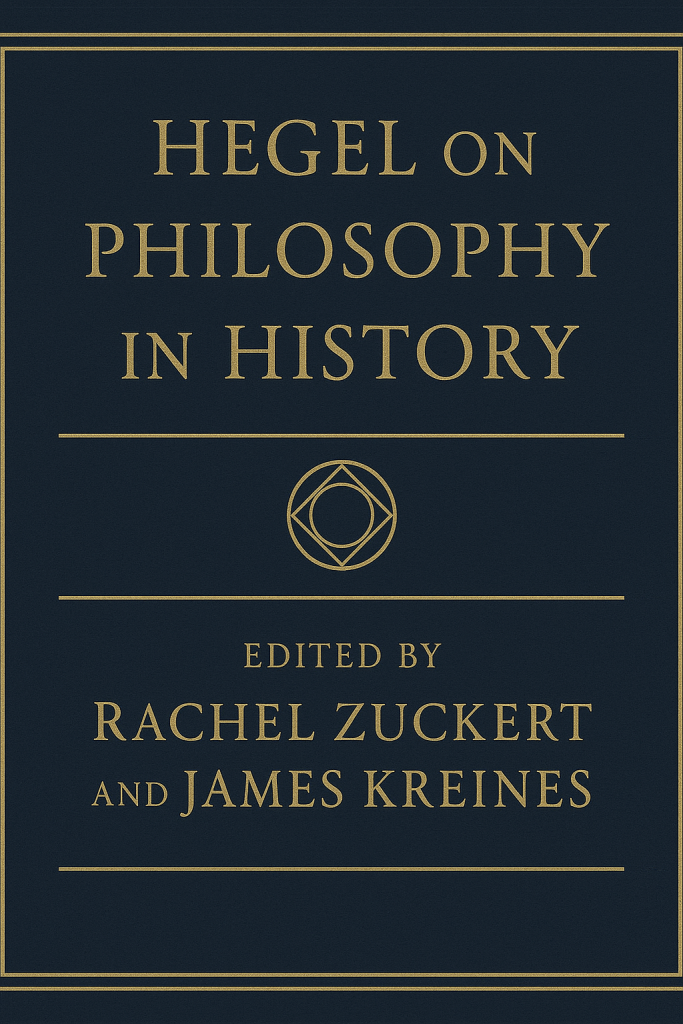
This festschrift for Robert Pippin brings together leading figures—John McDowell, Slavoj Žižek, Jonathan Lear, Axel Honneth, and others—to probe Hegel’s theses about the intrinsically historical character of philosophy. The essays range across the alleged “end of art” and its bearing on modern aesthetic self-understanding; the conception of human history—and, within it, the history of philosophy—as a progressive articulation of freedom or autonomy; and the account of self-consciousness as realized in medias res, through narrative self-interpretation and practical agency. Hegel specialists such as Rolf-Peter Horstmann, Sally Sedgwick, Terry Pinkard, and Paul Redding develop constructive arguments that philosophical reflection can register historical advances in intelligibility and normativity, while contributions from Robert Stern, Christoph Menke, and Jay Bernstein emphasize tensions: either philosophy does not advance unidirectionally, or Hegel’s demonstrations of progress fall short.
Across these debates, a recurrent question presses: to what extent do our ethical and political difficulties remain structured by antinomies Hegel meant to dissolve—between Aristotelian virtue and practical wisdom, sensibility and reason, individuality and the ethical life sustained by social institutions? Several authors suggest that modern capitalism intensifies these fractures by reorganizing recognition, labor, and value in ways that amplify alienation and normative contestation. The volume thus frames Hegel’s legacy less as a settled doctrine than as an ongoing inquiry into whether modernity’s self-interpretations can still claim rational progress, and what in art, history, and action would vindicate that claim.
The volume makes a precise scholarly wager: Hegel’s most fertile bequest is neither a metaphysical system sealed off from time nor a historicist dissolution of philosophy into mere chronicle, but an account of philosophy as an activity whose concepts, problems, and methods are historically formed and historically answerable. Hegel on Philosophy in History honors Robert Pippin by testing this wager across Hegel’s logic, practical philosophy, aesthetics, and post-Hegelian legacies; its distinctive contribution is to stage a sustained dialectic between two temptations—an Aristotelian reading of Geist (spirit/mind) as a form of life and a constructivist picture of Geist as a socio-historical achievement—and to extract criteria for when claims of necessity in Hegel are warranted, corrigible, or contingent. The upshot is less consensus than a clarified field of disagreement in which assertions of philosophical progress must be argued for, and in which the autonomy of reason is tested by its capacity to reckon with its own history.
The editors’ introduction sets the outer frame with exemplary clarity. They insist that contemporary philosophical practice is quietly guided by historical narratives—of “critical revolutions,” of the definitive triumph of scientific method, or of the surpassing relevance of formal logic—and that Hegel’s provocation is to bring those guiding stories to self-consciousness. The question is not whether philosophy has a history but whether philosophy can comprehend its historicity without reducing itself to epiphenomenon. To this end, the volume concentrates on two Hegelian themes that most visibly bind philosophy to history: autonomy (freedom) and self-consciousness, each explored in relation to the claims of progress and the criteria for rational criticism of an age. One finds here, not a new orthodoxy, but a rigorously staged disagreement about whether Hegel’s own practice sustains an overarching, progressive narrative or a more fissured, crisis-laden movement of rectification, breakdown, and partial repair.
The first axis of dispute concerns what it could mean to say that Geist “has a history.” John McDowell’s contribution proposes that we begin from an Aristotelian point: Geist is not a supersubstance that hovers above individuals or a collective subject that only comes to be by institutional fiat; it is the form of a distinctively human life. On this view, human beings are rational animals who live the life appropriate to rational animals only in a social space; but the sociality is a condition for the actualization of a form that is already definitive of what we are. The “historicity” that matters is therefore not the socio-constructivist thesis that we make ourselves into rational subjects; it is the historical development of conditions that enable us to achieve the second sense of freedom—the one in which our reasons are not merely inherited as authoritative but recognized as reasons and so known as binding. The decisive target here is the image of “collective self-making” often attributed to Hegel by post-Kantian constructivists: McDowell argues that reading Hegel through a metaphor of legislation and institution mistakes Kant’s own literal point about autonomy (that reason cannot regard the authority of reasons as an alien imposition) and, by extension, attributes to Hegel a social-genetic drama where Hegel is in fact describing what Geist is when it is actual. The actuality of Geist is Geist’s own activity; its “self-production” names the way living rational powers interrupt and transmute merely causal continuities, not a historical genesis of rationality from nonrational nature.
This Aristotelian accent has consequences. It licenses McDowell to distinguish a first sense of freedom (autonomy as the self-determination intrinsic to any responsible responsiveness to reasons) from a second, higher sense (freedom as acting or thinking in light of reasons known to be reasons). Historical progress would then not be measured by wholesale self-legislation or by ever higher layers of institution, but by the emergence of forms of social life in which the second sense becomes a real possibility. The authority of reasons is not instituted in the general case; it is disclosed in justificatory practices that can be assessed one case at a time. If this is right, Hegel’s insistence that philosophy belongs to its time need not involve a thesis about the historical construction of normativity; it can be the claim that only historically concrete life-forms offer the determinate content under which reason’s freedom can be known, rather than merely felt.
Placed against this, Sally Sedgwick reconstructs a very different route to historicity, beginning not from Geist but from the Logic. Her question is as stark as it is unfashionable: what does Hegel mean when he says that the development of concepts in the Science of Logic is necessary? Sedgwick rejects the picture of a presuppositionless deduction that secures timeless a priori forms and argues that Hegel’s necessity claims are two-tiered and historically situated. First: the transitions in the Logic are necessary insofar as they exhibit the intelligibility of concepts within a systematic whole; the felt inevitability of a move stems from the semantic pressure of the whole on the parts. Second—and more radically—the necessary results are contingent because the very standpoint from which they are necessary, Vernunft, is a historically achieved configuration of reflection whose assumptions Hegel neither can nor claims to ground “once and for all.” The Logic thus depends on historically formed habits of thought that could, under altered conditions, cease to be ours; Hegel’s method acknowledges this by treating the history of philosophy not as a ladder to be kicked away but as an evidential repository in which the forms of thinking that presently count as rational are legible. The conquest of contingency is always partly molded by the struggle against it.
Sedgwick’s emphasis on method closes the gap between logic and history without collapsing logic into history. If the necessity of a transition is the necessity by which a concept shows itself as demanded by what has already been won, then the felt force of the argument depends on what counts as already won—and that is a historical achievement open to reconfiguration. Hegel’s anti-Cartesian refusal of a “fresh start” is not quietism but a methodological discipline: philosophy must begin from the best self-understanding of its time, and the Logic is continuous with that beginning even as it normatively transforms it. This is why, despite the formal cast of many transitions, Sedgwick resists reading Hegel as supplying a framework valid independently of the history that made it intelligible. In this sense, the evidential ground of the Logic is the history of philosophy—not as chronicle but as the sedimented record of reasons by which thinking has come to recognize its own demands.
Ludwig Siep’s essay complements this picture by shifting from conceptual history to cultural history. He portrays Hegel’s Phenomenology as the paradigmatic text for thinking the position of philosophy in the stream it seeks to comprehend: neither the “view from nowhere” of timeless truths, nor the abdication of criticism in favor of ethnographic description. On Siep’s reading, Hegel situates philosophical work among the most potent “internal crisis triggers” of a culture, precisely because it articulates the self-understandings at stake in practical, religious, artistic, and political life. But Siep also argues that Hegel keeps a foot “outside” the stream: the standpoint of critique presupposes more than participant reflection; it claims an orientation that cannot be vindicated by the sheer facticity of a cultural form. This dual posture—reflective participant and trans-participant judge—poses a problem we have not solved: purely internal participation cannot ground robust critique, while a purely external vantage risks illegitimate appeals to teleology or completed metaphysics. Siep suggests that the Phenomenology’s pedagogy of catastrophic experience offers a way forward: cultures sometimes learn from normatively charged breakdowns that force a reconfiguration not capturable as incremental progress.
Read together, these three essays already enact the book’s central dialectic. McDowell bids us to resist turning history into a demiurge that manufactures rationality; Sedgwick warns that necessity without historical warrant is empty; Siep cautions that historical warrant without a critical standpoint is blind. The integrative task is to explain how philosophy can be internally historical and yet answerable to reasons that claim more than the prestige of local acceptance. The editors’ introduction explicitly frames the further contributions as variations on this task, organized by a composition that moves from “Hegel and history” (Part I), through “Hegel with his predecessors” (Part II), to “Hegel and his inheritors and critics” (Part III). The sequence is not merely topical; it dramatizes how positions established earlier are displaced and re-articulated in later contexts, so that the book’s argumentative center of gravity itself undergoes a controlled migration.
Part II deepens the inner tensions by returning to the ancient and early-modern materials out of which Hegel forged his project. Paul Redding proposes that the master–slave episode in the Phenomenology should be read together with its successor discussion of Stoicism to yield a historical account of philosophy’s own transformation—from an Aristotelian ideal of contemplative assimilation to a Stoic and post-Kantian ideal of cognitive transformation in and through language. On this vista, Hegel’s “Logic of the Concept” inherits the Stoic turn toward the activity of thought without denying the Aristotelian insight that rational powers are forms of life. The dialectical pressure here is palpable: if conceptual activity is transformative, how do we avoid a constructivism that dissolves objects into projects? If rational powers are life-forms, how do we avoid a naturalism that leaves normativity hostage to biology? The wager, visible already in McDowell and Sedgwick, is that Hegel’s idealism can absorb the activity of self-legislation as a logical thesis about the form of concepts while preserving an ontological thesis about rational animality.
Robert Stern reinforces the Aristotelian strand from the side of ethical theory. He challenges the priority often assigned to the Kantian motif of self-legislation by underscoring Hegel’s perfectionist concern with self-realization: the ethical question is how a rational form of life comes to flourish in determinate institutions and practices, not how a will legislates norms ex nihilo. If this is right, then the history of ethical thought registers not a unidirectional ascent toward ever purer autonomy, but a series of recalibrations of the relation between nature, norms, and social embodiment. The dialectical cost is plain: some phenomena central to modern moral experience—demand, obligation, the force of universal claims—cannot be simply read off from a picture of flourishing. The merit of Stern’s case, however, is to insist that for Hegel a merely socialized Kantianism misses the role of second nature—habituated, practical intelligence—in making reasons efficacious as reasons.
Terry Pinkard’s discussion of the form of self-consciousness supplies an important bridge. He presses the question implicit in both McDowell and Stern: how can we talk about “forms of life” without smuggling in a static anthropology, and how can we talk about “self-legislation” without hypostatizing a pure will? Pinkard’s answer is methodical: by reconstructing, in contemporary vocabulary, how Hegel understands acting for reasons as the living unity of natural purposiveness and normative accountability. On this reconstruction, the “form” of self-consciousness is neither an empirical psychology nor a purely formal I-think; it is the structure of a practice that can count as both one’s own and intelligible to others. The result is a conceptual lexicon that makes Hegel legible without trimming away his dialectical ambitions.
Rolf-Peter Horstmann, in turn, retrieves Hegel’s rehabilitation of metaphysics from the shadow of Kantian suspicion. Without denying the decisive Kantian strictures, Horstmann argues that Hegel’s claim—that the truth about objects requires understanding them “as also, in a sense, subjects”—is not a regression to pre-critical dogmatism. It is a development of Kantian insights about spontaneity and objectivity that removes the last residues of thing-in-itself talk. If so, the rational reconstruction of metaphysics is not a step backward but a formalization of what it means for concept and object to satisfy each other. The historical claim of progress here is deliberately narrow and risky: perhaps the history from Kant to Hegel really does show a teleological unfolding of a problem to its better articulation, even if that very articulation provoked a reception history that largely buried the point.
Karl Ameriks complicates the picture by recommending a Romanticized alternative to Hegel’s systematic ambition. If Hegel binds the modernity of philosophy to the completeness of a critical system that includes a philosophy of history, the Romantics model another way of being historical: fragmentary, experimental, attuned to singular crises without guaranteeing that they add up. The volume gains by including this dissent; it clarifies that one may share Hegel’s sense that philosophy belongs to history and yet refuse the aspiration to comprehensive rational comprehension. Whether such refusal preserves or surrenders philosophy’s critical power is a question the subsequent part re-poses from the other side.
Part III turns the Hegelian thesis against itself by asking whether the twentieth century’s disasters, economies, and arts permit any “reconciliation” claim. Christoph Menke proposes that the modern history of autonomy exhibits tensions that better fit a genealogical, conflictual picture than a rational, self-correcting one. Here Hegel’s own concept of second nature proves double-edged: it names both the indispensable habituation through which norms become efficacious and the social naturalization that autonomy must negate. The result is a picture of history as the struggle of powers, in which freedom’s realization cannot be identified with the institutionalization of any single normative program. Axel Honneth, by contrast, offers a constructive amendment: he argues that modernity has generated a third concept of liberty, alongside the negative and positive concepts—that of a communal freedom achieved in practices of mutual recognition. This Hegel-Marx-Arendt lineage, he contends, enlarges our moral self-understanding beyond the oscillation between non-interference and self-mastery, without effacing either. Both essays preserve Hegel’s thesis that history is a history of freedom while refusing the canonical teleology of overcoming.
J. M. Bernstein radicalizes the negative accent via Adorno’s Hegelian critique of Hegel. If the real is the rational, then the real of late modernity—administered, instrumental, organized around self-preservation—exacts a price that philosophy must count as unredeemed suffering. The Amphibian Problem—nature in history—remains unresolved: we universalize reason without reconciliation to nature, and in doing so absolutize a natural drive that corrodes the very subjectivity whose freedom we celebrate. The Hegelian imperative to “comprehend one’s time in thought” therefore becomes the demand to refuse theodicy, to think non-identity where identity is proclaimed. That refusal is itself historical: it presupposes the collapse of narratives in which catastrophe could be retrospectively justified.
Slavoj Žižek’s essay on comedy and modern art refracts the same crisis through aesthetics. If Hegel’s story of the “end of art” marks a passage to an age after the beautiful, then modern art’s abstractness, ugliness, and sublimity can be read as registers of disenchantment and the social abstraction of capital. Comedy, here, is the form that remains when tragedy’s dignity is impossible; it is dark, unfunny, the afterimage of historical horrors that cannot be sublimated. The very multiplicity of reasons to endorse Hegel’s thesis (scientific disenchantment, political catastrophes, consumerist emptiness) undermines any single, overarching narrative—precisely the kind of narrative by which Hegel had hoped to situate art within the progress of spirit. The essay thereby tests the limits of applying Hegel’s architectonics to modernity’s fractured cultural field.
Jonathan Lear concludes by bringing Freud to bear on Hegel’s ambitions for self-conscious life. If Hegel trusts rational correction and the integration of the ideal with the real, psychoanalysis reveals another route by which historical stability is secured: defensive non-integration, strategic blindness, refusal. The promise of a social world of genuine mutual recognition risks becoming an ideal that floats free of the psychic economies in which subjects actually live. Lear’s provocation is to turn Hegel’s own aspiration to integration into a therapeutic method—free association—as if to say: the way to honor the Hegelian task is to allow reason’s others to speak within reason, not as mere anomalies to be aufgehoben, but as constitutive partners in any serious self-understanding.
Across these essays, the book conducts a continuous pressure test on three families of claim. First, the claim that Hegel’s talk of necessity in logic and of progress in history can be made good without begging questions. Sedgwick’s reconstruction proposes that logical necessity is a function of intelligibility within a historically achieved standpoint, hence both robust and revisable; McDowell’s counterpoint suggests that the authority of reasons need not be institutional to be binding, hence history need not be a demiurge to explain normativity. The friction is principled: either you underwrite necessity by method and history or you evacuate it into constructivism; either you secure autonomy by a form of life or you risk naturalizing normativity. The book refuses premature arbitration; its achievement is to sharpen both risks so that further work must address them head-on.
Second, the claim that the history of philosophy is the history of freedom. Honneth’s “third concept” reframes the terrain so that freedom’s growth is measured by practices of recognition; Menke and Bernstein suspect that such growth is intermittent, perhaps reversed by capitalism’s abstractions and modernity’s catastrophes. Yet even these negative verdicts presuppose the Hegelian task: philosophy must parse its epoch’s institutions and artworks to decide what, if anything, counts as a gain in self-determination. If progress is real, it must be argued through the historically specific ways in which agents come to know their reasons; if regress is real, it must be shown in the ways institutions nullify that knowledge. The methodological unity beneath the disagreement is striking: all contributors treat history not as ornament but as evidence.
Third, the claim that philosophy can be simultaneously inside and outside its time. Siep’s dilemma—participant reflection lacks critical traction; exterior judgment courts illegitimacy—pervades the volume. The most promising reconciliations are methodological rather than doctrinal. They treat the history of philosophy as a reservoir of reasons that can be reactivated under present pressures, and they let breakdowns—moments where practices can no longer understand themselves—do diagnostic work. On this picture, to comprehend one’s time in thought is to submit one’s own concepts to the shock of historical evidence, including art and social pathology, without relinquishing the claim that some ways of going on with our concepts are better. It is a demanding discipline; it is also the one most consistent with Hegel’s aspiration to make philosophy answerable to what is wirklich.
The composition of the volume reinforces these conclusions. Part I lays out the methodological stakes by making explicit the competing models of Geist and of logical necessity. Part II tests those models against Hegel’s declared sources (Aristotle, the Stoics, Kant) and against his own effort to retrieve metaphysics without undoing critique. Part III forces the models to face the recalcitrant phenomena of late modernity—capitalism’s abstractions, aesthetic modernism, psychoanalysis, critical theory—where the very sense of “progress” is perilous. The editorial framing keeps the argumentative threads visible as they are displaced; one sees how an Aristotelian reading of Geist must be renegotiated when the problem is not “rational animality” but comic art under disenchantment, or how a historically contingent Logic fares when the history in question includes Auschwitz and the culture industry. The result is a narrative that does not culminate so much as clarify the conditions under which culmination would be thinkable.
If one asks, at the end, what this book adds to Hegel scholarship and to philosophical self-understanding, a careful answer suggests itself. It does not decide between Aristotelian form and constructivist achievement as the master key to Geist; it shows why both keys are needed, and how each alone mislocks crucial doors. It does not ratify a progressive philosophy of history; it refines the standards by which claims of progress would have to be argued, and it amplifies the voices that register catastrophe as more than local noise. It does not deliver a new system; it models a discipline of historically-attuned reasoning in which logical, ethical, aesthetic, and political materials are handled as interconnected evidence. In honoring Pippin, it demonstrates the live possibilities of a neo-Hegelian practice that neither absolutizes its time nor forgets that philosophy’s task is to think with and against that time until reasons become known as reasons. To the question posed at the outset—can we understand philosophy historically without dissolving it into history?—the book offers a learned, many-voiced, and ultimately stringent Yes, but only on condition that our standards of justification themselves submit to historical testing. That is a Hegelian answer. It is also an invitation to continue the work.
 Simon Gros
Leave a comment