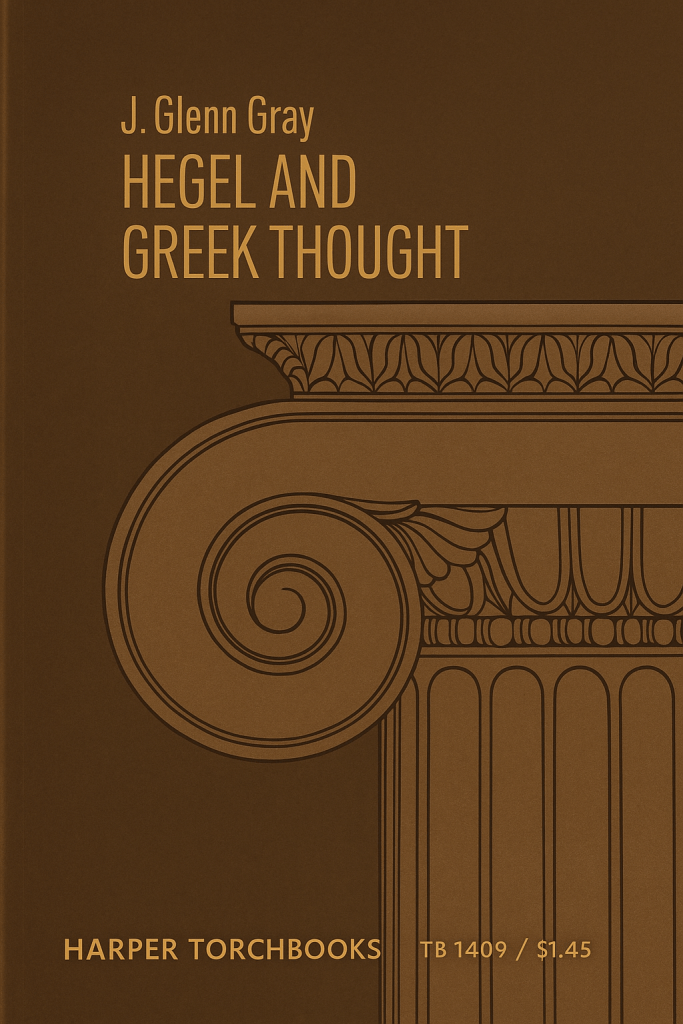
Hegel and Greek Thought frames a precise scholarly stake: it reconstructs, with methodical restraint and conceptual reach, how Hegel’s historical-philosophical imagination seizes upon the Greek world to clarify its own norms of reason, freedom, art, religion, and political life, and how this appropriation in turn reorganizes Hegel’s judgment of modern civilization. Its distinctive contribution lies in demonstrating, through a close, internal reading of Hegel’s lectures and youthful writings, that Greece functions in Hegel neither as an antiquarian ideal nor as mere source material, but as an articulated measure and mediation—a medium through which the logic of history, the structure of ethical life, and the limits of art become legible as a single, developing problematic oriented by freedom, and verified in the concrete unity of a people’s institutions, religions, arts, and thought.
Gray begins by establishing the outer frame: Hegel asks that we approach history with a single presupposition—reason governs the world—and he formulates freedom as the telos internal to the process by which subjective life becomes at home in an objective world. The leitmotifs are familiar yet rendered with renewed analytic clarity: the “slaughter-bench” vision that refuses naïve consolation; the mutual implication of passion and idea (reason’s “cunning”); the dialectical grammar of estrangement and reconciliation; and the alignment of individual growth, national culture, and world-history by one graded logic of spirit. The payoff is methodological: history is a rational process whose rationality is neither an imposed scheme nor a denial of conflict, but a way of picking out the essential in the flux by following how living wholes articulate themselves in institutions, laws, religions, arts, and philosophies—those objective forms in which freedom learns to recognize itself.
The emphasis on concretion is decisive. Hegel’s philosophical faith, as rendered by Gray, does not define truth as an abstract formula; it demands truth as the concrete—the intelligible structure disclosed in and through a content’s inner relations and development. Analysis (Verstand) that divides and isolates dissolves living unity; reason (Vernunft) reconnoiters the powers that hold the whole together by following the movement whereby the content overcomes its own one-sidedness. Gray situates this contrast not as stylistic preference, but as Hegel’s antidote to the antinomies of eighteenth-century rationalism: a logic of development replaces a logic of static parts; merger is retrieved through the recognition that only the whole is true.
Within that frame the Greek world is introduced as a determinate answer to a determinate problem: how can spirit inhabit nature without servility to it, and how can nature serve spirit without spiritual self-hatred? Hegel’s claim, reconstructed by Gray, is exact: the Greek achievement is a unity in which nature is spiritualized and spirit is sensuously embodied, a harmony that is neither the submerged unity of the East nor the post-Christian internal dualism of modern subjectivism. The Greeks discover a poise in which form and content are mutually adequate; their gods and their arts are not veils, but shaped presences that communicate ideality without flight from the visible. This is rendered in Hegel’s favorite figure: the Greek spirit as the plastic artist who transforms stone into spirit’s own expression, needing the sensuous to be conscious of the idea at all.
The composition sequence of Gray’s study mirrors, by design, Hegel’s own order of exposition. A preface situates the enterprise: isolate the Greek values as Hegel understood them, and trace how they guided his assessment of the modern world. A first movement lays out Hegel’s vision of history as a teleological continuity marked by dialectical crises, a continuity whose ultimate criterion is freedom—not as private exemption, but as the individual’s reconciliation with the objective order that educates and sustains him. Freedom here becomes the name for becoming at home in the world: the negation of alienness through education, discipline, and participation in institutions—those objective forms that Hegel calls a “second nature.”
The second movement turns to young Hegel’s discovery of the Greeks—the Tübingen years, the “communism of spirits,” and the formative friendship with Hölderlin and Schelling. Gray’s reconstruction is philological and diagnostic: one hears the early polemic against cold book-learning; one sees the enthusiasms that will harden into categories. The adolescent essays already signal a preference for living sources, for simplicity in form, and for an art that grows from shared memory and a people’s festivals; they contrast the “original” ancients with moderns who write for readers rather than for a community’s self-recognition. What begins as poetic nostalgia becomes, in Hegel’s maturity, an historical thesis: a people’s greatness lies in objective forms that let individuals feel their own substance in public life.
The movement then deepens by taking up the religion of beauty. Here Gray isolates the argumentative core of Hegel’s claim. Greek religion is interpreted as the artistic hypostatization of human ideals, born from passions that sculpture and poetry elevate to visible measure. The gods are formed ideals—concrete, determinate, resistant to the formless or the cloudy. This is more than aestheticization: it is a thesis about cognition. Because the highest for the Greek can be spoken in art, art is a mode of truth adequate to a stage of spirit; and because the highest for the modern exceeds sensuous fixation, post-classical art confesses its limit and passes into symbol and inwardness. Thus the same chapter that perfects the Greek synthesis already marks its displacement: by the very success of classical art, spirit outgrows art’s medium.
One consequence becomes central: the Greek religion’s serenity has a tragic underside. Necessity is supreme; reconciliation, when it occurs in tragedy, is purchased at the price of the individual’s effacement. The equilibrium of polis and citizen depends on a justice that remains impersonal, unanswering, and final. Hegel, as Gray shows, keeps the Greek affirmation of the objective intact while indicating the human cost of that affirmation: it yields composure without hope. Christianity, in Hegel’s dialectic, will transform the ground of reconciliation, making it personal, participatory, and knowable, and so reconfigure tragedy’s end as atonement rather than annihilation. In logical terms, the advance runs from beauty to thought, from the adequacy of sensuous embodiment to the intelligibility of freedom as a principle that can be known and willed.
The analysis of art and religion, so composed, feeds directly into the chapter on the Hellenic social ethos. Here Gray clarifies a pair of terms Hegel uses with precision. Sittlichkeit (social-ethical life) names the internalization of objective institutions—family, civil order, law, custom—into a “second nature” whose authority is lived, not merely assented to. Moralität (individual morality) names the modern thesis of a self-legislating subject who imposes duty upon itself. Hegel’s historical claim holds both truths while ranking them: the modern gain is the right of the subject to see itself in law; the Greek gain is the actual unity of individual and communal life. The problem is that each alone is one-sided. Greek life shows unity at the possible cost of critical interiority; modern life shows inner right at the cost of social fragmentation. The resolution, as Gray tracks it in Hegel, requires rebirth into a second nature that does not cancel conscience but renders it effective by objectifying it in institutions worthy of allegiance.
Gray’s discussion of political form is careful to follow Hegel’s method: begin from what the Greeks did, then draw the concept. Hence the recurrence of Athens under Pericles as emblem of a brief, luminous synthesis forged in struggle with Asia; hence also the reliance on tragedy for the inner consciousness of law and custom. A guideline emerges: law in the Greek world is discovered rather than invented; its authority stands in the universality of reason implicit in the order of things, even as its efficacy resides in habit and shared practice. Modern law, by contrast, demands personal insight into its validity; the subject must be able to find itself in the universal. Gray shows Hegel’s generosity to both sides: the advance of the modern is real, yet it needs the ballast of Greek concretion to avoid dissolving into subjectivism.
In this middle stretch of the book the parts begin to interpenetrate. The earlier thematic of art’s adequacy and its limit reappears as a political thesis: the passing of the Periclean form announces the coming reign of reflection. What held together in visible practices now becomes an object of thought; and with that shift, the individual’s separation from the communal increases. The same rhythm governs philosophy. Gray underlines Hegel’s spiral conception of intellectual history: each system is true as a partial concretion; each is aufgehoben—preserved and superseded—in a more inclusive grasp. The concrete grows by internalizing what appeared as the other. The upshot for Greece is straightforward: from Thales to Aristotle, thought ascends from abstract natural principles to ethical universals and finally to the articulated sciences of logic, nature, and spirit; but this ascent happens as the polis loses its unreflective unity, making philosophy an “evening” phenomenon.
That last theme is the fulcrum of Gray’s chapter titled Minerva’s Owl. Philosophy arrives when a life-form has run its course; its truth is retrospective, its function comprehension, not rejuvenation. This is more than melancholy. It installs a method: to know a world is to reconstruct its necessity from the standpoint of its maturity. The metaphors of dusk and ripeness are conceptually exact: philosophy grasps the ideal as counterpart to the real only when reality has completed its formative process. The lesson doubles back upon Greece and upon Hegel’s own act of reading: Greek thought is the owl’s first flight for Europe; Hegel’s history of philosophy is the owl’s later, higher orbit; Gray’s monograph maps those trajectories with restraint, holding fast to Hegel’s injunction that the true is the concrete.
To appreciate how Gray yields argumentative warrants rather than mere paraphrase, consider three tension-lines he keeps in play and brings to resolution in the book’s final movement.
First, art’s sovereignty and art’s insufficiency. The religion of beauty displays a stage at which sensuous form is commensurate with spiritual content. This sovereignty depends on determinate embodiment and on the gods’ legibility as elevated human ideals. Yet the very determinacy that makes classical form perfect also circumscribes what can be said: there comes a level of spiritual self-consciousness—our modern level—at which the highest outstrips image and must be stated as thought. Thus art reaches its truth and its limit in one and the same triumph. The continuity is dialectical rather than nostalgic.
Second, ethical unity and moral inwardness. The Greek polis exemplifies an achieved harmony in which the citizen’s desires and the city’s laws are internally one. The modern, through Christianity and critique, discovers the subject’s right to insight, conscience, and justification. Hegel, as Gray shows, neither discards the Greek unity nor canonizes modern subjectivity as ultimate. The task is to figure the second nature in which subjective right and objective order are one—where the state is experienced as a rational home and law as the subject’s own will in universal form. Here the book’s internal cross-references—art’s unity, law’s discovery, tragic justice—converge into a single speculative demand: that freedom become actual by being thought and built.
Third, beginning and end: the place of philosophy. If philosophy is evening, what is its power? Gray’s answer—Hegel’s answer—is to deny that “evening” means impotence. Philosophy cannot conjure new life into a spent form; but it does make explicit the universal that lives in the spent form and so equips a later form to preserve that truth. This is why the history of philosophy reads, for Hegel, as a spiraling ascent: each circle retrieves what would otherwise be lost by turning it into concept. As applied to Greece: Aristotle is the encyclopedic rescue of the Greek achievement at the moment of its political decline; Hegel is the encyclopedic rescue for modernity; Gray’s account is the disciplined staging of that rescue in an idiom that keeps us within the sources Hegel himself authorized—lectures on religion, art, history, and philosophy.
The book’s final pages consummate the argument by clarifying the locus of Hegel’s fidelity and his distance. Greek religion is praised for its humanity: worship as a “continuous poetry of life,” not a cult of lack; the divine as the elevation of human worth, not its denial; the festival as public pedagogy and shared memory. Yet that very humanism confronts a boundary—necessity—that art cannot convert into a freedom adequate to self-conscious spirit. Gray’s Hegel wants what Greece taught—public form, determinate beauty, the concreteness of shared life—and he wants what Greece could not supply: a reconciliation that survives reflection, an ethical order that remains objective while granting the subject’s right to know and consent, a justice the individual can affirm even at the price of life. The passage from beauty to thought names this ambition without injury to what beauty disclosed.
Because Gray keeps the work’s internal economy constantly visible, the parts not only merge; they also displace one another in an intelligible sequence. The youthful enthusiasm for Greece clarifies the problem—find a living unity of life beyond pietist inwardness and Enlightenment atomism—but it is displaced by a more stringent standard: the demand that unity remain when consciousness awakens. The account of Greek art and religion supplies the paradigm of harmony, and is displaced by the recognition of art’s limit as modernity’s task. The Hellenic social ethos shows how institutions embody spirit, and is displaced by the modern insistence that those institutions be intelligible as rational law to the citizen. The chapter on Minerva’s owl gathers the whole under a final index: comprehension comes too late for the life-form it comprehends, but not too late for philosophy to save its truth for the future. Each displacement preserves content by transposing it into higher articulation; each merger prevents loss by showing why the earlier moment was necessary.
Two methodological lessons make the book durable as scholarship. First, Gray consistently reads Hegel’s claims phenomenologically rather than dogmatically: religion, art, law, and political form are taken as modes in which a people knows itself; disagreements with modern historiography are not dismissed, but bracketed in favor of extracting the speculative insight that Hegel locates within the Greek configuration. This is why Gray can grant that Hegel idealized Athens and looked through tragedy—without reducing the reading to romantic projection—because the question under inquiry is the internal measure by which Hegel makes sense of history at all. Second, Gray eschews moralizing contrasts; his recurrent pairing of praise with limit is dialectical rather than adversarial. Greece is exemplary where modernity is deficient; modernity is emancipatory where Greece is mute. Only the concept of freedom holds both without erasure.
If one asks what distinctively new knowledge Gray adds, beyond elegant synthesis, the answer is threefold. He documents, by the early essays, that Hegel’s fascination with communal form and living memory precedes the system and therefore guides it, rather than being generated by it. He reconstructs the technical use of concretion as the thread joining all domains—“the whole is the true” is not a slogan but a research program that unifies art criticism, political theory, and the logic of history. And he demonstrates how Hegel’s celebrated aphorisms—freedom as being at home in the world, Minerva’s owl—do not hang as ornaments but serve as operational rules for reading the Greek materials. In every case the warrant is the same: where Hegel invokes the Greek, he is identifying the point at which a content becomes both sensuously present and internally measured, and therefore available to concept without remainder.
A final clarification, appropriate to Gray’s closing argument. The book is not a lament for a lost Hellas, nor a summons to return. It is an exercise in philosophical retrospection whose task is to keep the truth of a past form alive by understanding why it was necessary and why it had to pass. That is the meaning of the owl: philosophy arrives on schedule whenever a life-form needs its own justification articulated so that what is perishable in it can be distinguished from what belongs to the permanent education of freedom. In Hegel’s economy, the Greeks are immortal not because marble lasts, but because their contribution is entombed in the concept: the lesson that beauty can be a mode of truth; that institutions can be the living body of reason; that a people can know itself in art and festival; and that this very knowledge must one day demand to be more than an image. Gray’s book earns its place by showing, patiently and in detail, how Hegel made that demand—and how the Greek moment, grasped precisely, remains a necessary station on freedom’s spiral return to itself.
 Simon Gros
Leave a comment