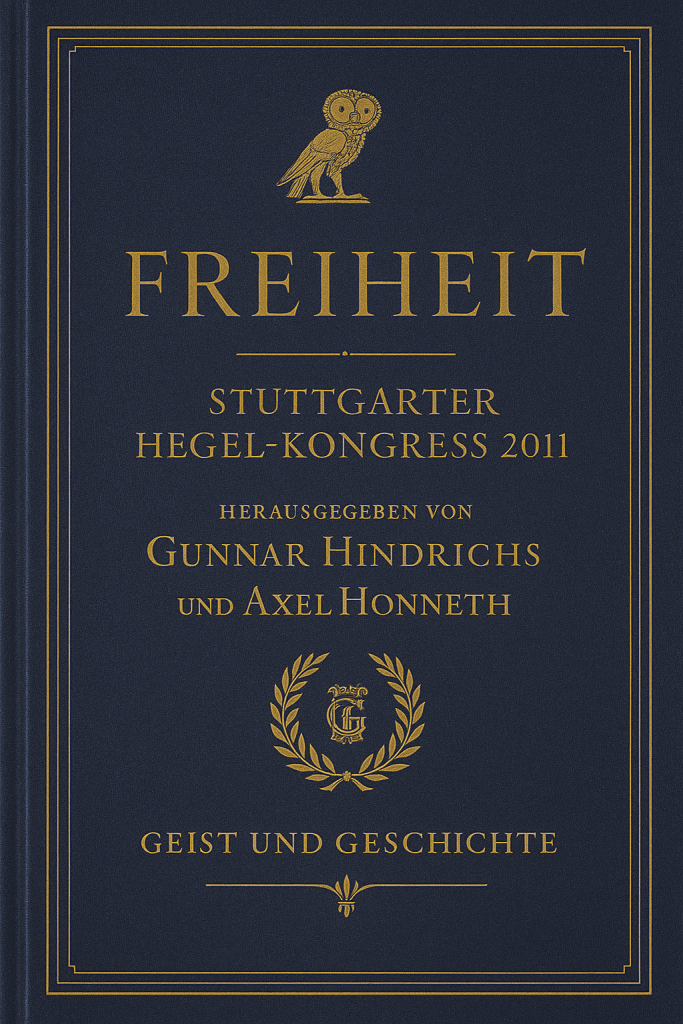
The volume’s distinctive scholarly stake is to specify freedom as a determinate field of conceptual tensions rather than as a settled datum, and to test Hegel’s resources for clarifying those tensions in contemporary registers—nature and second nature, art and imagination, determinism and time, autonomy and law, civil society and market, right and trust, emancipation and social pathology, and religion under “postsecular” conditions.
Its contribution lies in a disciplined montage of strong, partly incompatible perspectives that are nonetheless organized by an editorial frame: the International Hegel Association’s 2011 Stuttgart congress gathered eleven colloquia around nodal viewpoints and three plenaries that supply programmatic counterweights. Across the book, freedom is reconstructed as a practice-saturated intelligibility whose conditions of realization shift as the very terms used to secure it are displaced by others within the same argumentative field. The collection thus functions as a map of compositional pressures: each section exposes a limit in another, not to negate it, but to force a more complex articulation of objective, social, and spiritual freedom.
The outer framing already guarantees a methodological sobriety that is philosophically significant. The Vorwort insists that the concept of freedom names a problem-situation, not a self-evident state of affairs; the editors cite Hegel’s deliberately severe claim that no idea is more indeterminate, more equivocal, and more exposed to misunderstanding than freedom, and that precisely for this reason it bears the heaviest practical consequences.
The congress design—which sets “Erste Natur, Kunst, Determinismus, Autonomie, Gesellschaft, Markt, Recht, Emanzipation, Zweite Natur, Religion,” plus a colloquium devoted to the challenges of the Philosophy of Right—seeks not to harmonize these perspectives but to chart their fault lines so that proposals for resolution can be formulated under pressure. By emphasizing both the extra-academic reach of the theme and the non-exclusivity of Hegel exegesis as such, the frame positions the volume as a forum where Hegel’s systematic insights are re-entered from uneven vantage points to yield determinate diagnostics of our present. The editorial and institutional details mark the text’s position within the International Hegel Association’s series Geist und Geschichte and record the 22–25 June 2011 setting in Stuttgart, a reminder that the material is staged as a historically situated self-examination of modernity’s self-understanding.
The principal argumentative arc is set by the opening plenary, which elaborates freedom’s systematic differentiation within Hegel’s theory of Sittlichkeit. Axel Honneth recasts the issue with sociological concreteness: modern practices incessantly invoke the authority of individual freedom, yet their justifications employ divergent models that pull in different directions.
The conceptual labor here is twofold. First, one must distinguish the varieties of freedom that modern agents actually value and enact; second, one must locate their institutional placements in a functionally differentiated society. The book uses Hegel’s Rechtsphilosophie to organize this differentiation: negative or discretionary freedom (secured by subjective rights), reflective or moral autonomy (secured by the standing to justify one’s maxims), and objective or social freedom (secured by participation in institutions whose reciprocal structures re-express one’s purposes in the purposes of others).
Honneth’s thesis is that Hegel’s tripartite architecture remains the most promising instrument for clarifying how varieties of freedom coexist and conflict, and he emphasizes that social freedom is the standard by which modern institutions must be evaluated if we are to overcome the poverty of a merely subjective conception. This diagnosis closes by shifting the criterion of justice: the measure is not exhausted by the availability of negative and reflective freedoms, but extends to equal access to institutions of reciprocity—family, market, and democratic will-formation—through which agents experience ungezwungene Erweiterung of their purposiveness.
The volume’s internal composition then obliges one to pursue that Hegelian differentiation under thematic stress-tests. If Honneth lays out the grammar of social freedom by reconstructing the philosophical rationale of Hegel’s institutional triad, the subsequent plenaries and colloquia distribute that grammar across domains that both enable and unsettle it. The decisive effect is that each enabling domain doubles as a source of resistance: every attempted stabilization of freedom’s concept discloses its insufficiency when transferred to another order of phenomena.
One such displacement is supplied by David E. Wellbery’s exploration of the imagination as a medium for the becoming-conscious of freedom in Goethe’s time. Without opposing aesthetic and practical registers, the argument leverages literature’s capacity to stage the internal dynamics of freedom beyond a merely decisionistic model. What counts is the expansion of freedom’s phenomenology in forms that render its realization thinkable not only as choice, but as formation, figuration, and world-realization in and through poetic practice. The result is a pressure exerted outward from the aesthetic: the strict juridical-moral differentiation achieved in the first plenary must absorb a second, imaginal mode of articulation that neither cancels the institutional analysis nor permits it to close upon itself.
Ludwig Siep’s Natur und Freiheit installs a complementary pressure from the side of first nature. Here the question is how a concept of freedom commensurate with objective spirit can cohere with determinate claims about natural determination. Rather than yield either to a reduction of freedom to causal regularities or to a hypostatized supra-natural voluntarism, the issue is to articulate the dependence of living and rational forms upon natural conditions without evacuating spontaneity of content. The book’s structure immediately amplifies this problem, since the first colloquium treats Erste Natur und Freiheit under three angles: mastery of nature (Tetens), determination (Buchheim), and the relation of first to second nature (Rödl).
Rödl’s introduction is the pivot: it retrieves the concept of second nature not simply as McDowellian domestication of reason within nature, but also as Hegel’s own more exacting view—the domain of habit and formation in which spirit realizes itself in a necessary yet insufficient way because habit lacks reflective knowledge of its own foundation. Hence second nature is both the indispensable mechanicalization of spirit in the individual and an inferior realization relative to institutions such as law and science that incorporate an explicit consciousness of their rational ground. This double determination immediately reframes the earlier differentiation: objective freedom demands institutional forms that rise above mere habituation; yet those institutions themselves presuppose the sedimentation of habits through which spirit acquires a “mechanical” mode of existence.
The extended treatment of aesthetic freedom in the second colloquium further complicates the grammar by which freedom gains experiential content. The introductory and programmatic essays insist that aesthetic cognition can disclose freedom not only as the capacity to legislate norms to oneself, but as the lived transformation of passivity into an active passivity: a formed receptivity capable of constituting new spaces of sense. The juxtaposition of Kantian and Hegelian lines (Kern), combined with historical triangulations (for instance, the Diderot–Hobbes–Hegel constellation in Thomä), does not aim to dissolve distinctions; rather, it shows how judgments of taste and experiences of form solicit a concept of freedom larger than practical self-determination. The plausibility of Hegel’s concept of objective freedom is thereby anchored in a more capacious phenomenology: the subject becomes free not only when it wills, but also when it learns to undergo the world in a way that is already world-shaping.
The third colloquium’s cluster—options in the freedom/determinism debate (Willaschek), responsibility (R. Jay Wallace), the reality of freedom (Recki), and the temporality of freedom (Rohs)—shifts the pressure toward agency’s normative profile in conditions of causality and time. The move here is methodological: a theory of social freedom must answer for its accountability conditions. Responsibility talk presupposes that the agent’s deed can be owned, that rightness attaches to acts not as mere outcomes but as expressions of reasons; yet any assignment of responsibility presupposes a conception of temporalization—how an agent projects, defers, anticipates—that complicates the earlier institutional mapping. The book thereby forces a revisionary question: to what extent does the social embedding of freedom depend upon temporally articulated capacities of retention and protention that cannot be secured by law-like structures alone? The effect is to turn Hegel’s own dynamic conception of ethical life into a question demanding renewed articulation of agency’s diachronic form.
With freedom as self-legislation, the fourth colloquium directs attention to autonomy’s shape and limits. The introductory orientation prepares the analytical movement in Charles Larmore’s delineation of what autonomy can and cannot be, and in Christoph Menke’s reconstruction of Hegel’s theory of liberation. Here autonomy is not the mere assertion of independence; it is the immanent overcoming of heteronomy in practices whose rules are not external to agency but express it. Terry Pinkard’s intervention—linking freedom, necessity, and music—performs a conceptual experiment: music supplies a regulative model of necessity internal to the unfolding of form, and thus a non-coercive shape of norm-governed spontaneity. Across these essays, the earlier emphasis on institutions is recast in terms of forms that enact freedom’s lawfulness as an immanent order of activity.
The fifth colloquium intensifies this immanence by turning to social and individual freedom. The conceptual hinge is Rahel Jaeggi’s thesis that freedom may be conceived as non-alienation, thus forcing the theory to specify social pathologies that obstruct self-appropriation. William Bristow’s proposal to define freedom as “the end of us” pushes the discussion toward forms of self-constitution whose normativity is not reducible to choice, while Paul Redding’s triangulation of Hegel and Aristotle on free agency resets the virtue-theoretic coordinates within which Hegel’s modern categories can be read. The volume here presses upon the lived contradictions within civil society: where do market relations and division of labor reproduce pathologies that ethical life must both presuppose and repair?
Hence the sixth colloquium’s focus—freedom and market—does not treat the market as an external accident to the concept; it is a laboratory in which the concept’s institutional test is staged. Lisa Herzog’s question (“Free selves in free markets?”) exposes the mutual conditioning of personhood and exchange, Johannes Berger reconstructs Hegel’s analysis of market socialization, and Steven Lukes queries the ethical content of market orders. When read back through Honneth’s opening differentiation, the combined effect is to prevent any abstract endorsement or rejection: the market must be shown to be either a vehicle of social freedom—when its reciprocal structures re-express agents’ purposes in each other—or a generator of unfreedom—when it collapses reciprocity into formal equivalence that erases substantive participation.
The seventh colloquium, freedom and right, returns to the architecture of Hegel’s Philosophy of Right, but under thematic constraints sharpened by the preceding sections. Jean-François Kervégan’s entry provides the orientation; Giuseppe Duso then tracks the movement from natural-law conceptions of freedom to the ethical life of Hegel’s political philosophy; Franck Fischbach interprets the sense of the social in Hegel; and Sally Sedgwick reconstructs the emergence of the sittlicher Wille. In this sequence, right does not merely protect freedom; it expresses a social will whose content cannot be derived from private maxims alone. The argumentative point is that the concept of right must be expanded if it is to carry the weight Hegel assigns to social freedom: institutions possess a normatively grounded existence-claim insofar as they realize reciprocal forms of agency that cannot be reduced to subjective entitlements.
The eighth colloquium’s theme—Befreiung—revalues the entire arc by shifting from the possession of freedom to its production in and through history. Michael Rosen’s Freedom in History and Hans-Christoph Schmidt am Busch’s analysis of personal freedom and free life-activity open onto Andrew Chitty’s Hegel–Marx dialogue about freedom and community. The conceptual yield is double: first, liberation is not exhausted by legal enfranchisement; second, social forms can harbor internal contradictions that function as engines of transformation. Liberation thus becomes a name for the self-differentiation of social freedom under conflicts that ethical life cannot suppress without impoverishing itself.
The ninth colloquium makes this explicit by asking after the challenge of Hegel’s Philosophy of Right. Francesca Menegoni specifies the challenges; Michael Quante proposes a “cognitivist ascriptivism” to model responsibility at the level of right; Stephen Houlgate inquires into right and trust; and Angelica Nuzzo confronts contradiction in the ethical world as Hegel’s challenge for times of crisis. Nuzzo’s through-line is especially illuminating for the book’s composition: to think history under the sign of freedom is to refuse both origin and telos as the architecture of meaning; contradiction internal to practices is not an anomaly but the very form in which advancement is oriented. This is not a moral teleology; it is the work of objective spirit, which thereby extends freedom beyond the moral point of view into the productive and cognitive realms—art, religion, philosophy—where spirit realizes itself in forms that require their own standards of legitimacy.
It is then fitting that the tenth colloquium returns to freedom and second nature, with Sebastian Rödl’s introduction staging the question, Stephen Engstrom elaborating the relation between freedom and nature, Frederick Neuhouser tracing life, freedom, and social pathology, and Michael Thompson articulating a taxonomy of forms of nature—first, second, living, rational, phronetic. The argumentative yield is not a new dualism but a deepening of the earlier differentiation: second nature as habit is necessary yet insufficient; forms like law and science incorporate reason’s self-consciousness; life supplies the dynamic of self-maintaining form; phronēsis names a mode of rational life irreducible to theoretical articulation. The upshot is to re-situate social pathology: failures of freedom are not merely legal deficits; they are distortions of living forms in which reason’s habituation, institutionalization, and self-knowledge fail to align.
The eleventh colloquium, Religion der Freiheit, extends the field to the “postsécular” present. Gunnar Hindrichs frames the issue by noting the re-entry of religion into public orientation: if secularization seemed to relegate religion to a mere option, recent phenomena suggest a renewed structuring power. The Hegelian question is whether actual reason can comprehend this return as a modality of freedom’s realization rather than as an extraneous intrusion. Essays on gratitude and freedom (Dina Emundts), freedom in the twilight of subjectivity (Stephan Schaede), and democratic freedom (Tilo Wesche) press the point that religious forms cannot be quarantined from ethical life: they either become sites where spirit knows and enacts its freedom or they generate heteronomy that must be criticized in the name of that very freedom. The section thus supplies a final displacement: the earlier institutional grammar must be porous to modes of congregational, liturgical, and existential formation if it is to match the phenomena that “postsécular” diagnostics describe.
Across these itineraries the book maintains a compositional principle: every attempt to secure freedom’s concept by anchoring it in a single register triggers a counter-claim from another register, forcing a more articulated unity. The narration is thus argument-like without becoming a system. The opening plenary situates social freedom as the integrative concept; the colloquia show the at once enabling and displacing function of adjacent domains; the legal-political core is reinvested by challenges (trust, contradiction, ascription); the historical-emancipatory arc refuses moral teleology while insisting on immanent critique; second nature bridges nature and spirit without collapsing the difference; religion reopens the question of freedom’s ultimate forms in a cultural field that modernity has not neutralized.
This yields a substantive clarification for the methodological claim: the concept of freedom in a Hegelian key is a synthesis of three kinds of evidence—phenomenological (how freedom is experienced and imagined, including in art), institutional (how freedom is realized in practices that reciprocally express agents’ purposes), and genealogical (how freedom develops through contradictions without an external telos). Each of these evidences is cashed out in places where the volume offers textual support. The Vorwort grounds the problem-situation and the congress’s architecture; Honneth provides the tripartite differentiation and the justice criterion of equal participation in spheres of reciprocity; Rödl’s introduction clarifies second nature’s necessity and limits in Hegel’s own sense; Nuzzo’s argument formalizes contradiction as the motor of advancement beyond a moralized frame; Hindrichs’s Einleitung grounds the religious problematic in current diagnoses. These are not detachable theses; they are interlocked warrants that oblige the reader to think through transitions instead of selecting a single preferred portrait of freedom.
The editors’ compositional sequence begins with plenaries that diversify the evidentiary base—sociological-practical, literary-aesthetic, and nature-theoretic—the book forestalls any premature narrowing of the problematic. The colloquia then move concentrically: from first nature and art to determinism and autonomy, then to social-individual mediation and market, then to right and emancipation, then to the Philosophy of Right’s challenges, and finally to second nature and religion. The effect is telescopic: each turn revisits the earlier conceptual claims under a different light, never allowing the inquiry to rest in the stability of one register. This is the decisive contribution: freedom appears as a concept whose completion is distributed across multiple partial realizations whose conflicts are not defects but conditions of intelligibility. The achievement is to convert those conflicts into diagnostic instruments with which to calibrate our institutions, our self-understandings, and our historical expectations.
The Stuttgart volume neither dissolves nor resolves the indeterminacy that the Vorwort ascribes to the idea of freedom; it refines that indeterminacy into a field structured by recurrent tensions: habit versus reflective knowledge of law-like forms; choice versus formation; responsibility versus temporalization; autonomy versus the necessity internal to form; non-alienation versus the dynamics of civil society; market reciprocity versus moral content; right’s protection versus right’s embodiment of a social will; liberation’s conflicts versus the persistence of institutional life; contradiction as crisis versus contradiction as advancement; second nature’s necessity versus its insufficiency; religion’s re-entry versus the requirements of actual reason.
The book’s wager is that Hegel’s conceptual machinery is still the best available means to think these tensions as coordinates for objectivity rather than as symptoms to be eliminated. The poverty of our freedom consists in mistaking any one of these poles for the whole; the promise that the volume articulates, without triumphalism, is that freedom becomes more determinate to the extent that it relocates itself from the singular subject into the shared practices in which subjects find themselves mirrored and enlarged in one another. In that sense, the argument the book conducts is not one of linear proof but of cumulative orientation: it shows how freedom lives where the reciprocal recognition of purposes is institutionally real, culturally formed, historically conflictual, and spiritually self-knowing.
 Simon Gros
Leave a comment