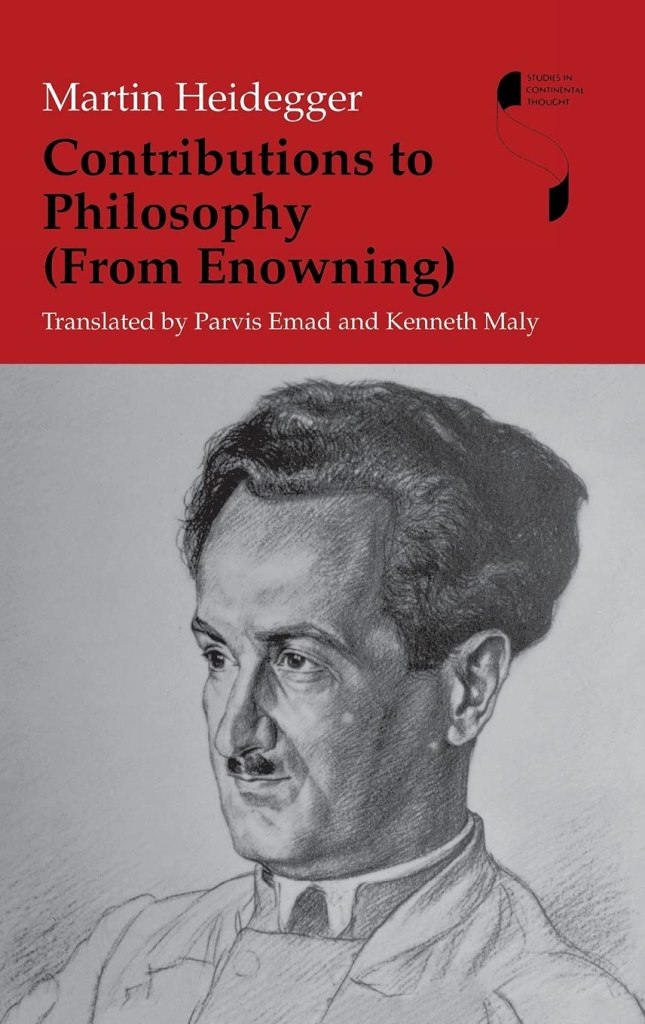
English translation of Beiträge zur Philosophie GA 65. Heidegger’s second most important work, this book was written during the 1930s but did not become available to the public until 1989.
This volume’s distinctive scholarly stake lies in showing how a thinking “from” enowning (Heidegger’s Ereignis) must be enacted rather than reported, and how that enactment reshapes the very form of a philosophical book. In the English edition, the translators’ decisions make visible the inner mechanics of the text’s six “joinings” and their jointure: a passage-work that replaces expository sequence with a structured advance of attunements, moves, and relays. The contribution is twofold: first, it offers a composition that performs being-historical thinking; second, it clarifies the methodological stakes that follow when be-ing (Seyn) is thought beyond metaphysical being (Sein), including a lexicon whose function is not lexical but orienting. The result is a treatise that binds form, method, and claim into one sustained act of thinking.
The outer frame programs the work’s task with disarming directness: the public title—Contributions to Philosophy—remains “bland” by design, while the essential heading—From Enowning—names a saying that belongs to what it says. The book insists that philosophy can appear publicly only as an attempt that declines the veneer of a finished “work”; future thinking must be underway, entering the concealed domain of the essential sway of be-ing and letting its jointure be granted rather than imposed. The “Preview” states this with programmatic force: what follows is a questioning along a pathway traced by a “crossing” from metaphysics toward be-ing-historical thinking, a crossing long enough to be a dwelling, where decisiveness resides less in doctrinal closure than in the compositional rhythm of approach, return, and leap.
The composition sequence binds everything: a “Preview” that orients the whole; six joinings—Echo, Playing-Forth, Leap, Grounding, The Ones to Come, The Last God—that must be read as co-resonant facets of a single motion; and, finally, a retrospective section entitled Be-ing that gathers what the six have enacted into a comprehensive re-grasping. The Editor’s Epilogue confirms the structural logic: the whole conveys “the crossing from metaphysics into be-ing-historical thinking,” beginning with the “echo of be-ing in the distress of abandonment” and proceeding through a mutual playing-forth of the first and the other beginning, the leap into be-ing, the grounding of its truth, and the preparation of the ones to come “of the last god.” In this sense, the book’s “outline” is neither a taxonomy nor an ascent, but a jointure that breaks into the free play of time-space opened by the crossing, staged to decide whose future there is.
The decisive claim concerns the locus and manner of philosophical saying. “From Enowning” does not mean about enowning; it names a saying en-owned by what it says. The translators mark this in English by rendering Ereignis as enowning (with en- bearing the enabling, inward-through movement), reserving be-ing (hyphenated) for Seyn to indicate a non-metaphysical thinking of being, and translating Wesen / Wesung as essential sway / essential swaying to avoid the metaphysical freight of “essence.” These are methodological indicators that protect the enactment from being re-absorbed into representational discourse. They allow one to read how projecting being open is always already a thrown projecting-open, and how abground translates Ab-grund—a ground that “stays away” without lapsing into a mere negation—so that grounding never solidifies into a foundation independent of the event it serves. The Foreword’s guidance can thus be read as an extension of the work’s method: to translate is to join the jointure.
Within this method the book undertakes what it calls being-historical thinking. The central move is to displace the “guiding-question” (concern with beings as such) by the grounding-question (concern with the truth of be-ing), so that be-ing is no longer thought in the perspective of beings. The text performs this displacement by repeatedly placing the reader into the between—that open, sheltering midpoint in which the arrival and flight of gods and human belonging are put into attuned relation—and by staying with the tensions that accrue within this between: decisiveness and indecisiveness, the nearness of what is most remote, the distress of abandonment as the first condition of help, and the historical need that be-ing has for those who go under. The result is a pathos and rigor of method in which the most formal terms function as attunements, and the most attuned moments function as arguments.
The “Preview” already displays how “From Enowning” organizes problem, claim, and evidence. The problem: an epochal abandonment of being that yields an enchantment of the immediately available, where the semblance of the independent priority of beings occludes their dependence on be-ing. The claim: only an en-thought truth of be-ing opens an other beginning, one that requires founders willing to “go under” so that beings may be restored in the strife of earth and world. The evidence consists in the internally staged sequence of enowning’s relations: Da-sein’s grounding in the clearing sheltering of truth, the strife of earth and world as the site of decision, the need for Da-sein to be carried by the inabiding that sustains the Da, and the insistence that all projecting-open is thrown. These are not propositions to be tallied; they are formal indications that gather credibility in the way the jointure holds.
From here, Echo functions less as a report on doctrine than as a sounding of the age’s condition: the dissonance of abandonment, machination, and lived-experience, a “gigantic” that levels measure by maximizing mobilization, and a complacency in which the lack of distress is itself the deepest distress. The text treats these neither as sociologies nor as moralizations; they are named to attune the questioning to the terrain in which the leap must occur. The echo reaches “far into what has been and what is to come,” furnishing the soil from which Playing-Forth can work the inherited first beginning into a foil and partner for the other beginning. Tension is deliberate: to play forth is to let the first beginning’s own strengths “show their hand” so that their prospective transformation can occur from within the event of be-ing. In both joinings, the logic is neither additive nor contrastive; it is a controlled intensification of attention to how the past and the coming relate under the charter of enowning.
Leap names the decisive movement into the essential swaying of be-ing. Because projecting-open is always thrown, the leap cannot be a voluntarist decision of a sovereign subject; it is a receiving of the call that lets projecting-open happen as the very mode of belonging to be-ing. Hence the work’s insistence on the exemplary terms: thrown projecting-open, counter-throw, and the refusal of perspective—since a perspective claims as its right what it passes through as a point of view—while the leap yields to what grants no survey. The book clarifies that the leap is not an exit from history but the only entry into it: as enowning’s between, it is where Da-sein is owned over into the decision of being-there and being-away, where history begins anew from be-ing rather than from aggregates of events.
Grounding radicalizes the stakes: to ground is to stand within abground, urground, and unground at once. The ground’s “staying-away” undermines the metaphysical demand for footing without collapsing into negativity; it is a mode of granting that withdraws in the giving. Truth appears here not as correctness but as clearing sheltering; language is grounded in silence, which sets the measure and so measures out Da-sein as the ground of the strife of earth and world. Since be-ing needs beings—in order to hold sway—grounding Da-sein means preparing the site of decision where beings can be restored into their steadfastness. The structure of evidence is genuinely be-ing-historical: the more the text shows how thinking must be reticent, the clearer its claims about language, truth, and measure become.
The Ones to Come thematizes inheritance and futurity. The ones to come are not a demographic class; they are those who sustain belonging to enowning’s turning. The book speaks of a grounding-attunement appropriate to them, of a people’s what-is-ownmost and the way Da-sein’s belonging becomes the sheltered possibility of grounding be-ing’s essential swaying. The temporality here is “time-space” rather than a linear sequence: a jointure where decision ripens as an event of measure. Against the background of the gigantic, the ones to come are prepared by a pedagogics of attunement—reservedness above all—that permits the call to be heard without being reduced to an information signal. The philosophical craft is pedagogical precisely because it is ontological: preparation is a practice of hearing.
The Last God gathers the book’s most delicate tension. The text neither constructs a theology nor evacuates divine language; it makes room for the passing of gods within the between that enowning is. Only when it is estimated how “singularly necessary” being is and how it does not hold sway as god itself, do the conditions of a history become real. The last god “needs be-ing”; the law of its hinting appears as the great individuation of Da-sein and the aloneness of sacrifice, where the shortest and steepest paths are chosen without spectacle. Here the book’s composition achieves its most intricate weave: the more it speaks of the remoteness of undecidability, the nearer it draws the reader to the site where decision is most intimately demanded yet cannot be forced.
The terminal section, Be-ing, functions as a retrospective intensification. After the sixfold outline, it re-asks what it means to “project be-ing open” when every projecting-open is thrown, how be-ing relates to the so-called “ontological difference,” what Da-sein means once its origin is enowning rather than anthropological subjectivity, and why language, as measure-setting grounded in silence, is the most originary “non-humanization” of the human as extant subject. The argument tightens rather than concludes: what began as a displacement of metaphysical horizons shows itself to have been a re-education of hearing, a training of saying, and an alteration of the locus where thought can be moved.
Across these movements, a constant conceptual economy governs the work’s procedures. First, the distinction of being and be-ing is never a terminological pedantry but a scalpel that prevents the collapse of enactment into representation; the hyphen both marks and performs a refusal of familiar capture. Second, enowning is not an “event” in the empirical sense but the very enabling that owns over, owns-to, and owns-over-to—hence the translators’ family of English renderings that sustain a phenomenological kinship across verbal forms. Third, projecting-open and its thrownness keep subjectivist misreadings at bay by showing that the openness within which thought moves is received rather than posited, and that the rigor demanded is a rigor of attunement rather than of deduction. Fourth, abground displaces the old alternative between firm ground and sheer abyss; this preserves grounding as a historically minded activity—coextensive with the practice of truth as clearing sheltering—rather than a final philosophical underpinning. Finally, language is method: measure-setting in the broadest sense, which is why silence is not the opposite of saying but its origin, and why a book that “says little from enowning” can be a maximal act of philosophical disclosure.
The work’s evidence is staged, not compiled. The Foreword explicitly counsels readers to attend to “formal indicators”: cross-references and syntactic reticences that signal pathways rather than summarize theses. This is not a stylistic affectation; it is the only diction proportionate to a thinking that refuses to reduce the truth of be-ing to “assertion” as the subsequent expression of representation. The English translation, by inserting square-bracket clarifications where necessary to keep the threads legible, teaches how to read it: every lexical choice must be weighed within a retrospective and prospective horizon; words such as Seinsentwurf are to be understood in their full kinship—projecting being open read within the rubric “projecting-open as thrown”—so that lexical familiarity does not annul phenomenological exactness. This pedagogical register is part of the book’s contribution: it makes the “how” of thinking inseparable from the “what.”
If one asks how the parts merge into and are displaced by one another, the answer lies in how each joining “says the same of the same” from a distinct essential domain. Echo and Playing-Forth provide the field of audition and inheritance; they are displaced by Leap, which takes that field as its condition and converts hearing into a stance. Leap gives way to Grounding in that grounding contains the leap’s posture as its ongoing work—opening the trajectories of sheltering truth, time-space as abground, and the measure of language. The Ones to Come presupposes that grounding as its pedagogy of futurity; The Last God places that pedagogy under the most strenuous horizon, forcing a thinking capable of holding together staying-away and onset without dissolving them into a synthesis. The final Be-ing neither summarizes nor corrects; it retroactively inflects every earlier motion, making explicit that the work’s truth is in its jointure. This is why external appearance suggests repetition, while the internal logic intensifies difference as a way of securing unity.
Within that jointure, certain tensions are cultivated rather than resolved. The privileging of be-ing over beings risks appearing to denigrate actuality; the text meets this by showing how the seeming independence of beings—under dominance of availability and serviceability—betrays an impoverished measure whose shine remains ungrounded. The proximity of be-ing and the last god risks theological appropriation; the text counters by making enowning the between of their relation, marking how history begins only where neither is collapsed into the other. The operationalization of language risks aestheticism; the book turns instead to silence and measure, to the strife of earth and world in which art, politics, and science are refitted to the clearing they require. The specter of subjectivism returns with every “projecting”; the ductus of thrown projecting-open counters it at the level of grammar. At each point the book’s vocabulary functions as a method for holding such tensions without anesthetizing them.
A word on the outer historical framing helps to delineate the specific scholarly contribution. The Epilogue situates the treatise as the first encompassing attempt at an other onset of the question of being after Being and Time, composed in the mid-1930s yet published only decades later, inaugurating a third division of the collected works and insisting that the proper title “From Enowning” governs the public one. It is, as the editor notes, a text that begins a pathway in 1936 with the attempt “simply to say the truth of being,” and it teaches its readers how to think that saying by distributing the labor of method to composition, diction, and cross-reference. In that sense, its greatest evidence is its form, and its greatest claim is that a new form is necessary if the question of be-ing is to be kept open.
To clarify the book’s distinctive contribution: it enacts a mode of philosophical writing in which argument is indistinguishable from attunement, and in which historical statement is inseparable from an education of hearing. The six joinings do not deliver materials; they modulate a preparedness to receive what cannot be forced, establishing a space where the truth of be-ing can be projected-open as a thrown practice, where language can be measured by silence, where ground can be thought in the element of abground, and where gods and humans can pass through the between that enowning is. The book’s final clarity is a moderated one: from enowning it has said as much as can be said without betraying its source, and in so doing it has opened a path whose measure is to be taken by those to come.
 Simon Gros
Leave a comment