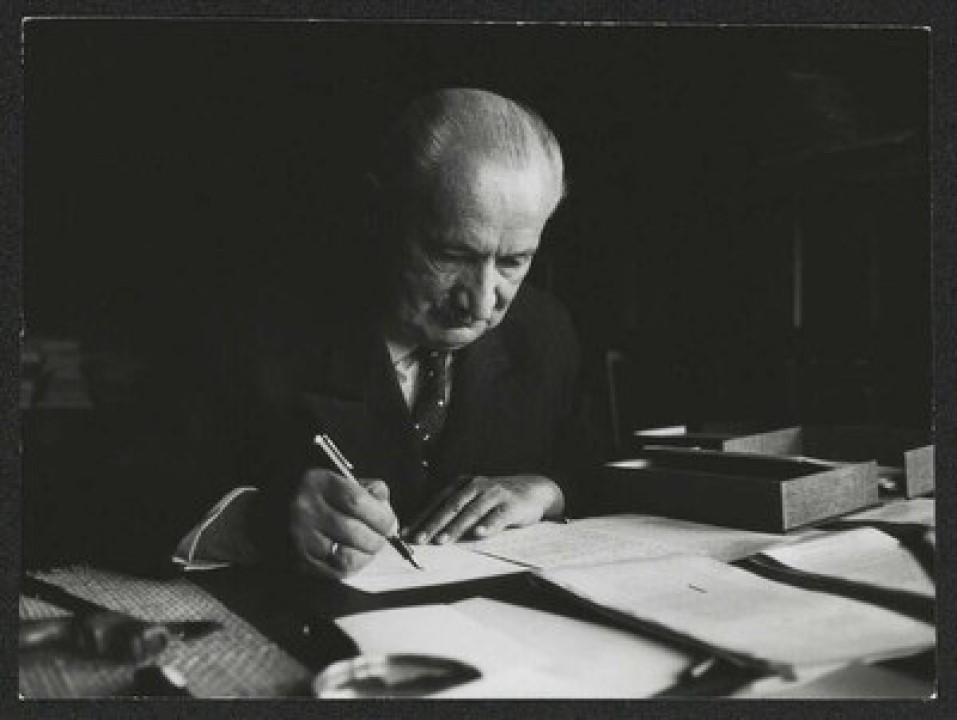
In 1958, Heidegger delivered the lecture “Hegel and the Greeks” at the University of Aix-en-Provence. At the invitation of the poet René Char, he later returned to Provence in 1966, 1968, and 1969 to conduct small, intensive seminars in the village of Le Thor with a circle of French philosophers that included Jean Beaufret and François Fédier. Each gathering lasted roughly a week and was structured around daily sessions. A final seminar, originally planned for 1973 in France, took place instead at Heidegger’s home in Zähringen due to his declining health and was shorter in duration.
The surviving records of these seminars vary. The 1966 meetings were not formally transcribed; the session notes assembled afterward preserve only portions of the discussions on Heraclitus. By contrast, the 1968 and 1969 seminars were documented by rotating participants who prepared daily “Protokolls,” later issued in small offset editions and only lightly revised for publication in Questions IV. The 1973 Zähringen transcript is more unified and polished, akin in tone and style to the summary appended to On Time and Being, and seems to have been intended from the outset for broader circulation.
Across these years, the seminars maintained a single orientation: to approach the question of Being by letting a particular philosophical text guide the way. Heraclitus and Parmenides provided the point of departure in 1966, Hegel in 1968, Kant in 1969, and Husserl in 1973. A Heidegger Seminar on Hegel’s Differenzschrift stands within this sequence. Its distinctive contribution lies less in doctrinal claims than in the mode of reading it enacts. Through a slow, interrogative engagement with Hegel’s 1801 text on difference—where concepts such as Entzweiung, Vereinigung, reflection, infinity, and system are allowed to unfold from within their own tensions—the seminar traces how philosophical thinking arises from the experience of separation and moves toward a unity that does not erase opposition but preserves it. Here the “need of philosophy” emerges as philosophy’s own inner motive force, and the Absolute appears not as a highest being but as the most gathered form of identity.
The work is framed by William Lovitt’s introductory note situating the seminar within a longer itinerary of Heidegger’s Provençal teaching and its German coda. The 1968 Le Thor meetings, for which “Protokolls” were written by participants and lightly revised, belong to a sequence that also includes the 1966 Heraclitus/Parmenides sessions, the 1969 Kant seminar, and the 1973 Zähringen Husserl seminar. All were ordered to the same orientation: to approach the question of Being. This editorial framing does more than date the material; it discloses a constant pedagogical resolve—brief, seasonal gatherings in which the object is not the accumulation of commentary but the shared testing of an approach that lets the text lead. The Le Thor transcripts retain the immediacy of that work: their selective, day-by-day summaries keep the sense of a search that touches Hegel’s terms only as they are needed to clear the way to the Sache selbst.
The opening session thematizes the law of this work. There is no personal authority over the seminar; authority belongs to the matter itself, and the text is a means, not an end. The teacher learns the most because he does not impose theses but listens—lets Hegel speak—and tests everything by returning it to the matter under question. Hence the promise, at once modest and exacting: if one truly “gets” a few lines, one will have learned to read the whole book; this is the secret of the seminar. That maxim, repeated with a certain irony, is not an indulgence in slowness; it is the method by which a living conceptual unity can announce itself through apparently minute phenomena.
The first conceptual preparation is a “kindergarten exercise in phenomenology”: the torn sock. A tear is zer-reissen: to rend in two, to make two. When the sock tears, the sock suddenly shows itself in the tear more forcefully than when it was intact and unnoticed. The lack is paradoxically positive: unity appears as lost, and this visibility is itself a clue. Philosophically, Entzweiung—severing—must be taken up as an event that makes unity noticeable in its absence. Hegel’s early text is read with this insight forward: severing is “the source of the need of philosophy,” because the becoming-autonomous of opposed terms awakens the demand for the power of union that does not erase opposition but gathers it into a living unity. Tornness is not a defect to be patched over; it is the experiential condition under which unity can be grasped as such.
The thematic economy is clear: Zerrissenheit (tornness) names an experience in which opposites—spirit and matter, soul and body, faith and understanding, freedom and necessity—have hardened into autonomy, ultimately condensing into the radical form “absolute subjectivity” versus “absolute objectivity.” Philosophical “need” emerges when the power of union recedes from lived experience and the opposites lose their living relation. From within that loss, unity can be sought as lebendige Einheit, living unity, not as a smoothing away of difference but as the keystone that sustains difference for the sake of the whole. The seminar underscores that Vereinigung is not “unification” in the flattening sense; it is the power that maintains the opposites for each other, holding open their relation without letting them fall into sheer separation.
At this point, the seminar does something characteristic: it displaces any rush to doctrinal closure with a historically precise question that itself functions as a phenomenological lever. How does the subject–object split arise? The answer is not merely lexical; it is genealogical. Once truth is taken as certainty, a quest begins for an unshakable foundation—subiectum—and the correlate world becomes ob-jectum, what is thrown before the subject. In Descartes this movement is explicit; in the Newtonian-Kantian configuration it becomes the a priori condition for the appearing of objects as such. What matters for Heidegger’s Hegel is that this entire staging—Bewusstsein as the dimension in which all togetherness is seen—be recognized as the space where the modern split is enacted, and hence as the field in which severing, and the need it awakens, must be thought. The seminar pushes the point: to leave behind the prison of Bewusstsein is not to flip from idealism to realism—both remain Cartesian if they are only arguing for the world for a subject—but to think anew the Greek sense of ego.
This diagnosis reframes the later Hegelian task. The need of philosophy—understood in the seminar as a subjective genitive—names what philosophy itself requires in order to be philosophy: unity. Philosophy needs the hen (the one) for its enterprise, and only by determining what it thereby needs can one also see why philosophy becomes necessary when unity’s power recedes from life. The dialectical thesis that totality is possible “only through reinstatement out of the greatest separation” is then read as a precise statement about method: the path is through tornness, because there living unity is most determinable.
From here the transcript marks a second, more technical inflection: Wissenschaft. For this Hegel the term names philosophy as absolute knowledge, a system not in the thin modern sense of a table of contents but in the strict sense of a self-articulating whole that advances by the unfolding of reason itself. The seminar reads a programmatic sentence from the Differenzschrift: philosophy, as a totality of knowledge produced through reflection, becomes a system whose highest law is reason, not understanding. The justification comes by way of contrast with Kant: where Kant, faced with the “abyss” of the unconditioned, refuses a speculative system and keeps the ultimate ground as “idea,” Hegel (already foreshadowed by Fichte) posits a way for the power of speculation to become the method of the system. What in Kant remained an incapacity of the finite understanding—its inability to ground itself—is transfigured in Hegel into the autonomy of reason’s own movement.
The hinge of this transformation is the seminar’s sustained attention to Hegel’s pages on presupposition and reflection. Philosophy’s “need,” when expressed discursively as a presupposition, opens a passage from that need to the instrument of philosophizing: reflection as reason. This formula signals a decisive revaluation. The understanding’s reflection, which isolates and fixes oppositions, would “abolish” the Absolute if left to itself; reason’s reflection relates finite determinations to the Absolute in a way that both negates their fixity and—paradoxically—grants them a mode of standing, a Bestehen, in and through that relation. The transcript brings out the tension: the understanding can name the “duty” of an absolute synthesis, but it cannot accomplish it; only the movement of reason can carry the oppositions into a unity that preserves them as oppositions.
To make this transition palpable, the seminar returns to the phenomenological floor. Can one speak of unity before severing? The exercise of dusk—night falling upon day—draws attention to an experienced Same within which transition occurs. The temptation to answer with generalities (“world,” “light,” “space,” “time”) is resisted; the point is to feel that the relation presupposed by tornness is not the negation of unity but its mode of manifestation. This insistence prepares the reading of those lines in Hegel where reason “renounces itself,” receding so that understanding may prevail; the retreat is not a disappearance but a backgrounding of the power of unity behind the ordering of beings. In this way the transcript explicitly says what Hegel does not: the ontological difference is at stake in the drama of reason’s withdrawal behind the products of the understanding.
Infinity now becomes the test-case. The understanding’s “to infinity” is mere end-lessness—bad infinity. True infinity is in-finite in the sense of the lifting-up of the finite; it is identical with the power of union. The dialectical danger appears immediately: does dialectic not slide into an endless “and so forth,” re-positing unities that generate fresh oppositions without reprieve? The seminar refuses easy answers (circularity, extrinsic fixity of the Absolute). It locates the solution in a speculative name: the most unsevered identity—die unentzweiteste Identität. This identity is not a higher homogeneity that effaces difference; it is a unity to which severing is originally unknown. Hence the vocabulary of Aufhebung receives its precise articulation in three conjoined senses: tollere (to lift or take up into presence), elevare (to raise above the opposition as opposition), and aufbewahren (to keep safe, to preserve). The seminar stresses that none of these senses is negative; to aufheben is to make appear, raise, and preserve all at once.
A remarkable detour, which is also the book’s conceptual center of gravity, concerns the danger that haunts the very phrase “ontological difference.” The danger is objectification. Under the horizon of metaphysics, the difference between Being and beings tends to be recoded as a difference between beings, and then Being is silently represented as a highest entity. Against this, the transcript clarifies two non-exclusive readings: the difference is “ontological” either because the difference itself is of the order of Being-thinking, or because the difference is what grounds ontology as the basic discipline of metaphysics. In neither case may the difference be captured from within ontology as a consequence that could master its principle; ontology already moves within the difference it cannot fully display. By illustrating how Aristotle’s energeia functions as a name of Being (without being a being), and how medieval translations compress energeia into actus (and then into creatio), the seminar shows how a certain theological stamp can occlude the very question of Being that Aristotle opened. Heidegger’s call is to “disencumber” philosophy for the sake of the Greek origin, not as antiquarianism but as a removal of conceptual accretions that prevent the question from appearing.
This historical-critical arc is not digression; it is the way the seminar makes Hegel’s own claims visible as the resumption and displacement of older fundamental experiences of what-is. Plato’s eidos names pure self-showing in the open; Aristotle’s energeia articulates the being-in-act of what moves and rests; Kant’s Gegenstand frames the object as that which stands over-against via the synthesis of a finite understanding oriented by the demand for certainty. Hegel’s early system-project, as the seminar reads it, measures the festes Land first entered by Descartes—“consciousness”—not mathematically but in the absolute sense: by a logic that unfolds Being, essence, and concept as the internally necessary itinerary of consciousness to absolute knowing. In that itinerary, “system” is not a static totality; it is the self-development of reason’s power to hold together opposites in an infinite intuition of the world, where Weltanschauung means: a singular intuition of the whole as whole.
The pivotal Hegelian sentence that the seminar keeps returning to says what the narrative has prepared: “The Absolute must be reflected, it must be posited.” The point is subtle. Reflection in its ordinary, Cartesian inflection (re-flectere) bends thinking back upon the I, producing the structure ego cogito me cogitare and making the I a kind of object in the very act of thinking. Kant formalizes this as the “I think” that must be able to accompany all representations. Hegel radicalizes it: the finite form of this principle, pushed to its limit, becomes the speculative power by which the Absolute itself is reflected and posited—not as an object opposite us, but as the unity that, in being reflected, grants finite determinations their standing only in relation to itself. Reason’s reflection, therefore, does two things at once: it negates the fixity of bounded determinations and—in the same gesture—preserves them as moments, granting them Bestehen in the Absolute. The understanding cannot perform this; it can only say that its duty would be to do so.
This is why the transcript labors over Hegel’s pages on the “presupposition” of philosophy. When the need of philosophy is stated in discourse—Heidegger’s gloss insists on the grammatical nuance—what is produced is a transitional articulation, a kind of ante-chamber, not yet the thing itself. The ante-chamber is necessary for the understanding to see its limit and for reason to receive its task: to unite two presuppositions—the Absolute and the totality of severings—in a movement that neither reduces the Absolute to a blank identity nor reifies tornness as a fate. Satisfaction of the need comes only when one penetrates to the principle that annihilates all fixed oppositions and at the same time comprehends the relation of the limited to the Absolute. The seminar permits itself the word “peace” here, but quickly adds that this peace is the vitality of opposition released from fixity, not its disappearance.
At the level of composition, one can see how the seminar’s parts merge into—and finally displace—each other. The Lovitt frame gives way to method; method opens into a phenomenology of the trivial phenomenon; the trivial phenomenon sharpens the reading of Hegel’s formulations on severing and union; these in turn re-configure modern epistemological history from Descartes to Kant as the stage upon which severing intensifies; that stage then requires the elevation of reflection to reason; the elevation of reflection turns back to structure the very sense of system and absolute; and that speculative structure demands a renewed historical contrast with Plato and Aristotle in order to prevent the Absolute from being mis-thought as a highest being. Each segment—the editorial preface, the pedagogical preamble, the phenomenological exercises, the textual exegesis, the historical detours—moves the center of gravity and forces prior moments to be understood as partial versions of what only the later moment lets us see: the Absolute as unsevered identity whose life is to preserve contraries in their living relation.
A second merging concerns the terms themselves. Entzweiung is initially a fact of life, the felt rift that shows unity by its absence. Under examination it becomes a structural predicate of every positing (every Setzen is a counter-positing), and thus carries within itself the necessity of “bad” infinity if left to the understanding. But once seen through the lens of Vereinigung—as a power rather than as a result—Entzweiung is disclosed as the very field in which Aufhebung can operate: to make things show themselves, to raise them into a larger arc, to keep them. The name “infinite” shifts accordingly: from mere “to-infinity” to the in-finite, the non-finite that is nothing other than the work of union. The terms that began as opposed (tearing/union, finite/infinite) thereby exhibit themselves as each other’s condition of intelligibility.
A third merging is pedagogical: the seminar’s “law of questioning” is not extrinsic to its Hegelian theme. It enacts the movement from fixity to living unity by refusing to let any answer settle as a thesis outside the work of showing. The anecdotes about Marburg and the slow reading of a few lines are not charming asides; they are the minimal form of Aufhebung as practice. The discussion of presupposition is itself a presupposition that must be aufgehoben into the work of reason; the talk of unity before severing is a phenomenological ante-room that demands passage; the historical excursions through Plato, Aristotle, the medievals, Kant, and Fichte are each placed, raised, and preserved in order to inflect the singular problem of the Differenzschrift. Thus the outer framing—editorial notes, session summaries, methodological mottos—finds its inner necessity in the unfolding of the conceptual center.
The strongest claim that emerges from this extended choreography can be summarized without losing the intricacy on which it depends. Hegel’s early system is read as a project in which reason, as the power of union, becomes the method by which the Absolute is reflected and posited, while every finite determination receives its truth as a preserved negativity. The seminar’s wager is that such a reading, if pursued with sufficient slowness and with vigilant care for the difference between Being and beings, will draw the reader to the place where the two terms that have long constituted metaphysics’ deepest opposition—what appears in its fundamental experiences (eidos, energeia, Gegenstand) and the question concerning the meaning of Being—can appear in their full reality as distinct yet non-rival claims upon thought. The path to that place is neither analytic nor synthetic in the familiar senses; it is the movement of reason as unfolding, a movement that continually builds itself into identities “conditioned by duality,” sets those identities over against themselves, and leads, not to a final theorem, but to an infinite intuition of the world contracted into the simplest identity.
Two clarifications, insisted on by the seminar, keep the whole picture from collapsing back into scholasticism or into a vague monism. First, the Absolute is not an entity. To call it the most unsevered identity is to deny any temptation to reify it while still insisting on its positive content: it is the very power of union that maintains opposites in their relation. Second, Aufhebung is never a negation whose dialectical magic yields positivity on the far side; it is a three-in-one act of placing, raising, and preserving. This is why a Kantian sentence about “lifting up knowledge to make room for faith” must be read positively: delimitation puts each power in its proper place, a gesture that is already a kind of preservation. In the same spirit, the seminar refuses to understand “need” as mere lack; need is two-sided, a distress and a troubling-oneself-toward—the initiative by which philosophy gains access to what it requires to be itself.
The late session’s explicit treatment of the danger attached to the ontological difference seals the achievement. Once one sees how easy it is, within metaphysics, to relapse into speaking of Being as a being (even a supreme one), the necessity of the seminar’s slow pedagogy becomes unmistakable. The transcript’s concluding admission—that the seminar did not reach the exact place Heidegger had wanted—should be taken in a precise sense. The point was not to produce a doctrinal culmination but to bring the participants to the threshold where they can see why the culmination cannot be given as a summary. The discussions of “page 16,” “page 17,” the presupposition and the instrument, the task of philosophy, the principle that annihilates fixed oppositions and relates the limited to the Absolute—all of these were scaffoldings that had to be climbed and then let drop, so that the unity that remains is neither a conclusion nor a concept but the enacted capacity to hold the opposites for one another without abolishing their tension.
In this sense, the composition sequence itself, with its successive days and changing centers of emphasis, is part of the doctrine. The first day sets the rule and gives the phenomenological key; the next days track the dynamics of severing into the modern history of certainty; then comes the labor of distinguishing understanding’s reflection from reason’s; then the dangerous bend where the difference between Being and beings can be mis-taken; and finally the speculative passage in which unsevered identity acquires its name and Aufhebung acquires its threefold sense. What begins as a seminar on Hegel’s Differenzschrift ends as a training in how to let the Absolute be reflected and posited in and as our reading, so that finite oppositions receive their standing only in their relation to it. The outer frame—Lovitt’s note, the Le Thor provenance, the Zähringen comparison—therefore finds its inner telos: the seminar “approaches the question of Being” by letting an early Hegelian text become the vehicle for a more originary experience than metaphysics can secure for itself.
If one seeks closure, the transcript gives instead a clarification. The satisfaction promised by the phrase “the need of philosophy can be satisfied in having penetrated …” is not a resting point, but the peace proper to a living unity: fixed oppositions have been annulled as fixed, oppositions themselves have been restored as living, the limited stands in its truth only in relation to the Absolute, and the Absolute remains the unsevered identity whose unfolding is nothing other than the very work of reason. The book thus leaves its reader with a refined sense of method and a sharpened sense of danger, together with an articulate name for what holds the entire itinerary together: a power of union that never conflates, a reflective act that negates fixity only to preserve content, and a speculative identity that contains every difference as difference. In this equilibrium of exacting care and measured boldness lies the seminar’s lasting gift: a way of reading Hegel so that, through Hegel, the question of Being can come to speech.
 Simon Gros
Leave a comment