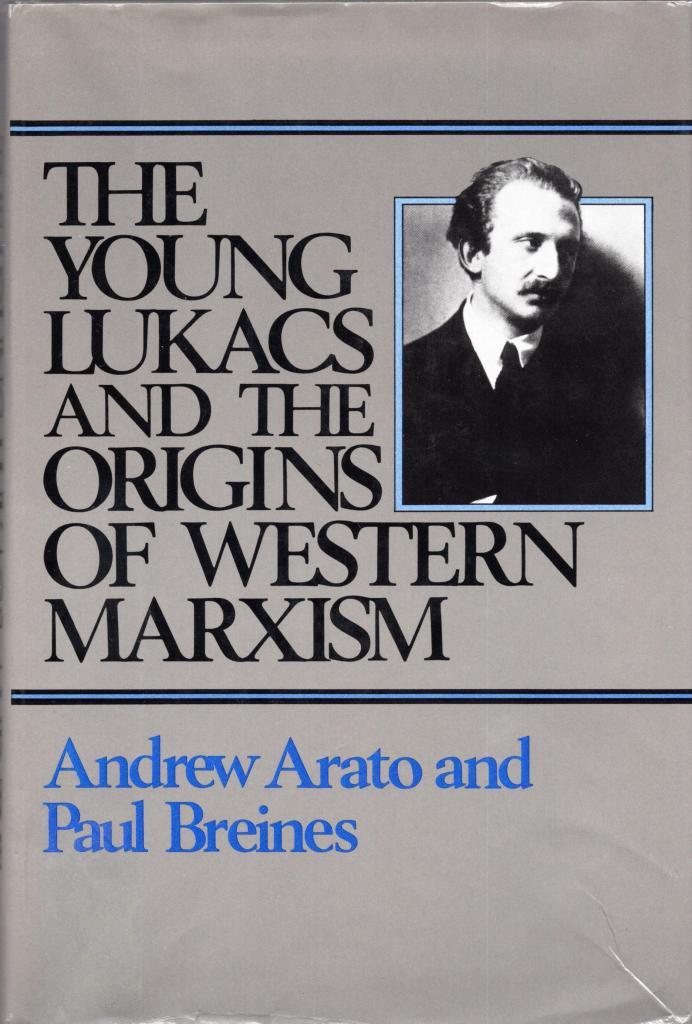
The distinctive contribution of Andrew Arato and Paul Breines’s The Young Lukács and the Origins of Western Marxism lies in its rigorous reconstruction of a problem: how a singular, crisis-formed synthesis of German idealism and revolutionary Marxism emerged, condensed, and fractured in and around History and Class Consciousness, and how that synthesis founded an intellectual lineage—“Western Marxism”—that remained structurally at odds with Soviet orthodoxy. The book’s scholarly stake is double: it tracks the composition sequence by which pre-Marxist cultural critique is transposed into a dialectical social theory centered on reification, and it frames the fate of that theory within the political and institutional transformations of 1923–1933. Its distinctive achievement is an immanent reading that judges Lukács’s claims by their own standards while situating their trajectory, reception, and eclipse inside an outer narrative of ruptures and rigidifications in Marxism’s history.
The authors signal their programmatic method at the outset: the center of their book is another book, History and Class Consciousness, and the task is threefold—genealogy, structure, and fate. The preface compresses the atmosphere out of which the 1923 essays arose: war and revolution, the collapse of late nineteenth-century forms, the birth pangs of a new century, the charisma and controversy that made Lukács appear simultaneously as the innovator of a self-consciously humanist Marxism and as a theorist whose very categories could be reterritorialized by the dogmatic Marxism he wished to avert. This inner tension—an appeal to the critical vocation of intellectuals amid accommodation to a new house of power—marks the book’s point of departure and its guiding paradox.
Within this outer framing, Part One elaborates the “road to Marx” as a series of determinate displacements in genre, milieu, and object. An early essayistic practice, cultivated under conditions of travel and exile, registers a structural constraint: the essay and the fragment become dialectical forms adequate to a world of antagonisms, keeping thought in transit and refusing false reconciliations. The authors link this stylistic economy to Lukács’s early sociological diagnosis of modernity: the rationalization of life, the division of labor, the depersonalization of social bonds, the erosion of shared symbols—processes that hollow out collective forms and press subjectivity back into an interiority that no longer guarantees unity. Read through Simmel and Weber, yet already corrected by an intuition of Marx’s commodity logic, this cultural sociology identifies a historically specific form of Versachlichung, an objective estrangement that overruns aesthetic culture and unsettles the dramatic form itself. It is within this crisis of form that Lukács’s philosophical desire condenses: to pass from a descriptive lament over fragmentation to a theory of mediation in which the social totality becomes thinkable as history rather than as fate. The authors’ reconstruction shows how this desire does not bypass, but rather intensifies, the antinomies inherited from the very tradition—German idealism—that nurtures it.
Part Two turns to the conceptual kernel: the reification chapter as Lukács’s singular attempt to write a dialectical social theory by mediating Weber’s rationalization analysis with Marx’s critique of commodity fetishism. Arato and Breines emphasize a decisive move: Lukács does not merely borrow Weberian ideal types to supplement Marx; he discloses identities between Weber’s categories of Western rationality and Marx’s determinations of capitalist being, and then insists that these “appearances” constitute a historically necessary second nature whose essence is the substratum of social action and thus the point of departure for theory. The commodity is taken as the inaugural category because in bourgeois society the abstract forms of exchange present themselves immediately, and to take them as merely subjective or to evacuate their historicity is methodological error. The analytic consequence is strong: reification ceases to be a marginal anomaly of economy and becomes the central structural problem of capitalist society in all its aspects, extending into science, philosophy, and everyday consciousness.
In this architecture, the philosophical history—Kant to Fichte to Hegel—operates as a theory of praxis that seeks the “identical subject-object” in a determinate, social sense. The authors’ immanent critique is precise: the attempt to let a reconstructed philosophy of praxis regulate social theory presupposes a self-critique of categories that Lukács signals but does not complete; the mediation intended to loosen the frozen immediacy of reified life remains conceptually blocked at key points. Yet the book insists that the failure is philosophically fecund. The path—not only the endpoint—matters, because the very process by which Lukács tries to turn a sociology of rationalization into a dynamic theory of objective spirit clarifies the measure of the task that any critical theory must face: to honor appearances as historically necessary forms, while extracting from them the objective possibility of their transformation.
From here Arato and Breines follow Lukács into the explosive hinge of class consciousness. They reconstruct his double spacing: the minimal, negative consciousness of workers—an experienced objecthood—versus the posited self-consciousness of the class as historical subject oriented to the totality. The analysis locates two gaps: between individual alienation and collective self-knowledge, and between the defetishizing moment latent in proletarian life and the defetishizing movement of revolutionary theory. Their charge is that Lukács’s egological model of subjectivity, inherited from classical philosophy and reinforced by his totalization of reification, omits the thick intersubjective mediations of work, communication, and institutions; the bridging of gaps thus oscillates toward a theoretical myth of proletarian freedom introduced at the outset as a regulative presupposition. The dialectic tends, at crucial points, toward a pseudo-dialectic—powerful in disclosure, vulnerable in passage to practice.
The authors’ compositional sequence renders this vulnerability legible against the chronology of 1922–1923: a year of revision and deepening leading to a text of remarkable originality and fatal flaws; then almost immediately a political terrain that foreclosed sustained theoretical debate inside the movement. The “Lukács-debate” of 1923–1924—short, sharp, decisive—makes plain how little root History and Class Consciousness had put down in the Communist organizations even as it electrified a wider intellectual field. Kun’s dismissal, Rudas’s extended indictment, and the procedural consolidation of an intra-party style that neutralized philosophical dissent show the speed with which an alternative was expelled to the margins as the International was Bolshevized. In that movement of expulsion Arato and Breines locate the historical birth of an intellectual subculture: Western Marxism as a professor-and-student discourse developing on the fringes of a political tradition that now identified its philosophy with a single orthodoxy.
Part Three narrates that marginality without romanticism. With Korsch expelled and Lukács integrated, the “philosophical struggle within the revolution” closes; the revolution itself has ended in Central Europe. Yet the ideas do not disappear; they migrate into debates around ideology and knowledge in venues like Die Gesellschaft, where Horkheimer, Marcuse, and others work (against both Mannheim’s relativism and any identification of truth with party line) to hold open a space for theory’s validity in the absence of a transparent link to a self-present proletarian subject. In this way the book disentangles the chronological proximity and the structural distance between the conceptual innovations of 1923 and the institutional consolidation of the 1930s—tracing lines that will later run through the Frankfurt School and other existential-Marxist articulations.
The authors treat a final, emblematic crossing: Lukács’s 1930 arrival in Moscow (after the “Blum-Theses” had been denounced), his survival during forced collectivization, and the near-simultaneous appearance of the 1844 manuscripts in print. Here the narrative captures a peculiar echo: Marcuse’s reading that the manuscripts vindicate the philosophical content of Marx’s project and the centrality of reification could be heard as a benediction upon the path History and Class Consciousness had cut, even as the Nazi seizure of power soon scattered the discussants and suspended the debate. The knot is instructive: documentary confirmation of the “youth of Marxism” arrives at the very moment when its prospective European carriers are dispersed, and Lukács himself, who had intuitively reconstructed much of the young Marx, is by then silent.
Arato and Breines close with a cyclical image: Marxism as a theory marked by long phases of formalization and dogma, punctuated by brief ruptures when history ceases to be endured as weight and becomes graspable as new life. The young Lukács is interpreted both as a rupture within theory—recollection of a repressed philosophical youth—and as a casualty of institutional rigidification. The 1960s provide a later echo: parts of the New Left rediscover the critique of reification as a language adequate to their own revolt against the thingification of everyday life; the rediscovery is real and tenuous, generative and unstable, often bifurcating into actionism or revived orthodoxy. The past decade, the authors suggest, has displayed fresh reassertions of rigid scientism alongside fragmented spaces of study and dissemination—conditions under which “reappraising the young Lukács” means sustaining a permanent rupture rather than installing one more orthodoxy.
The argumentative power of the book rests on its immanent standard of evaluation. Lukács is counted as one of the century’s few thinkers able to drive the antinomies of bourgeois modernity to their conceptual limit and to reveal, in thought, the necessity that the historical stage be surpassed as a problem for practice; History and Class Consciousness is judged the founding text of Western Marxism precisely because it strives to incorporate a philosophy of praxis into a critical social theory and fails in a way that instructs successors about the cost of such incorporation. The decisive chapters in Arato and Breines’s reading—the reconstruction of reification as the central structural problem and the mapping of the gaps in class consciousness—both anchor the book’s claim and expose its self-criticizing edge.
A further strength is the authors’ care with composition and sequence. They withhold any temptation to dissolve Lukács’s pre-Marxist writings into a set of “influences,” and instead let those writings disclose the purposive vision that shaped which influences were possible: a dream of the whole human being sharpened by the experience of capitalist rationalization. The cumulative argument shows how the early cultural sociology yields a horizon in which only a revolution in the very categories of social being could count as a path out of the “iron cage,” and how the later theoretical synthesis—commodity, rationalization, second nature, objective spirit—names the attempt to find such a path without recourse to mythic reconciliations. When the analysis falters, it does so at identifiable hinges: the overextension of reification into an all-encompassing immediacy that flattens intersubjective mediations, and the reintroduction of voluntarist freedom as the bridge theory cannot build. Those hinges are not dismissed; they are used to display the book’s internal standard of critique.
The outer narrative completes the symmetry. The text makes clear how the debate’s brevity, the consolidation of Bolshevized procedure, and the political defeats of 1923 combined to displace a nascent theoretical current into a long marginality. Yet the marginality is historically productive: a looser, professor-and-student discourse takes form, conserving humanist and Hegelian-dialectical emphases against a background that names itself “Leninist-Marxist philosophy,” and thus giving determinate content to a term that is admittedly odd: Western Marxism. The oddness is intelligible only against the century’s central asymmetry: an unanticipated revolution in the East and a non-revolution in Europe, and an ideology born from this paradox that prevails in the West; naming an alternative requires the index “Western” even for a tradition that, in another sense, was already Western to its core.
If one isolates the book’s most concentrated proposition, it might be stated thus. Reification, conceived as the second nature of capitalist society, is a problem of form before it is a matter of content; to think it adequately requires a theory that honors the autonomy of appearances and a practice that can mediate those forms without presupposing the subject that would perform the mediation. Lukács’s reconfiguration of Marx’s economy and Weber’s rationality advances the theoretical side of this demand; his theory of class consciousness shows the difficulty of its practical side. Arato and Breines, refusing consolation, make this difficulty their measure. From that measure they issue a restrained invitation—neither orthodoxy nor quietism: to sustain a rupture, to keep thought en route, to let the internal standards of critique remain active even when the institutions that once claimed to house them have hardened into their opposite.
The book establishes a disciplined continuum from Lukács’s early Kulturkritik through the reification analysis to the decade-long reception and dispersal, making visible how the parts merge into, and then are displaced by, each other—essayistic forms becoming sociological diagnoses, diagnoses becoming a philosophy of praxis, and that philosophy becoming, under political pressure, an intellectual subculture. The contribution is precise: a map of concepts tested against their own claims; a genealogy of an anti-dogmatic lineage within Marxism that survives as critique under conditions unfavorable to its flourishing; and a sober image of cycles and ruptures that treats the “youth” of Marxism less as nostalgia than as a continuously renewed problem for thought and action.
 Simon Gros
Leave a comment