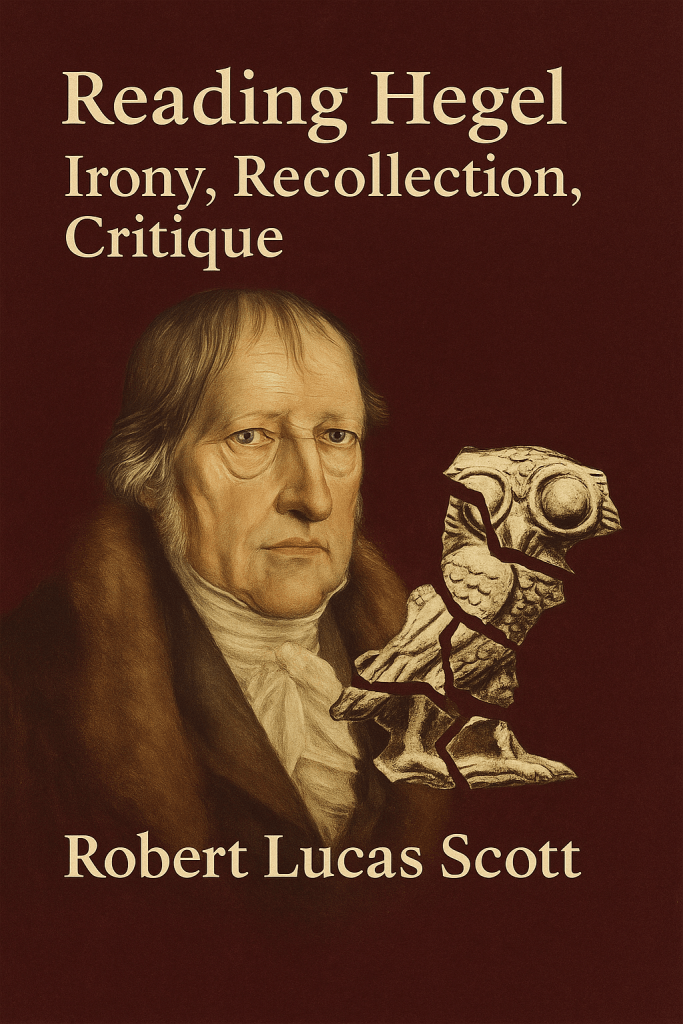
Scott’s Reading Hegel: Irony, Recollection, Critique stakes a precise claim: the only adequate way to “use” Hegel for literary study is to let Hegel’s own writing transform what reading is—so that interpretation must be practiced as speculative experience rather than applied as a detachable method. Across a preface of theses, an introduction that situates the living-dead afterlife of Hegel, and two movements that pass from extended readings of the Phenomenology to the fate of critique in contemporary theory, the book renovates three modalities—irony, recollection, and the tension between spirit and letter—until they become a discipline of reading. The result is both a defense and a reconstitution of critical practice: reading as dialectical ordeal, where truth appears only through a sequence of misrecognitions, re-cognitions, and returns that the text itself stages and the reader must undergo.
The book opens by naming a paradox: literary theory has defined itself against Hegel while remaining haunted by him. The Preface disentangles that haunting by charging that theory’s “Hegel” is too often a handful of exportable concepts—recognition, negativity, or the master–slave episode—abstracted from the mode of experience that produces them. When Hegel’s dynamic presentation is stripped away, one loses both the theory and the experience the theory articulates. Scott’s corrective is methodological without becoming method: one cannot begin with principles; one must risk a presuppositionless encounter in which reading moves naïvely with the text’s staged certainties so as to be corrected by their failure. In this sense, literary criticism has not yet been Hegelian; it has neglected the speculative experience of reading by which Hegel’s writing becomes legible.
This orientation is condensed into the first thesis: for Hegel, truth is ironic. “Ironic” here does not designate a posture or trope; it names a structure in which the true is a movement that continually exceeds itself, becoming other in order to be itself. To treat truth as a stock of accurate statements—“is” as flat identity—is to mistake an abstract sameness for speculative life. The “fear of error” that wants assurance beforehand is already error, because the truth of X is what X becomes by passing beyond its first look. The dialectical proposition “the true is subject” thus means that truth is the self-engendering course that advances and returns to itself and can only be grasped as such—that is, as surprise that must be lived through. Scott restores this dramatic character by insisting that one must “give force to what is,” abandoning precautionary distance in order to encounter the point where immediacy breaks and mediations become visible.
The second thesis turns the same key on Hegel: the truth of Hegel is ironic. If truth lives by becoming other, fidelity to Hegel cannot consist in preserving doctrines; it requires pushing his claims to their extremes until they move beyond themselves. There can be no orthodox Hegelianism because elevating “what Hegel said” into a fixed authority halts the very movement that makes his thought effective. The way beyond arbitrariness is not creative license but a “mind-numbing literalism” that begins with the letter in its stupidity and lets the text’s own experience recollect its truth. Reading thus oscillates between an absolute naïveté toward what lies before us and an equally absolute resolve to go to the end of what that immediacy conceals.
From these framing theses Scott derives his refrain: a speculative reading of Hegel yields a speculative mode of reading. The hinge is the speculative proposition, which is not a new syntax but a new practice of rereading in which any proposition can be made to live. The copula “is”—source of so much false comfort—turns out to be a metaphor that forgot itself. Sensuous certainty treats “is” as the coin of identity, yet its certainty omits everything determinate; it can only point. Speculation does not abolish “is” to protect us from error; it makes “is” carry the contradiction it had repressed: identity that includes nonidentity. To bring this off the page the reader must first misread to the letter, then reread for the spirit; what is naive at first becomes necessary in retrospect.
With this discipline in hand, Part I undertakes three long readings. The first follows irony through Hegel’s opening problem of beginning. A presuppositionless science must begin in the middle, repeatedly discovering that each promised beginning was already mediated. Scott treats this not as argumentative inconvenience but as the comedy native to speculative experience: the reader believes she is watching dialectic from a distance until it becomes clear she is on stage. The “is” that grounded sensuous certainty implodes, and the reader’s initial grasp of the proposition is recollected into a form adequate to its own movement. The irony here is constitutive, not rhetorical; and its lesson is practical: reading must learn to “linger with the negative,” sustaining contradiction without compensatory shortcuts.
The second reading relocates recollection. At the end of the Phenomenology, Hegel names spirit’s “coming-to-be” both as nature—free contingency—and as history, the knowing, self-mediating reconstruction of what has happened. Scott makes this doubleness the model of interpretive labor. Representation is not merely a symptom to be unmasked or an idol to be smashed; it is the site where what has happened is interiorized—Er-Innerung—and thus made available to intervention. The gallery of images that litters the Phenomenology—the drunken truth, the labeled skeleton, the topsy-turvy world, the life-and-death struggle—are not detachable allegories but stations of experience that must be recollected if their truth is to be anything more than a passing tableau. The reader’s task is to confer necessity on a contingent happening without pretending to have orchestrated it; recollection becomes the ethical name for that resolve.
Scott lingers with this “gallery” precisely to make vivid that the book’s images do work. The “tranquil kingdom of laws” and the “topsy-turvy world,” the vacillation of the servant who recovers himself through work only to find his freedom heavy, and the figure of unhappy consciousness—each scene articulates, fails to articulate, and thereby propels forward the constitutive gap between the infinite claims of spirit and the finite constraints of the letter. Absolute knowing then becomes the recognition that this gap is necessary, not a closing of it. Reading, correspondingly, advances by repeating forward: it can rescue meaning only by risking passage through the literal and the finite.
The third reading turns to the most combustible pair in Scott’s title: spirit and letter. Against both philological fetishism and romantic antinomianism, Scott reconstructs Hegel’s struggle with letter-bound thinking. The letters to Niethammer and others record Hegel’s growing impatience with erudite cobweb-spinning that fixes words and drains thought, while also praising the freedom with which Luther “quoted, interpreted, and manipulated” scripture. The point is not to side with whim against scholarship but to show how spirit is realized only through the letter’s internal contradictions. The notorious formula—“when one says ‘spirit’ or ‘God’ one speaks only of stones and coals”—does not debase theology; it exposes the speculative identity in which spirit is unity with itself in otherness, such that the lowest, dead materiality is precisely the scene where living concept appears. That is why Scott can write, in an intentionally scandalous gloss, “God is coal.” The shock does not reconcile letter and spirit by decree; it trains us to find the life already at work in the letter’s deadness.
Here the speculative and the pedagogical converge. Hegel’s counsel about educating boys—begin from abstractions, endure the mechanical letter, then release the conceptual—becomes a miniature of the reader’s itinerary. Scott emphasizes that a genuine dialectic of spirit and letter is not a refusal of the letter but its transfiguration by rereading. To denounce the letter is still to be ruled by it; to work through it is to discover that there is “not even a single non-speculative word that can be said.” The very words that seem loftiest—soul, spirit, God—are speculative first of all because, in use, they unite themselves with what they are not; the concept’s life shows itself as this power of holding contraries together rather than evacuating them.
Part II performs the inverse movement: instead of reading Hegel, it stages Hegel reading us, especially the present “postcritical” mood. The introduction has already mapped the two attitudes that dominate Hegel’s reception: the anti-Hegelian gesture that keeps discovering him waiting at the end of every path, and the ecumenical gesture that domesticates him into a toolkit—recognition for democratic theory, normativity for pragmatism, conceptual content for analytic semantics—by elevating a single motif into a quasi-transcendental condition. Scott neither exorcises nor domesticates. He reconstructs these appropriations and shows how their very selectivity testifies to what they avoid: speculative experience, which cannot be presupposed without ceasing to be experience. The problem with such de re readings is not that they are wrong in content but that they refuse to let the text alter their starting point.
It is in this register that Scott turns to the crisis of critique. Recent manifestos often oppose immediacy and mediation, recommending that criticism abandon “diagnostic” distance for attachment and surface. Scott shares the hostility to immediacy as cultural style and the commitment to mediation as a social process, yet he insists that Hegel’s lesson is more exacting: mediation cannot be summoned in advance as a maxim; it must be reached by traversing immediacy with conviction. The imperative “begin immediately with mediation” is itself an immediacy. Critique’s renewal, therefore, requires recovering speculative experience: letting a text bind us, so that what looked like attachment becomes the only passage to non-naïve mediation.
With this criterion in hand, Scott revisits familiar debates. He reconstructs the way liberal-democratic theory strips Hegel for parts—recognition without history, intersubjectivity without institutions—and shows how analytic rehabilitations that filter Hegel through “conceptual content” declare their restriction from the first page, thereby disqualifying themselves from phenomenological risk. The point is not to adjudicate doctrinally between these projects but to show how their very plausibility depends on a prior refusal of the ordeal that the Phenomenology prescribes. The reader who will not be read by the text will extract positions and miss truth.
The most striking test case is Scott’s long coda on poetry and autofiction at “the limits of critique.” If immediacy is the reigning cultural aesthetic, then Knausgaard’s My Struggle would seem its emblem: the first-person present, the minute dailiness, the refusal of character for “reality.” But Scott suggests that to read this corpus as immediacy is to read immediately. From a speculative standpoint, one finds a strenuous mediation: a writing that exposes, through its very procedures, the contradiction between the infinitude of subjectivity and the constraints of damaged life, and writes from the “standpoint of redemption” without pretending to redeem. The reader’s experience is recollective rather than immersive; the life written down is not redeemed by being written but is written as the very labor in which mediation appears. This is why Scott can gloss the Hegelian lesson in a Knausgaardian key: one gives oneself up to others—writer and reader alike—in order to take ownership of oneself.
In this traversal the book’s three motifs recombine. Irony supplies the structure of truth as becoming-other, which disables both the posture of sovereign critique and the contentment of postcritical attachment. Recollection supplies the temporal logic by which past forms are interiorized and thus altered in the present—what happens becomes what has happened, and only there can necessity be conferred. The tension of spirit and letter supplies the medium in which both moves are legible, because it prohibits any shortcut: dead words must be borne until their life shows, and living insights must consent to be written, cited, and taught. The effect is to reframe the whole book as a pedagogy. Reading is not the application of a theory but a schooling in the patience of contradiction, the courage of beginning again, and the tact to know when an image must be allowed to do its work.
Scott’s compositional sequence and outer framing underscore that pedagogy. The Preface declares theses in an openly “pistol-shot” risk: it begins by thematizing the impossibility of beginning without prejudice, then proceeds anyway, acknowledging that only the subsequent experience can warrant or unwind what has been announced. The Introduction thematizes reception history—the “everyone is a Hegelian” mood—and, more importantly, the how of reading, in which Adorno’s skoteinos is welcomed as ordeal while Kantian retreats from reconciliation are resisted in the name of recollection’s simplifying work. Part I is built as a relay: from the problem of what is and the instability of the copula, through the gallery of images that must be recollected, to the letters in which Hegel himself struggles with philology’s tyranny and the necessity of a letter animated from within. Part II reverses the vector, placing Hegel amid present arguments about sociology, theory, recognition, political economy, poetry, and life-writing; irony, recollection, and the letter are now the criteria of critical adequacy. The concluding movement’s defense of lyric and autofiction does not add a case study; it exhibits the book’s method in the medium where the conflict of immediacy and mediation is most palpable.
Two clarifications gather the book’s distinctive contribution. First, Scott’s “irony” is ontological-logical, not stylistic. When he writes that truth is ironic, he means that the true is alive only as self-difference held together—“itself and the lack of itself”—and that reconciliation is reconciliation with contradiction. Reading that refuses this will either fix meaning as flat identity or defer it into lateral postponement; speculative reading, by contrast, holds contradiction to the point where movement shows itself and can be recollected.
Second, Scott’s “recollection” names an ethical resolve rather than a mnemonic technique. The opposition between immediacy and mediation—so often handled as a choice of method—becomes itself an object of experience. Mediation cannot be legislated; it must be produced by going through immediacy in good faith. Hence the peculiar rigor of Scott’s proposal: a criticism that is both more intimate and more exacting than postcritical attachment, because it stakes itself on being transformed by the text’s course; and more demanding than older diagnostic critique, because it refuses the safety of an initial outside. The past becomes binding after it happens, and only there can critique find its target and its timing.
Because the book remains largely internal to Hegel’s texts and their transmission, its polemics against selective “Hegels” never require external denunciation; the proof is in the experience it offers. The chapter on the speculative proposition reads like an initiation: one learns to feel why “is” cannot be taken straight and how a proposition becomes speculative only as it is reread. The chapter on the gallery demonstrates, by inventorying scenes, that images are not ornaments but the very tissue of phenomenology’s pedagogy. The chapter on spirit and letter shows, in the starkest way, how the most pious vocabulary is speculative in use—how “God is coal” both scandalizes and instructs because it compels us to think unity-in-otherness without rhetorical anesthesia. And the long coda on critique puts all this to work where theory’s impasses have seemed most intractable.
If one wanted a single sentence for Scott’s wager, it might be this: the only way to read Hegel faithfully is to let Hegel be the reader of our reading. That means beginning where we are, consenting to misread, allowing ourselves to be corrected by the movement we undergo, and recollecting what happened until what happened becomes intelligible as history. It means accepting that every true beginning will prove to have been a beginning in the middle and that the end will only tell us how to start over. And it means learning to hear in the most familiar words the most unfamiliar task: to hold contradiction until it lives.
In closing, the book’s stake and contribution become clear. It does not add “Hegelian reading” to the marketplace of methods; it redefines reading as the very practice that Hegel’s phenomenology discovered and performed. Irony names the life of truth; recollection names the work that makes that life ours; the spirit and the letter name the medium in which both must appear. The effect for literary study is bracing. Critique need neither abdicate nor dominate; it must submit itself to the sequence of experience that makes mediation possible. Texts are not objects to be mastered or mirrors to be loved but events to be undergone and recollected. Scott’s book shows that such recollection is the reader’s freedom: a freedom that does not abolish constraint but discovers itself within and against it, as unity with itself in otherness—in the letter, in time, and in the hard grammar of “is.”
 Simon Gros
Leave a comment