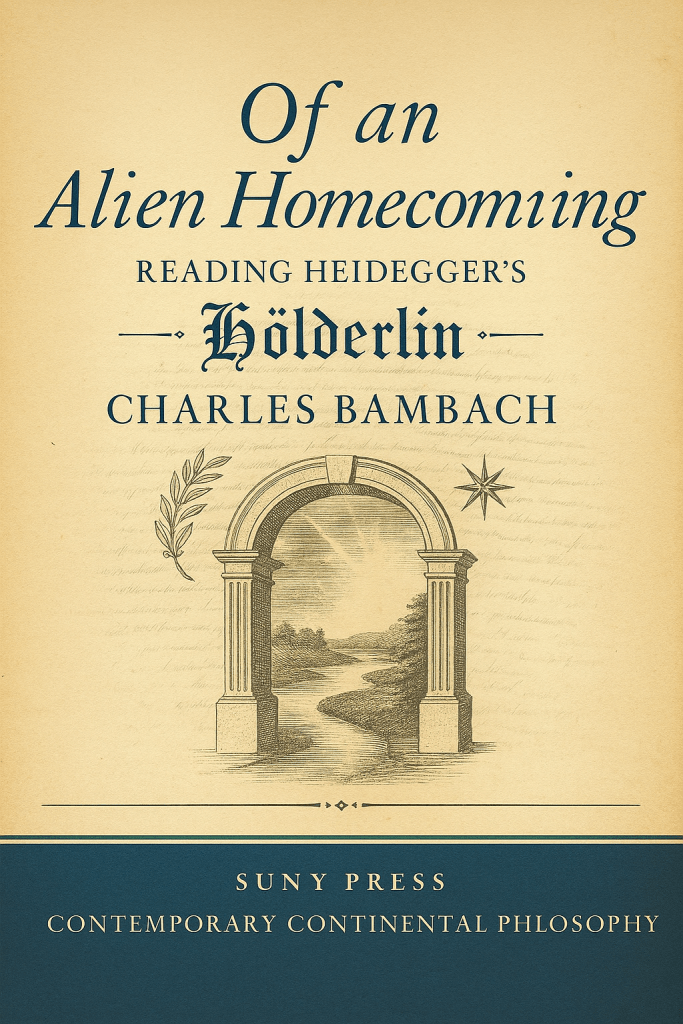
This study establishes, with unusual steadiness and reach, how the problem of homecoming under estrangement becomes the pivotal relay between Heidegger’s thinking and Hölderlin’s poetizing across the decisive years 1934–1948. Its distinctive contribution lies in reconstructing the inner logic by which figures of journeying, the river, the withheld homeland, and the passage through the foreign are organized by Heidegger into a metapolitical grammar of German destiny, and in demonstrating how that grammar both carries the force of an ethical orientation to dwelling and is compromised by the exclusions that emerge in parallel in the private notebooks. By binding philological attentiveness to a history-of-being framework, the book shows why Hölderlin functions for Heidegger as a name for transition itself, and why that name remains inseparable from the historical convulsions that gave it urgency.
The book opens by locating the question of home at the center of Heidegger’s itinerary: the loss of home in an age of calculative organization and the possibility of another way of dwelling articulated by poetry. The Preface re-casts the Greek nostos as a philosophical invariant of return, so that the home is never simply a site reached by arrival but a withheld essence disclosed only through a circuit into foreignness; the poet’s vocation is homecoming under the condition that the homeland is first prepared as nearness to an origin that remains concealed. This sets the stake for Heidegger’s encounter with Hölderlin’s late hymns and letters: Ausflug and Rückkehr name a law of history by which the passage outward is already an inaugural form of return, and Heimat must be learned in the element of the foreign. From the outset, this movement of return is bound to the fracture it traverses; the book insists on the Riss, the tearing that simultaneously separates and prepares, as the experiential cipher by which rivers, seasons, and names manifest the scission of the time of destitution and the possibility of an advent.
From this vantage, the volume repeatedly makes two methodological wagers. First, that the decisive texture of Heidegger’s reading is grasped only if one follows how the poet’s words are folded into an other beginning of history, a beginning that cannot be plotted as a program yet is incessantly staged in the lecture room as a kairological readiness. Second, that such staging is historically marked: the readings are inseparable from the failure of the rectorate, the turn from immediate political activism toward a metapolitical idiom, and the postwar insistence on poverty, measure, and nearness. The author does not set aside philological quarrels; he acknowledges the reproaches that Heidegger’s “elucidations” dislocate the poems from their literary-historical contexts, yet he shows how that very dislocation belongs to the way Heidegger thinks with the poems—as if their language were a vestibule through which thinking must pass in order to learn a measure for the earth in an epoch of abandonment. The subtitle’s quotation marks are treated as a programmatic signal: “Hölderlin” is already a displacement, a citational site in which the native and the foreign are knotted, so that any return to the proper bears the imprint of an alien accent.
The composition sequence—early hymns, wartime Remembrance, the Danubian Ister, a historical interlude on 1945–46, and the postwar “Western Conversation”—exhibits an intentional drift. Initial emphasis on the hymns “Germania” and “The Rhine” (WS 1934/35) is read against the collapse of Heidegger’s rectoral project and the transfer of his hopes into a poetic topography where river-names and seasonal rhythms shoulder the burden of founding. The lectures are presented as a laboratory in which Germania becomes a mythic name for a task, and The Rhine becomes a river-figure for originary springing-forth: physis as poiesis, beyng as the event that seizes the human into a vocation. Here, Hölderlin is inscribed as founder and destiny: poet of poets, hence the only one by whom the Germans can be schooled into another hearing of being. The textual work is exacting: “springing-forth,” “demigods,” and the reinentsprungene are treated as technical figures that compass both ontological genesis and historical assignment. The book insists that such figures neither remain allegory nor reduce to metaphor; they engineer an approach where language does not decorate thought, it occasions it.
Yet the author does not permit these lectures to consolidate into a serene hymnology. He shows how Germania drifts into the rhetoric of a secret Germany—a reception traceable to Hellingrath and the George-Kreis—and how this drift permits Heidegger to construe poetic calling as a German bequest, a singular mission that tacitly presupposes a topology of friend and foreigner. This presupposition later hardens in the Notebooks into a vocabulary of machination and a diagnostic of an occlusion of the first beginning, in which “the Jews,” in a handful of entries, become the index of a planetary deformation. The volume does not sensationalize these passages; it exhibits them precisely at the points where the lecture-courses recruit the river hymns for a destinal national history, so that the speculative and the political appear as two inflections of a single design. The result is a controlled but unflinching demonstration of how the metapolitical grammar requires exclusions that poison its ethical ambition.
The wartime Remembrance course is then read as a crucial turning: the Bordeaux sojourn is treated as the exemplary itinerary in which the foreign gives the measure for home. The staging of the lectures is itself thematized by the author—the vestibule that precedes entry, the greeting of the wind, the equinoctial balance that orders festival time. Each scenic element is interpreted as a way to enact the “law” that becoming homely occurs in unhomeliness. The text is keen to show that this is no romanticization of exile; rather, it is a formal principle by which naming, translation, and dwelling are bound. The river carries the name from source to mouth; naming reverses origin and end; translation exposes the uncanny of the human, whose essence becomes ordeal, Katastrophe. The seminar’s exegesis of Andenken thus exceeds commentary: it elaborates a practical hermeneutics for the poetico-historical situation, where to remember is to be claimed by what withdraws and to make room for the festival time that interrupts homogeneous chronology. The author demonstrates how this hermeneutic binds the ethical and the historical without sentimental recourse; hospitality becomes a strained term, because it must pass through questions of who welcomes whom into what, once the homeland is no longer a possession but a task.
The Ister lectures give the book its central scene. They develop the polarity of Ausfahrt and Rückkehr into a principle of historical articulation and make the river the privileged name for a law of reversal. The author unfolds with care the “Böhlendorff logic” of oppositional harmony: intimacy is conflictual; dwelling is the exposure to the rift that alone grants nearness; translation is a founding violence that returns the native language to itself by letting what is foreign strike it. This is not summarized as theory of culture; it is displayed as a practice of saying that binds time to locale by way of proper names. The Danube is “German” in a manner that cannot be territorialized, because its German is the task of receiving a bequest—which is to say, of withstanding a measure. Demigods (poet and river) are treated as bearers of a transitional divinity, those who do not found by construction but by letting the rift remain as rift. The author patiently traces how tragedy becomes a name for the human: not a literary genre alone, but the manifestation of the contradiction through which any ethical dwelling must pass. This makes contradiction itself into a mode of truth-showing, and oxymoron into a grammatical device adequate to physis as event. The cumulative effect is to exhibit an ethics without moralism, in which restraint, measure, and preparedness belong to a discipline of naming that refuses mastery.
At this point the book inserts its historical interlude on 1945–46, not as a digression but as a pivot that discloses the cost of the metapolitical idiom. The postwar texts are read as a Kahlschlag, an attempt to clear down to poverty of thinking, and also as a rhetoric of ressentiment: war-guilt and retribution are registered in a style that insulates a spiritual Germany from political catastrophe while maintaining the dream of destiny. The author shows how the Hölderlinian vocabulary—poverty, festival, bread and wine—survives the collapse by being redistributed from a political eschatology to a more rarefied poetics of nearness. Yet the Notebooks still hum with verdicts about the West and its decay that keep alive the figure of an elect receiver of the bequest. The point is not to accuse anew but to clarify: the same structures that grounded a non-aesthetic poetic of dwelling also sustained a narrowing of the we, and this narrowing does not vanish with stylistic softening.
The concluding movement turns to the dialogue manuscripts collected as “The Western Conversation.” The author treats these dialogues as an experiment in form that adapts the lecture’s dramaturgy into a more intimate medium: thought staged as speech on a path, with the river as companion. The Schwung—the sweep from first to other beginning—receives here a conversational enactment; what could only be proclaimed in the mid-1930s is now posed as a question: how does one keep open a transition for which there is no timetable? The Ister reappears as ordeal and site, the bread and wine fragment becomes the locus for re-measuring the German bequest, and the geographical names that earlier bore a national mission now bear a more chastened weight. The book’s reading is restrained yet decisive: the dialogue shows how far Heidegger’s language has learned from Hölderlin, and also how little it can unlearn of its longing for a unique historical role. The conversation thus exemplifies both the refinement of an ethics of dwelling and the persistence of its delimiting dream.
Across these parts, the author’s method keeps faith with three commitments. First, to read the Hölderlin volumes of the Gesamtausgabe as a continuous project in which poetry is neither ornament nor pretext but the matrix by which thinking attempts to leave metaphysics behind. Second, to keep the lexicon of beyng-history legible by holding it close to concrete textual cruxes: the “greeting of the wind,” the equinoctial balance, the reversal in naming, the law of the river’s course, the demigod as mediator, the vestibule as threshold. Third, to set this lexicon within constraints that are historical without being reductively causal: the rectoral failure, the wartime staging of remembrance, the postwar poetics of poverty, the late dialogues as a polishing of a voice first loosened by the poet. This triangulation enables a reading in which the philological and the speculative are not adversaries; the poem yields a syntax of experience that philosophy receives as instruction.
A notable achievement of the book is to make explicit how the outer framing governs the internal argument. The Acknowledgments and Preface acknowledge the pandemic’s isolations; the Preface’s long meditation on quotation marks is then made to bear on the very title, signaling that “Hölderlin” is both invoked and held at a distance. The Introduction proposes Hölderlin as a beginning and transition; the sequence of chapters enacts successive vestibules—lecture hall, festival time, riverbank, interlude of ruin, dialogical path—each of which prepares hearing and each of which modifies the sense of home. The Postscript, while brief, gathers the stakes by renewing the concern for whether anyone can still hear what needs to be heard amid a media din; this is not nostalgic complaint but a restatement of the kairos problem that has been present from the first pages. Such framing does not add thesis to content; it gives form to the claim that the reception of Hölderlin is already a practice of threshold-keeping.
The book’s ethical insistence is quiet and persistent. Ethos is treated as the way human being comports itself to the claim of language when the gods have fled; dwelling names neither enclosure nor settlement but a disciplined readiness to be appropriated by what withdraws. The author reconstructs how measure-taking, festival, bread and wine, and the fourfold later vocabulary are seeded by the Hölderlin lectures and then redistributed across the postwar texts. He also makes explicit that such ethos requires an addressable we and that Heidegger’s constitution of that we remains narrowed by the metapolitical imaginary of a chosen receiver. The tension is permitted to remain unresolved in the analysis, because the unresolvedness belongs to the case: the same movement that liberates thinking from aestheticism and technicity also furnishes a myth that fails the most basic tests of non-exclusion. The author’s wager is that the ethical kernel of poetic dwelling can be rigorously thought while the metapolitical narrowing is exposed as a failure of vigilance.
That wager is sustained by patient attention to rhetoric. The study shows how Heidegger’s lecturing dramatizes: vestibules to slow the approach, greetings to tune hearing, temporal figures to break chronology, oxymora to bear contradictions without dissolving them. The persuasive core lies in the demonstration that these are not ornaments but disciplinary devices: they are ways to make manifest the rift as rift and to teach a non-coercive use of names. The same attention allows the author to indicate where rhetoric turns into capture: where the name “German” is left unexamined in its exclusivity, where the figure of the foreign hardens into a fixed antagonist rather than a necessary partner in the return to the proper. The analysis is most compelling when it shows this transition at the level of a single word—Heimat, Fremd, Andenken—and lets the philological finding illuminate the speculative construction.
As a result, the book displaces several familiar antinomies. It does not choose between historical reconstruction and speculative retrieval; it exhibits how the latter is already historical in its staging and how the former becomes intelligible only in light of the project of an other beginning. It refuses the short circuit in which political biography alone would adjudicate philosophical worth; at the same time, it shows how the metapolitical vocabulary cannot escape judgment once its exclusions come to speech. It holds together Hölderlin’s modern reception—Hellingrath’s edition, the George-Kreis myth, wartime patriotic appropriations—with the way Heidegger submits that reception to a different measure that claims to depart from aestheticism and apparatus. The study’s originality lies in the detail of these crossings, and in the way the details cumulatively re-plot the relation of poetry and philosophy as a concrete practice of dwelling in the rift.
The cumulative picture of Heidegger that emerges is neither penitential nor exculpatory. He appears as a thinker who re-founded his language under the pressure of a poet, a reader who made of lecture and dialogue a stage for learning to speak with fewer guarantees, and a man who preserved, through successive regime changes and private defeats, a belief in a “secret Germany” as bearer of a bequest. The author clarifies how this belief both nourished a form of resistance to the reduction of world to machine and saturated his vision with an election that could not bear the other as partner in destiny. The paradox is not smoothed; it is exhibited as the site where any contemporary engagement must linger if it is to inherit the strengths and limitations of this path.
The book closes, in effect if not in overt declaration, by returning to the first question: whether there is still something like a home. Its answer is indirect. If there is such a thing, it will be because a language can be learned that lets what withdraws be near, that takes measure without dominance, that receives the foreign as the medium of return. The poems are not cited as authorities but employed as training grounds for this language; the lectures and dialogues are read as exercises in slow approach; the notebooks are consulted as thermometers that register where the approach freezes into dogma. The reader leaves with a clarified sense that homecoming—if it is to be more than a slogan—requires a rigorous pedagogy of saying, a penumbra of ethical restraint, and a vigilance against mythic consolations that promise destiny without the ordeal of translation. That such vigilance can be learned from the very texts that sometimes betray it is the book’s sober confidence and its enduring contribution.
In clarifying, one might say: the study teaches that to think with Hölderlin is to stand in a vestibule where names become heavy, seasons alter time, and rivers pronounce a law of history that binds foreignness to the return to what is proper. This vestibule is neither sanctuary nor tribunal; it is a place to learn to speak otherwise. The author shows how Heidegger learned—how his tongue was loosened by the poet—and where he refused to learn further. The lesson is difficult and timely: dwelling will become thinkable only as the discipline of an alien homecoming, and the measure of that discipline is whether it can preserve openness where myth tempts closure. The book holds us at that threshold with an exacting calm.
 Simon Gros
Leave a comment