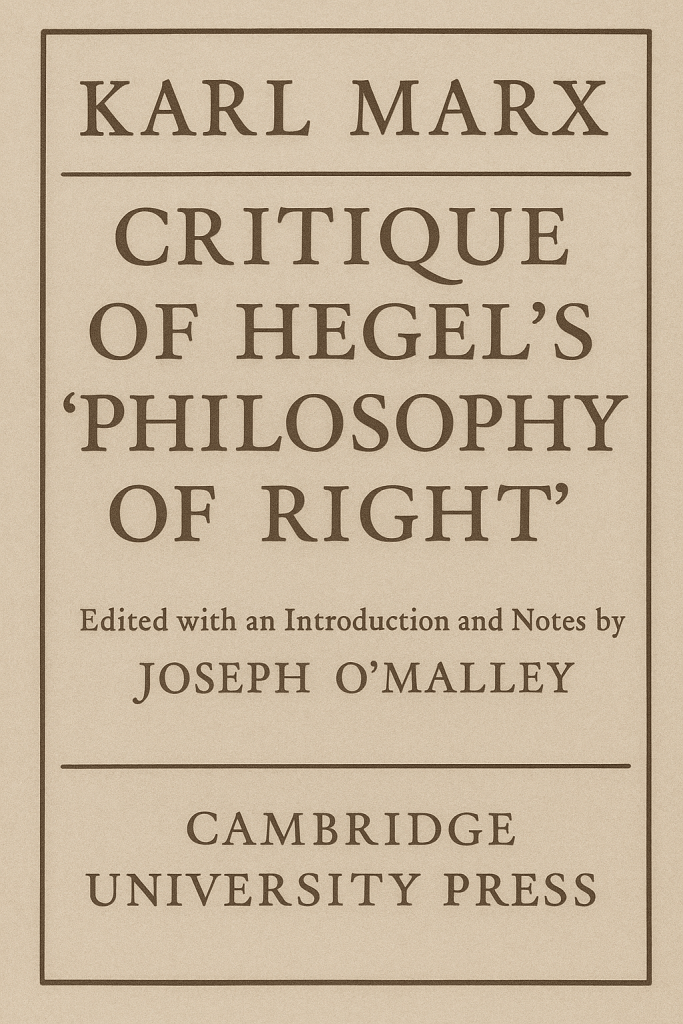
Karl Marx’s Critique of Hegel’s ‘Philosophy of Right’ is a pivotal work in his early intellectual evolution, capturing both his engagement with and his divergence from the German idealist tradition embodied by Hegel. This work, representing Marx’s first extensive confrontation with Hegel’s political philosophy, marks the beginnings of his endeavor to unravel the delicate bonds between political structures and economic forces. Focusing on Hegel’s delineation of the state’s constitution in paragraphs 261–313 of the Philosophy of Right, Marx carefully dissects Hegel’s conceptual framework. Through detailed, paragraph-by-paragraph commentary, Marx subjects Hegel’s arguments on the nature and organization of political authority to a rigorous critique, ultimately challenging the philosophical foundations upon which Hegel builds his vision of the state.
Marx’s Critique of Hegel’s ‘Philosophy of Right’ takes the apparently tranquil surface of Hegel’s constitutional theory and turns it into a diagnostic theater for modern political life. Its precise scholarly stake is to demonstrate, by a sustained immanent reading, that Hegel’s most accomplished presentation of the rational state reproduces the self-estrangements of the nineteenth-century polity it purports to reconcile. Its distinctive contribution lies in the way it welds three operations—transformative (Feuerbachian) demystification, close textual explication, and historico-genetic reconstruction—into a single critical procedure that treats Hegel’s paragraphs on the internal constitution of the state (§§261–313) as both philosophical propositions and mirrors of social reality. The result is an argument-like exposition that preserves Hegel’s empirical sharpness while stripping away the speculative form that, in Marx’s view, mystifies it.
The outer frame of the work already instantiates its problem: an unfinished manuscript-notebook, without title or date, composed in Kreuznach in the summer months of 1843, copying and confronting the paragraphs of Hegel’s doctrine on the constitution (the executive, the Estates, the mediations between Crown, government, and “civil society”). That the front cover and early leaves are lost underscores the contingency of its transmission; that Marx intended to revise it, then issued instead a separate “Introduction” in early 1844, shows how the subject exceeded a single tract. As a composition sequence, it begins as the long-delayed fulfillment of a plan first announced to Ruge in 1842, becomes a paragraph-by-paragraph commentary produced after Marx’s turn from journalism to archival study, and is then partially displaced by the independent Einleitung which theorizes the stakes of critique (including the celebrated theses on religion). In that sense, the Critique is both groundwork and hinge: it compresses the experience of Rheinische Zeitung polemics, the Kreuznach excerpt notebooks in political theory and history, and the first sustained experiment in the method that Marx would carry into the mid-1840s manuscripts.
The outer frame also includes the afterlife of the manuscript: Marx abandoned its revision because the argument multiplied beyond what a single publication could bear; he later recalled it as his first systematic attempt to grasp the play of material interests in a political order whose legal self-presentation he found increasingly at odds with its social physiology. The work then lay dormant until Rjazanov’s archival discovery and first publication in the MEGA; and in two later autobiographical nodal points—1859 and 1873—Marx pointed back to this text as the locus where he first distinguished his use of dialectic from Hegel’s “mystified” version. These retrospective markers double as interpretive cues: the Critique is both a negation of speculative form and a first pass at re-grounding the political in historical-economic determinations.
Inside the work, the first operation is transformative criticism. Taking over Feuerbach’s subject–predicate inversion, Marx insists that what speculative philosophy treats as an independent Subject (“the Idea,” the “universal”) is in truth a predicate abstracted from empirical relations and then hypostatized. The task is to reverse the vector: return predicates to their real subjects, i.e., to human practices and institutions. In religion, Feuerbach had shown that the divine is a projection of human perfections; in speculative right, Marx argues, the “Idea” is a projection of social determinations treated as their own ground. Hence the striking claim: Hegel speaks about the same empirical content that any sober political theory must address, but he speaks of it as moments of the Idea, thereby preserving the features of the empirical order while cloaking them in a theological aura. This way of speaking—not the facts themselves—is the target. Marx’s method, then, is not to substitute different facts but to liberate Hegel’s good descriptions from their mystifying syntax.
From this follows the second operation: close textual explication that tracks Hegel’s characteristic “inversion.” Again and again, the path runs as follows: Hegel begins from a determination of the “Idea,” deduces an institutional necessity, and then aligns an empirical arrangement with that necessity; Marx interrupts each link in the chain, showing that what functions as a deduction is in fact a retrofitted rationalization, an allegorical re-inscription of the given as the necessary. In this procedure, “allegory” names precisely the practice of ascribing to an empirical existent the meaning of an actualized Idea. To break the spell, Marx places Hegel’s transitions under a magnifying lens, exposing the grammatical displacements by which the determining becomes the determined, the conditions appear as conditioned. Once the connective tissue is shown to be illusory, the empirical content can be treated on its own terms—now available to historical critique rather than speculative reconciliation.
The third operation is historico-genetic. If the churchly double of politics is religion, then the appropriate analogue to Feuerbach’s psychogenesis of God is a genesis of the modern state from its actual social premises. The unity of the method lies here: to exhibit the contradictions in Hegel’s text as reflections of the contradictions of the institutions themselves, and then to clarify them by tracing the determinate historical processes that produced a separation between political universality and the particularism of “civil society.” Marx accordingly introduces increasingly copious historical materials as the Critique advances, justifying a transition from purely immanent reading to the historico-political anatomy of estates, bureaucracies, and parliamentary forms.
From these three operations, a field of problems opens. Hegel promises a reconciliation of universality and particularity through a graduated system of mediations: corporations within the “acquisitive” estate tame market egoism; primogeniture within the “substantial” estate anchors disinterestedness; the bureaucracy constitutes itself as a universal class; and the Assembly of Estates, designed as the middle term between Crown and populace, accomplishes the formal unity of the state. Marx accepts the descriptive acuity—he even relies on it—yet he contends that each mediating device betrays, rather than sublates, the very contradiction it claims to heal. The method dictates the judgment: once the speculative gloss is removed, Hegel’s apparatus is revealed as a faithful register of modern estrangement.
Consider first the bureaucracy. Hegel assigns to it a universal function, the translation of the state’s general aims into determinate administration. Marx’s explication recovers a different picture: the bureaucracy forms a corporation within the state, a pseudo-universal that treats popular life as mere material for career advancement and internal hierarchies. Precisely because it must appear universal, it turns universality into a specialized property of an office-holding stratum; precisely because it is charged with mediation, it converts mediation into enclosure. If Hegel’s pages are accurate, they document a closed, self-reproducing circle that confers on itself the monopoly of political intelligence while operating in secrecy, above transparent standards of responsibility. The contradiction between a “universal class” and an actually particular corporate interest is not a textual accident; it is the social contradiction of which the text is an image.
Next, the Estates. In Hegel’s architecture they are to be the organ through which the people participate in public affairs and the universal concerns of the state are taken up as the people’s own. The upper chamber—anchored in primogeniture—supposedly secures independence from market fluctuation and thus cultivates a political ethic of disinterest; the lower chamber—elected through corporate forms—supposedly channels the articulated interests of civil society into lawmaking. Marx’s analysis drives a wedge between the “supposedly” and the “actually.” The chamber of peers remains medieval in spirit; the elected chamber is modern only in a formal sense; the bicameral whole is a hybrid that presents reconciliation as ceremony. The Estates manifest, therefore, the illusion of popular participation, not its reality; the “middle term” becomes a buffer preventing the dualism of state and civil society from being confronted as such. The famous irony—recorded in Marx’s dry remark on Hegel’s §§312–313—is that the two houses work less to ripen deliberation than to pre-empt a direct opposition between Estates and executive, thereby ensuring that what appears as neutrality is in fact neutralization.
Primogeniture is the connecting hinge that discloses the whole logic. For Hegel, entailed landed property shields one estate from arbitrariness and market shocks, grounding a stable political ethos; for Marx, the entail secures a juridical island whose continuity requires the juridical sacrifice of other family members and the political sacrifice of the public’s claim to the land’s social meaning. What presents itself as a bridge between private and public is a technique of insulation; what is posited as a source of universal independence is the reproduction of a very determinate particular order. Marx’s further inference—prefiguring his later doctrine of the Aufhebung of private property—emerges here as an internal necessity of the critique: if the most celebrated “mediations” function by reproducing separation, then a genuine reconciliation cannot consist in the perfection of these forms but in their displacement.
The decisive conceptual knot is the separation itself. Hegel’s narrative acknowledges the modern split between the religious (universal) sphere and the profane (particular) sphere, redescribed as the political state and civil society. Marx keeps the recognition and rejects the solution. The “citizen” and the “member of civil society” are not harmonized by the Estates, the bureaucracy, or the Crown’s constitutional dignity; they are compelled to enact a schism. The state becomes the religion of popular life, the heaven of universality, while everyday existence remains the earth of need and competition. The speculative form transforms this estrangement into an accomplished reconciliation; the critical form transforms the reconciliation back into an object of history. On this terrain the Feuerbachian and the historico-genetic lines cross: as religion is the self-consciousness of a being alienated from itself, so the political State is the redeemed image of a social life that does not yet possess its own universality.
From here the Critique develops, almost of necessity, two positive determinations that will outgrow the commentary frame. The first concerns who could enact universality: Hegel finds a “universal class” in the bureaucracy; Marx, by 1844, identifies it in the proletariat, whose universal deprivation gives it a position from which the partial interests of civil society can be negated and a community adequate to species-being can be established. That claim, too, is prepared in the Critique, less as a sociological thesis than as a deduction from the failure of bureaucratic universality; the very place left empty by Hegel’s pseudo-universal is reoccupied by a class that, precisely because it has nothing particular to conserve, can become the bearer of a universal emancipation. In the same vein, primogeniture’s role as a political cement instructs Marx to seek the abolition of private property as a condition for a human Gemeinwesen; the critique of Hegel’s institutional bridge becomes the bridge to the later program.
The second concerns how universality becomes an institutional practice: universal suffrage appears as the political form through which the state–civil society duality can be aufgehoben rather than disguised. In place of the theatrical mediations of Estate-representation, Marx points to a direct mechanism by which the general interest can be articulated, not corporatively filtered. That this point is only sketched in the Critique and becomes explicit in the writings immediately following is consistent with the composition sequence: the commentary loosens the joints of Hegel’s constitution; the Einleitung names the horizon where political emancipation becomes inseparable from human emancipation.
It is crucial, however, to recall that Marx’s insistence on universality, emancipation, and a human Gemeinwesen is not a utopian importation but a conclusion from within the very text he is opposing. He grants Hegel two decisive points: first, that the modern state is historically distinct in its separation of public and private spheres; second, that the question of mediations is the right question. His disagreement is not that Hegel asked for mediation, but that he canonized as reconciliation what are, in practice, techniques of estrangement. The argument therefore proceeds by tracking how parts merge into—and are displaced by—other parts: the bureaucracy emerges to replace the universal people, then is displaced by the claim of a class that can embody universality without corporate privilege; the corporate lower house appears to reconcile civil society to the state, then is displaced by the demand for suffrage that refuses corporative intermediation; primogeniture offers a “substantial” anchor, then is displaced by the principle that the social character of property cannot be reconciled with entail. Each displacement is not an external fiat but the activation of tensions Hegel himself assembles and names.
In the Einleitung appended in this edition, Marx clarifies the outer framing of critique itself. The critique of religion is “essentially completed,” and that critique—understood as the exposure of a world’s self-estrangement—is the presupposition of all critique. Religion is the self-consciousness of a world that has not yet gained itself; its truth is the truth of man’s social world projected. Translated back into political terms, this becomes a thesis about the state: what presents itself as an independent rational subject is, in reality, the social life of man torn from itself and re-imagined as an otherworldly universality. The famous formula about religion as the “opium of the people” belongs here not as a slogan but as the terminus of an argument about the redoubling of suffering and the promise of illusory happiness. In this setting, the critique of law and the state must aim at the conditions that require such redoubling—the material relations that keep universality in heaven.
Thus the method of the Critique is inseparable from its claim: to practice “true philosophical criticism,” which both shows contradictions and grasps their necessity, requires a genetic account of how such contradictions arose. The measure of a political order is not its speculative coherence but its capacity to express the immanent rational-ethical content of social life. This is why Marx increasingly leans on historical studies of medieval and modern institutions, the differentiation of assemblée constituante and assemblée constituée, the comparative fortunes of peerage forms in France and England, and the transformation of property regimes; the hermeneutics of Hegel’s text passes into the history of forms. The “immanent critique” thereby becomes a portal to material history, not a detour from it.
From the standpoint of evidence, then, the work’s wager is double. First, that Hegel’s account is empirically faithful enough that, once demystified, it can serve as a dossier for the modern state’s contradictions; second, that the very mediations Hegel valorizes carry within them the historical record of their failure. Marx’s textual patience—his willingness to quote, paraphrase, and dissect—should be read as a sign of confidence in the descriptive power of what he opposes: if things were otherwise, there would be nothing to transform, only something to discard. The measure of the argument’s success is precisely that the reader begins to hear in Hegel’s periods the grinding of real institutions, and to feel how each proposed synthesis flattens into a technique of postponement.
The closing movement of the Critique is also the opening of a program. Marx’s marginal scorn for the justification of bicameralism in §§312–313—his curt “O Jerum!” at the promise that two houses prevent “snap” decisions—registers more than a stylistic impatience; it marks the point where speculative equilibrium (“complementary organs of one body”) becomes, in his judgment, a deliberate check upon the articulation of popular will. The dramaturgy is complete: every institutional “middle term” doubles as a screen. Once this is recognized, the commentary cannot end with a better reading of Hegel; it must end by indicating forms in which universality ceases to be a representation of the people to themselves and becomes the direct practice of a people conscious of its species-life. That is why universal suffrage and the positive abolition of private property appear—not as appendages imported from elsewhere—but as the conceptual consequences of the critique’s own discoveries.
To clarify: this book neither trivializes Hegel’s achievement nor denies the ambition of reconciliation. It pursues a stricter reconciliation: one in which the unity of public and private life is not ritualized via corporations, entail, and chambers, but produced by reshaping the material conditions that make universality a second life opposed to the first. The Critique secures this claim by showing that Hegel’s greatest political text is strongest where it is most empirical and weakest where it subordinates description to a deductive itinerary from the Idea. It preserves the former and dissolves the latter. In this precise sense, the Critique is both a philosophy of right in the key of history and a prolegomenon to a materialist theory of society. Its argument-like narrative carries us from the speculative sentence to the parliamentary rule, from the bureaucrat’s file to the entail’s deed, and from there to the social horizon in which citoyen and bourgeois are finally the same human being at work in a community that no longer requires a second, sanctified world to guarantee its universality.
If we ask, finally, what makes this early text pivotal in Marx’s itinerary, the answer is methodological and substantive at once. Methodologically, it shows him learning how to read a canonical philosophy as a coded history of institutions and how to let that history dictate the displacement of the very parts that claimed to heal the whole. Substantively, it identifies with exemplary clarity the modern split between political form and social content and begins to specify, from inside a critique of Hegel’s constitution, the political and economic conditions under which that split could close. The Critique is therefore both terminus and threshold: the term of Marx’s earliest phase of philosophical journalism, and the threshold of his mature inquiries into property, class, and the constitution of a genuinely human commonwealth. Clarifying in this way is to carry out the promise announced in the appended Einleitung: to move from the critique of heaven to the critique of earth, from the examination of religious imagery to the transformation of the social world that requires it.
 Simon Gros
Leave a comment