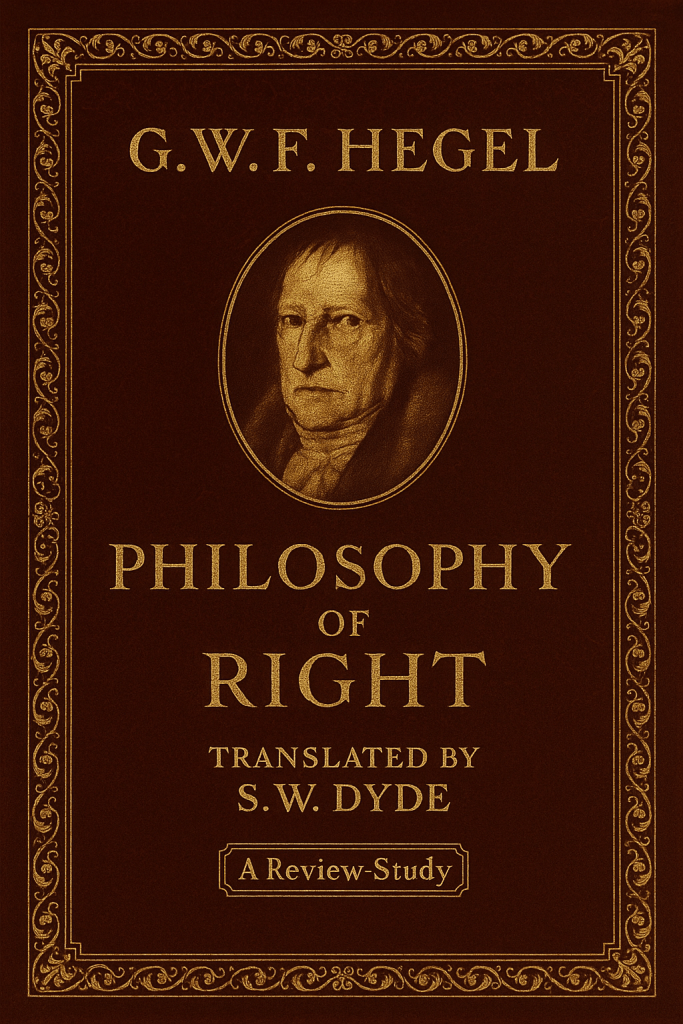
The Philosophy of Right develops a precise claim: to exhibit right as the actuality of freedom, to show how freedom—no mere predicate of the subject but the subject’s own substantial form—realizes itself through the determinate institutions of ethical life. Its distinctive contribution is methodological as much as doctrinal: it refuses both the empiricist compilation of legal materials and the voluntarist appeal to feeling, insisting upon a speculative presentation in which the concept generates its own reality. In this unabridged Dyde translation, one can see the work’s compositional grain—paragraphs, Hegel’s notes, and lecture “additions”—and with it the pedagogical intention to make the logic of will visible as a sequence that moves from abstract personality to the family, civil society, and the state. The unity of “law” and “politics” here is neither an edict nor a metaphor; it is the form in which reason becomes world.
Hegel’s author’s preface declares that the science of right must be understood from the standpoint of speculative method, where matter and form are inseparable and proof consists in the concept’s own necessity. Philosophical cognition, he argues, has fallen into disrepute not because demonstration is impossible, but because rules of definition, classification, and inference have been either fetishized or discarded in favor of “free speech from the heart,” thereby confusing subjectivity with science. The Logic (presupposed here) has already exhibited what a speculative proof is; the present treatise displays that logical spirit in a concrete field. Hence the work does not construct a state “as it ought to be,” but seeks to know the actual state as reason—“to apprehend what is”—and to reconcile spirit with the present as the rose in the cross. It is the famous “grey in grey” of philosophy’s belatedness that marks this standpoint: when a form of life has matured, thinking articulates its inner law; Minerva’s owl flies at dusk, not at dawn.
The introduction sets the object: the idea of right, i.e., the concept and its realization, and immediately identifies that idea with freedom. Freedom is no empty faculty alongside thinking; will is “a special way of thinking,” the self-determination of thought into actuality. Thus the territory of right is spirit; its more determinate place is the free will, and the system of right is the kingdom of actualized freedom. The conjunction of concept and embodiment here is critical: just as soul is not without body, so the concept has its truth in the shape it gives itself. Right is this embodiment of freedom—and therefore cannot be reduced to opinion, accident, or the “wares of sleep.”
From the outset Hegel distinguishes between the philosophical science of right and positive right. The former develops the concept; the latter records validity in a state with the contingencies of history, application, and decision. A Montesquieu-like historical sense is welcome, where legal forms are grasped in their total nexus; but the historical origin of an institution is no justification of its concept. A thing may have arisen necessarily under a set of circumstances and yet be devoid of rational right; conversely, a rational institution cannot be validated by genealogy alone. To confuse origin-in-time with origin-in-concept is to replace the absolute with the relative. In short, the philosophical treatment neither ignores positivity nor bows to it; it exhibits where and why right must become positive while keeping its criterion in the concept.
The work then begins in medias res of the will’s structure. The will contains the moment of pure indeterminacy, the “I” that withdraws from every given content; it contains equally the moment of determinacy, in which the “I” posits a specific end and so becomes actual. These are not two faculties externally combined; they are the dialectical elements of one and the same practical thinking. Negative freedom—the passion for emptiness as boundless possibility—may even achieve political form as the fury that abolishes all determination in the name of equality. But such indeterminacy is itself a determinacy; the truth of freedom must therefore pass beyond this abstractness to the will that determines itself in and through an objective world. The will’s infinite subjectivity must encounter its own limits in order to be with itself in the other.
From here the first part presents Abstract Right: the sphere in which the person, as a self-related universal, gives itself existence in things and enters relations of possession, exchange, and accountability. The person is free in the austere sense of personality; its reality is first property—not because human fulfillment lies in things, but because the will must externalize itself and thereby stabilize the distinction of mine and thine. The act of possession, use, and alienation elaborates this first embodiment. In this sphere right’s commandments have the character of prohibitions (“do not infringe, retain equivalence”) because the relation to the other is only formally recognized; the content is still an object external to will as such.
Property then summons its own contrary. Because the thing is not merely a mute object but a bearer of my will that stands for another, the passage to contract is necessary: the objective relation of will to will, where I remain owner only through identity with another’s will. Contract does not subordinate me to an alien subject; it elevates my subjective willing to universality, creating a common will through which property changes hands. The logic within contract—its reliance on recognition, the separation of ownership and possession, the need for cautio (security) via pledge, mortgage, and surety—reveals that right cannot remain at the level of externality. Because the particular will continues to stand over against the common will, there is always exposure to breach; hence wrong emerges as the negation of right that right must negate.
Wrong appears in ascending concretion: the unpremeditated injury that fails to recognize another’s right; fraud, where subjective will subverts the common meaning of words and deeds; and crime, where the particular will posits itself as the source of right against right’s universality. The inner necessity here is not moralism but logic: the very structure of right as the unity of an intrinsic universal and an existent particular contains the possibility of their opposition. Wrong, however, is a nullity relative to right; in punishing crime, right negates its negation and becomes actual, not merely potential. This is the turning point at which the abstract universality of right shows its insufficiency: justice carries within itself a claim to inwardness, to the subject’s own self-relation.
The transition to Morality is therefore the necessary deepening of freedom. The will is now for itself: it posits itself as accountable not only for what it has done, but for the inner determination of its deed as its own. The doctrine of purpose and responsibility marks the first inflection: I can be imputed only for what was in my representation and end. Yet action inevitably enters a world of consequences whose web cannot be fully commanded; the right of knowledge protects the finite will from an infinite burden, but it also obliges the will to cognize the universal side of its deed. This tensive structure leads to intention and well-being: I strive to secure my particular good in the universal nexus; and finally to the good and conscience: the universal end of will as such, and the inward tribunal that lays claim to absoluteness while risking the collapse of all objectivity.
Hegel’s analysis of conscience is deliberately problem-laden. If authority-driven casuistry turns good and evil into probabilities managed by experts, subjectivism fares no better; it enthrones conviction as criterion and dissolves objectivity into private certainty. Then “irony” appears: the airy sovereignty of an “I” that conjures and disperses norms at will, a culture’s vanity at high tide. The very excess of inwardness becomes its own vacuity. What is needed is neither the despotism of the letter nor the anarchy of feeling, but the concrete identity of subjective will and the good. The name for that identity is the ethical system: the truth of right and morality in which both find their measure and fulfillment.
Ethical life (Sittlichkeit) is the idea of freedom that lives—the living good—whose actuality is the action of self-consciousness in institutions that are themselves the substance of that action. Its first natural actuality is the family: a unity of love and trust in which the person transcends the prudish fixity of mere personality. Marriage, common property, upbringing, and dissolution are treated here as moments in which the ethical substance becomes determinate: the family is neither a mere contract nor a mystical fusion; it is a natural ethical totality whose integrity nonetheless gives way, by its own principle of personality, to a plurality of families. At this point the ethical appears “lost,” not in fact but in form, because universality now emerges only in and through independent particulars. That sphere is civil society.
Civil society is the system of needs, justice, and police/corporation—the web in which individuals, as private persons, pursue well-being while relying upon a universal order that they neither command nor fully understand. The system of wants discloses the rationality of labor, interdependence, and exchange; the administration of justice universalizes the right of persons into standing institutions; police and corporations represent the immanent universal that mitigates contingencies, coordinates welfare, and offers a halfway house between atomized interest and the state’s universality. Hegel’s institutional vocabulary here is deliberately prosaic; the point is to show how the universal inhabits the “middle term” of social life without romanticizing it. Civil society is rational, but insufficient: it oscillates between wealth and poverty, between the pride of independence and the fact of systemic dependence. It therefore requires a higher unity in which universality is not merely functional but substantial.
That unity is the state: the ethical totality in which freedom is present as objective law and as the self-consciousness of citizens who know themselves in its powers. Hegel’s insistence that philosophy “apprehend what is” reappears here with polemical edge against both abstract republicanis m and emotive anti-statism: the state is not a construct of whim, but the actuality of the ethical idea. As such it possesses internal polity (constitutional articulation), external relations (international law), and the higher court of world history. Internally, the state reconciles the moments of monarchy (the moment of decision), executive (the moment of subsuming particularity under universal), and legislature (the moment of universal determining itself as law). Externally, the relation of states exhibits force and contingency; yet even in war, states respect one another as states, the implicit covenant of their absolute worth and the possibility of peace. Ambassadors are respected; warfare is not hatred between persons; modern wars are “humanely” prosecuted to the extent that enmity is depersonalized into duty.
At this horizon the particularity of national spirits enters into a visible dialectic: passions, interests, virtues, and vices play out on the largest scale; independence itself becomes vulnerable to fate; and through these collisions the world-spirit produces itself with the “highest right,” judging lower spirits in the tribunal of history. Hegel’s austere thesis here is consistent with his method from the start: the universal is not beyond the world, but at work in it; the rational is real, and the real rational, not in the banality of whatever-happens-is-right, but in the claim that only the idea truly is, and that its appearance in time is the process by which spirit arrives at itself.
To display how each part merges into—and is finally displaced by—the next, one must track the concept’s self-movement rather than collect topics. Property presupposes personality; contract elevates personality into universality through recognition; wrong exposes the nullity of a merely external right and forces justice into action; punishment, as the negation of the negation, restores right and turns the will inward; morality universalizes the act through intention and the good, then dissolves into emptiness if it cannot find objectivity; conscience, pushed to its limit, arrives at irony; the ethical system rescues both universality and subjectivity by being their concrete identity; family realizes this identity naturally, but dissolves into the openness of particularity; civil society organizes this openness, but cannot secure universality as substance; the state secures the substance, and in doing so exposes its own finitude in the international relation; world history, finally, is the process in which this finitude is judged and aufgehoben in the universal spirit’s self-revelation. Each displacement is not a mere replacement; it is a sublation in which the earlier moment is preserved as a determinate element in a richer whole.
If one asks for the “evidence” in a field whose objects are institutions, Hegel’s answer is constant: the concept’s necessity is its proof; and this proof becomes phenomenally legible where the earlier form forces a transition. Thus the necessity of contract is read off the publicity of property itself—as for another—and not smuggled in from sentiment or convenience. The necessity of wrong is read off the abstractness of the universality achieved by contract; the necessity of punishment is read off the nullity of a negation that claims universality for the particular. Likewise, the necessity of moving beyond conscience is read off the self-dissolution of conviction into arbitrariness. These are not moral exhortations; they are the inner logic of the will, displayed in institutions.
The outer framing of the volume matters for grasping this inner motion. Dyde’s translator’s preface stresses that the book before us has three strata: the original paragraphs, the author’s notes, and student additions from Hegel’s lectures. The additions often illuminate but do not carry canonical force; the notes expand argumentative lines the paragraphs have only sketched. This compositional layering mirrors the doctrine it serves: a core structure, its reflective articulation, and a living voice that situates the structure in pedagogy and debate. The same preface underscores three general stakes drawn by Hegel’s editor Eduard Gans: the work’s systematic thoroughness; the unification of law and politics as organic phases of one whole; and the place of “natural right” both prior to and after the Philosophy of Right, i.e., in the subjective mind that precedes the objective spirit and in world history as the world-spirit’s right. These frame the science without replacing its proof.
Within the parts themselves, Hegel’s compact analytic moments often carry polemical resonance that the additions make explicit. In Abstract Right, for instance, the treatment of pledge and surety shows how a purely object-centered relation cannot suffice: the value—rather than the particular thing—is what must pass, and the guarantee of this passage presupposes recognized persons. The juridical ingenuity of cautio is a symptom of a deeper truth: universality is already at work in the market form, though not yet as ethical substance. In Morality, the analysis of consequences warns against two opposite errors of the understanding: to judge solely by consequences or to disregard them entirely. The consequences are the act’s own universal form; yet the unessential accretions of circumstance cannot be imputed as if they were the act itself. Such discriminations are the will’s schooling in universality.
International law and world history, finally, disclose the extremity at which the ethical idea confronts its own limits. Because the state is particular, the sphere of its external relations manifests contingency; no higher earthly judge composes disputes. Even so, the recognition of states persists as a norm that humanizes conflict; the very conduct of war presupposes the concept of peace, the respect for ambassadors, and the principle that hostilities are not vendettas against families or private persons. The “family of nations” in Europe represents a concrete attenuation of enmity grounded in shared forms of right, religion, and civilization. Yet this sphere also displays the dialectic by which national spirits, in their finitude, are superseded by the world-spirit, whose judgment is history itself.
If one keeps the short description’s accent—freedom realized beyond Enlightenment definitionism and romantic intuitionism—the book’s scholarly stake can be clarified in closing. Hegel does not abolish the Enlightenment; he subjects its abstract universals to the test of actuality, reconceiving freedom as participation in an ethical order whose institutions are the truth of right and morality. He does not enthrone the state as an idol; he displays it as the living unity of universality and subjectivity, the place where citizens recognize themselves in law and where law is nothing alien because it is their own substance. Nor does he dissolve politics into history; he locates both within spirit’s demand to be at home in what is. The method remains constant: to let the concept generate its determinate world and to show, at each threshold, the insufficiency that drives the transition. Philosophy paints grey in grey not to quiet critique but to make critique rational—so that reconciliation is no compromise with injustice, and freedom is known as the work of spirit that has learned how to be with itself in the other.
If one wanted, beyond this point, to track every cable of the argument—every paragraph on marriage, inheritance, police power, corporations, estates of the realm, or civic representation—one would find the same logic at work: a refusal of both abstract individualism and abstract universalism, and a care for the institutions in which freedom is neither specter nor decree but ethos. The book’s distinctive contribution, then, is not a catalogue of opinions about family, economy, or constitution; it is the proof that these are the necessary shapes of freedom’s own concept, each preserved and aufgehoben in a system where the rational is real because it has learned to be concrete.
 Simon Gros
Leave a comment