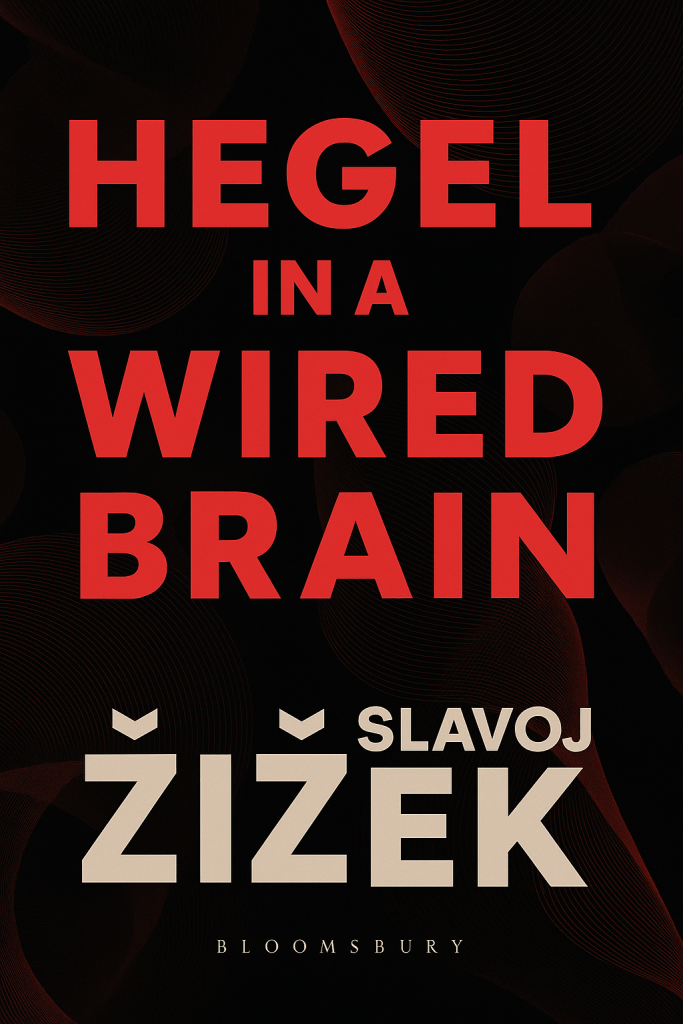
In Hegel in a Wired Brain, Slavoj Žižek approaches G.W.F. Hegel not as a relic preserved behind the glass of intellectual history rather than as a thinker whose conceptual architecture continues to shape the space in which we now attempt to understand our own technological transformation. Published to mark the 250th anniversary of Hegel’s birth, Žižek rejected the idea of philosophy as retrospective commentary. If, for Hegel, thought arrives belatedly, then this belatedness becomes an advantage precisely when confronting phenomena Hegel himself never imagined: neural interfaces, predictive algorithms, the self-training of artificial intelligence, and the integration of cognition into networks. Žižek begins not with some nostalgic return to Hegel but with the question: what happens to “thought” when thought becomes externalizable, transferable, and computationally iterable?
Žižek’s project is structured as an experiment in conceptual endurance. It asks whether Hegel’s dialectical intelligence can still register the shocks of a world in which brains may one day communicate as directly as devices, in which platforms mediate both desire and knowledge, and in which the promise of a shared cognitive space is indistinguishable from the threat of total synchronization. The wager is precise: if Hegel’s notion of absolute knowing sets the limit at which a historical order becomes thinkable, then the wired brain and the figure of Singularity do not signify our leap beyond Hegel but the latest theater in which the dialectic stages the paradoxes of freedom, self-relation, and collective life. Rather than forecasting futures, Žižek uses Hegel to trace how new forms of power and subjectivity emerge from their own internal breakdowns.
The opening move is therefore not to position Hegel behind us, but to rearrange our vantage. Hegel becomes a frame for interpreting the contemporary, not an ancestor to be commemorated. The fact that Hegel knew nothing of digital architectures or neural implants is not a limitation; it is the very condition that allows his method to illuminate them. For Žižek, the claim that the twenty-first century will be Hegelian is neither a celebration of the canon nor a polemical provocation. It is a hypothesis about how novelty now appears: as the encounter between unprecedented technological conditions and the persisting contradictions that structure subjectivity and social life. The book thus asks how our present reorganizes itself when Hegel is treated not as the last chapter of a past philosophy but as an active vantage point from which the logic of the new can be discerned.
To ask from whence one speaks is already to outline the triad—Spinoza, Kant, Hegel—that fixes the method’s horizon: realist ontology; the transcendental fissure that withholds the thing; and Hegel’s speculative reversal in which limitation is in the thing and inconsistency is the signature of reality rather than an epistemic accident. When Cantor and Gödel sharpen this inconsistency into a structural impossibility of consistent totality, Žižek reads Hegel not as a theodicy but as the only theory equal to such paradoxes. The real does not wait beyond phenomena; it inscribes itself as their misfit and self-reference. From here the book’s center of gravity becomes the contemporary site where consistency and totality are forced back upon one another: the project of directly wiring brains to machines and to each other.
The composition is explicitly paratactic. Rather than a systematic treatise, the book lays out a sequence of violently juxtaposed thought-episodes—digital police, neural interface, Soviet tech-gnosis, the gnostic turn of Singularity, a theological detour through the Fall, an excursion into the reflexivity of the unconscious, a literary fantasy of Beckett’s unnamable—followed by a concluding treatise on digital apocalypse. This formal choice is not an aesthetic caprice; it emulates the Phenomenology’s own syntax of disjunctive series, where the unity of the work is performed by the way each part is displaced by the next, not by a higher architectonic imposed from above. The secret model, Žižek confesses, is Doctorow’s Lives of the Poets: disparate stories that are recognized retroactively as fragments of a single life, an apt figure for how the book’s essays rebound toward the final treatise that frames their philosophical stakes.
The first displacement exposes the political ontology of digitalization as Fichte’s revenge. If Fichte’s police imagination once looked comic in its demand for preventive oversight—an omnipresent registration that tracks every citizen’s movements and possibilities of transgression—Žižek notes that the empirical objection (“who would supervise the supervisors?”) fades when the supervising agency is a distributed data infrastructure. The earlier Hegelian retort—that a rational state distinguishes between what is essential to unity and what should be left to free life—now misfires against predictive governance and pre-emptive regulation. The form of unfreedom that matters today is the one experienced as freedom: the subjective exercise of choice coincides with objective control, precisely because the medium of choice has become the interface that captures, profiles, and anticipates the chooser. Surveillance capitalism supplies the police without a state: privatized infrastructures that convert human experience into behavioral surplus, while liberal freedom is reframed as the burden of constant self-entrepreneurial choosing. The Hegelian point is not moral panic but conceptual clarity about a unity of opposites: the more permissive the system, the more completely it must format the field on which permission is exercised.
The analysis escalates where the interface touches the nervous system. “Wired brain” names a direct link where thoughts trigger events and machines stimulate or steer thought. Žižek declines the technological question whether this is feasible now; instead he asks what follows for the structure of experience and for the status of the free individual, should even modest versions materialize. He formulates three levels for a critical analysis: feasibility, the possibility of genuinely sharing experience rather than extracting signals, and the survival of subjectivity in a common noetic space. The decisive thesis appears early: what eludes Singularity is not first-person qualia as such, but the unconscious in its specific correlation with the autonomy of the Cartesian subject—the reflexive cut that makes the subject unequal to itself. This is the pivot on which the later sections—on the Fall, on the libidinal economy of Singularity, on the Unnamable—will turn back.
Žižek’s scene-setting insists on a double demarcation he calls a Hegelian approach. First, do not define in advance the very objects whose emergence the inquiry will itself articulate; “wired brain” and “Singularity” are formally marked topics, to be filled out by the dialectic that attempts to think them. Second, refuse empirical dispersion without lapsing into abstraction. The book deliberately brackets technical roadmaps and limits itself to the one question Hegel would recognize as essential: how will a wired brain transform not merely our self-experience as free individuals, but our standing as free individuals? In Hegelian terms, only when threatened by its negation does a form exhibit its essence; only at dusk can one grasp what a day was.
At this point the book’s inner narrative ideas gather closer. From predictive policing to neuro-interfaces, the passage is not a change of topic but a change of medium, from a symbolic big Other that aggregates traces of action to an apparatus that proposes to read intention itself. The ethical danger is not solely extraction without consent; it is the redefinition of consent when the channel of willing and the channel of registration converge. Even rudimentary brain-to-brain experiments expose the temptation to treat intention as a programmable unit and cooperation as a circuit property. The methodological effect is to press the question whether communication without external mediation is thinkable in Hegel’s terms at all, or whether the very dream of removing mediation is a gnostic fantasy that would dissolve the symbolic space in which identity, negation, and recognition take place.
To historicize that fantasy, Žižek reopens a largely forgotten archive: early Soviet bio-cosmism. There, in conditions of material scarcity, emerged a strange alloy of mechanist materialism and salvific gnosis: collective paradise by scientific means, abolition of sexual difference, techno-resurrection of the dead, a cosmic Reason in which all beings would participate. Andrei Platonov’s fictions supply the corrective: in “Eternal Tract,” a device that transmits thought-commands leads to environmental devastation and death; in The Foundation Pit, the negative monument is a hole that will never be filled, a figure of expenditure that produces no world. Žižek reads Platonov’s toská—a desolating ache where life is reduced to the labor of survival—as the experiential underside of grand projects that promise unmediated communion. The lesson for Singularity is surgical: the desire for a common mind may be the latest version of a gnostic wish to cancel finitude, whereas a Hegelian Aufhebung preserves the gap as the condition of freedom.
This brings the theological motif to the surface. If Singularity is advertised as the undoing of alienation, Žižek retrieves a paradoxical doctrine of the Fall to test the promise. The Fall, allegorized as surrender to the immediacy of sensation, is punished by a loss of mastery over the body; the moral is not prudery but a philosophical point about mediation. To abolish mediation in the name of purity is to confuse the condition of thought with its obstruction. Hence the crucial difference between sublation and abolition: a dialectical preservation that internalizes its negation versus a technological fantasy that foresees a leap to pure immanence. In his late turn beyond the gnostic register, even Platonov’s communism accommodates toská as the stubborn residue that no joyous fusion can metabolize. In Žižek’s hands the upshot is rigorous: a wired communion that dispenses with language would not be a higher actualization of Spirit; it would be a destruction of the scene on which Spirit exists at all.
Freedom then returns as the fulcrum. Liberal individualism locates freedom in the narrating self; predictive infrastructures expose that self as a bricolage of stories that rationalize drives and contingencies. The liberal rescue—delegate to the better knower, even let “Google vote for you”—mistakes an epistemic advantage for a political right. Hegel is more radical and more sober: reconciliation is not a glowing ideal on the horizon; it is the bitter truth that emerges when projects fail on their own terms. The French Revolution’s terror and twentieth-century attempts at emancipation are not admonitions against trying; they are the form in which a truth appears when pushed as if its conditions did not include their own contradiction. In the same register, the wired brain is not a prophecy to be endorsed or feared; it is a contemporary figure of the infinite judgment—“spirit is a bone”—now rewritten as “mind is a machine,” a paradox whose clarity depends on maintaining the cut that makes identity differ from itself.
The psychoanalytic hinge secures this cut. What eludes Singularity, Žižek maintains, is not the privacy of experience but the unconscious as the objective structure of misrecognition by which the subject is constituted. If subjectivity arises where a set includes itself among its elements, where a genus fails to subsume its own case without remainder, then the reflexive paradoxes evoked by Cantor and Gödel are not post-Hegelian refutations but confirmations of the Hegelian insight that inconsistency is the stamp of the real. A brain-to-brain channel may transmit commands or even patterns of association; it does not transmit the gap in which a subject is implicated by the very act of speaking—by the very act of consenting, willing, or knowing. The point is delicate and decisive: a system may outperform us diagnostically and coordinatively; it cannot become the place from which we are accountable to ourselves and to others unless it reconstitutes the symbolic scene it meant to bypass.
The book’s literary interlude—Beckett’s “Unnamable”—plays this thesis as a thought-experiment. Imagine a consciousness that refuses all stable predicates and persists as an exhausted monologue. Such a voice frustrates capture because it is less than a message; it is an insistence at the level of form. Žižek’s suggestion is not that human thought will forever outrun decoding but that what counts as thought for the purposes of freedom is not reducible to transmittable content. The unnamable is an index of subjectivity’s structural misfit, the same misfit that keeps the dialectic moving and that preserves the place of the I as a point of non-coincidence with itself.
All these threads are finally gathered in the concluding treatise on digital apocalypse. The question is crafted with theological precision: apocalypse with or without a kingdom? Will the passage to Singularity be a disclosure that also inaugurates a post-human order, or a naked apocalypse—a downfall without redemption? Žižek refuses chiliastic comfort. He proposes that the apocalyptic element is intrinsic to our encounter with truth because recognition shatters the world sustained by our illusions. A wired world that discloses to us how we choose would already be catastrophic for the liberal image of agency. But catastrophe here is not necessarily annihilation; it is the subjective experience of a transformation we cannot render hospitable without altering our concepts of freedom, responsibility, and common life.
The book’s “outer frame” thus clarifies itself retroactively. The early chapters on digital policing and neural interfacing do not merely prepare the ground; they compose a field in which the theological and psychoanalytic detours can do their clarifying work. The sequence is deliberate: from the administrative logic of predictive control, to the metaphysical temptation of immediacy, to the theological grammar that names that temptation as a desire to undo the Fall, to the analytic insistence that freedom is born at the site of an unhealable split. Each step converts the preceding one into a moment of a larger movement; each is displaced, not discarded, by what follows. The final treatise does not summarize; it recognizes the notional truth at dusk: our epoch’s imaginary of perfect knowledge is the mirror in which the dialectic glimpses the negative labor that sustains subjectivity.
If one insists on the empirical horizon, Žižek concedes a limited role to feasibility studies, exoskeletons steered by thought, non-invasive pathways that register internal speech, even primitive brain-to-brain tasking. Those vignettes are not the book’s evidence; they are its occasions. The real evidence is conceptual: whenever mediation is short-circuited in fantasy, the social and institutional remainder grows monstrous; whenever the unconscious is ignored, compulsion returns under the mask of optimization; whenever freedom is imagined as transparency, domination reappears as personalization. Such are the reasons why the book remains internal to Hegel while relentlessly courting what Hegel “could not imagine.”
This problematic reaches a particularly sharp point in Žižek’s treatment of Elon Musk, whose public persona, entrepreneurial theatricality, and quasi-prophetic rhetoric around Neuralink epitomize the contemporary fantasy of emancipatory immediacy. Žižek refuses both the cynical dismissal of Musk as a profit-driven showman and the technophilic vision of him as a Promethean agent of species-transformation. Instead he seizes Musk as a symptom-bearer, a figure through whom our epoch attempts to imagine the abolition of mediation—the collapse of language, labor, education, political deliberation, and psychic interiority into a single transparent circuit of cognition. What fascinates Žižek is that Musk does not merely promise new capacities; he promises the removal of friction, which in Hegelian terms is the removal of the very negativity through which Spirit constitutes itself.
Neuralink’s promotional scenes of prosthetic recuperation or telepathic interface appear as therapeutic breakthroughs, yet their rhetorical horizon is ecstatic fusion: a species unburdened by the slowness of speech and the opacity of desire. Žižek reads this as the return of the gnostic yearning for a prelapsarian unity, where thought would be pure light without the resistant texture of the world. However, in Hegel’s logic, the labor of mediation is not an obstacle but the substance of freedom; it is only because spirit is delayed by the world that it becomes capable of reflection, responsibility, and recognition. Musk’s vision thus becomes structurally tragic—not because it seeks too much power, but because it seeks to abolish the very conditions under which power becomes intelligible. The wired brain, in Musk’s choreography, is an ontological short-circuit: it identifies emancipation with the elimination of the gap that makes selfhood possible. Žižek presses the point without polemic: a subject without delay is not liberated but dissolved. The paradox is that Musk’s dream of the transparent mind exposes, with unprecedented clarity, why the unconscious is not an evolutionary leftover but the enabling structure of freedom. The moment one attempts to bypass it, one abolishes the subject in the very act of announcing its completion.
For closing let’s restate the stake with the sobriety of a practical maxim. If Singularity comes, the question will not be whether to flee into isolation or to merge ecstatically. Freedom will consist in organizing disconnectability as a political right while reconstructing the symbolic institutions—law, language, responsibility—that can survive immersion. The only chance of reconciliation is to preserve, within any network of shared signals, the very negativity that the network cannot encode. In that sense, Žižek’s book is neither celebration nor lament. It is a Hegelian instruction in how to see the truth of our time in the way our projects go wrong: the insight that a reconciliation worthy of the name appears only when we endure the failure of immediacy and turn the gap it reveals into the medium of common life. That, and nothing more, is enough—until dusk falls again.
 Simon Gros
Leave a comment