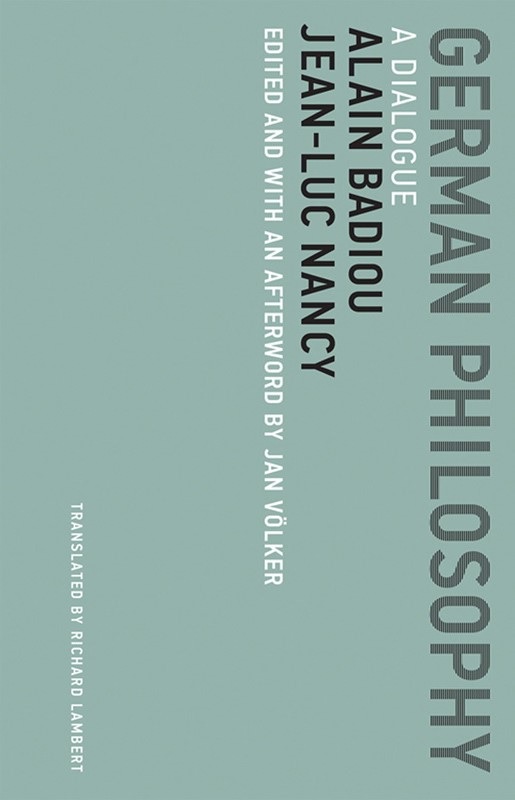
German Philosophy: A Dialogue stakes a precise claim: that a contemporary reckoning with the German tradition can be staged as a rigorously philosophical dialogue whose method is neither commentary nor synoptic lecture, but the testing of concepts at their points of maximal tension where France and Germany have historically intersected. Badiou and Nancy submit the canonical figures—Kant, Hegel, Marx, Heidegger, Adorno—to a procedure that measures what can still be thought under their names once one insists on universality without folkloric nostalgia and on experience without psychologism. Framed by Jan Völker’s editorial composition and afterword, which specify the setting (Berlin, January 30, 2016), the revision of the transcript, and two additional written questions (Adorno; contemporaneity), the book contributes a model of philosophical presentness grounded in exacting claims about the knowable, the sayable, and the political forms these claims presuppose and re-shape.
The book’s outer frame is explicit and exacting. The dialogue took place at the Universität der Künste Berlin, was revised by the interlocutors, and includes post-event responses to two further questions on Adorno and on philosophy’s contemporaneity; Völker’s afterword provides a reflective coda on what it means to conduct “a philosophical dialogue on German philosophy from a French perspective,” and it thematizes the paradoxes of philosophical dialogue as such, including its recursive destination in writing and its refusal to be reducible to an exchange of opinions. This composition sequence—event, revision, addition, afterword—secures an arc whose “present” continually redoubles itself in publication and commentary, such that orality neither dissolves into the page nor stands outside it. In Völker’s formulation, philosophical dialogue is “always already bound for the book” while the book is “not its terminus,” a temporal zigzag that lets concepts and problems co-constitute a shared space and time; the afterword thereby formalizes the book’s self-understanding as dialogue that writes philosophy’s present.
This exterior framing bears directly on the interior method. The very first exchange positions the Franco-German relation as both historical conjuncture and conceptual operator. Badiou delineates discontinuous philosophical “periods”—Greek, Arabic, seventeenth-century French, eighteenth-century English, German Idealism, and a twentieth-century Franco-German sequence organized around phenomenology and its legacies—culminating in an uncertain present in which the end of a recognizable “French” period compels a new responsibility for young German and French thinkers. The point is not to archive a tradition but to mark periodicity as a philosophical variable: thought intensifies in spurts, with periods retroactively constituted by the problems they have managed to pose as universal.
Nancy’s response relocates the hinge: the Franco-German crossing is neither a thin diplomatic corridor nor an academic traffic pattern, but a transformation of saying itself—language in which the act of enunciation inhabits what is said. German philosophy, he proposes, introduced a heightened reflex of voice such that philosophical discourse comes to operate as praxis in its own right; the difference with French clarity is not a matter of rhetoric but of the ontological status of discourse as act. This is anchored in concrete claims about language—from Leibniz’s early meditations on German as a philosophical medium to Heidegger’s exemplary suspicion regarding language’s privilege—which Nancy compresses into a thesis: German thought makes palpable a saying within the said. The stakes for a dialogue about German philosophy thus include an account of how texts do what they say when they say what they do.
Within this frame the book advances, not by problem sequences that conjoin method, claim, and counterclaim. The first such sequence turns on Kant. Völker presses both interlocutors on the timeliness of the critical inheritance; Badiou answers by stating an axiom: reason has no limit. The Kant he admires and resists is the obsessive constructor of limits—of pure reason’s scope, of morality’s formality, of aesthetic divisions—whose genius consists in transforming his obsessions into an indispensable modern apparatus, and yet whose strategic aim remains unpalatable to a “neoclassical” taste for the absolute. Badiou’s axiom is not bravado; it is a methodological decision that identifies obscurantism with any thesis of the unknowable as such. Explanatory labor remains a categorical imperative of truth-seeking, precisely where culture tempts one to confuse explaining with excusing.
Nancy opens Kant differently. “Limits” in Religion within the Limits of Reason Alone designate prophylaxis against Schwärmerei, not a foreclosure of reason’s infinite drive. Reason is driven by a Trieb toward the unconditioned, and critical delimitation separates Verstand (understanding) from Vernunft (reason) to secure—not abolish—the field in which the Ideas orient thought beyond object-knowledge. The thing-in-itself is read as posited existence, the bare there is of the real, rather than a hidden substrate; what matters is that the positing is multiple from the outset, such that existence refuses to be the behind of phenomena. Freedom then names the keystone of the system—capacity to begin a new series—which binds critical philosophy to history rather than removing it from it. This reading, with its refusal to fetishize unknowability and its insistence on the multiple existence of things, directly rebuts the caricature of Kant as the legislator of epistemic defeatism.
The second sequence tests the concept of system where negativity is concerned. Völker’s question—how much system is necessary to think negativity?—solicits two complementary strategies. Nancy’s Hegel is the mobility of the negative itself: the ceaseless activity by which being sublates the “spiritless copula.” System here names neither a finished edifice nor a deductive prison, but the living whole within which determinate negations form lines of passage; negativity is movement. Badiou’s Hegel is an object of passion and limit alike: a vast prosodic machine of traversal whose encyclopedic impatience strives to exhaust the shapes of spirit and of nature, thereby closing the horizon of the to-come even as it narrates the path of spirit toward absolute knowledge. The beauty of the construction—its creative negativity, its daring jargon, its narrative genius—cannot erase the pressure toward completion radiating from the work’s architectonic. The difference is not formal; it specifies two metrics of philosophical sufficiency: the self-foaming infinite that enjoys itself and never halts, and the encyclopedic exhaustion that knows itself as ending.
As the dialogue advances, it acquires a determinate ethical-political vector: the mourning of the gods as a condition for a universalizable creation. Badiou’s claim is austere. Modern philosophy organizes mourning in such a way that forgetting becomes possible; the element of creativity is the element of loss itself, and from within this element a shareable universality can be established. Humanity’s task after the failure of divine antagonists is to construct a universal peace, and the philosophical task is to secure the protocols by which this work is rationally shared. Nancy agrees that the religions’ fantasmatic capture must be resisted, though he gives the scene a different accent: the impossible—that which exceeds calculable possibilities—must be thought within philosophy, without summoning back a sacred guarantee. The genealogical line here runs from the Greek intimations of the gods’ departure to Nietzsche’s aphoristic shadow-durations; it arrives in a present that neither seeks restoration nor treats absence as merely negative.
A third sequence engages Marx and the status of praxis. Here the dialogue performs a fine discrimination. For Badiou, Marx is not straightforwardly a philosopher, just as Freud is not: each organizes philosophical resources toward a definite, codified practice—class struggle, analysis—whose ends are extra-philosophical. This does not diminish the philosophy in Marx, particularly the anthropological horizon of generic humanity and the critique of specialization, which sketch a universal value of the human as polymorphous activity beyond the division of labor. It does, however, admonish against confusing philosophical conceptuality with programmatic transformation; the now-famous eleventh thesis on Feuerbach misdescribes philosophy as “interpretation of the world,” whereas philosophy is concept-formation oriented around the problem of universality, not hermeneutics. Nancy accepts the distinction while turning the screw elsewhere: Marx does not adequately name the end he continually presupposes—the spirit of a world without spirit, the “individual property” that would remain after the disappearance of private and collective property—yet the 1844 manuscripts reveal a decisive category, jouissance, as recognition of value in and as production. The residual philosophical work is to think this absolute value of humanity without myth. The point of convergence is striking: each discerns in Marx the announcement of a generic humanity and a non-romantic universality that exceeds the doctrinal fusions of the twentieth century.
The written addendum on Adorno and contemporaneity then recasts the negativity question under late-capitalist conditions. Völker articulates the puzzle: the relative non-encounter between post-’60s French thought and Critical Theory; the urgency of a critique proportionate to the complexity of capitalism. Badiou’s answer is methodologically programmatic: revive the communist hypothesis by critiquing the negative dialectic; replace an obsession with enemies with an affirmative dialectic whose measured negation presupposes affirmation as real ground. Nancy’s reply shifts the emphasis to language and reception: Adorno’s hermetic syntax, lag in translation, the French appetite for lexical invention, and the broader question of contemporary philosophical language. The exchange neither canonizes nor dismisses Adorno; it re-positions negativity and critique as open problems whose renewal requires both conceptual invention and a transformation of how philosophical language bears difficulty.
The question of Heidegger, placed near the end, is posed with full gravity. Badiou credits Heidegger with restoring the question of being against the long Kantian-positivist eclipse while insisting on the German closure of Heidegger’s retrieval; the philosophical achievement and the political catastrophe remain inseparable data in any adequate judgment. Nancy refuses both exoneration and simplification: to say “a great moment of thinking, but…” is insufficient; the entwining of philosophical hyperbole with historical resonance must be read as such, including the hyper-political absorption that fascism names. The resulting problem is deliberately left uneasy: can there be a fascist philosophy as philosophy, i.e., a thinking fundamentally oriented by the primacy of a people or race? The dialogue’s merit lies in how it keeps the conceptual question attached to the archive—Black Notebooks, the Beiträge—without collapsing the ontological claim into the biographical file.
Running through these sequences is a meta-methodological dispute about reading. Badiou confesses to a self-described naïve reading that takes philosophers at their explicit word about their project and refuses modernization by later hermeneutics; Nancy insists that we never read from nowhere and that certain threads can be drawn from within a history of reception without claiming to ventriloquize the author’s “true” intention. This is not scholastic quibbling; it bears immediately on what counts as philosophical evidence. For Badiou, evidence concentrates in the author’s manifest claims and the system they assert; for Nancy, evidence includes the inherited use of these claims across ruptures and continuities that constitute the discourse’s present. The book lets these methods collide without adjudication, as if to demonstrate that any living dialogue about “German philosophy” today must disclose its criteria of reading alongside its theses.
All of this returns us to the afterword’s conceptualization of dialogue. Against the Deleuzo-Guattarian suspicion that “discussion” narrows philosophy to opinion-trading, Völker reconstructs dialogue as a practice adequate to philosophy’s dual allegiance to concept and problem. Concepts are the instruments of distinction; problems are the publicly shared spaces they articulate. The dialogue’s chiasm lies precisely here, where being and sense cross, where the insistence on a “real irreducible to the fiction of something hidden” becomes the condition of a present that is neither linguisticist nor subjectivist. The contemporary vogue for “new realisms” is acknowledged as a symptom; the book’s wager is that the Franco-German combinatorics can pursue the real without yielding to naïve objectivism because it never forgets that the saying and the said co-constitute the scene of truth. Hence the insistence that philosophy’s address is universal yet always enacted in historically accented languages; translation is not a concession but the milieu where philosophies appear “in their true structure,” rejuvenated by the repetition of their distinctions.
If one threads the book according to its strongest claims, a single argumentative figure comes into view. First, the historical discontinuity of philosophical periods is neither an antiquarian chronology nor a nationalist registry; it is the modality by which universals acquire address. Second, the Kantian bequest is a doubled imperative: separate understanding from reason so that the drive to the unconditioned can be thought without fetishizing “unknown things,” and bind the practical and aesthetic Critiques to a thinking of freedom as historical initiative. Third, Hegelian negativity must be valued as movement and worried as exhaustion; philosophy traverses all things and risks closure in the same gesture, which is why the enjoyment of spirit at the end of the Encyclopaedia can name both infinite fulfillment and the temptation to end the future. Fourth, Marx’s generic humanity supplies the anthropological figure of a universality that has no need of myths, yet philosophy guards its difference from the programmatic so that its concepts do not collapse into policy. Fifth, Heidegger’s return to being compels vigilance about the affinities and ruptures that bond ontological radicality to disastrous politics, whereas Adorno’s negativity demands an affirmative dialectic that re-learns how to negate because it first knows what it affirms.
The cumulative effect is more than the sum of topical discussions. Each part is composed to pass into the next by a displacement: Kant’s delimitation opens space for Hegel’s movement; Hegel’s movement occasions the question of historical completion; Marx’s praxis forces a differentiation of philosophical and extra-philosophical procedures; the “death of the gods” installs the existential medium in which universality must be built without transcendental guarantees; the critique of negativity re-centers affirmation so that critique does not harden into ressentiment; the problem of Heidegger bows the whole back to the basic decision about the real that had underwritten the first pages. The dialogue is thus a spiral rather than a line; its afterword folds the spiral into a reflection on the genre that made the spiral possible.
It is helpful, as closing clarification, to register the book’s distinctive contribution in three interlocking precisions. It clarifies method by exhibiting dialogue as the philosophical form in which concept and problem achieve co-presence without subordination; it clarifies claim by arguing, against both obscurantism and positivism, that the real is accessible under protocols of reason that remain shareable in common language; and it clarifies evidence by refusing to isolate the archive from its uses while also refusing to collapse the archive into those uses. The philosophical stake is the construction of a contemporary universality exacting enough to mourn what it must, alive enough to enjoy its own activity, and disciplined enough to name its axioms—no unknowable as such; negativity as movement; affirmation as the ground of critique—without rhetorical grandstanding. Under the conditions the book itself sets, that is what it means to approach “German philosophy” from a “French” vantage: to let translation, in the fullest sense, be the medium in which thinking’s present is shared.
 Simon Gros
Leave a comment