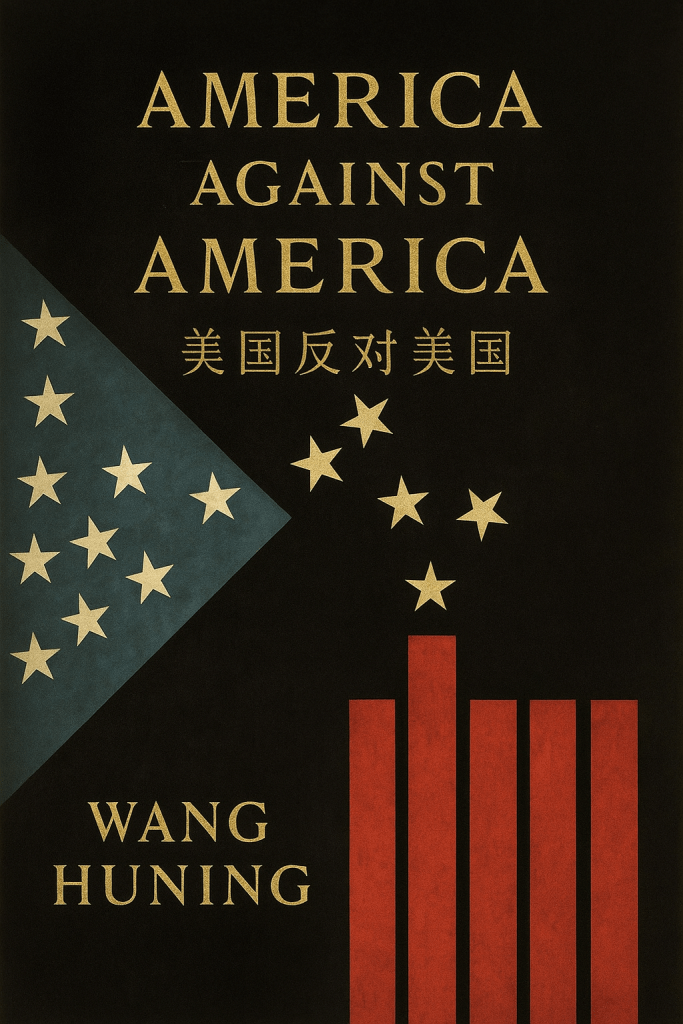
In 1988, a young Chinese scholar undertook a research trip to the United States at a moment when the world was undergoing profound political and economic realignments. Over the course of six months, he traveled through 30 cities and visited 20 universities, observing not only institutions of learning and government, but the texture of everyday life—the streets, neighborhoods, communities, and the subtle patterns of social interaction. At the end of this journey, he composed a work entitled America Against America (sometimes rendered as America Versus America), a sustained reflection on the internal contradictions of the American political and socio-economic system, and a measured critique of the ideological tensions embedded within capitalism and liberal democracy as they appeared at the close of the 20th century.
That young man was Wang Huning, who is now a member of the Chinese Communist Party’s Politburo Standing Committee—China’s highest decision-making body—and the first-ranked secretary of the CCP Secretariat. Often referred to as the “Grey Eminence” of the Party, Wang has long been regarded as the chief architect of contemporary Chinese political thought, shaping guiding ideological frameworks under three successive paramount leaders beginning with Jiang Zemin in the 1990s. More than three decades after his American journey, Wang remains a central figure in the formulation of China’s domestic governance strategies and its foreign policy posture, influencing how the Chinese state interprets, responds to, and positions itself in relation to global power shifts.
America Against America is therefore not simply a travelogue or a commentary on another society. It is an inquiry into the conditions of American success in the 20th century—its dynamism, technological leadership, and institutional flexibility—as well as a sober analysis of the structural contradictions that, even in the early 1990s, appeared as latent sources of potential decline. Despite being written more than thirty years ago, the book continues to circulate at the highest levels of Chinese governmental and academic life; it remains a foundational interpretive framework for how many Chinese policymakers understand the United States. For anyone engaged in the study of US–China relations today, reading Wang’s text is indispensable: it offers a window into the intellectual roots of contemporary Chinese strategic thinking, and into the enduring question of how great powers sustain themselves—or fail—under the weight of their own internal divisions.
The distinctive contribution of the work lies in the way it transforms a traveller’s ethnography into a disciplined anatomy of political management. The book’s scholarly stake is exacting: to test whether a historically-socially-culturally conditioned method of comparative analysis can grasp the American polity as a dynamic system whose coherence arises from opposed forces that it both enables and threatens. Its wager is methodological rather than doctrinal: through dense observation—airports, streets, universities, think tanks, vernacular enclaves—it asks why there is an America at all, and whether the mechanisms that achieve prosperity and order also secrete the conditions of fragmentation. The achievement is an immanent critique that preserves sympathetic clarity: the empirical richness never dissolves into caricature, while contradiction itself becomes the organizing principle of understanding.
The outer frame is declared without theatricality. The author situates his six-month, multi-city fieldwork as a concrete application of a prior theoretical design for analyzing political life as a historically-socially-culturally conditioned landscape. He cautions that he writes as an observer, not a statistical investigator, and thereby binds the argument to a discipline of vivid observation first, abstraction second. The declared aim, modest in tone yet far-reaching in consequence, is to answer a “simple” question—Why is there an America?—by tracking the management processes through which a vast and heterogeneous society holds together, develops, and contends with its own negations. This orientation supplies the work’s double fidelity: it refuses rose-tinted encomium and equally refuses coal-gray denunciation, asking instead how a specific ensemble of institutions and practices converts tendencies into order and at what cost.
From the opening pages the method takes form through images that are neither incidental nor ornamental: customs lines at San Francisco organized by status; the sparse “citizens” queue beside the dense, impatient column of visitors; the visible superiority and the equally visible frustration; the observation that entry choreography is already a lesson in membership and differentiation. In the same register, the juxtaposition of private jets and the ragged community of Berkeley’s “People’s Park,” or homeless sleepers on Bush Street on inauguration night, works less as moral shock than as a phenomenology of institutional sedimentation: law, economy, and charity each embody a politics of inclusion and exclusion that a society learns to take for granted and then must relearn as problem. The book insists that America is a name for coexisting images that refute one another while both remain true, a thought compressed in the formula America against America.
The composition sequence—announced in the table of contents—moves from landscape and infrastructure to political spirit, from national character to regulation, from interwoven forces and elections to pyramidal institutions, from “soft governance” to the reproduction of elite competence and the organization of active intelligence, and finally to the undercurrents of crisis. This order is not decorative; it encodes a thesis about causation and visibility. First the sensors and channels through which a society circulates itself; then the inherited codes by which it narrates collective purpose; then the ensemble of incentives that stabilize plural conduct into policy; then the institutions that convert preference into decision; then the factories of knowledge that feed decision; and only then the negative side of the ledger—the crises that seep between the stones of a brilliantly functioning edifice. The titles read like a system map: infrastructure and commodification; creed and constitution; habits and myths; formal and informal regulation; parties, interests, and lay advocacy; electoral drama and its structural incompletion; the verticals of authority; the managerial discipline embedded in non-state organizations; the educational and technological crucibles of reproduction; the think-tank archipelago; and, finally, family, generation, narcotics, organized crime, homelessness, race, indigeneity, spirituality, and imperial projection as the sea-floor currents that tug beneath the surface.
The first analytic knot is infrastructural and appears under the emblem of the four “C”s—car, call, computer, card. This is not a quaint taxonomy of conveniences but a grammar of mediation: mobility, telepresence, computation, and tokenized identity form a social metabolism that makes large-scale management not only possible but habitual. Automobility spatializes agency, saturating land with arteries that translate autonomy into asphalted routine; the telephone saturates time with immediacy; computation integrates administrative domains and gives them a common language; cards bind persons to systems by abstract credentials that can be authorized, revoked, scored, and automated. The claim, patiently drawn from observation, is that institutions are materialized by these media: order becomes reproducible because everyday practices—from paying in a cafeteria to renewing a license—bind citizens to the administrative nervous system. Yet, the same quartet generates fragility and cost: pollution and accidents, interference and surveillance, systemic vulnerability to machine failure and viral disruption, and the drift of identity toward a symbolic rather than personal management. The analysis neither laments nor praises; it maps how mediation achieves scale and how scale breeds dependency.
This infrastructural thesis inaugurates the book’s central political idea: the American regime achieves lightness of government by encouraging high-pressure commodification, which in turn builds self-organizing systems in domains—housing, food, transport, employment, education—that would crush any centralized administrative apparatus if borne directly. Commodification becomes the catalyst by which specific life-spheres decouple from politics proper and discipline themselves with price signals, contracts, and firm-level coordination. The state shifts from direct to indirect rule—regulating the regulators—and conserves its energy for macro-coordination among these semi-autonomous fields. The argument is not mystical; it is verified sector by sector: real estate as an economic pillar whose incentives drive continual construction and differentiation of space; food supply as a chain of producers, distributors, and retailers whose sheer abundance deflates the very problem that elsewhere defines governance; transportation as a tapestry of private carriers whose profitability compels continual service improvements and territorial knitting; labor markets as exchanges in which the object is less “noble vocation” than exchange value, permitting people to transact entry into the commodity world by salary rather than ration. This economy of delegated order is the engine of prosperity and the reason the state does not drown in a thousand administrative particulars. It also generates moral and political hazards that demand a second-order governance if the first order is not to devour itself.
Because the analysis insists on mediation rather than essence, it also insists on limits. A self-organizing housing sphere still produces homelessness; abundance can coexist with visible abandonment. An efficient food system generates waste along with variety and leaves pockets of deprivation intact. Transportation capitalizes mobility but demands a geologic investment in roads, fuel, policing, and insurance that reorders landscapes and locks in carbon. Labor markets coordinate employment but abstract the meaning of work into exchangeability, with all the attendant insecurity and stratification. Hence the book’s governing formula: for every affirmative force one can locate a negative twin, and the truth of the society is the co-function of these contraries. The text makes this explicit by turning commodification’s magic against itself: it reduces burdens on administration, provided that administration learns to regulate the commodity mechanism rather than supplant it; where regulation fails, commercialization corrodes law, culture, and spirit, and the state spends more energy cleaning the spill than it would have spent steering the tanker.
This framework earns its authority by testing universality claims against stubborn counter-worlds. The Amish chapter is not a pastoral interlude; it is an experiment the society runs on itself. Within minutes of a modern university town, a seventeenth-century life persists: horse lanes etched into state highways; carriage triangles warning the automotive swarm; stringent codes of plain dress; calendars without decoration; refusals of electricity, or its careful domestication by off-grid generators; schooling that binds children to a world designed for usefulness rather than spectacle. Two insights are extracted with the calm of a field anthropologist. First, modernization is never merely exogenous; to withstand it one must refuse it in the inner world, where security and meaning are decided. Second, regimes of freedom discover a pragmatic method of managing the unassimilable: practical non-management, the deliberate non-imposition of uniformity that lowers conflict by allowing enclaves to remain anachronistic without being criminal. Thus the society’s claim to pluralism becomes credible exactly where it ceases to insist upon itself.
A parallel and more tragic experiment unfolds in the account of the Amana colonies. Here, collectivism as a lived religious economy survives a century before succumbing to external pressure, internal fatigue, generational revaluation, and the slow erosion of charismatic authority into hereditary routine. The 1932 vote to separate church and enterprise, to demutualize collective property and install a shareholding order, dramatizes a lesson that exceeds folklore: institutions endure only so long as their formative belief can reproduce itself in the younger generation under the incentives of a surrounding world. When belief declines, governance shifts from sacrament to contract, from elders to boards, from common kitchens to restaurants, from vows to dividends. The book draws no schadenfreude from this passage; instead it marks the delicate dependence of any alternative life-form on cultural reproduction and on a shield against the magnetism of the dominant value system. The result is elegant and severe: in such an environment, alternative orders become history unless a stronger counter-order emerges.
From infrastructure and life-worlds the analysis ascends to the registers of creed and constitution. Under the heading of “ancient political spirit” the text treats “American spirit,” Mayflower covenantal imagination, constitutional inheritance, and the rules that codify a two-century experiment into a usable present. The point is not sanctimony but operative myth: traditions provide the cultural genes that bind innovation to legitimacy. Americans talk incessantly of innovation while obeying tradition; the explanation offered is disarmingly simple: in such a setting, yesterday’s innovation becomes today’s tradition, which then authorizes tomorrow’s innovation. Hence the country’s capacity to appear forever new without discarding its ancestors, and hence the difficulty, in other settings, of preaching innovation where tradition is lived as an immovable cosmos. Here the method reaches comparative bite: it shows how a constitutionalized political creed underwrites pluralist competition but also cooperates with oligarchic concentrations that channel decision through parties, interests, and organizations capable of paying the entry costs of power.
The book’s middle movements anatomize regulation and force. “Multi-Level Social Regulation” names the array—the invisible hand, money-management society, standardization of persons, regulatory culture, tax design, rule by science and technology, and even the mundane disciplining of pets—through which a polity routinizes behavior without perpetual coercion. The ambition is to render coercion unnecessary by building compliance into the environment: prices, forms, numbers, schedules, codes, and devices do the work that sermons and police once tried to do alone. This is not a conspiracy theory; it is a sociology of embedded rule. The “interwoven political forces” then enter as the agonists and adjudicators of this setting: donkey and elephant as brands of organization; party fertilization and the ecology of interest groups; lay advocacy and radical associations; arguments about diversity and excellence; and the frayed question of whether participation amounts to popular rule or to disciplined acquiescence. The cumulative result is an image of mediated democracy that runs on organization density, media performance, and money’s frictionless travel through institutional channels.
“Incomplete Campaign” locates the drama where citizens expect to see democracy in action—primaries, conventions, televised debates, the choreography of “election day,” and the recurring puzzle who is in charge?—and it records, without melodrama, the gap between event and outcome. The pageantry of selection is real, as are the rules that structure it, but so is the asymmetry of access and influence. “Political Pyramid” raises the perspective to Capitol Hill, the federated society of fifty states, counties and cities, the clarity of transparent proceedings, and the machinery by which officials are chosen and then woven into a lattice of liaison and oversight. The impression is of a system that cultivates redundancy for stability, and stability for investment, while accepting that redundancy also shelters inertia and complicates reform.
A distinctive feature of the book is its portrait of soft governance: the disciplines housed in driver’s license bureaus, factories and firms, service bureaucracies, corporate headquarters, and the secular “divinities” that command loyalty on earth. The essayistic tone here conceals a rigorous claim: modern power disperses itself through organizations whose charters are not political but whose effects are. The enterprise is not democratic and need not be; yet its methods, incentives, and technologies regulate bodies and time as effectively as law. This strand then links to the long chapter on reproduction of the system, which follows the education complex from primary schools through MIT, the Kennedy School, the Naval Academy, and the broader furnace of technology to the export of education as a strategic industry. The analytic thread is steady: elite reproduction is a technology of governance, and the talent factory is a constitutional organ of the state in everything but name.
The adjacent landscape—active intelligence—surveys the think-tank archipelago: a thought factory where Brookings, the Carter Center, defense forums, regional affairs institutes, knowledge reservoirs, and libraries compose a market of ideas that is also a market for ideas. Here the same dialectic reappears: privatized cognition accelerates policy imagination, incubates expertise, and saturates public discourse; it simultaneously risks reducing inquiry to patronage, turning concept production into brand management, and outsourcing deliberation to those with the means to finance long arguments. The method of the book remains consistent: it places admiration and skepticism in the same frame and requires that the reader practice both at once.
Only after mapping infrastructure, creed, regulation, force, election, hierarchy, organization, reproduction, and cognition does the argument open its ledger of undercurrents of crisis. The list—family concept, ignorant generation, stray youth, narcotics, triads, beggar’s kingdom, Black challenge, indigenous situation, spiritual crisis, “Empire of the Sun”—is not a jeremiad. It is an inventory of negative potentials that, if left unchecked, become structural. The point is to record the regularity with which affirmative mechanisms (mobility, competition, pluralism, commodification, elite reproduction, active intelligence) throw off negative residues (disintegration, alienation, organized crime, homelessness, unhealed racial and colonial violence, spiritual hollowness, and imperial projection). The concluding gesture is neither prophecy nor verdict; it is a demand for second-order design: by what instruments can a society reabsorb the costs of its own successes? Without such instruments, the same forces that created prosperity liquefy solidarity.
What, then, is the argument’s inner logic? First, that modern order relies on media and markets to translate plural life into governable patterns; second, that such translation produces efficiencies that the state could never generate on its own; third, that these efficiencies are bought with vulnerabilities—technical, moral, ecological, distributive—that the same state must then learn to manage indirectly; fourth, that belief, tradition, and myth are not decorative but operational, converting yesterday’s innovations into today’s norms; fifth, that enclaves of refusal and communes of faith act as diagnostic instruments, revealing the strength and limits of the surrounding order; sixth, that an ecology of organizations—parties, firms, schools, labs, think tanks—constitutes the real texture of rule; seventh, that beneath the surface run the slow waters of unrest and decay, which no pageantry can annul. Each of these propositions is not asserted ex cathedra but composed from reiterative observation in airports, academies, neighborhoods, factories, legislative chambers, and religious settlements. The book’s empiricism is the anchor of its philosophical reach.
To read America Against America as a polemic would be to miss its hardest discipline: the refusal to universalize American arrangements, and the insistence that mechanisms “good” or “bad” remain products of historical-social-cultural conditions and so are not simply exportable. The implicit comparative lesson comes through most clearly in the sustained discussions of economic development and political democracy that haunt any observer trained in another context: the chronology of development does not obey a single template; democratization may trail, track, or precede material modernization; and the vital question is which social changes render a polity fit to sustain rule by consent once it has become wealthy. In this register the book reads as an admonition against both fetish and phobia: neither the imitation of models nor their denunciation helps one know what one must know to govern one’s own world.
The composition’s tone earns trust by confessing its limits: coverage is finite; statistics are cited but not canonical; subjectivity is possible; the book should be read as macro-sociology rather than microbiology. Yet this very restraint hardens the claims that are made. The “four C”s are not a flourish; they are a paradigm of how everyday artefacts become constitutional devices. The commodification thesis is not an ideological reflex; it is a pragmatic demonstration of how government survives complexity by outsourcing it and then learning to referee. The Amish and Amana are not tourist curiosities; they are control cases that test the universality of modernization and diagnose the failure modes of collectivist belief. The undercurrents are not alarmism; they are the system’s debt schedule coming due. Each thread does not merely support the others; it displaces them, and is in turn displaced, producing a narrative that merges into—and is finally displaced by—its successors: infrastructure points to creed because practice presupposes belief; creed points to regulation because belief must be operationalized; regulation points to forces because rules join battle with interests; forces point to elections because legitimacy depends on renewal; elections point to pyramids because choice must be institutionalized; pyramids point to soft governance because power diffuses; soft governance points to reproduction because organizations need cadres; reproduction points to active intelligence because cadres need ideas; and active intelligence points to crisis because ideas without repair mechanisms become alibis.
The book’s final pedagogical value is methodological. It models a way of thinking that offers to comparative political theory an alternative to both structural determinism and cultural nominalism: a mediology of power in which cars, phones, computers, cards, campuses, think tanks, and credit ledgers are not background but the very threads from which politics is woven. It asks analysts to trade outrage and awe for the slower virtues of attention, proportion, and the humility to ask whether one can explain why a thing exists before proposing how to replace it. It is, finally, an ethics of looking: to admire without forgetting what is broken, to criticize without forgetting what works, and to hold contradiction as the most honest portrait of a living order. In that sense, its title is not a verdict but a method: to say “America against America” is to accept that the phenomenon is internally divided, that its flourishing generates its erosion, and that understanding must be built to the same complexity as its object.
The book’s stake is the analysis of a political economy by its own inner logic; its distinctive contribution is the demonstration—across infrastructure, myth, regulation, organization, knowledge, and crisis—that a high-capacity society sustains itself by circulating coordination through mediated systems it does not fully control. The result is a discipline of comparative thought whose first imperative is exact description, whose second is patient inference, and whose third is a refusal to confuse the portability of concepts with the portability of conditions. If the work endures, it is because it teaches how to look before one judges, and how to let contradiction become a guide rather than a scandal.
 Simon Gros
Leave a comment