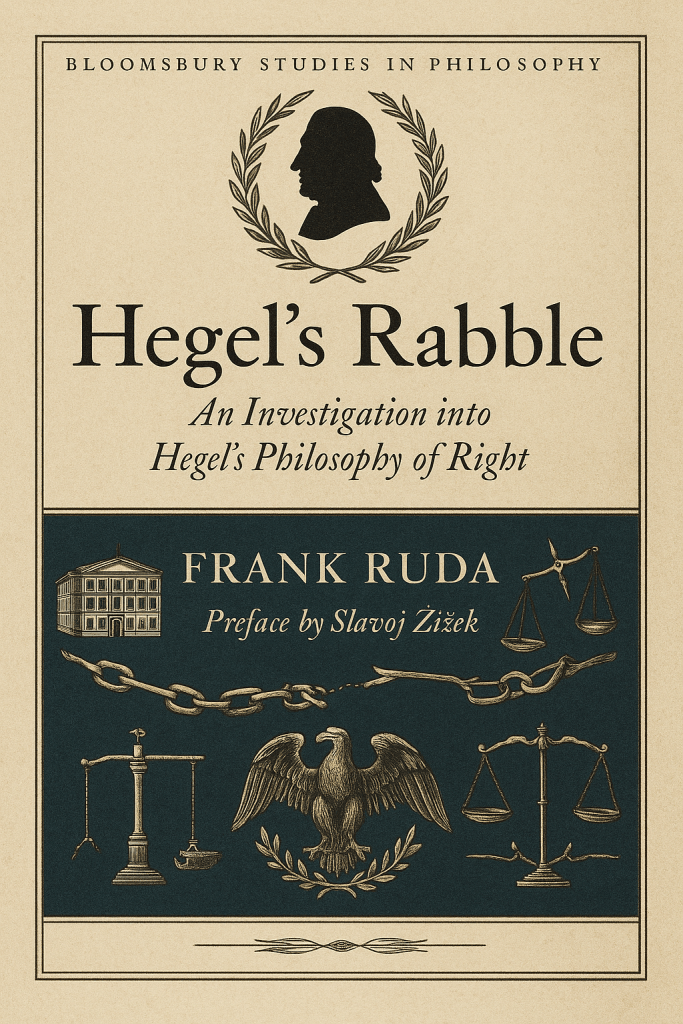
Frank Ruda’s Hegel’s Rabble: An Investigation into Hegel’s Philosophy of Right proposes that the seemingly marginal figure of “the rabble” is not an incidental social pathology but the pressure point at which Hegel’s entire political architecture—civil society, the state, and the ethical life that binds them—reveals its internal limit. The book’s distinctive contribution lies in treating the rabble as a formally necessary surplus of the modern order, a structurally produced excess whose appearance both motivates Hegel’s deduction of the state and compromises its closure. Drawing methodological energy from contemporary systematic philosophies of universality, it reconstructs Hegel’s argument around poverty, resentment, and unbinding, and then traces the way this argument folds into a theory of the state’s sole aim while generating, almost against itself, the conceptual space from which the early Marxian notion of the proletariat can be rigorously thought.
The book is framed by Slavoj Žižek’s preface, The Politics of Negativity, which situates the study within a broader problematic of negativity, repetition, and the uneasy relay between finite determination and a compulsion that evades sublation. The preface reads Ruda’s close reading of a few paragraphs on the Pöbel as a symptomatology for Hegel’s political thought as a whole, and as a hinge where post-Hegelian breaks become legible: the rabble as the socially immanent embodiment of universality, a “part of no-part” whose persistence marks the point at which mediation cannot coincide with reconciliation. This outer frame already previews the book’s wager: a minimal topic becomes the diagnostic that compels a re-staging of Hegel’s system around its most recalcitrant remainder.
From this preface the composition proceeds by building an argumentative arc that begins with an introduction—significantly introduced as a “fiction,” not as an idle feint but as a methodological staging for testing a limit-case—and culminates in a conclusion that names “Hegel’s impossibility.” The table of contents maps the movement in discrete yet interlocking steps: from Luther and the transfiguration of poverty; through the question of poverty itself and the un-estate from which the rabble emerges; to a transition that distinguishes the poor from the rabble; then a doubling into pauper-rabble and luxury-rabble; a formula of “infinite unbinding” in which resentment and an “absolute” rabble are articulated; a theory of lost habit and laziness; a re-specification of attitude and state; a treatment of “right without right” or Un-Recht; a dialectical determination of “willing nothing”; and, finally, a re-presentation of the state’s sole aim and the rabble as an un-organic ensemble. Excursuses—on Honneth, on the French Revolution, on intension and extension—serve not as diversions but as conceptual switch-points where threads are re-tied under shifted determinations. The outer framing thus couples a symptomatic preface with an inner sequence that advances from poverty’s visibility to the rabble’s formal invisibility, and from there to the state’s paradoxical task.
Ruda’s stated stake follows from a simple but decisive observation: in Hegel’s Philosophy of Right, civil society, by its own dynamics, generates impoverished masses; from this necessity there contingently emerges an attitude in which poverty becomes rabble. The rabble is neither a sociological subcategory nor a moralizing label; it is the name for a determinate failure of mediation that civil society both produces and disavows. Ruda’s claim is that only by re-thinking this problem—“the only problem Hegel is able neither to resolve nor to sublate”—does the proletariat of early Marx become conceptually accessible without transposing Hegel’s determinations into a different register. The “reconstruction” promised in the jacket copy is thus literal: the book returns to Hegel’s derivations and re-derives their pressure-points so that the rabble appears in the order of reasons rather than as an empirical afterthought.
The first decisive conceptual hinge is Ruda’s differentiation between the poor and the rabble. Poverty as such does not make a rabble; the rabble makes itself. That formula—macht sich von selbst—is crucial. It indicates that we are dealing with a self-constitution at the level of disposition (attitude), a transition in which deprivation becomes an active stance toward right and work, one that claims a right to subsistence while refusing the mediations through which right is realized in civil society. This “right without right” indexes an internal fracture of the order of right itself, not a mere lack within it. Here the argument bends: the emergence of the rabble does not invalidate Hegel’s logic of civil society; it consummates it by revealing its latent form. When civil society’s contradictions make poverty structurally necessary, the passage from poor to rabble is no longer a moral accident; it is a formally available possibility that, once actualized, cannot be re-absorbed by admonition or policing.
To clarify how possibility is specified, Ruda distinguishes two modes of emergence that later organize the book’s central pair: pauper-rabble and luxury-rabble. The poverty-side is characterized by a logic of double latency: because civil society necessarily produces impoverished masses, anyone can, as a function of singular fate, deteriorate into the un-estate of poverty; and because this production is not a matter of individual misdemeanors, the potentiality for rabble is universally distributed in a manner that is formally prior to concrete social determinations. This “universality” is not an abstract predicate; it is the systemic horizon within which any subject of civil society encounters the possibility of becoming nothing other than rabble.
By contrast, the rich—or luxury—side is generated by what Ruda calls a logic of double contingency: first, a subjective contingency (the arbitrary decision to enter the game of speculation, gambling, or risk); second, an objective contingency (success within that indeterminate game). The rich rabble is therefore particular; its very emergence presupposes the hypostasis of contingency and particularity into a pseudo-universality—the “rule” of wealth—that is both produced by civil society and alien to its ethical aims. The distinction between universality (on the side of poverty) and particularity (on the side of luxury) becomes the linchpin for everything that follows; it explains why rabble can be simultaneously the universal possibility inscribed in modernity and the particularized excess that ostentatious wealth incarnates.
In this light, the famous claim that the poor rabble cannot be identified by an external criterion becomes comprehensible. Luxury has a visible signature—luxus as the indeterminate demonstration of property; poverty has none. The “minimal difference” that distinguishes the poor from the poor-rabble is the attitude joined to poverty; it does not appear outwardly. What appears are simply the poor. There is no external marker to separate the one from the other. This inconspicuousness is not a merely epistemic difficulty; it is a logical feature of a transition that occurs within the subject’s relation to right and work. If the emergence of the poor rabble is universal and necessary, its invisibility follows from the fact that it is structurally unpresentable to policing gaze as anything other than poverty—precisely because what distinguishes it is the stance it takes toward mediation, not a condition that policing can alleviate.
The analysis of resentment pushes this line further. In the chapter that articulates the “formula of infinite unbinding,” the rabble becomes the name for a process in which the negation of organic bonds is itself supposed to have been negated and sublated—but is not. Ruda’s usage of “un-organic” is technical: either an organ is within the body and determines the organism, or it is detached and ceases to be an organ; the un-organ is neither simply inside nor outside. It is internal and external at once, a detached part that nevertheless insists in and harms the organism. The rabble functions as just such an un-organ for the ethical organism: it is produced by the organism, detached from its mediations, and yet it continues to determine the whole from within. The “infinite unbinding” of resentment names the subjective temporality by which this detachment circulates, neither returning to work-mediated right nor exiting the organism altogether.
Because the luxury-rabble is grounded in double contingency, its unbinding is episodic, indexed to the rhythms of success and display. Because the poverty-rabble’s emergence is universal and necessary, its unbinding becomes structurally interminable. Ruda emphasizes that only the poverty-rabble presents the paradigm of absolute and complete unbinding: once the possibility of accumulating property is lost, re-entry into legal and statist contexts remains barred; its time is, in Hegel’s rigorous sense, eternity, the perpetuity of exclusion that civil society’s own necessity has generated. The dialectical asymmetry is decisive: the rich rabble demonstrates contingency’s power to counterfeit universality; the poor rabble demonstrates universality’s power to generate an unending unbinding that no mere policy can terminate.
The book’s middle movement turns on attitude (Gesinnung) and habit. If patriotism, as Hegel formulates it, is volition become habitual truth—subjective certainty that issues from truth rather than opinion—then the rabble’s stance is the negative of that habituation: a stance that refuses to internalize mediation as second nature. Ruda treats this not as a moral defect but as a structural correlate of civil society’s contradictions. To analyze attitude is to show how rabble “makes itself”: poverty supplemented by an orientation that claims the right to subsistence as such and regards work’s mediation as either impossible or illegitimate. The inquiry into “lost habit” and laziness is thereby pressed into service of a larger thesis: when habit fails to bind subject and ethical substance, the subject’s will becomes unmoored from the determinate universality of institutions and clings to an abstract universality—subsistence as such—that cannot be realized without negating the mediations through which right exists.
This is the context in which Ruda reads Hegel’s terse statement about the state’s “sole aim.” The Encyclopedia passage distinguishes vulgus (aggregate of private persons) from populus (the people as ethical body). The sole aim of the state is that a people should not come into existence, power, and action as an aggregate. The state is not founded upon the social bond that it expresses; it is founded upon un-binding—which it prohibits. The formulation is paradoxical only on the surface. If civil society, left to its own devices, produces disaggregation—private persons who act as an aggregate—the state’s task is precisely to block the presentation of this aggregate as such, to interdict the manifestation of pure multiplicity as political power. That prohibition is not arbitrary repression; it is the condition for the presentation of the people as ethical unity rather than as a swarm of private wills. Ruda’s point, however, is that the rabble is the name for the failure of this interdiction—a failure produced by the very dynamics the state is tasked with regulating.
The chain now tightens. Civil society becomes “too poor” with respect to universality not by lacking wealth, but by an excess of wealth—the excess of the rich rabble. Conversely, impoverished masses are necessarily produced. From these opposed excesses—necessity on the side of poverty, contingency on the side of wealth—two rabbles co-emerge. The co-emergence is the logical co-production of the state and the rabble: the contradiction that determines civil society leads to both. The state’s instruments—corporation and police—combat poverty yet cannot abolish the lack inscribed into civil society’s determination; they even perpetuate it in radicalized form. The very attempt to stabilize mediations reproduces the conditions under which the rabble “makes itself,” whether as universal poverty-rabble or as particular luxury-rabble. Ruda’s reconstruction draws the consequence Hegel leaves implicit: there is a rabble of necessity and a rabble of contingency; a universal and a particular rabble; and their relation is the index of how the ethical organism is determined from within by an un-organ it cannot excise.
These determinations feed directly into the book’s culminating thesis about impossibility. In the rabble Hegel encounters a limit that his Philosophy of Right—a philosophy of freedom—cannot simply internalize. The demand that emerges here is a demand for equality that the system cannot accommodate without ceasing to be what it is. Hegel’s own characterizations—in terms of negative understanding, shamelessness, the refusal of work, evil, and the equation of the rabble with abstract negation—function, in Ruda’s reading, as a symptomatic over-determination by which the system marks the site of its own unpresentable. The conclusion thereby doubles back on the preface’s topology of negativity: rabble is the socially inscribed form of a negativity that cannot be idealized into reconciliation, because its very form is the abstract universality of a right that negates the mediations of right.
At this point the composition sequence reveals its logic. The early chapters, concerned with Luther and with the transfiguration of poverty, present poverty under theological and moral aspects only to displace those frameworks by the specifically modern dynamics of civil society. From here the inquiry passes through the juridical and economic determinations that install the poor as a necessary product, and then through the subjective determination—the added attitude—that converts necessity into a stance. That stance is thresheld, first as resentment, then as absoluteness, by which the rabble’s unbinding no longer requires subjective interior limitation. The theory of laziness and lost habit supplies the anthropological medium in which these subjective structures persist across time, while the analysis of attitude and state shows how political form attempts to re-bind what civil society unbinds. The discussion of “un-right”—right that no longer functions as right—renders explicit the way the rabble’s claim to right without mediation is both a distortion of right and a symptom of right’s own abstraction. The subsequent determination, “to will nothing or not to will anymore,” expresses an exhaustion internal to civil subjectivity once habit fails: will either empties itself into the universality of mere subsistence or collapses into the refusal of volition. The last chapters, on the state’s sole aim and the rabble as un-organic ensemble, do not reverse the sequence; they name its structural consequence: the ethical organism that must prevent the aggregate from appearing in its plurality cannot prevent the internal production of an un-organ that manifests plurality’s pressure from within. The “outer frame”—preface and conclusion—closes the circuit by declaring this structure an impossibility for Hegel’s system while placing it at the threshold of Marx’s conceptualization of the proletariat.
Two conceptual tensions anchor the book’s argumentative density. First, the tension between universality and particularity as it is redistributed by the rabble. The poverty-rabble is universal not because everyone is poor, but because the system’s necessity distributes the possibility of becoming rabble to anyone prior to their concrete determinations. Luxury-rabble is particular not because it is rare, but because its genesis requires the stacking of contingencies that counterfeit universality. This redistribution explains why civil society’s wealth can impoverish universality and why the state’s ethical aim can be undermined both from above and from below.
Second, the tension between presentation and prohibition, as concentrated in the sentence about the state’s sole aim. The state, insofar as it forbids the appearance of the aggregate as aggregate, operates as a presentation-regime: it must ensure that the people appear as an ethical body rather than as mere multiplicity. Yet the rabble is precisely the appearance of multiplicity’s insistence within the ethical body: the un-organ that both belongs to the organism and disables its self-presentation. This is why Ruda can write, following a Badiouian inflection, that the state is founded upon un-binding which it prohibits, and why the question arises whether a politics of equality can be thought without the state’s regime of presentation. That question is not an external critique; it is the immanent consequence of Hegel’s own distinction between vulgus and populus applied to the site where the distinction fails to hold.
The book’s method is notable for the precision with which it links textual micro-determinations to systematic claims. The recurrent return to terse Hegelian sentences—on poverty’s necessary production, on rabble’s self-making, on the instruments of the state, on the aim that bars the aggregate—enables Ruda to isolate the transitions by which Hegel’s derivations proceed and to register where a derivation stalls. When civil society necessarily produces impoverished masses, subsistence no longer appears as the moral reward of diligence but as a universal demand that has been structurally detached from work. When that demand is asserted as right without mediation, Hegel’s order of right discovers within itself an abstract universality that is indistinguishable, from the system’s point of view, from a negation of right. The state’s efforts—corporations, police—index this indistinguishability; they attempt to re-attach the claim to the mediations of right but cannot do so without intensifying the very contradictions that generate the claim. The argument thus merges conceptual exposition with source-based warrants, and the book’s compositional rhythm mirrors its thesis: each chapter articulates a determination that, in the act of assembly, displaces the previous determination’s sufficiency.
Two further moments crystallize the system’s edge. First, the relation between resentment and the absolute rabble. Resentment can be understood as the subjective interior limitation through which the rabble’s stance is first stabilized. Yet the dialectic does not end in this interiority; it tends toward a form in which even this interior limit is unbound. “Absolute rabble” names this passage: a condition no longer characterized by external lack, or by deprivation of this or that determinate good, but by the abstract universality of a will aligned with nothing more than subsistence as such. In this passage, formal universality—“right as such”—severs itself from the mediations that alone make right concrete.
Second, the doubling of rabble into necessity and contingency. On the necessity-side, poverty’s structural production ensures that the rabble is a universal possibility; on the contingency-side, wealth’s display ensures that particularity can masquerade as universality. The two sides are not symmetrical: necessity is logically prior and temporally interminable; contingency is episodic and theatrically visible. The state, tasked with preventing the aggregate from appearing, is thus pressed between a universal unbinding it cannot end and a particular unbinding it cannot disavow without undermining the very freedoms civil society promises. Ruda’s Hegel is therefore not simply a thinker of ethical closure but a thinker whose very precision opens an aporia.
What, finally, of Marx? The book’s coda gestures toward a conceptual relay rather than a replacement. If the rabble is Hegel’s impossibility, the proletariat is the early Marx’s attempt to think the same structural site under determinations that are no longer subordinated to the ethical organism of the state. Ruda’s claim, announced at the outset, is that only by re-thinking the Hegelian problem of the rabble can one see how the proletariat is neither a moral agent nor a sociological bloc, but the name for universality produced at—and as—the failure of mediation. The coda’s promise is not an external correction of Hegel; it is an extension of the book’s dialectical labor beyond the limit that Hegel marks but cannot sustain.
In closing, the study clarifies its own paradox with admirable consistency. The rabble names a structurally necessary impossibility—necessary because civil society produces it, impossible because the ethical organism cannot integrate it without abolishing the distinction between people and aggregate that defines the state’s sole aim. The book makes clear, in a language at once philological and speculative, that this paradox is not an embarrassment to be smoothed over; it is the generative wound around which Hegel’s doctrine of right is organized. By tracking, with unusual patience, how poverty becomes rabble, how rabble fragments into universal and particular, how resentment gives way to an absolute unbinding, how habit is lost and attitude hardens, how right becomes un-right and willing falls to willing-nothing, and how the state’s aim is forced against the very aggregate it must forbid, Ruda provides a reconstruction that both compels and exceeds Hegel’s own pages. The final clarity is austere and exact: Hegel’s rabble is the concept by which Hegel’s political philosophy discloses its limit, and, in disclosing it, opens the very space where a politics of equality would have to begin.
 Simon Gros
Leave a comment