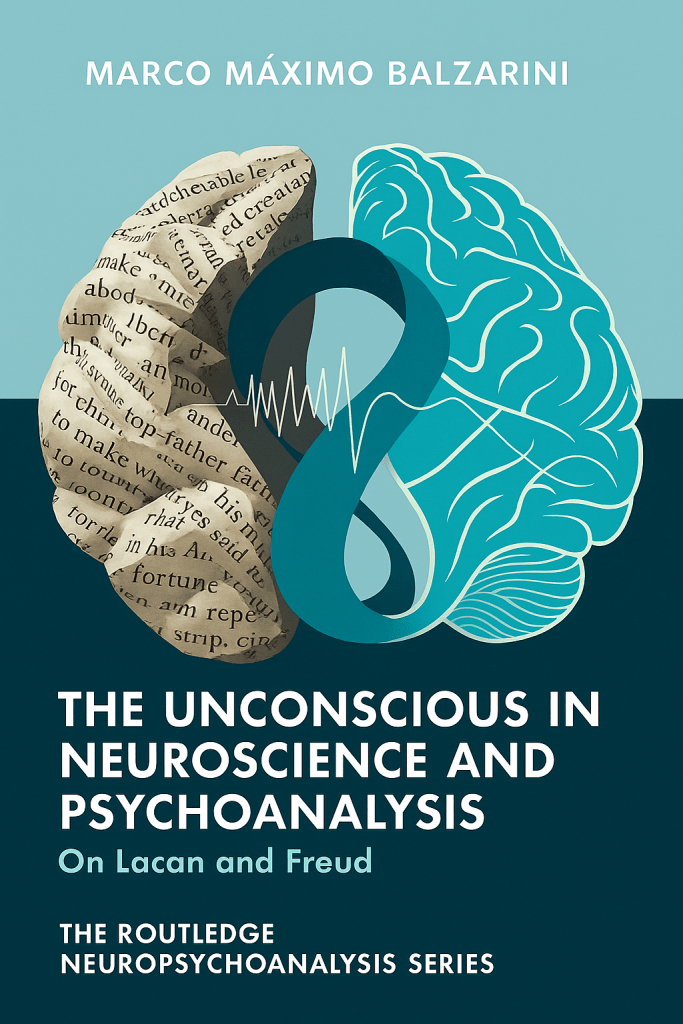
Marco Máximo Balzarini’s The Unconscious in Neuroscience and Psychoanalysis: On Lacan and Freud isolates with unusual precision the point at which two powerful explanatory regimes—neurobiological description and psychoanalytic articulation—cease to translate into one another and nevertheless cannot stop addressing the same phenomena. Its distinctive contribution is to formalize that impasse as a productive constraint on theory and clinic: by reconstructing the current neuropsychoanalytic repertory (plasticity, memory systems, affective circuitry, cortical–subcortical coupling) and placing it under the pressure of Freud’s metapsychology as reread by Lacan, the book clarifies what any “integration” would have to conserve if it is to remain faithful to the logic of the unconscious. In the process, it reframes fashionable correspondences as testable theses about method, evidence, and the rights of speech in the field of mental life.
The argumentative arc is framed from the outset by two exterior gestures. First, a series preface situates the volume inside the Routledge Neuropsychoanalysis Series, whose programmatic memory reaches back from Freud’s abortive Project for a Scientific Psychology through the institutionalization of Neuropsychoanalysis in 1999–2000 and into a present where both proponents and critics are solicited to specify their claims. This framing fixes the historical stakes: a moving frontier of attempts to correlate mental phenomena to brain organization without collapsing one discourse into the other. Second, a local preface by Mariana Gómez locates the book’s ethical center of gravity: a defense of singular suffering against any promise of normalization that would identify mental health with homeostatic balance, speed, and efficiency. Together these two frames compel a question that is not rhetorical but methodological: how does the Freudian–Lacanian unconscious differ from the “unconscious” posited by contemporary neurosciences, and what follows for clinical practice once the difference is specified rather than wished away.
The introduction tightens this into a working hypothesis by adopting Kuhn’s notion of incommensurable disciplinary matrices: psychoanalysis and neurosciences proceed with different objects, different measures of progress, and different techniques of verification. The claim is not diplomatic relativism; it announces a test. The book will measure how far integrative proposals can go before they import, often tacitly, the very assumptions that dissolve the unconscious as a psychoanalytic object. The wager is that Freud’s “saying”—his repeated, not merely programmatic differentiation of biological excitation from the specific insistence of drive and repression—can be vindicated against contemporary reductions that read him as awaiting later biological confirmation.
That test begins with a reconstruction of the current neuroscientific register under which “unconscious” is invoked. The platform term is neuroplasticity. In this literature plasticity names the organism’s openness to inscription by experience; epigenetics supplies the transgenerational mechanism by which environmental regularities alter patterns of expression; the insula is nominated as a filter where instinctive regulation is interrupted, mentalized, and rendered available to representational work. Under this view, the brain is genetically programmed to be open to the nonprogrammed, and the plastic trace becomes the material transcription of lived events, ever re-associating under the governance of synaptic efficacy. What makes this program convincing is its internal differentiation: authors such as Ansermet and Magistretti explicitly deploy plasticity to resist genetic determinism and to mark a neurobiological basis for singularization; others (Kandel and collaborators) show, in a different idiom, how memory formation in model organisms reveals durable inscription mechanisms consistent with experience-dependence. As Balzarini presents it, this is not a crude localizationism but a sophisticated effort to anchor freedom and uniqueness in neuronal openness.
The next movement concerns the name “unconscious” inside this platform. Here the decisive bifurcation runs between procedural and declarative memory. One stream equates the unconscious with non-declarative automation—action plans, basal ganglia programs, amygdala-mediated affective valuations—thus construing unconsciousness as the reliability of routines that no longer require cognitive supervision. Another stream, more cautious, draws the unconscious toward declarative contents that are inaccessible without associative work, thereby preserving a structural distance from immediate recall while still remaining within a mentalist vocabulary. In both cases, “unconscious” names either the machine of efficiency that supports survival (adaptive, homeostatic, optimal) or a domain of meaning awaiting the right cue for entry into working memory. Balzarini’s text does not caricature these positions; it presents them in their strongest version with citations to the precise claims regarding amygdala function, temporal lobe substrates, and the clinical–anatomical method invoked by Solms to correlate lesion sites with phenomenological changes. The procedural/declarative controversy is not an idle scholasticism: it bears on whether “the unconscious” is a name for mind’s backstage or a term of art for what analysis alone elicits in speech.
It is at this pressure point that Balzarini introduces the Freudian–Lacanian counter-specification. The unconscious at stake in analysis is not the positive remainder of perception inscribed as a memory trace; it is the place where a trace is missing, the structural effect of repression that renders satisfaction irrecoverable and returns as symptom and repetition. In this grammar, memory without subjectivity is torture—the Borges figure of Funes, condemned to an inventory that never forgets because it never cuts. Language—in the analytic sense of the signifier that separates perception from remembrance—operates not by storing but by producing lack. The unconscious is not what lies below attention; it is what insists as negativity in and through speech. On this reading, insular mediation and synaptic footprints remain insufficient as explanations because they supply only increasingly refined accounts of how experience leaves marks; they cannot model the analytic fact that an analysand’s truth appears as an effect of saying, including the effects of mis-saying. The method demands a negativity no anatomy can furnish on its own.
Once this negativity is secured, the book can return to the neuropsychoanalytic field with a different kind of rigor. Balzarini is scrupulous in his reading of Solms and colleagues: the insistence that psychoanalytic constructs require biological anchor points is not dismissed a priori. The insistence is interrogated as a metapsychological decision—what counts as an “anchor,” and on what terms? When Solms argues that the mind is locatable in the brain and that the inaccessibility of certain memories renders them “mental” yet unconscious, the proposal is acknowledged in its clinical ambition: to move beyond glossy imaging toward convergent, lesion-informed inferences about function. Yet the question persists: does this reconstrual of “the unconscious” as inaccessibility to working memory—situated in “lower brain processes” and dissociable from higher-order awareness—preserve the analytic logic of the unconscious as a function of the signifier, of transference, and of desire? The burden of proof, Balzarini suggests, lies with any model that would equate analytic negativity with neurophysiological seclusion.
A decisive series of demonstrations clarifies the stakes by mapping the drift from metapsychology to biology in apparently innocuous premises. The move from openness (plasticity) to autonomy (an internal reality that self-activates actions in resonance with somatic states) produces a picture of the subject whose law is interior and whose relation to the Other is expendable. The ensuing ethic is adaptation: the “good” is homeostasis; the clinic becomes a training in optimized automatisms; the unconscious becomes the fast, efficient decision-apparatus outside awareness. Balzarini tracks how this ethic is generalized into a worldview—neuroreligion—where the brain, reified as causa sui, replaces the transcendent guarantor once supplied by theology. The argument is not rhetorical but evidentiary, and it links claims about basal ganglia routines, adaptive unconscious decision-making, and the rhetoric of public neuroscience whose prescriptive tone (“make the brain your ally”) converts empirical description into a standard of conduct. The critique is not anti-scientific; it exposes a normative slide that the science itself does not license but too readily tolerates in popularization and policy.
From within the neurosciences, Balzarini also identifies a counter-tendency: a revolt against reductionism that seeks to use cerebral division itself as a resource for reconciling analytic negativity with neural description. Here the proposal by Adrian Johnston and John Dall’Aglio—“there is no intracerebral relationship”—becomes an index of fracture internal to the organ: a constitutive mismatch between non-representational affective systems and declarative, language-mediated neocortical systems. Dall’Aglio’s further attempt to map Lacan’s registers (Real, Symbolic, Imaginary) onto dynamic constellations of neural activity belongs to this same effort: refuse crude localization while letting the brain’s own heterogeneity model a kind of internal non-relation that would be hospitable to psychoanalytic structures. Balzarini registers this ingenuity and also its cost: the more successfully we simulate the analytic “non-relationship” within a neural architecture, the more we risk mistaking simulation for equivalence—that is, we risk thinking we have found the analytic real when we have only drawn a homology. The merit of these efforts is to raise the bar for what a credible bridge would look like; their danger is to confuse isomorphism with identity.
To consolidate the distinction between analytic logic and neural modeling, the book reopens Freud’s texts at the very place where recent integrators posit a deferred biological fulfillment. Freud’s position, reconstructed here, protects the analytic hypothesis by bracketing biology insofar as metapsychology needs its own concepts to grasp the difference between excitation and drive, between physiology and the compulsion to repeat, between trauma and the symptomatic knotting of satisfaction and prohibition. The analyses of hysteria already bind this refusal to a clinical proof: functional paralyses that do not respect neuroanatomical pathways testify to an order of determination that is topological in speech, not spatial in tissue. This proof does not dismiss the organ; it delimits what kinds of explanation count as adequate to a formation like a symptom. Balzarini repeats the point often enough that it becomes a methodological refrain: analytic causality is neither located nor localized; it is articulated.
At this juncture the composition begins to displace its own opening emphasis. What started as a patient survey of neuroscientific constructs becomes an internal audit of the costs of “biologizing the unconscious.” The targets are less individual theories than families of consequence: the imag(in)ization of the unconscious through images that promise to show what can only be heard; the neuropharmacological model that reduces suffering to a pharmacodynamic profile; the juridical expansion of “the right to health” into a duty to normalize; a new scientism that inherits the structure of hysterical discourse by incessantly showing “evidence” while abolishing the speaking position from which evidence becomes fact. Each of these tendencies is reconstructed in its strongest formulation before its limit is indicated: a symptom is not a datum; it is the way a subject speaks their relation to jouissance, and a practice that seeks to silence that speech cannot, when it succeeds, be said to have cured anything but inconvenience.
The argumentative pressure culminates in a chapter devoted to the neuroscientific imputations against psychoanalysis—inefficacy, unfalsifiability, non-science, diffusion deficits, theoretical insufficiency, resistance to evaluation, and cultural unwelcome. The force of Balzarini’s reply is not defensive; it is grammatical. He shows that the criteria invoked (randomized evidence hierarchies, mechanistic demonstration, short-horizon outcomes) belong to a discursive regime in which the object is normalized functioning. Psychoanalysis does not reject outcomes; it respecifies the good as the subject’s know-how in relation to their symptom, which is to say, the ability to live with the element that breaks homeostasis because it is the condition of desire’s address. To demand of such a practice that it supply markers of efficient re-adaptation is to have already decided that the symptom’s truth is a dysfunction and that speech is a noise. The counter-claim, drawn from the very preface that frames the book, is exact: analysis can yield therapeutic effects, but they are neither its compass nor its measure.
The book’s inner logic is best understood as a series of conversions in which one set of materials is folded into another and then displaced by it. The first conversion translates neuroscientific vocabulary into psychoanalytic relevance by asking, case by case, which of its claims touch analytic problems as problems. Thus plasticity becomes legible as an argument about inscription; memory-systems theory becomes legible as an argument about access and inaccessibility; adaptive unconscious models become legible as arguments about decision without deliberation. The second conversion reverses the lens: analytic constraints—negativity of the trace, primacy of the signifier, the status of jouissance—are then used to re-parse the neuroscientific material, preserving what is usable (heterogeneity, dynamics, genuine discoveries about coupling and decoupling) and discarding what commits one to a concept of the unconscious incompatible with the clinic. The final conversion is ethical and institutional: once the distinctions are clear, the public rhetoric of the brain is audited for its normative drift and its power to legislate standards for suffering. That sequence—translation in, translation back, ethical audit—supplies the book’s compositional logic and explains why each earlier section is eventually displaced by a later one that reclassifies its terms.
A great example of this compositional displacement comes in the treatment of “brain mapping” proposals for Lacan’s registers. Dall’Aglio’s dynamic mapping is acknowledged as an advance over crude localization and as a salutary refusal to deny the brain’s complexity. Yet, once the analytic logic of non-relation is restored to its status as a principle of speech rather than a property of tissue, the mapping is recoded as heuristics rather than homologies. This does not deflate its interest; it marks the boundary where analogy ceases to be warrant. The brain can be divided against itself; such division is not yet the subject.
A similar displacement occurs in the treatment of Solms’s clinical–anatomical method. In the first movement, the method is received as a corrective to the seductions of neuroimaging spectacle; it asks for convergent, lesion-based inference, and it treats dreaming as a privileged laboratory for dynamic changes that analysis observed long before scanners existed. In the subsequent movement, however, the very elegance of the method forces the decisive question: what counts as a “dynamic change” for analysis, and at what point does a phenomenological shift stop being evidence about the unconscious and become evidence about consciousness’s supports? The book thereby demonstrates a general rule for interdisciplinary traffic: to preserve the specificity of a discourse, the traffic must be policed precisely at the point where agreement seems easiest.
If one asks what kind of “evidence” the book ultimately marshals, the answer is as unspectacular as it is decisive: a concatenation of theoretical distinctions made to bear on clinical intelligibility. The text’s most polemical moments—on neuroreligion, on the ascent of neuro as a master signifier, on scientism’s affinity with hysterical showing—are anchored by earlier demonstrations that retain their force only if one grants the primacy of speech in the constitution of facts. To that end, even detours—on the ethical redefinition of cure, on the illegibility of singular suffering under standardized models, on the role of the law as a condition for the very existence of analytic discourse—are not ornaments but pillars. They state the conditions under which the analytic object can appear.
The closing idea—Final Thoughts—returns to the pragmatic question that haunted the introduction: what should psychoanalysts do in a world where neuroscientific discourse organizes resources, policies, and expectations? The answer is severe and instructive. Analysts should neither retreat into sterile refusal nor surrender the object of analysis to a language that cannot speak it. They should develop fluency in neuroscientific claims in order to test them at the point of their seductive overlap with analytic concerns, and they should insist, each time, on the difference between a correlate and a cause, between a model and a logic, between a homology and a translation that leaves the analytic object intact. The discipline is not to be saved by neurobiology or dissolved by it; it is to be articulated alongside it under the rule that the unconscious has no intracerebral address because its address is the Other of speech. That maxim is not a dogma; it is a methodological axiom derived from Freud’s own refusal to let biological explanation do the work of analysis.
To clarify, then: the book’s stake is to re-secure the difference that makes joint work thinkable. Where neurosciences show plasticity, analysis hears the cut that founds memory; where laboratories distinguish procedural from declarative systems, analysis distinguishes automation from repetition and insists that neither accounts for desire’s negativity; where integrators propose mappings, analysis tests whether the mapped structure preserves the function of lack; where public rhetoric elevates homeostasis to a sovereign good, analysis returns the symptom as the mark by which a life becomes legible to itself. This is not an appeal to mystery but to method. The brain may be the necessary condition for any speaking life; it is not the condition under which the unconscious can be said. The only condition there is speech itself, and the book’s careful, sometimes severe, often generous readings establish exactly why that condition cannot be substituted.
 Simon Gros
Leave a comment