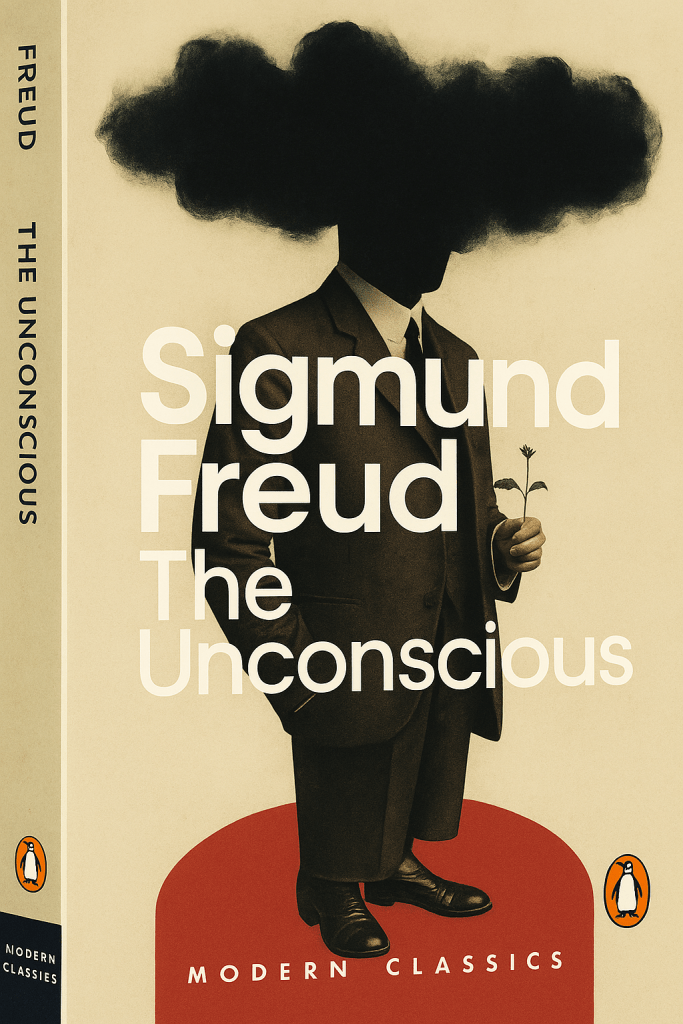
Freud’s The Unconscious stakes a rigorously delimited claim within the metapsychological project: to sort, with clinical economy and conceptual pressure, the diverse meanings of unconscious and to anchor them to an evidential grammar—dream-work, symptom-formation, slips, fetishistic substitutions, ambivalence of the drives, and the economy of repression—so that the psyche’s most elusive processes can be specified as mechanisms, not metaphors. The distinctive contribution of this volume is to display the theory as a staged construction: from the developmental shift of psychic regulation (pleasure to reality), through an anatomy of drive-fates and a technical analysis of Verdrängung, to the systematic exposition of the unconscious as descriptive, topographical and economic—then its late codas: Negation, Fetishism, and the wartime note on ego-splitting. The result is an argumentative sequence in which each essay becomes both ground and limit for the next, a continuous re-inscription of evidence into method.
The editorial and paratextual frame matters, because it clarifies the book’s composition and the claim it makes on our reading. In this Penguin edition the contents lay out a precise chronology: the 1911 programmatic Formulations on the Two Principles of Psychic Functioning; the 1915 metapsychological triad Drives and Their Fates, Repression, The Unconscious; then the 1925 short, technical Negation; Fetishism (1927); and finally the late, posthumous The Splitting of the Ego in Defence Processes (written 1938, published 1940) that retrospectively torques the entire edifice. The introduction (Mark Cousins) and translator’s preface (Graham Frankland) make explicit the internal architecture and the terminological decisions that keep drive (Trieb) from dissolving into “instinct,” Besetzung into “investment,” and the “descriptive/topographical/economic” triad into a merely didactic taxonomy. The table of contents and publication history set up the outer frame for the “workplace” of Freud’s argument, insisting that what appears dogmatic is in fact serial self-clarification under theoretical constraint.
The opening essay provides the first hinge: how the psychic apparatus, originally governed by the pleasure principle—hallucinatory wish-satisfaction and the reflex of avoiding unpleasure—comes to “bind” excitation by deferring discharge, consulting memory, and testing reality. The conceptual stake is not edification but economy: attention, judgement, memory-trace, and motor control are reorganized so that satisfaction can be secured rather than imagined. The “reality principle” does not abolish the pleasure principle; it conserves it by postponement and instrumentality, while leaving enclaves—the domain of fantasy—exempt from reality-testing. These enclaves become the preferred terrain for repression and symptom-formation, because the sexual drives, by their developmental arrest (auto-erotism and latency), remain proportionally longer tethered to the archaic regime of pleasure and thus expose a structural weak point where the apparatus can be folded back from rational thought into primary processes. The essay compresses the method: developmental postulate; economic premise; and a clinical vignette that translates these into the grammar of neurosis.
The transition from principles to drives introduces the book’s most demanding wager: that the unconscious cannot be understood without a quantitative register. Drives are inner, constant pressures with aims, objects, sources, and pressures that cannot be neutralized by flight, only by satisfaction, i.e., by altering the inner source of stimulation. This is why the apparatus acquires complexity: what a reflex cannot evacuate must be bound. The metapsychological necessity emerges: beyond description (some acts are simply not conscious) and topography (systems separated by censorship), there is the economic: relative “quantities” of investment, displacement, transformation into affects, the circulation and overflow that jointly make symptoms intelligible and, crucially, treatable. The drive chapter catalogs the fates that answer to this economy—reversal into the opposite (activity→passivity, and love→hate), turning back upon the self, repression, sublimation—embedding the transformations sadism↔masochism and voyeurism↔exhibitionism in a formal schema that connects aim-reversal, object-switch, and narcissistic scaffolding. The theoretical virtue is sobriety: each fate is a defensive procurement under the pleasure principle’s governance, a way to keep excitation mobile when direct satisfaction is blocked.
Here the argument acquires its characteristic density. Freud elaborates what it would mean for a drive to change its aim without losing its pressure, or to change its object by turning the original vector inward (sadism → self-torment → masochism in a three-step progression), or to bifurcate into active and passive poles that remain mutually intelligible because each is a re-routing of the same economy. The narcissistic phase functions as a formal hinge: when the object is the subject’s own body, the later transformations—whether to an external object (voyeurism) or to being oneself the object perceived (exhibitionism)—can be derived as structured deviations from a common preliminary situation. The plausibility of these constructions lies not in introspective appeal but in their clinical fertility: they forecast what analysts repeatedly meet—ambivalence that is not a paradox of sentiment but a lawlike coexistence of opposed aims; substitutability of objects without loss of drive-coloration; and the readiness with which pain, once coupled to arousal, can be recruited as a passive aim while retroactively generating a sadistic infliction under an identificatory circuit.
The pivot to Repression then binds these dynamics to the book’s central evidential claim: the unconscious is not merely what is “not conscious”; it is a systemic and economic arrangement maintained by a technique—repression—that separates ideational representatives of drives from their quantitative charges. The method is explicit: one must track separately the idea (representative content) and the emotive charge (quota of affect/energy), since clinical phenomena show them diverging: the idea is ejected from, or prevented from entering, consciousness, while the quantitative component can be suppressed, expressed as emotion of a new quality, or transformed into anxiety. The success of a repression is measured not by the disappearance of an idea but by the fate of its energy; “failed” repressions are those in which the charge returns as unpleasure despite ideational exclusion—which is to say, what the clinic calls a return of the repressed (symptoms and substitutions). This two-track exposition is the essay’s methodological center: interpretive claims are warranted only if one can show how ideational substitution (displacement, condensation) and affective transformation (especially into anxiety) co-produce the symptom’s logic.
The comparative casuistry that follows—anxiety hysteria, conversion hysteria, compulsion neurosis—is not anecdotal adornment but a stress-test of the mechanism. In phobic formations the libidinal tie (e.g., toward the father) vanishes ideationally while its charge is transformed into anxiety and displaced to an animal substitute; avoidance behavior then rationalizes the economic situation by spatializing the formerly internal danger. In the obsessive sequence, repression first “succeeds”: the hostile impulse that has regressed into sadism is countered by a reaction-formation (heightened conscientiousness), and the idea is expelled with its affect seemingly abolished. But the ambivalent organization that enabled the reaction-formation becomes the channel for return: self-reproach, social anxiety, importunate prohibitions, and trivial displacements all testify that the quantitative element has found routes back, while the ideational rejection is tenaciously maintained to restrain action. The essay concludes not with closure but with a methodological moral: because substitute-formation and symptom-formation are not identical with the mechanism of repression, analysis must proceed piecemeal, from different angles, until a synthesis does justice to the convolutions actually observed.
Only at this point can The Unconscious—the central theoretical essay—secure its terminological gains. Freud distinguishes the descriptive use (anything not conscious, including the merely latent) from the systemic use (belonging to a psychical system with specific properties and processes). The topographical picture is thus introduced: unconscious acts undergo an initial phase; censorship interposes; either they are barred and become repressed (remaining unconscious), or they pass to a second system (the preconscious/conscious) where they acquire capacity for consciousness without necessarily becoming conscious. The ambiguity of terms is not a misfortune but a controlled instrument; abbreviations (ucs/cs/pcs) index the systematic usage, while investigation begins from consciousness because the method demands it. The theoretical gain is the triangulation of the three registers—descriptive, topographical, economic—so that evidence (memory, dream, symptom) can be assigned to its proper level of explanation.
The book’s inner architecture becomes explicit here: the 1911 Formulations supplied the developmental contrast (pleasure vs. reality); the 1915 Drives and Their Fates supplied the transform calculus of aims and objects; Repression supplied the economy of exclusion and return; The Unconscious integrates these as a metapsychology. The integrative force is clearest where Freud shows why the economic is not an optional gloss: without relative quantities of investment and discharge one cannot explain why a mere idea banished from consciousness is still efficacious—why a repressed wish is alive as a pressure, organizes displacements, and compels symptomatic formations that are at once expressions and denials of the wish. The metapsychological surface is austere—censorship, systems, qualities of processes—but the argument is inductively anchored: the very phenomena whose “anecdotal” character once invited skepticism now supply the constraints that the theory must obey.
Two short essays at the center and periphery of the volume then clarify, in miniature, decisive points in the machinery. Negation is the minimal logical operator by which repressed content finds a “way into consciousness”—a content is presented while its acceptance is refused (“No, that is not my mother”), thereby exhibiting the paradoxical economy of admission-through-refusal. Though the edition does not isolate long quotations here, the preface and introduction insist that such pieces are not ornaments but precise keystones: a demonstration that even where the ego repudiates the proposition, it must first raise it; the path of thought is opened while its cathexis is withheld. The essay’s scale proves a methodological point: metapsychology must be able to state itself in the smallest hinges, not only in grand syntheses.
Fetishism brings the most scandal-sensitive of the mechanisms into analytic daylight and, in this edition, stands as a functional bridge to the late paper on ego-splitting. The canonical vignette—where a perceived lack is displaced and a part-object (e.g., the little toes) is invested as the “substitute” that simultaneously denies and acknowledges castration—shows how turning away from reality is seldom a brute hallucination. The fetish is not the mere assertion of a contrary perception; it is a valuation-shift enabled by regression and displacement, which, in lived practice, allows the subject to proceed “as if nothing were amiss,” while a symptom (anxious sensitivity about the toes; being eaten by the father in an oral regression of the danger) testifies that acknowledgment persists in other channels. The fetishistic compromise thus exhibits the exact structure earlier essays established: ideational substitution coupled to a diverted charge; a defensive binding that both preserves satisfaction and institutes anxiety.
The late paper The Splitting of the Ego in Defence Processes does not overturn the earlier metapsychology; it displaces it by sharpening its problem-frontier. Ego-splitting is not just a topographical complication; it is a structural outcome of the same economy: under certain threats, the ego maintains two incompatible attitudes side by side—one that accepts the perception and one that denies it—each with its own investment and defensive technique. Retrospectively, this clarifies the status of fetishistic denial as more than a local perversion: it is an instance of a general defensive strategy—preserving satisfaction by partitioning belief and valuation while exporting conflict to symptoms and rituals. The economical premise persists: splitting is expensive but serviceable; it converts an impossible demand (banish danger and keep pleasure) into a tractable arrangement of mutually insulated cathexes. That this late note arrives after the systematic essays is not an editorial accident; it shows the theory learning from its own edges.
Throughout the volume, the translator’s preface quietly but significantly affects the epistemic texture of the argument. Rendering Trieb as drive (rather than instinct), Besetzung as investment, and retaining the plainness of Ich/Es where possible rescues Freud’s demonstrations from anachronistic Latinity that can blur the operational character of his claims. Translation here is not a philological nicety but part of method: a term like investment immediately displays the economic register without importing pseudo-precision, and the refusal to “elevate” everyday diction forces the theory to stand on its mechanisms rather than on the prestige of Greek or Latin gloss. The preface even anticipates the density of the metapsychological essays by warning that Freud was “thinking with his pen,” resolving contradictions by writing them out—precisely the dynamic readers witness as the essays move from general formulations to edge-cases like sadism’s special aim (pain) or the analytic diagram for voyeurism and exhibitionism, where a preliminary narcissistic stage is essential to the later oppositions.
If one follows the argumentative current rather than surveying chapter islands, a single problem-complex recurs with escalating refinement: how does the apparatus achieve homeostasis under the compulsion of drives that do not accept reality’s obstacles as instruction but as offense? The 1911 essay answers: by installing attention, memory, deliberation, and action in the service of deferred, safer pleasure; fantasizing is preserved as a chartered reserve, which secures archaic satisfactions and simultaneously leaves a breach for repression. The 1915 drive essay answers: by allowing aims and objects to be variably rearranged without altering the pressure; the apparatus can extract satisfaction along modified paths (passive aims, narcissistic detours), thereby keeping excitation at tolerable levels. The 1915 essay on repression answers: by withdrawing cathexis here, reassigning it there, and transforming the charge into affects that can be weathered, even when the original idea is kept from consciousness; symptoms are the currency in which such accounts are settled. The Unconscious then formalizes: the topography and the economy are the two faces of a single mechanism; censorship is a threshold that distributes contents and energies; unconscious processes possess “special properties” (e.g., timelessness, displacement, condensation) that are not oddities but functional features of a system built to bind and redistribute excitation.
A recurrent tension—never resolved, always worked—is the status of reality in a psyche that experiences reality chiefly as obstacle. The clinical pay-off of this philosophical claim is exact: the boundary between phantasy and reality is not a place; it is a test. Wherever no obstacle intervenes, phantasy proceeds; wherever resistance is encountered, the apparatus must choose—displace, deny, or rebind. Hence the fixation points of repression (primal repression creating a permanent attractor for later derivatives), the way reaction-formations successfully hold in one phase only to be undone by returns along the very pathways ambivalence affords, and the reason fetishistic valuations can stand beside symptoms that insist on the danger denied. The economy is mercilessly consistent: we cannot abolish a drive by disbelieving it; we can only reinvest its energy in formations that partially satisfy, partially fail, and thereby perpetuate the dynamic that analysis alone can lay open.
This sequence—principle → drive → repression → system—does not end by erecting a closed doctrine; it ends by specifying a working method whose warrants reside in converging constraints. First, developmental constraint: the sexual drives’ special history (auto-erotism, latency, delayed object-finding) aligns with the observed “weak spot” where thought can be pulled back under pleasure’s rule. Second, transformational constraint: the drive-fates must be expressible as formal operations (aim reversal, object change, narcissistic mediation) that show up identically across different symptom-clusters. Third, economic constraint: any proposed mechanism must say where the energy goes; ideas cannot be discussed without their charges. Fourth, topographical constraint: censorship and system-belonging determine which processes can occur (timelessness, displacement) and under what conditions a content may become “capable of consciousness.” The result is neither metaphysics nor mere clinical narrative; it is a linked set of procedures for identifying the unconscious in the only way possible—by its effects, its necessary substitutes, and its exigent, repeated returns.
If there is an outer frame to emphasize at the end, it is that the book demonstrates how a theory survives by revising its frontiers without renouncing its core. The 1911–1915 materials establish a disciplined inferential path from phenomena to mechanisms; Negation and Fetishism refine the grammar of admission-through-refusal and denial-through-displacement; Splitting reframes the very host of defences (the ego) as capable of partitioning itself to preserve pleasure and minimize unpleasure under threat. Each later piece displaces the earlier without annulling it; each earlier piece constrains the later without foreclosing it. That is the scholarly stake here: the unconscious is not a thesis one might accept or reject on doctrinal grounds; it is a systematic constraint on how psychic evidence coheres at all. The book teaches this not by proclamation but by the slow, exacting accumulation of arguments that re-route incredulity into method, turning scandal into anatomy. In that sense, Freud’s body of essays here justifies the claim the short description evokes—that what is repressed never ceases to act—but it justifies it by tightly argued displays of how pressure is transformed, how denials conceal affirmations, and how the basic drives are continually re-written so that satisfaction and refusal coincide in the same formation. Such is the double illumination of this volume: it clarifies our most basic drives and shows, at the same time, why clarification must always be accompanied by a renewed mapping of the routes by which they return.
What this book finally offers is not a single picture of the unconscious but a procedure for reading the psyche’s productions as evidence under three irreducible descriptions—descriptive (what is and is not conscious), topographical (which system and which censorship a process belongs to), and economic (what happens to the energy when an idea is repressed, displaced, or transformed). The composition sequence shows why each descriptive clarity requires the next displacement: principles yield to drive-fates, drive-fates force a theory of repression, repression necessitates a full topography and economy, and those in turn demand late refinements on denial and splitting. Read in sequence, the essays earn the volume’s narrow, decisive thesis: unacceptable thoughts and feelings are repressed into an unconscious that is not a void but an active system, whose laws of transformation illuminate both our most basic satisfactions and the complex artifices by which we express—and simultaneously refuse—what we most fear.
DOWNLOAD: (.pdf)
 Simon Gros
Leave a comment