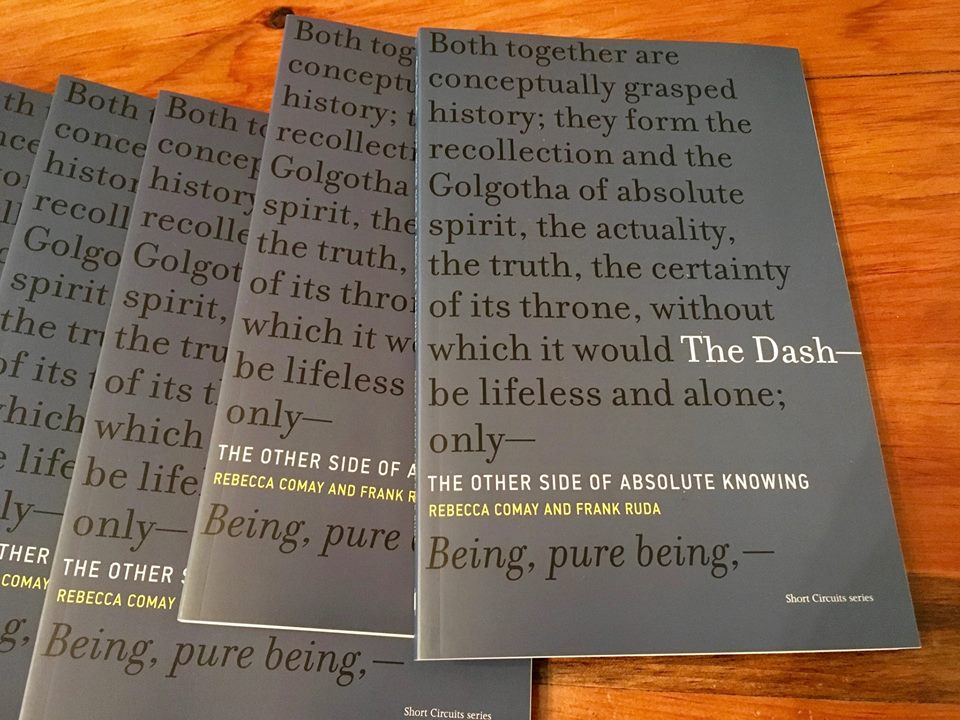
The Dash—The Other Side of Absolute Knowing advances a precise scholarly wager and distinctive intervention. It argues that the figure most often treated as the mystical excrescence of Hegel’s edifice—absolute knowing—is the structurally exacting nerve of his rational project; and it proposes that this nerve becomes legible only when Hegel is read to the letter, with an almost pedantic vigilance for his most mundane textual minutiae. Comay and Ruda stage this wager at the seam that binds and tears apart Hegel’s two strangest completed books, Phenomenology of Spirit and Science of Logic, by forcing the reader to dwell on a small, equivocal mark: the dash that closes the Phenomenology and the dash that inaugurates the Logic. In that punctuation, they locate a method, a rhythm, and a politics of reading that reorients the commonplace opposition between demystifying modernizations of Hegel and fateful restorations of metaphysics.
From the outset the book announces a double refusal. It resists the widespread presentist cure that trims Hegel to the contours of pragmatic “spaces of reasons,” and it refuses the compensatory metaphysical inflation that would shelter Hegelian system in an ontotheological plenitude. The authors’ claim is more exacting: the only way to produce a rigorously non-metaphysical Hegel is to affirm, and to arrange demonstrations for, the very point usually declared metaphysical: absolute knowing. The contemporary rehabilitation of Hegel—across radical theology, liberal theory, analytic pragmatism, speculative realism, and psychoanalysis—tends to proceed by subtracting the “absolute bone in the throat of knowledge.” Comay and Ruda invert that inclination and argue that what is commonly dismissed as mystical turns out to be the system’s most rational kernel; the place where Hegel’s supposed regression becomes the site of his radicalism, and where a renewed practice of praxis becomes thinkable. The programmatic statement is explicit and unambiguous in the introduction, and it establishes the argumentative pressure that the book subsequently sustains.
Their point of departure is not a doctrine but a reading protocol: the insistence that speculative reading means suspending in advance distinctions between major and minor, essential and inessential, conceptual and stylistic. The vigilance demanded by Hegel—Comay and Ruda stress—requires risking triviality to the point of pedantry, because the infinite judgment binds the “highest” and the “lowest,” the necessary and the contingent, in a single speculative act. This is why the book concentrates so intensely on punctuation, and in particular on the dash. In the German Gedankenstrich the genitive oscillates: the dash is a pause in thought and a dash through thought; it is the mark of interruption and the thought of interruption. As mark, it refuses to decide in advance whether it is a break or a bridge, a termination or a continuation; it can arrive singly or in pairs; it looks backward and forward at once; and it is the performative index of the ambiguity of Hegelian transition, mediation, and closure. This is not a philological diversion: the small sign opens the question of totality, identity and difference, beginning and end, and thereby of the compositional logic linking Phenomenology and Logic.
The composition sequence provides the book’s outer frame and inner motor. The Phenomenology ends with a sentence that gathers itself into its own retrospect and then—precisely at the place where one would expect the period of system—breaks on a dash. That final dash, Comay shows, is double-faced: it confirms the dynamism that the Phenomenology has just enacted, and it simultaneously diverts the entire line of march into a new “beginning” that does not belong to phenomenology at all, but to pure logic. The dash is at once minus and emphatic underscore. It concedes the ineliminability of appearance while suspending its grip; it ends and repeats; it seals a completion in the very gesture that refuses completion. Conversely, the Logic begins with an anacoluthon—“Being, pure being, without any further determination—”—that is barely a sentence. The commas defer predication, the dash interrupts even the possibility of grammar, and the result is that we are made to begin after a subtraction that has not yet delivered any content at all. The dash, here too, is a hinge that both cuts and joins, and it is the physiognomic figure of a decision that is neither voluntarist nor simply given.
Ruda makes the point with severity: after the long work of the Phenomenology, Hegel cannot write any “pure” words; he can only write vanishing, phenomenological words that authorize the possibility of pure science and then evacuate themselves. Only at that limit, after hundreds of pages of prerequisites, does writing begin, and when it begins it begins with Being, pure Being, and a dash—an inaugural series that Hegel never revised. The dash does not follow the comma as a piece of optional cadence; it embodies interruption, unrepeated singularity, and what Ruda names a “subtraction” that is not the determinate negation of anything, but a minus that subtracts the sub-—the substrate of repeatability and place—leaving a mere -traction that gains traction precisely as the embodied barring of substance. In this sense the dash is the visible sign of Ent-schluß, the cut that is a resolve, the speculative sign of Aufhebung as such—the silent linkage enabling the chain of speculative prefixes that will compose the vocabulary of the Logic. One of the book’s most economical formulations captures the force of the claim: the dash has “validity without significance,” which is to say, it is the operative visibility of method without a semantic payload, the how of the speculative turn in statu nascendi.
The argument accordingly reframes the relation between the two books. Against both the Platonizing reading that would construe the passage from Phenomenology to Logic as an ascent from appearance to being, and the Kantianized reading that would relegate Logic to the status of a transcendental explication of discursive norms, Comay and Ruda insist that absolute knowing exposes experience to its impossibility, and that the “beyond” of experience is strictly immanent to experience. The passage to logic does not install a stable perspective over experience; it dislocates the coordinates of subjectivity altogether. At this juncture, what arrives is not “mindedness” but a radical destitution of the very form of subjectivity, a release into free contingent happening, where something like decision becomes thinkable only as the irresolvable clinch between activity and passivity. In that pocket, the dash operates: it is not the sign of mastery but of interruption, not the period of totality but the scar of an impossible beginning.
If this is the transition, its stakes become evident in the book’s sustained engagement with deflationary pragmatism. The now familiar picture of Hegel as the philosopher of recognition and of historically negotiated norms preserves as untouchable the form of a “space of reasons.” Its historical dynamism becomes a managed incrementalism; change is continuous, exits are sealed, and the terms under which one counts as a rational agent are secured precisely by the shared grammar that arbitrates commitments. Comay and Ruda contest this on the terrain of language itself. They argue that language is internally incomplete and normatively ungrounded; it includes what they call an other side, an inneres Ausland, that intermittently forces thinking to speak otherwise. The speculative dash is the microscopic index of that inner rift; it interrupts repeatability from within repetition, reorders the temporality of reading, and thus marks that no transcendental space remains safe from dislocation. On this basis the authors retrieve from the Left-Hegelian legacy not a catechism of critique but a politics of commitment: absolute knowing as the acknowledgment of partisanship inherent to thought, and the exposure of the mirage of a view from nowhere.
The methodological consequence is a pedagogy of literalism. Reading Hegel means reporting what is there, suspending anticipatory selection, and letting the smallest element take on the weight of method. Comay and Ruda align this with the psychoanalytic “fundamental rule,” as if Hegel’s absolute method were the counterpart in speculative writing of free association in analysis: the demand neither to pre-select what counts nor to pre-judge what must be connected. The analogy, foregrounded in the introduction, prepares their most disarming insistence: that Hegel can be plausibly called an ordinary language philosopher not because he traffics in everyday chatter, but because he extracts, from the most banal particles, the weirdness of speculative work. The dash thus becomes the test of a reading that descends to the floorboards of language and discovers—through the very device by which we usually skip forward—that philosophy begins where the grammar of ordinary completion breaks off.
A pivotal section of Part I refracts this through the critical inheritance of Kant. The crisis Hegel diagnoses in the Logic’s 1812 preface is not simply the death of metaphysics but the paradox whereby Kant’s project to complete metaphysics by extirpating dogmatism eventuates in a renunciation (Entsagung) of speculative thought itself. The result is a cultivated people “without metaphysics,” caught between an evacuated formalism and a pragmatism of everyday life; a false alternative that must be refused by choosing formalism—but only as hyper-formalism. The reason is precise: Kant’s formalism is not empty enough; it smuggles back a given form that functions as content and thus re-installs the positivity it had wished to rule out. Comay and Ruda rework that critique into their own register: only an exaggeration of form to the point where it subtracts even the sub-—where the dash is the index of that subtraction—allows the form of the decision between form and content to come into view. In this way the logic of subtraction does not enervate practice; it constructs the condition for a transformation of the very framework within which “pragmatism” adjudicates reasons.
Because the dash concentrates interruption and Ent-schluß, it also bears the weight of the book’s reflection on beginning. Ruda details how Hegel’s first words—“Being, pure being”—compose an anacoluthon (Satzbruch), a grammatical breaking where completion cannot follow. The beginning is incomplete, incompleting, and incompleted; it is a cut in the sentence and of the sentence. That cut is not a flourish; it is the only way to begin without presupposing the given conditions of beginning, the only way to enact a beginning that does not depend on a prior content masquerading as form. If early readers forgot this almost immediately—Ruda shows that critiques of the “being–nothing” chapter can be mapped back onto a forgetting of the inaugural anacoluthon—the book’s exacting habitation of the dash restores the path of reading by which the beginning can be maintained as interruption rather than filled in as foundation.
Comay’s counterpoint chapter, “Hegel’s Last Words,” gives the other half of the rhythm: the exit from the Phenomenology. Every history of that book—from the courier dodging artillery to deliver installments to the printer, to Hegel’s hypochondria and procrastinations—may be entertaining, but the philosophical “last words” are not anecdotal. The final dash confirms and cancels; it closes and reopens. It retrospectively composes the phenomenological itinerary, and it prospectively points to a successor that cancels the phenomenological horizon as such. Comay’s minute analysis of how a single dash coordinates retrospective confirmation with prospective sublation displays the authors’ principle in its purest form: the punctuation does philosophy.
The middle movement of the book, “The Dash, or How to Do Things with Signs,” elaborates this into a theory of speculative sign-function. The authors argue against construing the dash as a linguistic atom. Far from being the minimal unit, it is the sign of the splitting of the linguistic atom itself—precisely because there is no limiting zero-degree of shrinkage in language, only an interminable fissuring that demands an interminable analysis. In an audacious detour through ancient atomism, they show how atoms co-emerge with the void and are already split, such that “less than nothing” can generate a world. The dash, then, is not the tiny thing that language is finally composed of; it is the figure of the clinamen’s volatile subtraction within discourse, the internal void that forces the deviation by which matter and meaning first take place. This is not a metaphorical overlay; it is a conceptual mapping of how speculative form indexes its own material incompleteness.
If the dash is subtraction rather than determinate negation, it follows that mediation no longer means a middle term that bridges opposed claims. Comay and Ruda press a different Hegelian term: Ver-mittlung without mediator. In the place where competing universalities stalemate, mediation is not compromise; it is the sharpening of antagonism until the very framework of the conflict fractures. At that point the decision that arrives is singular and unrepeated; it is not arbitrarily voluntarist, since nothing in the prior situation could compel or authorize it. Here again the dash is the small, visible figure of a logic of de-cision: a cut in which the speculative prefixes that will populate the Logic quietly connect, while the content they will carry is still suspended. The book’s wager is that such an account of mediation speaks directly to practice—against the incremental management of norms and for the possibility that a community may be forced to speak, think, and act otherwise by the inner dislocation of its own speech.
These formal claims are not indifferent to the historical scene. The introduction frames them as a diagnosis of our philosophical conjuncture, in which Hegel has paradoxically become “Feuerbachian”: everyone is willing to be Hegelian once the absolute is ignored. Comay and Ruda reply that only by pushing to Hegel’s extremities—where his thought appears most regressive—do we locate his contemporary force. The return of absolute knowing therefore does not reinstall a theology of presence; it defeats the phantasm of Allseitigkeit, the sovereign view from nowhere, by acknowledging the partisanship inherent in thought. Absolute knowing terminates the fiction of an impartial tribunal—“an eye turned in no particular direction”—and installs instead the work of decision. That shift has consequences for how we understand the political valence of speculative reading: it rescues from left-Hegelianism something other than the cult of purity; it insists on a commitment that can never be secured by a universal that floats above conflict.
The book’s epilogue signs this in a final, mischievous imperative: the point is to lose. This is not a romantic salute to failure; it is the exact correlate of the subtraction that begins the Logic. To lose is to give up the last refuge of givenness—the compulsion to find in form a content already waiting—and to enter a sequence where repetition is held in suspense. In that sense, Comay and Ruda’s sustained address to two dashes is not antiquarian; it is an instruction in orientation. The punctuation trains the eyes to the sites where philosophy must choose without guarantee. The rational kernel is located where one would least expect to find it: in the marks that interrupt sense and displace grammar. At those marks, absolute knowing does not crown a teleology; it registers the intermittency, hesitation, blockage, abruption, and random change—the vicissitudes of the drive—that structure the movement of spirit.
One can distill several tightly connected theses that the book documents to the letter, while also inviting inferential extensions. First, the textually secured claim that the dash at the end of the Phenomenology confirms and cancels, at once closing a methodological circle and opening an alien sequel; the authors’ readings of Hegel’s sentences are precise and leave no ambiguity about the dual orientation and the effect of interruption and prolongation. Second, the textually secured claim that the dash at the beginning of the Logic embodies an anacoluthic beginning, interrupts repeatability, and functions as a minus that subtracts the substrate of repetition—again argued by close analysis of the syntagma “Being, pure being,—” and of Hegel’s insistence on keeping the beginning unchanged. Third, the textually secured claim that absolute knowing marks the immanent exposure of experience to its impossibility, carrying us beyond the structural givenness of consciousness without installing a noumenal sanctuary, and that this has systematic consequences for how Phenomenology and Logic are to be read together. Finally, there are inferential elaborations that the authors responsibly foreground as such: that the dash can be read as the speculative sign of Aufhebung, that it indexes a de-cision prior to any content, that it provides a micro-model for understanding mediation without mediator, and that it trains a political sensibility opposed to norm-secured incrementalism. The book consistently marks where it is reporting Hegel’s text and where it is extracting a methodological figure from the text’s smallest operations.
The long middle sections drive the lesson home by following the dash’s consequences for reading practice itself. If, as Comay emphasizes, the dash can appear singly or in pair, and if a reader cannot know in advance which it will be, then reading is forced into a double tempo: one must race ahead and hold back simultaneously. The experience of the sentence becomes an object lesson in Hegel’s most stubborn antinomy: there is no quilting point that is final; every suture can and must be repeated, and every repetition may fail to arrive. This is not skepticism about meaning; it is a trained exposure to the rhythm of speculative exposition, and it is the point where the book’s micro-philology reveals a discipline of philosophical patience.
If one asks what Comay and Ruda finally achieve by organizing a book around two small strokes, the answer is not modest: they redeem the promise of a non-metaphysical Hegel by intensifying the very point that was said to be metaphysical; they recompose the articulation of Phenomenology and Logic without collapsing either into the other; and they model a method in which the rational kernel is not hidden behind the mystical shell, but produced in the reader’s labor at the shell itself. The wager succeeds because its demonstrations remain internal to Hegel’s text and because the inferential expansions are anchored by that internality. The result is a stringent, almost ascetic exercise in speculative literacy that also carries an unapologetically political impulse: to expose the imaginary impartiality of reason’s tribunal and to take sides at the place where sides can no longer be secured by preexisting norms. At the book’s beginning and end, the dash is neither ornament nor emphasis; it is the minimal sensible of a maximal claim—that absolute knowing is a discipline of interruption.
If one were to close by clarifying the distinctive contribution, it would be this. The Dash demonstrates that what makes Hegel contemporary is not a domestication of his claims to the scale of local normativity, but the insistence that the smallest marks of his writing organize a logic of beginning and ending that cannot be smoothed into progress. The book’s guiding thought—that absolute knowing is the rational kernel—does not float free of textual warrant; it is extracted from the letters and marks where Hegel sabotages grammar in order to begin at all. Comay and Ruda thus deliver more than a thesis about Hegel; they deliver a practice of speculative reading, one that compels us to inhabit the interval where a sentence breaks off and a science begins. In that interval, hesitation accelerates, demurral insists, and interruption prolongs; the dash does not merely punctuate a doctrine of absolute knowing—it is its other side.
 Simon Gros
Leave a comment