The Seminars of Jacques Lacan are an organized experiment in epistemic restraint and conceptual invention, a multi-decadal laboratory where psychoanalysis is made to answer for its own concepts by submitting them to the exigencies of speech, structure, and act. Their distinctive contribution is a method for holding the Freudian field at the point of maximal tension between clinical fact, logical form, and linguistic materiality. They do this by installing a discipline of reading as a discipline of listening, making interpretation exemplary of a broader operation whereby desire, knowledge, and enjoyment are braided under the pressure of the signifier. Through a series of displacements—from ego-psychological vocabulary to a symbolic calculus; from phenomenology to topology; from moral categories to discourses and knots—the Seminars gradually elaborate a practice that is at once therapeutic, theoretical, and political, sustained by an exacting attention to the letter and an obstinate insistence on the real.
The outer frame is overt and practical. An analyst addresses an audience across years of institutional relocations, editorial vicissitudes, and institutional conflicts, and yet preserves a single wager: that Freud’s discovery bears a rational structure that can be re-constructed in public. The medium is spoken, but the logic is exacting. Each annual cycle takes a thematic nucleus—technique, the ego, psychosis, the object relation, the formations of the unconscious, desire, ethics, transference, identification, anxiety, the fundamental concepts, the crucial problems, the object of psychoanalysis, the so-called logics of fantasy and of the act, the re-routing of discourse, the rewriting of sexuation, and the later torsions of Borromean topology—and forces it to yield what it presupposes. The result is a doctrine that develops by rectification: a notion is taken over at the point of its maximal received clarity, and then pressed until it shows where it depends on the structure of the signifier, where it yields to the insistence of drive, where it encounters the opaque remainder Lacan calls the object of desire, and where the analytic act cuts across its quasi-systematic closure. This spiral method ensures continuity without circularity. Each seminar folds into the next as problem into method, method into obstacle, obstacle into new concept, until the earlier thought becomes visible again in transformed coordinates.
The initial move is methodological and places technical vocabulary under the governance of symbolic articulation. In early teaching devoted to Freudian technique, Lacan takes the clinical scene as a regulated exchange rather than a relation of personalities. Interpretation is defined less by what it reveals than by the place from which it speaks, and the interpersonal bond is diagrammed not as empathy, nor as a suggestive milieu, but as a structure of demand suspended over a lack. The ego is acknowledged as a functional precipitate of imaginary misrecognition—shaped by the mirror relation and stabilized by identifications—yet Lacan refuses the convenience of a psychology of functions. What appears as self-possession is read as a network of signifiers commandeering the body, while the analyst’s position is re-specified as a rigour of silence, equivocation, and timing. The earliest problem posed, therefore, is how to maintain a practice that intervenes in the order of the signifier without violating the ethical basis of the cure. The answer, only adumbrated at first, is that the analytic setting must be engineered so that the subject’s speech discovers its cause where mastery fails.
From this engineering follows a first decisive displacement: the preference for symbolic determination over imaginary plenitude. The imaginary is delineated as the register of images, identifications, rivalry, and mirroring; the symbolic as the register of difference, law, and substitution; the real as the refractory limit that resists capture. The ego is assigned to the imaginary, the law to the symbolic, and the remainder of enjoyment to the real. Yet this tripartition is not a taxonomy; it is a dynamic map in which each register’s claims are tested by the others. The topic of psychosis obliges Lacan to formalize this interdependence. Psychosis is shown to hinge on a specific deficit in the symbolic that destabilizes imaginary anchoring and exposes the subject to phenomena where the real returns without mediation. The basis of the argument lies in how it refuses any pathologizing essence. Linguistic structure provides the sufficient reason for delusion, and the clinic is described as the controlled reintroduction of a missing anchoring point where fiction can again do the work of truth.
Having secured the efficacy of the symbolic, Lacan undertakes the critique of the then-dominant object-relational thinking. The object is situated not as the good that completes the subject, nor as the correlate of instinctual maturation, but as a remnant that survives symbolization. This remainder—misaligned with need, and surplus to demand—receives the name objet a. It has no positive nature; it indexes the subject’s division by the signifier and marks the site where drive finds its circuit. This concept reorganizes the field. Where object relations demanded a narrative of development culminating in successful attachment, Lacan shows a pulsing short circuit: the subject loops around a partial object that is never present as such but manifests in the gaps and edges of the body. The mouth, the gaze, the voice, and more abstractly the lost thing the subject takes to be the cause of desire, are reconceived as functions by which enjoyment stains the signifying order without becoming its content.
The re-centering of objet a requires a new treatment of desire and its interpretation. Desire is presented as the metonymy of a lack produced by the signifier. It slides along signifying chains, never arriving at a definitive object because its cause is the structure of the chain itself. Interpretation, under these conditions, cannot provide content that would satisfy the demand. It must operate as punctuation, cut, and equivocation: to shift the subject’s position with regard to what they suppose the Other wants, and to bring into relief the obscenity of that supposition. The analytic act is therefore neither enlightenment nor persuasion; it is a calibrated disturbance in the economy of signifiers that allows desire to manifest as desire. The technique of the cut in the session aligns with this logic: duration and interruption are instruments by which the subject is made to confront the factor that does not fit.
The ethical elaboration of this result takes center stage with the systematic scrutiny of what it means to act in fidelity to desire. Lacan isolates an ethics without moralism, structured by the imperative to avoid betrayal of desire. The proximity to tragedy is acknowledged: a desire radicalized becomes compatible with disaster, but the analysis asks whether an ethics worthy of the analytic experience can be grounded in the subject’s relation to their cause without lapsing into asceticism or hedonism. Here the figure of das Ding (the unassimilable kernel evoked by Freud around “the Thing”) is introduced to articulate how the good of the community and the enjoyment at the heart of the subject stand at an inescapable angle. The seminar makes the wager that analysis can render this angle thinkable. Sublimation is described as a shift of the object’s place in the field of the signifier, raising it to the dignity of the Thing without claiming it as possession; the beautiful emerges as a veil that situates the terrible at a bearable distance; the good is revealed as a precarious compromise stabilized by symbolic positioning.
Transference is then reconceived from the ground up. It is less a feeling toward the analyst than the subject’s supposition that knowledge exists in the Other. The analyst’s position is to embody this supposed knowledge while betraying it at the exact moment that the subject attempts to enthrone it as the guarantee. The concept of the subject supposed to know is both a map of the transferential bond and the most economical definition of a school of analysis: where knowledge is supposed, desire is mobilized; where knowledge collapses, desire is forced to find its cause elsewhere. The clinical corollary is precise: interpretation should strike at the point where the subject’s question to the Other masks a demand to be recognized, and it should do so in the equivocal medium of language that permits the surfacing of the residue that knowledge cannot master.
At this juncture identification is treated as the modality by which the subject borrows predicates to patch over division. To identify is to organize a signifying position around a master signifier that stabilizes a chain. This has consequences for desire—since the master signifier enjoys a privileged opacity—and for anxiety, which is treated as the affect that does not deceive. Anxiety is said to appear when the subject encounters the object cause of desire too directly, when the topological partition that allows the object to function as cause is threatened. This is an ethical insight as well as a clinical one. The analyst aims neither to flood the subject with presence nor to anesthetize them against encounter. The aim is to maintain the precise distance at which the object can cause desire without collapsing into possession or expulsion. The distinction between desire and drive clarifies this: drive is a circuit sustained around an empty space, indifferent to the identity of its aim, while desire is always situated between the demand of the Other and the enigmatic insistence of enjoyment.
Out of this chain of rectifications emerges the reformulation of the “fundamental concepts.” Unconscious, repetition, transference, drive—each is given a structural definition. The unconscious is a knowledge that speaks where the subject does not know; repetition is bound to the insistence of signifying difference and the inertial return of satisfaction; transference is the installation of knowledge in the Other as condition of interpretation; drive is a montage of bodily edges arranged by signifiers into a loop around loss. The subject of the unconscious is defined topologically: a place where signifiers alternate, leaving a remainder; a place split between enunciation and statement; a place where the letter marks a body. The notion of the cut becomes a formal instrument, no longer only a clinical tactic. Through the cut, the chain of signifiers produces a zero-point that allows counting to commence, and with number comes the possibility of writing.
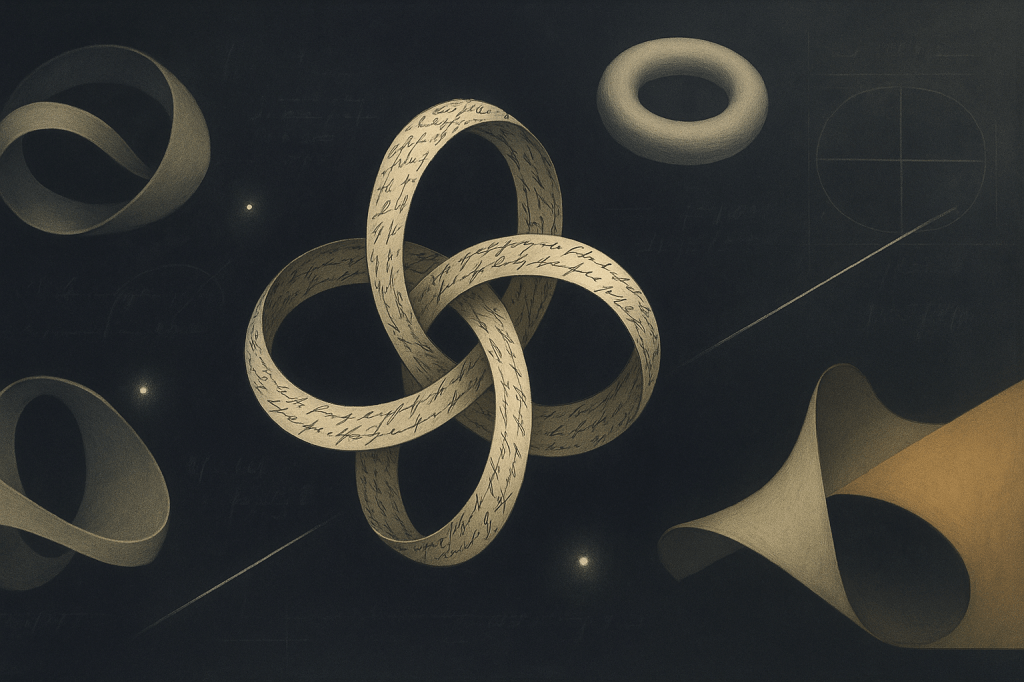
As the doctrine consolidates, the method shifts register. Geometry and topology replace phenomenological description, because the structures at stake involve torsions that ordinary spatial imagination distorts. The cross-cap, the torus, the Möbius strip, and later the Borromean knot are not decorative illustrations but devices for controlling the invariants across transformations in the subject’s speech. They allow Lacan to trace the consistency of a division: a single surface with two faces; a cut that produces connection; a link that disintegrates when any ring is removed. These topological procedures track the connection between the registers of symbolic, imaginary, and real more faithfully than metaphor can. They also permit an exact re-statement of older discoveries: the mirror stage finds a rigorous rearticulation in the Möbius continuity of inside and outside; the paternal metaphor is drawn as a transposition across a cut that yields a new consistency; the symptom is tied—later sinthome—into the other rings so that the subject holds.
Discourse theory arrives when the clinic’s microphysics must be situated in a macropolitical field. Four discourses—Master, University, Hysteric, Analyst—are given as the minimal articulations of social bond beyond interpersonal exchange. Each discourse organizes the positions of agent, other, truth, and product around a specific primacy of elements: master signifier, knowledge, divided subject, object a. The innovation is to place the analytic situation inside a general theory of social link without reducing it to sociology, and to show that transformation occurs by rotation of places. The analytic discourse is the paradoxical configuration where the object itself is placed in the position of agent, and where the knowledge that results is borne by the other. This both formalizes the ethics of the analyst’s desire and guards against the enchantment of mastery in the clinic and in the school. It also systematizes the critique of ideology: the university discourse reveals the violence of neutral knowledge; the master discourse discloses the primitive underspecification that a command always covers; the hysteric’s discourse makes manifest the productive questioning that sustains invention; the analyst’s discourse institutionalizes a place where the cause is allowed to work.
The sexual relation is reworked through writing rather than through anthropology or psychology. Lacan claims there is no formula that writes a relation between two positions that would guarantee complementary satisfaction. This is neither an empirical claim about men and women nor a moral thesis about intimacy. It is a logical consequence of how signifiers distribute places and how enjoyment borders language. The formulas of sexuation are written on two sides—one with the exception that universalizes, another where exception is suspended and where the quantifier ranges without limit—thereby drawing two types of logical consistency rather than two genders. Woman is written as “not-all” with regard to the phallic function, meaning that a supplementary enjoyment may be at stake that is not captured in the economy articulated by the signifier of castration. The implication for the clinic is stark: analysis cannot promise harmony. It can clarify the logic by which a subject knots their satisfaction to the signifier and thus produce a freedom that is neither resignation nor conquest but the invention of a singular solution.
Language itself becomes the decisive matter under the name lalangue: a substance of equivocation, sound, and letter that precedes grammatical order and pervades it with residue. Interpretation in this phase plays on homophony and writing, on the letter as the unit that touches the body. The symptom is approached less as a message to be decoded than as a knot-work that binds the registers. This opens the way to the sinthome: a singular construction in which the subject’s way of enjoying stabilizes their world. The late proposal is sober: analysis does not dissolve symptom in the name of truth; it rearticulates symptom as sinthome, a minimal artifice that ties the subject’s life without appeal to an ideal of health. The case of a writer is exemplary here because writing manifests the dispositif by which equivocation is harnessed into consistency. What had begun as a critique of imaginary closure and a valorization of symbolic articulation concludes as a doctrine of the real’s binding by a construction that deserves the dignity of a proper name.
Across this movement the place of the analyst becomes clearer by inversion. The analyst’s desire is not desire for the patient’s love, nor desire for knowledge. It is the desire that a certain cut take place—the cut that separates the subject from the supposition of a knowing Other and puts them in relation to their cause. To sustain this desire the analyst must accept the structural emptiness of their position, making themselves the support of objet a while refusing to embody any predicate the patient offers. The framework of the session is thus a machine for managing time and equivocation. Duration is a function of construction rather than of convention; the end of a session is an interpretative gesture, a scansion that inscribes a letter. The only authority invoked is the authority of the letter as it is produced in the analysis itself.
The composition sequence of the teaching is not accidental to the doctrine it transmits. The early insistence on returning to Freud through structure lays down a rule: no appeal to immediate experience suffices when the unconscious is at stake; logic is required. The interrogation of psychosis and object relation refines what “logic” must mean here by introducing foreclosure and the partial object; the passage through ethics consolidates the consequences by refusing to legislate enjoyment; the re-theorization of transference protects the field from charisma and from knowledge’s intoxication; the theory of fundamental concepts codifies what had been practiced; the topological and discursive phases arm the clinic to withstand the seduction of hermeneutic closure and to enter the political without dissolving into it; the late writing of sexuation and of the sinthome secures the limit where theory makes room for invention. At each step the earlier gain is displaced, and the displacement preserves it. The ego is not erased but localized; the symbolic is not enthroned but knotted; the object is not found but functioned; desire is not fulfilled but vectored; ethics is not abstracted but situated in the act; transference is not neutralized but transmuted; concepts are not defined once but written so that they can be used; discourse is not criticized from outside but rotated from within; sexuation is not categorized but logically drawn; the symptom is not dissolved but retied.
A series of recurrent demonstrations anchor this progression. First, that the signifier produces the subject by dividing it, leaving a remainder as condition of its movement. Second, that the object as cause cannot be assimilated to any object of knowledge or consumption, and that this causal status is what analysis must respect. Third, that interpretation is an act on the letter—on the homophonies, condensations, and displacements that betray the logic of desire—and that its efficacy lies in how it adjusts the position of the subject rather than in how it supplies information. Fourth, that the act which concludes an analysis does not crown a narrative of understanding but effects a re-knotting, at once minimal and decisive, where the subject authorizes the contingency of their sinthome. Fifth, that the politics of analysis is intrinsic to its method: it lives or dies by how it organizes the places of knowledge and mastery, and its only security lies in a doctrine that renders mastery structurally impossible.
Clinical materials in the Seminars never serve as mere examples. They function as constraints that force re-writing. The hallucinated voice does not illustrate the Other; it compels the articulation of how the Other fails as locus of signifier. Obsessive ritual does not lend color to drive; it requires the topological description of a circuit that keeps loss alive. Hysterical complaint is not a foil for theory; it becomes the engine that reveals where knowledge must cede to questioning. Aesthetic and literary excursuses are deployed with the same discipline, not to enrich a humanistic texture but to sharpen concepts. Tragedy is used to isolate the moment when desire encounters its limit without reconciliation; courtly love is taken as the stylization of a social technology for managing the impossible; logical paradox serves to register how enjoyment is indexed by prohibition and exception; the joke gives a lab bench for observing the minimal technique of equivocation.
The editorial outer frame is inseparable from the doctrine because publication itself must answer to the principles it conveys. The Seminars teach that knowledge is supposed in a place, that the letter cuts, that equivocation is the truth’s vehicle. The edited forms respect this by presenting speech as speech—marked by digression, correction, and renewed definition—and by conserving the variability of formulations across years rather than harmonizing them into a textbook. This leaves the reader in the position of an analysand in one respect: to extract from the serial unfolding a consistent use, to follow how each recasting of a term reassigns the force of the previous version, to accept that the doctrine is an operation rather than a catalogue. The outer frame also dramatizes the institutional stakes of theory. A school that calls itself analytic must stage, within its writing and its governance, the collapse of mastery it ordains for the clinic. The Seminars do this simply by continuing to move, year after year, from definition to cut, from cut to writing, from writing to knotting.
If one tracks how earlier parts merge into—and are displaced by—later constructions, a rough anatomy appears. The “return to Freud” sets a symbolic grammar that abolishes any residual psychologism; the clinic of psychosis and the critique of object relation open the path to the object cause; the ethics of desire solidifies the orientation toward act rather than adaptation; the theory of transference and identification scales the method to the social bond; anxiety, the fundamental concepts, and the logical devices consolidate a writing practice in which geometry and algebra can convey clinical invariants; the discourse theory leverages this writing to map institutions; sexuation and lalangue attune the writing to the limit where the body persists in language; the sinthome closes the spiral by reassigning the symptom as minimal construction. Each later node takes the earlier as its matter, rearranging it under pressure of a new impossibility.
The Seminars therefore practice a strict materialism of the signifier without any of the triumphalism that such phrases can evoke. The signifier materializes as letter, equivocation, and cut; enjoyment materializes as the stubborn satisfaction of drive and the flash of anxiety; the real materializes as the limit that writing can circumscribe without mastering. This materialism abolishes appeals to interiority or presence, yet it is neither cold nor abstract. It treats the suffering in the clinic as the insistence of a mis-knotting that demands a new stitch. Its politics lies in how it denies knowledge the right to occupy the place of command, and how it converts the analyst’s authority into a function by which the object is allowed to act.
In the end the contribution is an economy of exactness. To speak exactly is to respect ambiguity, because equivocation is how the letter touches the body; to act exactly is to cut where structure makes a cut possible, because elsewhere action is suggestion; to think exactly is to preserve the remainder as remainder, because to erase it is to enthrone fantasy. This economy guides a practice that accedes to a limit without resignation. The subject leaves the analytic scene neither reconciled nor converted, but equipped with a way of binding their modes of enjoyment that does not require a master’s guarantee. The Seminars are the documentary record of how this equipment was forged: a series of intensely argued constructions in which clinical insistence and logical invention never stop exchanging places.
If there is clarity at the close, it is a clarity without closure. The doctrine proposes devices—signifiers, objects, cuts, discsourses, knots—that must be used rather than believed. Its authority derives from the economy of consequences it sustains: when desire is indexed to its cause rather than to a demand, the symptom can be retied as sinthome; when the analyst supports the object rather than the master signifier, knowledge can be produced without enthronement; when writing respects the real as limit, invention can replace adaptation. The Seminars teach such consequences by showing them at work. Their precision is a function of their readiness to begin again, to say the same differently so that something other than the same can occur.
 Simon Gros
Leave a comment